


As I sat down to examine the data and reflect on the past quarter, the fine-wine market felt remarkably muted. That was despite—or perhaps precisely because of—the buzz surrounding the Bordeaux en primeur campaign, which once again took center stage even among the most skeptical in the trade. Looking back on my own quarter, I am left with a strangely similar impression. However, saying that seems unfair, given that it was filled with many last-minute (“once-in-a-lifetime”) decisions and experiences: my first trip to Tokyo, spontaneous and squeezed into the ten-day US–Iran war ceasefire window with a layover in Abu Dhabi; a whirlwind weekend in Mykonos involving more than one rental-car mishap; a fascinating Château Margaux research tasting at 67 Pall Mall in London, followed by a long-overdue conversation with an MW friend over Martinis at Duke’s; and another impromptu trip to the world’s biggest GT3 race, the CrowdStrike 24 Hours of Spa, experienced from inside the pit (Rowe’s by plan, and McLaren’s by accident).
These were just a few highlights, heavy dopamine hits followed by lows. It is commonly believed that peak moments are not the best time to make long-term decisions. Excitement can sharpen our sense of opportunity, but it can also distort it. Stable periods often offer more room for future planning. This is why the current state of the fine-wine market, one that could be compared with the subdued period between 2012 and 2015, may seem unremarkable but could prove to be precisely the environment in which the best long-term decisions are made. Prices have corrected, information is more widely available, and a new generation of collectors is approaching the market with greater analytical discipline and more care over how it deploys capital.
Recent research from fine-wine market think tank Areni Global points to this shift. The opportunity now is to enter with patience and perspective rather than at peak speculation.
Nascent growth
Q2 saw the market continue to move sideways, with the major Liv-ex indices remaining largely flat: the Liv-ex 100 index dipped 0.1% during the quarter but ended the first half of the year up 0.1%, while the broader Liv-ex 1000 gained 0.4% across both periods (fig. 1). Matthew O’Connell, co-CEO of Bordeaux Index, described the improvement as tentative: “It is clear that fine-wine prices halted their decline in H1 and have been gently picking up—albeit nascently—in recent months.”
Related


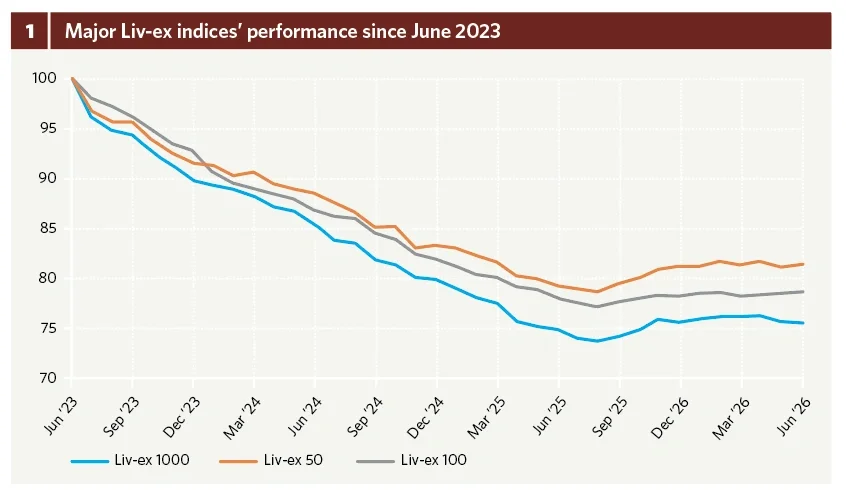
Such marginal movements reveal little about the fine-wine market’s direction in isolation. Their significance lies in the relative stability they represent. Prices appear to have reached a plateau, giving buyers greater confidence that the correction has eased and that current levels may offer an attractive and, most importantly, consistent entry point.
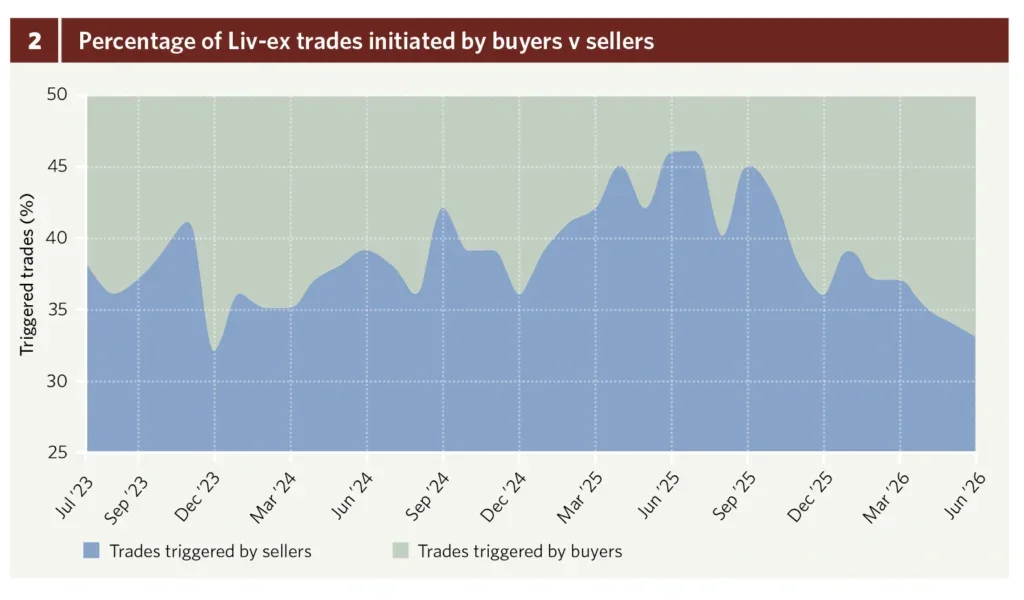
That stability is already affecting (and reflecting) trading behavior. Liv-ex data shows that the proportion of trades initiated by buyers has overtaken the proportion initiated by sellers (fig. 2). In practice, more buyers are lifting offers rather than waiting for sellers to lower prices to meet their bids. Liv-ex market analyst Sophia Gilmour explains: “Over the past three years, buyers have largely been able to dictate prices, with sellers being pulled downward to meet bids where they are. There is evidence to suggest this power dynamic is shifting.”
While this is not immediately moving broader indices—and is mostly observed in categories such as Burgundy, where production is lower and individual wines command higher prices—it indicates initiative and conviction. “A higher proportion of buyers willing to trigger should have a positive impact on price performance,” Gilmour expects.
Content from our partners
Pockets of regional strength
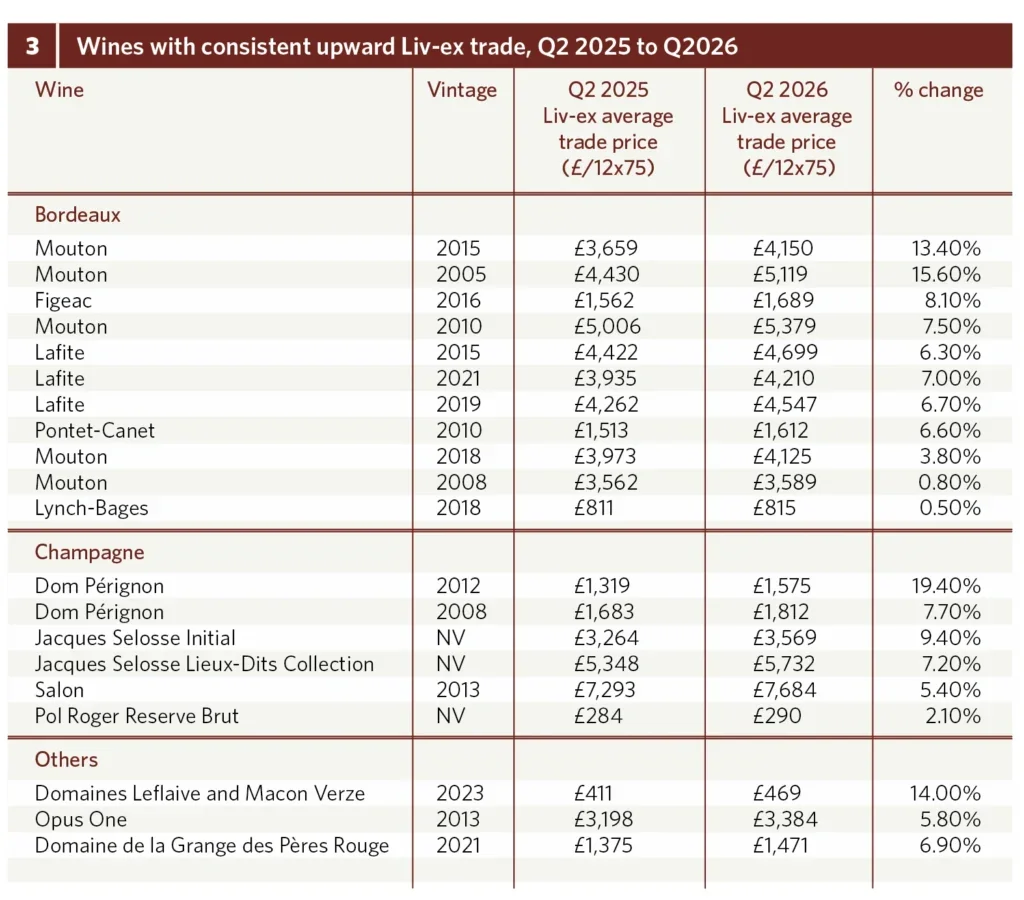
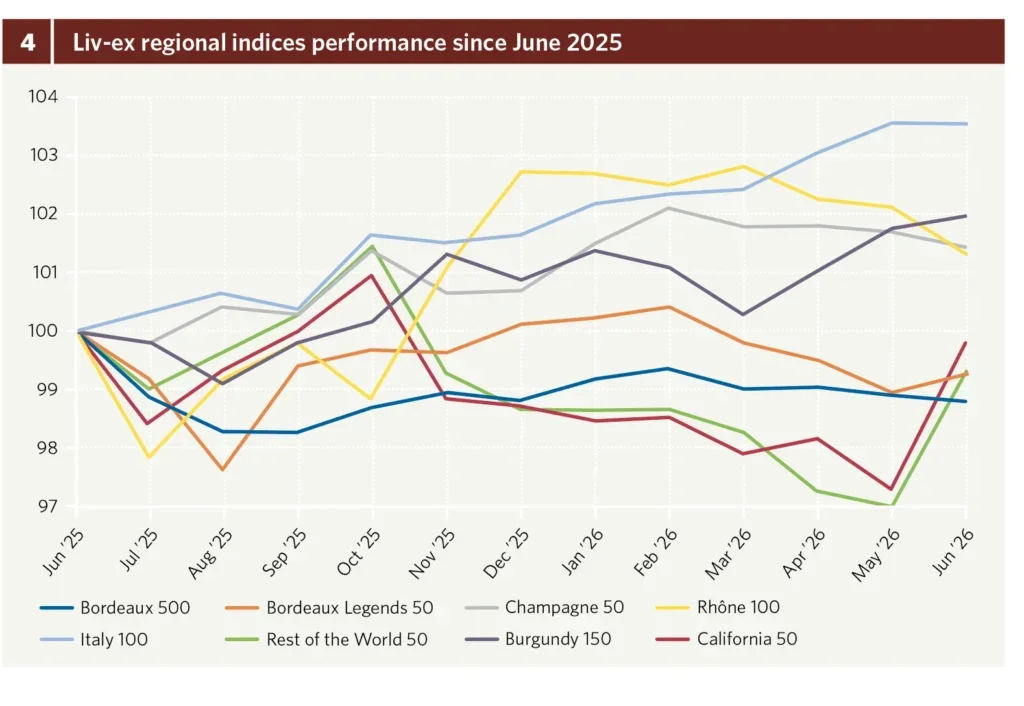
Regional performance remains mixed, with Bordeaux seeing some of the biggest losses over one year (fig. 4). The headline data, however, conceals a more selective recovery. Although the Bordeaux 500 index declined 1.2% over the year and remained flat in H1, the region has contributed more wines with consistently rising trade prices than any other market segment (fig. 3).
Over the course of one year, the Italy 100 index has been the strongest regional performer, rising 3.6%—and up 1.9% in H1 alone (fig. 4). Vinum’s fine-wine consultant Miles Davis points to Ornellaia and Soldera as important drivers of Italy’s recent performance. “The latter has been the star performer from Italy and goes to show that going your own way and not being part of the local classification can work—it’s all about the quality of the wine,” he wrote in his June market report.
Burgundy ranked second, rising 1.9% over the year despite a less even recovery, akin to its nature. Remarkably, it led the market in Q2 2026, with a 1.6% increase. Davis comments, “Burgundy had a good month (May), representing 45% of our turnover. Coche-Dury outpaced all other names by a distance in price performance. White Burgundy at the top end is rock solid, and top cuvées seem to be even more desirable than ever before. It would appear the usual suspects are in permanent demand.” Gilmour adds even more context to the data: “Burgundy’s upper echelon has found renewed demand, with bid exposure (by volume) for the Burgundy 150 reaching an all-time peak in June.” She notes that “an uptick in purchasing of Leroy, DRC, and peers does indicate that some wealth is trickling back into fine wine.”
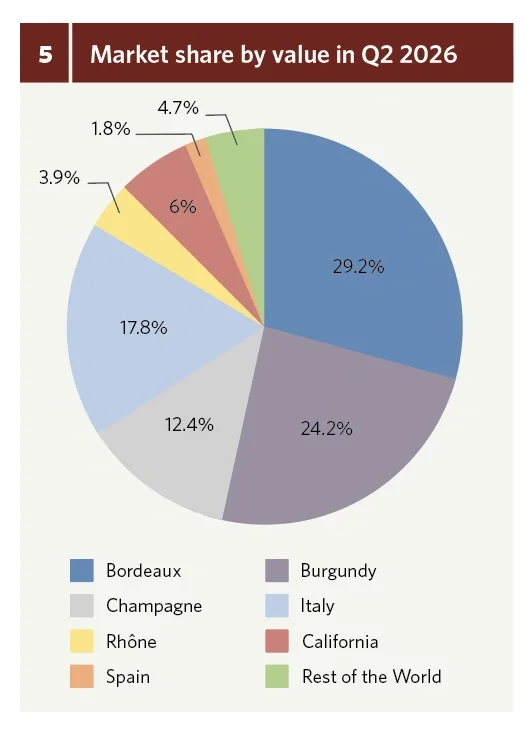
Burgundy also came close to leading in market share terms (fig. 5,). In Q2, its share of secondary market trade by value peaked at 24.2%, second only to Bordeaux at 29.2% (a record low). Feedback from the trade supports the shift. O’Connell tells me they are seeing “strong Burgundy activity on LiveTrade in particular, definitely the highest of the past couple of years.” Likewise, George Wilmoth, private client director at Justerini & Brooks, comments, “Burgundy demand remains solid, though more ambitiously priced domaines are proving harder to place. By volume, white Burgundy is slightly more in demand; however, by value the picture changes considerably, with red Burgundy accounting for two thirds of all Burgundy sales.”
Farr Vintners’ Stephen Browett also reports healthier demand. “Overall sales in the second quarter of 2026 have been encouraging,” he says, “especially for ready-to-drink vintages. Bordeaux remains the biggest region—with nearly 50% of all sales—but demand for Burgundy remains high, and sales of Champagne, top Rhônes, and Italians have been steady.”
Italy also expanded its share of the wider market, reaching a record 17.8% in Q2. To put this into perspective, Italy’s market share stood at 15.3% last year, and 11.5% in 2022. Champagne (12.4%), too, enjoyed increased buying activity compared to Q1 (10.9%) but remains slightly below its 2025 average of 12.8%.
US back in the game
Buyers in the US fine-wine market increased their share of Liv-ex trade to 26.9% in Q2, up from 23.3% in Q1, partly reflecting weaker Asian participation (fig. 6). More significantly, they paid an average of 1.1% above market price in Q2 compared with essentially flat 0.03% in Q1, suggesting genuine buying intent rather than a passive increase in market share or simple stock replenishment.
Higher domestic prices and favorable exchange rates have allowed US buyers “to outbid their European and Asian peers,” Gilmour notes. Alexander Westgarth, CEO of WineCap and Westgarth Wines, adds, “American capital, in my experience, is unusually comfortable buying into a market that’s just been through a bad patch—it’s the same instinct that shows up in US equity flows after a drawdown. Three years of repricing followed by early signs of stabilization is the kind of setup that tends to draw value-driven buyers off the sidelines, and it doesn’t require anyone to believe the correction is fully over.”
Although tariffs on European wine are now expected to remain in place, buyers are adapting. Robbie Stevens, head of broking at Liv-ex, tells me, “US members have punched well above their weight in terms of purchasing power over the past five years on Liv-ex—the reelection of Donald Trump in November 2024, and the onset fear of tariffs, which were eventually realized in April 2025, saw US buyers switch off the taps overnight. Over the past year, and more specifically since Q4 2025, we’ve seen the cautious return of US buying power, with overall bid exposure matching pre-tariff levels this month.”
Their return has coincided with a narrowing gap between trade and market prices—another early indication that bearish momentum is easing.
The fine-wine market’s main event
No recollection of Q2 in the fine-wine market would be complete without a mention of the successes and shortcomings of the en primeur campaign, though the previous issue covered the market and the 2025 wines in greater detail. Now that the dust has settled, however, the trade’s response offers a clearer assessment of what worked and what did not.
O’Connell describes Bordeaux 2025 en primeur as “a reasonably muted campaign.” Buyers showed some willingness to engage; and producers, some willingness to be constructive,” he says, but there was “usually not enough common middle ground to drive high demand.” More bespoke releases proved an exception and were generally well received.
Results varied across the trade. At Farr Vintners, en primeur sales were “50% higher than for the previous vintage,” according to Browett, but remained well below other recent campaigns. At Justerini & Brooks, sales finished only fractionally behind last year. Wilmouth described this as disappointing given the quality of the vintage and the merchant’s view that pricing was broadly reasonable. “I suspect pricing probably needed to be closer to 2024 pricing, or even 5–10% below 2024 pricing, to really ignite interest,” he says.
Browett attributes buyers’ reluctance less to the 2025 vintage itself than to the legacy of earlier, overpriced campaigns, particularly 2021: “Customers who bought this vintage en primeur have seen prices fall dramatically, which inevitably leaves a bad taste in the mouth and a reluctance to make the same mistake twice.” Thibaut Mathieu of Corney & Barrow reports similar feedback. Clients considered release prices too high and preferred mature vintages already available for less. “It was another missed opportunity, sadly,” he says. Upcoming releases across the fine-wine market “will need to match or undercut last year’s prices if producers are to attract buyers back.”
That competition from physical stock is unlikely to disappear. Wilmouth is nevertheless optimistic about the remainder of the year, expecting mature Bordeaux to “go from strength to strength” as buyers recognize how significantly prices have fallen. The opportunity for Bordeaux remains clear, but increasingly it lies in back vintages offering proven quality and immediate availability at more attractive prices.


