Anthony Rose reviews 2012 Drappier Éclose.
The dinner with Michel and Hugo Drappier at Hide in London fell on May 12, in the thick of Les Saints de Glace, the ice saints, whose feast days in mid-May mark the traditional last frost of the French spring. Michel Drappier counts five of them. It was a fitting frame for an evening devoted to a house whose recent history has been shaped by the tension of a region warming so fast that ripeness is no longer the problem and one where a single cold night in May can still take the crop.
Éclose, unveiled at Hide in London and in New York, is not simply Drappier adding another prestige cuvée to the shelf. It is an attempt to redefine what long-aged Champagne can feel like, through élevage rather than dosage, luxury cues, or sheer power. Three threads run through it: the house’s long-standing commitment to low-intervention winemaking and Pinot Noir vinosity; a growing preoccupation with holding freshness in a warming climate; and the oak egg, or Ovum, as a tool for texture, movement, and slow evolution.
Michel Drappier completed his 51st harvest last year. Decisions at Urville are still made collectively—by Michel, his son Hugo, the eighth generation, and Hugo’s brother Antoine, the estate’s enologist. Both Michel and Hugo trained in Beaune, and for all the generational handover, there is remarkably little ideological friction on show.
Related
Michel’s father André—who died in March 2025, aged 98—opposed a good deal of what is now taken to define modern Drappier: organic viticulture, low-dosage wines, the return of horses to the vineyard. The reintroduction of oak barrels in 2002 horrified him. Yet he was a firm supporter of low-sulfur winemaking, and Michel was careful to frame the family’s history as continuity rather than rupture. The shared principle, across all three of the generations, is that Champagne’s first duty is to give pleasure.
2012 Drappier Éclose: Going beyond terroir alone
The spirit of experiment without dogma was there in the first wine poured, the Brut Nature Sans Soufre in magnum. Pure Pinot Noir, built on the 2022 vintage with 10% reserve wine, it represents the culmination of nearly four decades of work. Drappier made its first Brut Zéro wines in the late 1980s and refined the idea into Brut Nature in the mid-1990s. They were vinifying without sulfur altogether by 2000–01 and released the wine commercially—the first sulfite-free cuvée in Champagne, they believe—in 2007. It has since become central to the range and will be certified organic next year.
Michel was clear that the work begins in the vineyard. Dedicated picking teams operate close to the winery at Urville, with obsessive attention to fruit health—perfect grapes are non-negotiable if sulfur is to be reduced or removed. In the cellar, every stage is designed to limit oxidation naturally. Wines stay on lees for extended contact. Gravity replaces pumping wherever possible. Tanks are smaller now and filled gently from below. Only the first pressing is kept; the tailles are sold off.
Content from our partners
The anti-sulfur position is stylistic and personal in equal measure. André disliked the reductive character sulfur could bring; Michel describes himself as “X sulfur intolerant.” What began as a single experiment has reshaped the whole house style. Where 60–80mg/l was once routine, Drappier now works between 0 and 35mg/l across the whole portfolio. “Some people think it’s better because nothing is hidden by sugar or sulfur; most of them just enjoy the natural taste of the juice,” Michel observed.
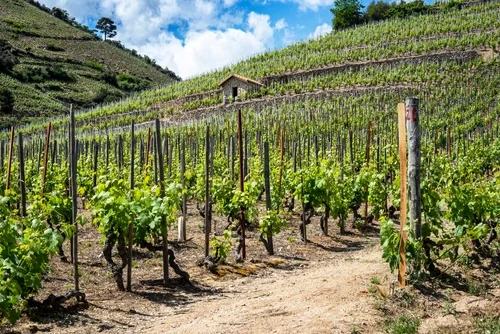
Drappier farms 55ha (137 acres) organically, certified in 2014. Pinot Noir accounts for around 70% of plantings, alongside Meunier, Chardonnay, and the rare historic whites Arbanne, Petit Meslier, and Blanc Vrai that go into Quattuor. Fromenteau (Pinot Gris), planted in 2011, has since yielded a single-variety Coteaux Champenois, Trop M’en Faut! (with an exclamation point in the name). Michel is realistic about the commercial return—outside Scandinavia, demand for certified organic Champagne remains modest. People buy wines they enjoy, he suggested, not labels.

The wider strategy is shaped by climate. The house has invested heavily in oak—partly because wood tannins help protect against oxidation, and partly because barrels allow a different kind of reserve wine. Alongside that sit perpetual reserves kept separate by variety and, since 2024, underground stainless-steel tanks dug into the hillside to hold reserve wines in as fresh and static a condition as possible. The contrast is deliberate: dynamic evolution in oak against suspended animation in steel, giving the blending team two opposed tools for warm vintages.
Michel was candid, even provocative, on the subject: “The positives of climate change are greater than the negatives so far.” Everything else the house is doing, though, reads as preparation for volatility. Voltis, the disease-resistant hybrid, went into the ground in 2023, chiefly for sulfur-free Brut Nature and for plots close to housing where spray-free viticulture is an advantage. Since 2015, Drappier has considered itself carbon neutral within Champagne, via solar panels, organic fuel, and offset projects including forestry managed by Antoine. Meanwhile, a house dating from 1077 is being converted into a ten-bedroom hotel and spa.
Underpinning all of it is Michel’s conviction that the Côte des Bar has a geological identity of its own. He returned repeatedly to Kimmeridgian limestone, which places Urville closer to Chablis than to much of the Marne, and to altitude—the vineyards sit slightly higher than the Montagne de Reims, giving cooler nights and, in his view, better-preserved acidity. In a warming Champagne, that is an increasingly valuable asset and, not incidentally, an argument the Aube has spent a century waiting to make.
The Ovum is a curved, angle-free oak cask built for Drappier by Taransaud and proportioned, the house says, on the Fibonacci sequence. The press material leans hard into the poetry of “movement,” “geometry,” and “continuous lees suspension.” The practical account is more persuasive. Concrete, terra-cotta, and stainless steel were all tried and all rejected as insufficiently fresh or sharp; oak alone gave the tension the house wanted alongside the texture.
Michel’s explanation was revealingly unmystical. He dismisses quasi-spiritual talk of planetary rotation, speaking instead of temperature gradients, slow convection, lees circulation, and the varying ratio of wine to oak contact as the egg narrows. That groundedness makes the project considerably more convincing than the language surrounding it. What the egg is really doing is reconciling two things that tend to pull apart in mature Champagne: evolution and richness on one side, freshness and tension on the other.
Éclose was not conceived whole. The first trials, in 2010, worked too well—the wine was absorbed into Grande Sendrée. That is less of a coincidence than it sounds; both wines come from the same Sendrée lieu-dit, the parcel whose name recalls the ashes (cendres) of the forest fire that enriched its soils in 1836, and where Kimmeridgian limestone is overlaid with red clay. The 2012 became the true experimental vintage and the first release. Now, 15 years on, a research project has turned into a commercial cuvée.
As Hugo put it, the ambition was to go beyond terroir alone, to make a wine of real density while keeping the Drappier signature: vinosity, Pinot Noir vinified as a white wine, extra-brut freshness. “For our family, this represents the crème de la crème, a true culmination.”
The specification matters, because the timeline is the wine. It’s 60% Pinot Noir, 40% Chardonnay, from organically farmed old vines. First-pressing juice only, unfiltered, very low sulfur. Three years on fine lees in the oak egg; bottling under cork and agrafe rather than crown cap; ten years on lees in bottle; disgorged in 2025 with a further year’s post-disgorgement aging. Dosage is 4g/l, from a liqueur aged 25 years in oak. That means 13 years, in other words, before anyone was allowed to drink it.
The result is a Champagne that behaves at times like a grand oxidative white Burgundy, nutty, vinous, faintly Vin Jaune, while keeping the line and lift of the region. Production is 3,000 bottles in total, of which just 574 were released as the première éclosion, or first hatching:
Commercially, the launch says something interesting about prestige Champagne in 2026. Drappier is positioning Éclose less as a luxury statement than as an insider wine for people already invested in the house. Michel kept returning to the idea of a “fan club” and of giving existing customers “a new experience”—language a long way from that of the grandes marques. The tiny volumes, allocation pressure, and strong US collector demand reinforce the point, and his tone was closer to bemusement than triumph. This still feels like an artisanal experiment that unexpectedly became desirable.
Éclose can also be read as a climate-era prestige cuvée—one that seeks freshness through structure and élevage rather than relying on raw acidity that warmer vintages may no longer supply. Read that way, it is not a departure at all but the accumulation of everything Drappier has been doing for 30 years—low sulfur, organic farming, extended lees aging, reserve management, the return to oak—arriving in a single bottle.
Tasting
2012 Drappier Éclose
Pale gold, with subtle leesy aromas over candy apple and smoky grilled almonds, with a hint of citrus zest for lift. A fine, creamy, rich mousse; lovely fruit quality, vinous and full-flavored, with a mature, almost Burgundian, Vin Jaune nuttiness bisected by an incisive blade of fresh acidity. Beautifully dry finish. | 96