Billecart-Salmon was founded but three years after the Congress of Vienna had put a stop to France’s burgeoning empire. The monarchy was restored, however, chastised. In provincial Mareuil-sur-Aÿ, the marriage of Nicolas-François Billecart and Elisabeth Salmon initiated a rather more modest dynasty, its commercial evolution greatly assisted by the aptitude of Elisabeth’s brother Louis, whose technical prescience foreshadowed the efforts of later generations and a particular focus on cool fermentation and temperature control, the origin of the house’s reputation for producing wines of great purity and precision.
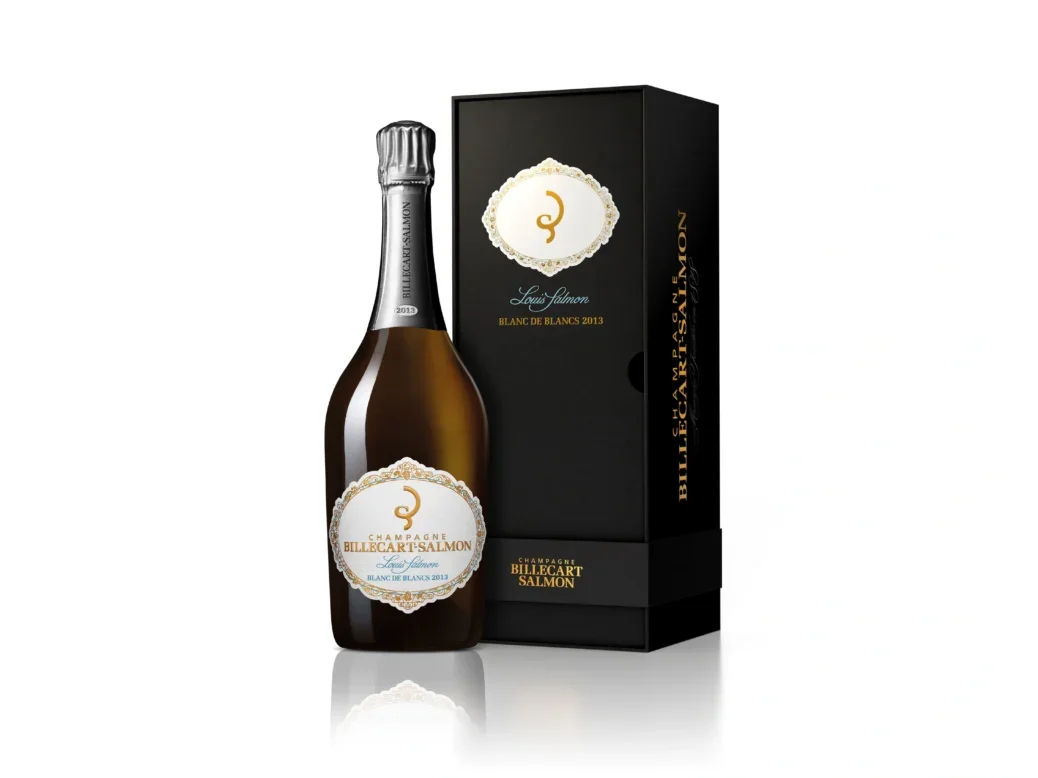
It is fitting, therefore, that Louis is remembered with this outstandingly pure blanc de blancs, which slots neatly into the prestige portfolio next to the Cuvée Nicolas-François, the Rosé Elisabeth Salmon, and the single-vineyard Clos St-Hilaire. Louis celebrates his 12th outing with a magnificent vintage, breaking a pattern of releases every two years that started in 2008. There was a 2012, but the next vintage will be 2015. (No Louis XIV sun king / sun wine jokes in prospect, alas). The wine is always sourced from grand cru fruit in the Côte des Blancs, almost exclusively in this instance from Cramant (44%), Chouilly (26%), and Le Mesnil-sur-Oger (25%). Chouilly and Cramant are relatively northerly in this southern enclave and traditionally yield wines of floral elegance and subtle yet complex fruit, without the steely personality of the wines made further south. Mathieu Roland-Billecart reminds me that the vins clairs are all tasted blind and that the wines are therefore “tailor made,” some years favoring specific villages over others. No recipes and no formulas. Although not always the case, the 2013 has been made exclusively in stainless steel, with a full malolactic fermentation and a modest dosage of 4g/l. This batch (overall production is small, so there may only be one) was disgorged in January 2024 so has been afforded an appropriate period for post-disgorgement integration—fundamental yet so often neglected, even with prestige cuvées.
Billecart-Salmon is now run by Mathieu Roland-Billecart. His stated mission is “to give priority to quality and to strive for excellence,” with no demonstrable evidence of a wish to develop the volumes of the brand, which is cleverly positioned across the off- and higher on-trade sectors. Be that as it may, a significant shareholding (45%) was sold to the Frey Group (which also owns Château La Lagune and Paul Jaboulet Aîné) in 2005, which is all the more significant as the new partner own 85ha (210 acres) of prime land in its own right, the family ownership a mere 16ha (40 acres), with a remaining 200ha (500 acres) secured by long-term contract. These key vineyards have not been legally integrated into the Billecart-Salmon structure so may offer the opportunity for further influence by the Frey Group. The nature of such influence has not been evident in the quality of the wines, however. A steady ship, therefore, playing to its strengths, and with a robust R&D program.
The 2013 Louis is especially impressive, the child of a late harvest, which followed a cool growing season, a late flowering, and interludes of rain in early September. Warmer days, allied to significant diurnal contrast, allowed the sugar levels to develop evenly and ensured that acidity levels were preserved. The fruit was harvested in the last week of September and the first of October—a far cry from 2026’s August scramble. The comparison is significant: The 2026 is presumed to be an archetype for vintages to come, with the management of potentially excessive ripeness key; the 2013, by contrast, sings the virtues of the past, with the management of acidity levels more important. Mathieu is not alone in comparing 2013 with other subtle, tense years, such as 1988, 1995, and 1996, all now greatly admired. The 2013 Louis Salmon manages to be both rich and linear, the former maybe more surprising but bequeathed by both the midsummer sunshine and the inherent quality of these grand cru grapes. Its taut linear structure, on the other hand, underlines the merits of this exceptional vintage and underwrites the prospect of a promising evolution.
Related

Tasting
2013 Billecart-Salmon Louis Salmon
(100% Chardonnay; disgorged January 2024; dosage 4g/l)
Pale gold, a pewter sheen, a Turner Thames Estuary early on a sunny September morning; a bright, crystalline, light-affirming mousse. The nose recalls soft fruit from earlier in the season: agile, citric-tinged, gently yielding, measured. Then grilled almonds and hints of melted butter, a little more depth and yellow-fruit ripeness than anticipated—no sleight, merely a function of the far-from-hollow crown of grand cru authority. The palate is assured and persistent, rigorous and finely chiseled. More mouth-coating generosity than expected, far from voluptuous, but with the linearity that signals the best examples from vintage and variety alike, crafted with dexterity; fulgent and poised, favonian yet pleasingly sapid. Mathieu notes how both white pepper and Virginia tobacco mark the finish, though the spice is decorous and discreet and does not undermine the fundamental purity of this first-rank Champagne. | 96
Content from our partners