Andrew Jefford is inspired by 2021 Domaine de Bon Augure DSLS IGP Haute Vallée de l’Orb.
It was almost two years ago: a hot, bright Friday in mid-April. We were in the medieval village of St-Guilhem-le-Désert in France’s Hérault. “Go on,” said the family, “take that path, the one you always wanted to take. But be back in two hours.”
Why is St-Guilhem “le Désert”? Because it was wild and uninhabited when the Abbey of Gellone was founded there by St Guilhem some 1,200 years ago, in 804 ce. There are only 230 souls there now, talking and breathing among old stones, beneath roofs of fired-earth tiles. The Hérault river smashes its way through a gorge nearby; the village twists up along the course of a tributary called the Verdus, which is soon lost in the Cirque de l’Infernet (the “little hell” cirque), where it’s supplemented by the Source du Bout du Monde (the “spring at the end of the world”). I walked up that lonely rising path I’d coveted, intoxicated by wilderness. Half an hour later, I came unexpectedly to an old building where no building should be. There was a gate, which bore a notice: L’hermitage est habité. Merci de respecter le silence de ce lieu propice à la prière et la méditation. L’ermite (“The hermitage is occupied. Thank you for respecting the silence of this place suited to prayer and meditation. The hermit”).
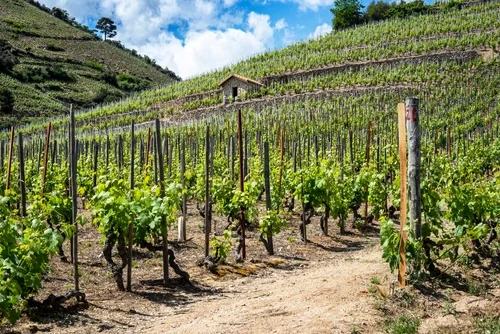
This is Languedoc—an infinity of lonely places, and most of them intricate, thanks to its contorted limestones, its chaotic physical matrix: a squabble between two plate collisions. It’s a landscape that rebuffs rather than welcomes—unless you want to meditate, pray, or grow vines.
Related
Might one still find, somewhere in France, a little of the original Burgundian spirit, that longing for spiritual service and nourishment that drove the founders of Cluny and Cîteaux to seek out loneliness and labor under heaven tending vineyards? If so, here it is. A couple of weeks ago, I met the white-robed Frère Marie-Pâques in another Languedoc hamlet called St-Barthélemy. As a former wine grower himself at the Abbaye de Lérins on the Île St-Honorat near Cannes, his charity Les Compagnons du Sens helps young growers establish domaines in the Upper Orb Valley. He also makes the best wild-boar pâté I’ve ever eaten. At La Dalmerie nearby is an orthodox monastery; over the hill are two communities based on the teachings of Giuseppe Giovanni Lanza del Vasto (named Shantidas by Gandhi), the Communauté de l’Arche and La Borie Noble. Cross another hill to Roqueredonde, and you’ll find Europe’s largest Buddhist temple, sheltering the community of Lerab Ling: retreats available.
Remarkable and singular wine
I owed my meeting with Frère Marie-Pâques to a thoughtful wine grower called Cédric Guy and his UK importer, Daphne Teremetz of Saison Wines. Cédric used to be (to continue the theme) a partner at the sun-and-schist Faugères domaine of Abbaye Sylva Plana but found the cool white-wine land and the personal autarchy he dreamed of at Joncels in the Upper Orb Valley. This was the site of the former Abbaye de St-Pierre aux Liens; indeed, the village is grafted into the abbey ruins. Monks, said Cédric, normally farmed the land closest to the monastery, but at Joncels they left that land to their workers, choosing instead to farm the limestone breccia slopes he’s purchased further up the valley, and particularly the walled enclosure where he makes this, his most ambitious cuvée. His has been the other motive force, along with Frère Marie-Pâques, in bringing young newcomers to the area, once he realized that the few old vineyards that remained here were disappearing. “You have to attract youngsters while there are still vines,” he insists. “If the vines are gone, it’s over. Replanting and then waiting for a crop is too costly for most young growers.” The zone in general is propitious for Chardonnay (as research commissioned some years ago by Michel Laroche proved), and from next year, barrel-fermented Chardonnays grown on limestone within the IGP Haute Vallée de l’Orb can use the mention complémentaire of Monts d’Avène.
The DSLS is a remarkable and singular wine: barrel-fermented Petite Arvine of authority and assurance. Both St-Guilhem and Joncels were on Compostela pilgrimage routes. Pilgrims and itinerant monks, Cédric points out, were great transporters, in times past, of vine cuttings from abbey to abbey. He was curious to see how this Swiss variety would perform in highland (1,500–2,000ft [450–600m]) Languedoc. It’s pale gold and aromatically complete yet undemonstrative. Soft pear, iris, orange peel, the greenhouse: sound, strange, compelling. Sip it, and you’ll find it mouth-filling yet bright and tenacious. Its orchard fruit retains weight, wealth, and vinosity. The fruit acidity has surging excitement and complexity without brittleness or bitterness. It’s as if Alsace married Burgundy in a glass.
Content from our partners
He’s been here for a quarter-century now—and has had help from above. When he arrived, the climate was too cold to make anything but sparkling wine; the harvested fruit would reach the cellar (down in Faugères) at 11.5% ABV. The second decade of this century, though, has lifted the ripening cycle, and all his wines are now still and poised at around 13%. The domaine name came from a taciturn geologist whom Cédric asked to examine the soils before he bought the land. The geologist took his time; Cédric heard nothing. He grew impatient, shrugged his shoulders, bought the land—then told the geologist what he’d done. C’est un bon augure, was the hieratic reply: “It’s a good omen.” And what of DSLS, locked away in enigmatic inverted commas? Dieu seul le sait—God alone knows. ▉