Biondi-Santi’s viticulture and winemaking director Federico Radi was laid low by a virus and unable to join us, but that did nothing to dampen the enthusiasm of those gathered at Hunan in London on a spring day for what was to follow: the presentation of the 2023 Rosso di Montalcino, the 2020 Brunello di Montalcino, and Riservas from 2019, 2013, 2006, 1988, and 1983.
I’ve mentioned before that while on a par with the highest echelon of Tuscan wine aristocracy, namely Antinori and Frescobaldi, the reputation of Biondi-Santi (the winery name is hyphenated, the family name is not) has rested firmly on its Brunello di Montalcino. It was at Il Greppo, the family farm just outside Montalcino, that Brunello was effectively born, when Clemente Santi’s 1865 “vino rosso scelto (brunello)” won two silver medals at the 1869 agricultural fair in Montepulciano. The estate today remains synonymous with longevity, purity, and a single-minded devotion to Sangiovese.
Biondi-Santi’s modern identity was shaped by Franco Biondi Santi (1922–2013), who combined aristocratic bearing with scientific rigor. Building on the massal selection begun by his grandfather Ferruccio at the time of phylloxera, Franco pursued a five-year clonal study with Florence University that culminated in Brunello Biondi Santi Vine number 11, the BBS11 clone, entered in Italy’s official register of Sangiovese clones in 1978 and the first to bear its producer’s name. Replanted widely across Montalcino, it became a genetic cornerstone of quality-focused Brunello.
That work continues. BBS11, which performs best on poor soils, is planted in most of the vineyards being renovated; where it suffers, the estate turns instead to a massal selection of its best old vines, matched to Montalcino’s diverse topography. New selections from the oldest parcels, including a plot dating from the 1930s, are identifying mother plants to secure genetic continuity.
Related
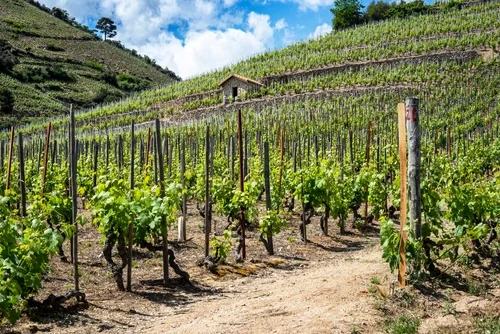
The 150ha (370-acre) estate has just over 30ha (74 acres) under vine, divided between four distinct microzones. Tenuta Greppo, at 1,640ft (500m), occupies steep terraces surrounding the winery to the southeast of Montalcino, on poor galestro soils, a friable, flaky schist, rich in marl. I Pieri sits at 1,200ft (370m) facing east. Scarnacuoia, east of Montalcino, is an old, terraced vineyard on galestro at 1,475ft (450m). The fourth pillar is the lower-lying Pievecchia, at 650ft (200m), facing north. This permutation of altitude, exposure, soil, and vine age underpins Biondi-Santi’s identity.
Toward ever-greater precision
When Franco took over in 1970, the family was working just 5ha (12 acres) at a time when the entire denomination amounted to fewer than 100ha (247 acres); today, Montalcino’s Sangiovese vineyards cover some 2,610ha (6,450 acres), yet the Biondi-Santi style has barely moved. In December 2016, a majority stake in the estate was acquired by Christopher Descours, owner of Champagnes Rare, Charles Heidsieck, and Piper-Heidsieck.
Under CEO Giampiero Bertolini, who arrived in 2018, and Federico Radi, viticulture and winemaking director since 2017, the stated philosophy has been “evolution, not revolution.” The all-Tuscan team that ran the estate under the family was retained, and a systematic study of the estate was set in train, aimed at understanding which plots have the most potential and which rootstocks and trellising suit each site. If anything, the changes have been deeper underground than visible above it.
Content from our partners

In 2018, the estate launched an ambitious parcelization project with Chilean terroir specialist Pedro Parra, drilling down, literally, into the geology of Montalcino’s heterogeneous galestro soils of sedimentary rock, sandstone, and marly schist. Electromagnetic mapping and 32 calicate, or hand-dug soil pits, produced a picture of how water, rock, and sand are distributed and how roots interact with them. Twelve distinct parcels have been identified, and since 2019 the fruit from each has been vinified separately in small vats, the aim being to build a clear picture of every site’s identity. The goal throughout is precision: matching rootstock, clone, and trellising to each microzone, with microvinifications providing evidence-based support for future decisions.
Climate change looms large in this thinking. Sangiovese is particularly susceptible to humidity and rain, and while warmer vintages have helped, heat and drought bring problems of their own. Seven hectares (17 acres) of new vineyard were bought high on the hill near Tenuta Greppo, at 1,640ft (500m), expressly for freshness. A new trellis system with movable horizontal bars keeps bunches protected during the worst heat of the day, netting shields the grapes from excessive sun and hail, and the canopy is managed to keep the vineyard as aerated as possible.
Cover crops enhance the soil microbiology; herbicides and anti-botrytis sprays are avoided; bunches are summer-pruned and hand-sorted after picking; and fermentations run on natural yeasts. Longer term, the estate is moving to organic certification. Radi is convinced that heat and drought can be mitigated by encouraging roots to reach deep into the earth, and an important part of that is extending the age of the vines to between 60 and 70 years, against an Italian average of 30–35 years.
In the cellar, large Slavonian oak remains central, but the old botti have gradually been replaced with new ones made from the same oak by the same cooper, Garbellotto. The point is neutrality: to avoid any overt oak influence and allow only the slow aging required to polymerize the tannins.
The hierarchy of wines is unchanged. The Rosso di Montalcino comes from young-vine Sangiovese and spends 12 months in cask; it now accounts for around one quarter of production and is destined to become increasingly important as the new vineyards come on-stream, with a precise personality of its own rather than being an afterthought. The Brunello annata is produced from estate vines between 10 and 25 years old.
The Riserva is made only in exceptional years, from vines at least 25 years old, and runs to only about 12,000 bottles. Grapes are hand-picked and brought to the winery in baskets; fermentation takes place in oak, concrete, and stainless steel; and the wine then spends three years in large Slavonian oak followed by 30–36 months in bottle. The back label bears the date the Riserva left La Storica, the historic bottle library at Tenuta Greppo, and if a bottle is recorked later, the information is added to a certificato di ricolmatura around the neck.
So, can the new stewardship truly preserve such a legacy? So far, the approach has not been to replace the instrument but to fine-tune it, adjusting rootstocks, reading the soils more intimately, refining the oak—adapting to climate realities without sacrificing identity. Biondi-Santi has never been about fashion, power, or value-for-money calculations. As Franco once observed, nature is capable of creating great things; you just have to know how to wait.
Tasting
2023 Biondi-Santi Rosso di Montalcino (13% ABV)
This was a challenging year that needed rigorous selection thanks to significant temperature swings and irregular rainfall, yet the mid-September harvest brought in good-quality fruit. Aged in Slavonian oak casks for 12 months, this is a vivid, bright ruby in color, super-fresh when you put nose to glass, the initial cherryish whiff confirmed by the bright, pure cherry fruit that follows. And while this is a Rosso and not a Brunello, there’s deceptive concentration and depth in a structure of gentle tannins and acid spine that makes it such a delightfully elegant drink. | 91
2020 Biondi-Santi Brunello di Montalcino (13.5% ABV)
After a rainy June, July and August turned warm and dry while maintaining a positive day–night differential that sustained the natural balance of the vines and helped build aromatic profile, with harvest starting on September 9. Aged in Slavonian oak casks for 24 months, this is a youthful bright ruby in color, with a fresh, floral, and cherryish perfume mingling with a herbal note; still youthfully bright and elegantly full-flavored, above all showing a seamless purity of Sangiovese fruit with a textural finesse underpinned by juicy freshness of acidity and gentle tannins. A wine very much in both the Biondi-Santi and the Brunello classical mold. | 93
2019 Biondi-Santi Il Greppo Brunello di Montalcino Riserva (14% ABV)
Vinified in oak, concrete, and stainless steel, still with a youthful ruby hue and refined aromatics of light smoke, camphor spice, and cherry. Super-fresh and inviting; you can almost smell, certainly sense, the vigor. The fruit combines opulence with restraint, vibrant, ripe dark-cherry sweetness underpinned by a firm but fine structure of muscular, sinewy tannins, relative power, and a spine of juicy acidity, tapering to a fine, seamless finish. Needs time and will hold for 20+ years. | 95
2013 Biondi-Santi Il Greppo Brunello di Montalcino Riserva (13.5% ABV)
Still youthful in the glass and only now starting to shade to garnet at the rim, with an elegantly mature, lightly floral, smoky bouquet, fresh and fine-scented. On the palate, a core of youthful, sweet spice and sour dark-cherry richness, delicately balanced, with seductively seamless fruit, initially sweet and then veering toward an elegant umami savoriness as it progresses to a similarly seamless finish. | 95
2006 Biondi-Santi Il Greppo Brunello di Montalcino Riserva (13.5% ABV)
Good, youthful color, especially for a 20-year-old Sangiovese; it still smells very fresh, with no hint of oxidation and a lightly herbal and gamey mature bouquet. There’s an initial youthful vigor to the fruit, a mature, sweet core of cherry at its center, giving way to a sweet-savory finish in which the tannins are still present along with a mineral note, although yielding. The spine of acidity holds the wine together well, and it should remain in very good shape for at least another 5–10 years, perhaps longer still. | 94
1983 Biondi-Santi Il Greppo Brunello di Montalcino Riserva (13.5% ABV)
Topped up twice since release, this is deep-colored and rich, with a dense middle shading to garnet at the rim. Mature smoky and gamey notes on the nose, feeling very much ready now. It tastes mature and delicate, a sweet core of fruit with a melt-in-the-mouth texture, thanks to the bolstering spine of acidity that now forms its main structural element and brings a savory feel. Toward the finish, the fruit is maturing gracefully and still vigorous. Now at its peak and ready to drink; not worth further cellaring. | 95