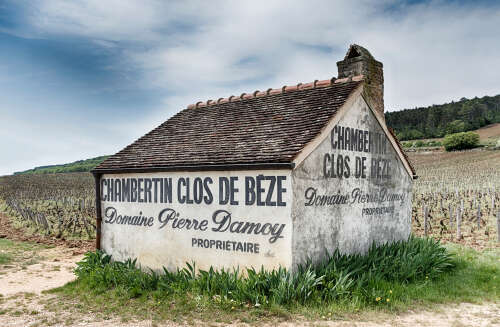
A passion for Burgundy has been the non-negotiable requirement of everybody who has even the faintest claim on the romance of wine. With the exception of Champagne, it has been, and remains, the truest indicator of a properly hedonistic and sensual being, the closest thing to pure concupiscence that a glass of fermented grape juice has to offer.
Explanations for this longstanding preference usually turn on the stylistic and spiritual opposition thought to exist between the wines—red wines, specifically—of Burgundy and those of Bordeaux. Where cru classé claret is austere, demanding, rectilinear in structure, and pedantically balanced in its building materials, grand cru and premier cru Burgundy is untamed, unbuttoned, more readily seductive, full of wild and dangerous aromas, dabbed in red fruit perfume on initial contact, and yet rolling with voluptuous meaty pheromones beneath.
It’s there in the enumerated intoxicants to which Baudelaire prefers his muse, Jeanne Duval, in the ode “Sed Non Satiata” from Les Fleurs du Mal (1857). She is better even than Constantia or opium or Nuits (-St-Georges). That good. Her eyes are the cistern where his weariness drinks, but Burgundy is one of the irresistible potions on the same spectrum as, but outshone by, her loveliness.
Uniquely invigorating
It was at least as important to the mythos of Burgundy, though, that as well as being the wine of languid sensuality, it was also uniquely invigorating, a spur to frenzied action and martial spleen. Napoleon Bonaparte considered Gevrey-Chambertin an essential weapon in his armory. It accompanied him on the conquest of Europe, inspiring both the militaristic impulse and the elevation of spirits that enabled it: “Nothing makes the future look so rosy as to contemplate it through a glass of Chambertin.”
Related


The savage brio that Burgundy was held to bestow on the drinker inspired the musical ebullience of composers and performers too. Beethoven’s close friend and sometime secretary Karl Holz recalls an evening when the composer, in unusually excellent spirits after several glasses of Burgundy, played some of his own greatest piano works “with unparalleled energy.” In between the impromptu renditions, he insisted that Holz help him drink to the brilliance of the new compositions on which he was working.
Brahms is known to have played his own work with a more loose-limbed passion after a quantity of good Burgundy, which, it was observed by his dinner companions, appeared to imbue him with extra vigor. Unverified rumor insists that, on the famous 1889 Edison wax cylinder recording of him playing his Hungarian Dance no 1 in G minor, his reckless, uncoordinated performance is largely owing to his having been at the bottle. If that is his voice introducing himself as “Dr Brahms,” the rumor seems to need little authentication.
Wagner’s biographer Ernst Fritz Schmid wrote that, in Paris, the composer insisted that only Burgundy should be drunk at gatherings of friends, since only that wine stood comparison with the mythical grandeur of his operas. Its complexity and resonant depth were reflected in his dramatis personae. Berlioz, writing to his mother, explicitly tells her that Burgundy is so much better than Bordeaux, as he is reminded on drinking it every night. Debussy’s table talk, great aesthetic discussions about Impressionism and music theater, was lubricated for preference with Burgundy, in which office it was incomparable.
Content from our partners
An older and better place
Literary characters are more often sent into rhapsodic flights by Burgundy than by stuffy old claret. When Charles Ryder orders the wines for him and the prosaic dullard Rex Mottram at Restaurant Paillard in Paris in Brideshead Revisited (1945), he picks a 1906 Montrachet to go with the sole, followed by a 1904 Grand Cru Chambertin-Clos de Bèze with pressed duck. “I rejoiced in the Burgundy. It seemed a reminder that the world was an older and better place than Rex knew, that mankind in its long passion had learned another wisdom than his.”
Philip Marlowe helps the worldly-wise corporate secretary Adrienne Fromsett load up the trunk of her car prior to a trip in The Lady in the Lake (1943): “I noticed that she had also packed two bottles of Burgundy. I assumed that they were expensive, but I wouldn’t know for sure.” Count on it.
But then there is nothing expensive about the glass of Burgundy that Leopold Bloom drinks with a gorgonzola sandwich at Davy Byrne’s Dublin pub in Ulysses (1922). It’s the real thing, unadulterated with coloring additive: “Sips of his wine soothed his palate. Not logwood that. Tastes fuller this weather with the chill off.” (It’s mid-June.) It does its job while he recalls a stirring sex episode with his wife Molly. “Mild fire of wine kindled his veins. I wanted that badly … Glowing wine on his palate lingered swallowed. Crushing in the winepress grapes of Burgundy. Sun’s heat it is. Seems to a secret touch telling me memory. Touched his sense moistened remembered.”
If it doesn’t set you hurtling on a Hungarian dance at the piano, or to subjugating Austria, it will make you horny.