


Rod Phillips reports on the travails of Canadian icewine.
Vinopolis, the wine exhibition in London from 1999 to 2015, featured one large image illustrating Canadian wine: a woolen-hatted man crouched in snow, his beard crusted with ice, and his gloved hands picking shriveled, frozen grapes for icewine. If it weren’t for the grapes, you might have thought it was an image from the Soviet Gulag. But the harvester was no forced laborer. Typically, the people who pick icewine grapes in Canada are volunteers who turn up in frigid temperatures in the dead of night, simply for the love of the luscious, sweet wine that first put Canada on the world wine map.
To many people, it seems to make intuitive sense that Canada—famously dismissed by Voltaire as “a few acres of snow”—should be a major icewine producer. Two thirds of the country’s vast surface is under snow for more than six months of the year, but in the minds of many people it is the whole country, all year round. Once, talking to someone in Australia about Canadian icewine, I was told, “Of course they make icewine there, with all that ice.” Putting aside the thought that icewine is made by fermenting ice cubes, there’s an underlying truth there: that to sustain regular icewine production, a region must experience very cold winters on a regular basis. But there must also be a growing season that ripens grapes, and the number of areas with both conditions is quite small, even in Canada.
Icewine is made from grapes that have been left on the vine long enough after the regular harvest to freeze, and under wine law they can be picked only when the temperature drops to at least 17.5°F (–8°C). Most producers put the sweet spot—a particularly apt term in this context—at between 17.5°F and 14°F (–8°C and –10°C). At that point, the water in the grapes is frozen, and there remains only a tiny volume (5–10%) of liquid in the form of sugars, acids, and flavor compounds. When the grapes are crushed—in heavy-duty presses operated outside in the frigid temperatures—only this liquid is released (the frozen water doesn’t thaw) and fermented. The result is a very sweet, somewhat viscous, fairly low-alcohol wine. Icewines generally come in at about 200g of residual sugar per liter, but some exceed 300g/l. (For comparison, Sauternes typically has 100–180g/l.)
Related


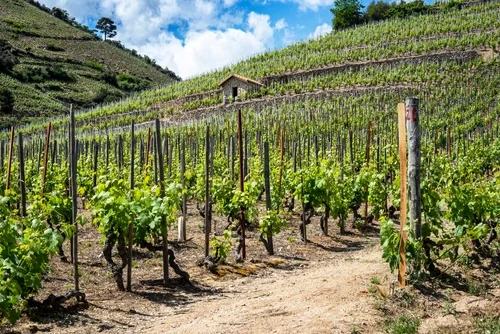
Although icewine was first made in Europe, Canada is now the dominant producer, with Ontario’s Niagara Peninsula making the overwhelming bulk. One reason is that for the past 50 years, every winter in Niagara has achieved the magic temperature of 17.5°F. Other producing regions—such as British Columbia in Canada and Germany and Austria—cannot say the same. Winter temperature warming due to climate change has effectively put an end to regular icewine production in some areas.
Canadian icewine attracted the attention of the wine world when Niagara Peninsula’s Inniskillin Vidal Icewine 1989 won the Grand Prix d’Honneur at the 1991 Vinexpo exhibition in Bordeaux. The award led to wider acknowledgment of icewine as a category—and as Canada’s wine industry expanded in the early 2000s, icewine production rose. It was largely spurred by receptive markets in Asia, especially in China, and by purchases by tourists of what appeared to be a uniquely Canadian souvenir.
But the heyday of Canadian icewine has receded, and even if it would be wrong to add “and fall” to the story of the “decline” of Canadian icewine, there have been downward shifts in production and exports over the past decade. In Ontario, the key producer, between 750,000 and 850,000 liters of icewine were produced annually between 2010 and 2018, with about one million liters in 2018. But the volume began to decline from 2019, and in 2022 only 111,000 liters were made (all figures rounded to the nearest thousand). Production rebounded in 2024 to 394,000 liters, and it increased again in 2025 to 469,000 liters. That’s a lot of icewine, but only about half of what was being made a decade ago.
Content from our partners


Icewine was a common feature of many Ontario wineries’ portfolios, but it is now confined to a few. A decade ago, 46 producers made 116 individual cuvées of icewine, but in 2024 only 15 wineries made icewine, which they produced in 52 cuvées. There were 66 cuvées in 2025, again about half the number ten years ago. A similar pattern is evident in exports of Canadian icewine. In 2017, 298,000 liters were exported worldwide, but the volume fell to 137,000 liters during the Covid pandemic. It began to rise from 2021, and by 2024 it had recovered to 154,000 liters. Again, that’s a lot of icewine, but far less than the pre-pandemic level.
Icewine: Export shifts
Within that global figure, exports to China stand out. In 2017, Canada exported 150,000 liters of icewine to China, representing half of that year’s exports, but the volume and share of exports to China have declined consistently since then. Volume plummeted to 50,000 liters in 2020, the year the Covid pandemic began, but instead of then rising, like trade in general, exports of icewine to China continued to fall. In 2024, they amounted to 28,000 liters, one fifth of the volume only seven years earlier, and representing one fifth of all Canadian icewine exports, rather than one half. It’s clear that changes in the Chinese market alone are responsible for much of the shift in icewine exports.
On the other hand, there has been growth in exports to other countries. Exports to the United States were in the 40,000–50,000-liter range from 2017 to 2023, but they rose to 82,000 liters in 2024. Exports are not necessarily indicative of icewine consumption in the importing country because not all of it ends up on wine-store shelves. Some is imported for sale in airport duty-free stores, where it stands among other luxury beverages—though Canada sells by far the most duty-free icewine. Some Canadian icewines have been served in first-class cabins of non-Canadian airlines such as Asiana and Emirates.
Nor are all exports of icewine consumed in the sense of being drunk, because it has been especially popular as a gift. Jeff Letvenuk, director of marketing at Pillitteri Estate Winery, a major icewine producer in Niagara Peninsula, says, “It has always had strong appeal in Asian markets as a gifting product.” Indeed, there is an unproven belief that many bottles are gifted over and over and never opened. The good news for recipients at the end of a gifting chain who do decide to drink the wine is that many icewines age in an interesting and very drinkable way.
To explain the decline of icewine exports to China, it’s impossible to overlook the rapid decline of wine consumption in general in China, which in 2024 was only one quarter of what it was in 2019. Perhaps more important for icewine specifically is the note in an annual report of Changyu Pioneer Wine, one of China’s largest wine producers, that sales of wine for business banquets and as gifts had ceased to represent a significant part of its income. A government crackdown on business spending on luxury goods, foods, and events will certainly have had an impact on icewine sales.
Beyond purchases of Canadian icewine in China, many Chinese tourists buy icewine when they visit Canada, often on package tours that include stops at icewine producers—many close to Niagara Falls, a major tourist attraction. Pillitteri Estate, which has exported icewine to China since 1999, had dedicated tasting rooms at its Niagara winery for Asian tourists and has a program allowing Chinese tourists to buy icewine at the winery and have it shipped to China.
For several reasons, however, fewer Chinese tourists come to Canada than a decade ago. In the immediate pre-Covid years, more than 700,000 Chinese tourists arrived in Canada each year, but in 2021 there were only 41,500. In 2023, China broadened its list of Approved Destination Status countries for Chinese tour groups and excluded Canada, which had been included since 2009. This reflected the poor political relations between the two countries, and it is only since 2025, when the Canadian government determined to increase trade with China, that relations have improved. In late 2025, Canada was added to the list of countries approved for Chinese tour groups. Even so, more Chinese tourists opt to visit British Columbia than Ontario, and British Columbia icewine is a threatened species: Of more than 250 wineries, fewer than 10 have made icewine in the past few years.

Niagara wineries that do make icewine report that it is tourists, and specifically tourists from Asia, that buy it from the cellar door. Matt Dixon, director of sales at Ravine Vineyard, says they didn’t produce an icewine for a few years but have started making it again. “It is doing well, mostly with the tourists we have visiting us,” he says. But the decline in Asian tourists underlies the decision of some wineries to give up on icewine. John Hare, owner of Niagara’s Hare Wine Company says, “Pre-Covid, we would see a lot of Asian tour groups and FITs [foreign independent travelers]. But since Covid, they have not returned to Canada—nowhere near the volume previously. For us, making icewine is quite expensive as I do not have my own press; I use a presshouse, which increases the cost significantly. So, icewine is a great product if people are buying it, and worth the time and money to produce But, with little demand, for me it is not worth the squeeze at this time.”
Another China-related issue is counterfeit Canadian icewines, which have been a problem for many years and which some people believe are more widespread than ever, despite attempts to thwart them. Jeff Letvenuk of Pillitteri Estate says that it “is a larger issue than it has ever been. With the rise in e-commerce and a plethora of third-party online sales channels in international markets, counterfeit icewines are showing up all over the place.” Pillitteri has adopted security tags on icewine sold in certain markets, and Letvenuk bravely puts a positive spin on counterfeiting: “The good news here is that this indicates that Canadian icewine has become a globally recognized luxury item. Otherwise, there wouldn’t be so many attempts to counterfeit it.”
Finally, but perhaps most important for the future of Canadian icewine exports, China has begun to produce its own icewine. A number of regions in various parts of China, have both growing seasons suitable for viticulture and the very cold winters needed for icewine production. Some producers imported Vidal vines from Canada, but Beibinghong, a hybrid developed in China, is also popular for icewine. The scale of Chinese production is uncertain, but there are reasonable estimates that China is now second to Canada, and less verifiable claims that China now makes 40% of the world’s icewine. The bulk of Chinese icewine is sold domestically, and it will almost certainly reduce demand for Canadian icewine in China even further.
The United States, which is now the biggest market for Canadian icewine, poses its own challenges. Trade between the US and Canada has been complicated by US tariffs on some key Canadian goods since early 2025 and periodic claims by Donald Trump that Canada should become the 51st state of the US. In response, most Canadian provinces (including the three most populous) have banned the sale of American wine and spirits—at a massive cost to American producers, because Canada was their largest market. An American response that includes tariffs on Canadian alcoholic beverages is expected, and it would affect what is now the largest market for icewine.
The consumption conundrum
Yet the decline in Canada’s icewine production can’t be attributed solely to shifts in export markets. Many Canadian wineries have simply given up on icewine because it was a small part of their portfolios but demanded specialized equipment, as well as a disproportionate amount of time. Part of the puzzle is that consumption of icewine is a mystery. It’s an expensive, super-sweet wine of which few people want more than an ounce or two at a time, and then rarely. It seems likely that repeat purchases for consumption are rare, and the challenge for producers is to constantly expand the market of first-time buyers. One tactic is selling it in 20cl bottles, rather than the usual 37.5cl, and some producers even sell it in 5cl bottles. In Canada, a 20cl bottle of Vidal icewine starts at about C$20–30, while 37.5cl costs about C$50. Riesling typically costs more, and less common varieties are priced at about C$90–100 and more for the larger size.
Producers have also tried to make icewine less one-dimensional. While almost all were initially made from Vidal and Riesling, Cabernet Franc has become especially successful, while other varieties include Chardonnay, Cabernet Sauvignon, Shiraz, and even (at Pillitteri) Kerner and Corvina. Some icewine is oak-aged. Sparkling icewine is also available, and in a twist, some Niagara producers offer traditional-method sparkling wine with a dosage of icewine. Cocktails with icewine as an ingredient appear on many drinks lists.
But my sense is that while most people find it intriguing to try icewine, very few adopt it as even an occasional drink—partly because of the price, partly because of the style. Icewine is promoted as a dessert wine—to be drunk with dessert or alone as dessert—and also for pairing with foie gras and blue cheeses. But more than once, I’ve thought that asking, “Would anyone like a glass of icewine?” toward the end of a night’s eating and drinking is tantamount to asking, “Can I call anyone a taxi?”
It might be too soon to call last orders on icewine, but despite recent bounces, it seems to have passed its heyday. Perhaps tourism from China to Canada will recover to previous levels and boost icewine sales, but it’s a fragile foundation for growth. It’s clear that whatever other influences there are on icewine production and sales, the volatile China market has had a major impact, just as it has on other sectors of the wine industry.


