Joanna Simon reviews the new pair of grand cru Côte des Blancs Chardonnay releases from Champagne Barons de Rothschild.
It was 20 years before Champagne Barons de Rothschild launched its first single-plot Champagne, a 2019 Vintage Côte des Blancs Chardonnay named Le Grand Clos after its source, the eponymous walled vineyard in Vertus (WFW 89, p.60). A year later comes the second installment of what is to be a series of cuvées parcellaires, and this time it’s not one but two new Côte des Blancs Chardonnays, reinforcing the house’s focus on Chardonnay (with low dosage) and also its intent of zeroing in on the region’s great individual terroirs among its own vineyard holdings.
The new cuvées are both grands crus, and like the premier cru Le Grand Clos, each takes the name of its lieu-dit: Le Bateau in Cramant and Les Maladries in Avize. If the majestic-sounding Le Grand Clos was a gift of a name, Le Bateau also has appeal, even if no one knows whether it refers to the shape of the land with its north and south exposures at either end, or the fact that it was once sea, which gives the saltiness and minerality for which the wines have always been recognized, or if it references something else entirely.
There is no such mystery over the name Les Maladries, but the Rothschild Champagne house probably won’t be going out of its way to enlighten those to whom it is unfamiliar. Certainly, it is not explained or translated on the back label, which, in all other respects, is a model of transparency (as is that of Le Bateau), giving precise vineyard parcel size, date of planting, soil type, aging vessels and length of time, disgorgement date, and dosage. For WFW readers who don’t know, Les Maladries (also spelled Les Maladrières) were leper colonies or plague hospitals sited outside towns and villages in the Middle Ages.
Related

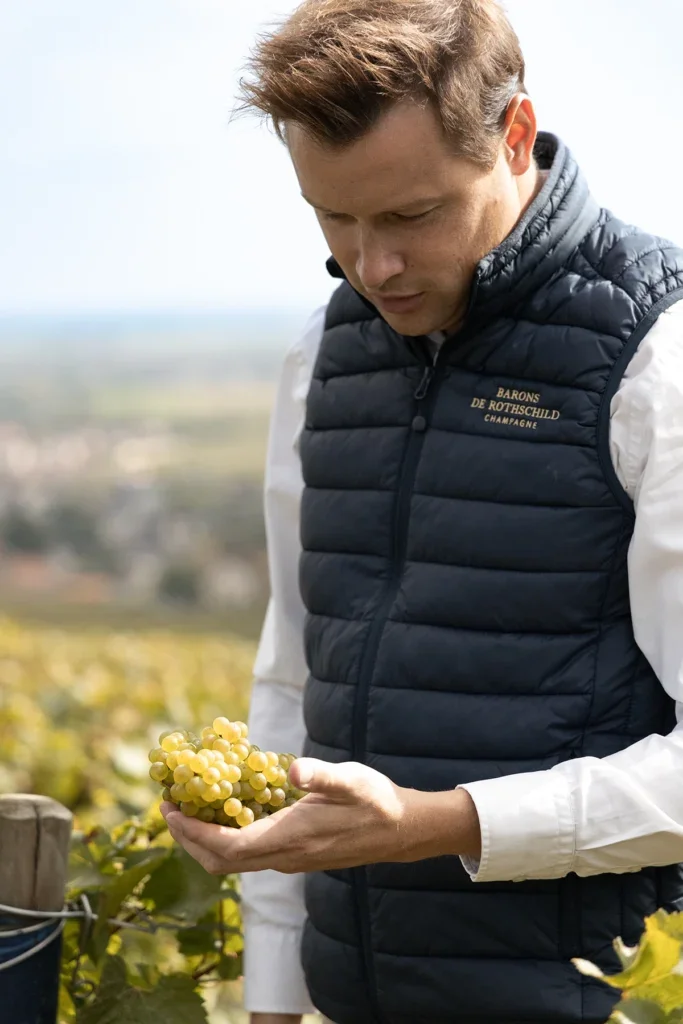
If one of the lieu-dit names could occasionally prove problematic, the vintage chosen for the new cuvées, 2021, might seem even more so. Chef de cave Guillaume Lété, who has now been in the post for more than a decade (and is still only 38 years old), says it was “a difficult vintage, a cold expression.” Coming at the end of September, the harvest was distinctly late by today’s standards and yields were low, but the silver lining was the concentration that resulted, especially in the Chardonnay grapes. Comparing 2021 with previous vintages, Guillaume thinks it is closest in expression to 2013, a similarly troublesome, nail-biting growing season and late harvest, but one now celebrated for, among other things, the precision, acidity, and anticipated longevity of its Vintage Champagnes.
Despite the challenges of the growing season, Guillaume says that they felt comfortable with the two parcels in 2021. They were bought in 2015–16, and the grapes had mostly gone into their Rare Collection cuvées until 2021. But having seen, as he puts it, “something quite different in these two,” they had been observing them for a while and had built up quite a bit of knowledge about them. By the time they decided to go ahead with the two 2021s, the idea had been in his mind for a few years—and sometimes, he adds, “We like to start when it’s not so easy.”
Tiny but mighty
If Le Grand Clos seems Lilliputian at just over half a hectare (1.24 acres), the plots of the new cuvées are even tinier. Les Maladries du Nord (to give it its full name) is just 0.28ha (0.69 acre), and yet it dwarfs Le Bateau in Cramant at 0.12ha (0.3 acre). And although there are more bottles of Les Maladries 2021 than there were of Le Grand Clos 2019—2,542 versus 1,788 bottles—the princely total of Le Bateau 2021 is 906 bottles.
Content from our partners

The lieux-dits are only about 2km (1.2 miles) apart as the crow flies, but the terroirs are quite different, as one would expect from two grands crus and, indeed, from what Champagne Barons de Rothschild is setting out to achieve with its cuvées parcellaires.
What they have in common is old vines with very deep roots: Les Maladries du Nord was planted in 1938 from a massal selection; the parcel of Le Bateau was planted in 1974. This age and depth, says Guillaume, allow them to be ambitious in terms of grape maturity and expression, giving Chardonnay that has a lot of flavor—“which is what we like”—but also retains freshness and a citrus dimension.
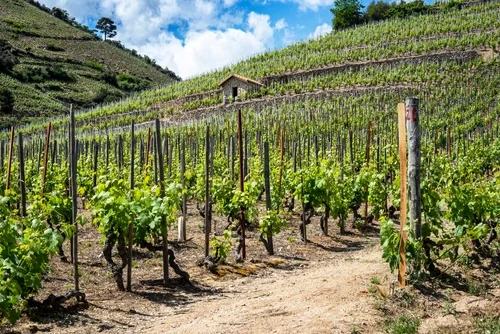
In terms of location and terroir, Les Maladries du Nord is just east of the village of Avize on the mid-slope with a northern exposure, and it’s on argilo-calcaire; more specifically, a shallow clay soil—about 12in (30cm)—before a base that Guillaume describes as “strong chalk.” Le Bateau is in the northeast of Cramant, and the Rothschild parcel is at the top of the slope, with a sunny, full-south exposure on pure chalk consisting of 2–4in (5–10cm) of very crumbly chalk before solid chalk.
The differences in the two terroirs are reflected in aspects of the winemaking. For both cuvées, alcoholic and malolactic fermentations take place together, and as soon as the malolactic is finished, the team moves fast to racking, in order, Guillaume says, “to have the light [fine] lees that will protect the wine for nine months and give structure.”
Both were bottled in July, but Les Maladries spent the preceding nine months divided equally between concrete eggs and three- to four-year-old oak barrels of 500–600 liters. “The egg upgrades the minerality, keeps freshness, and gives a lot of texture, which you balance with the oak,” Guillaume explains. Le Bateau was entirely oak-fermented in three 228-liter barrels, one from a Burgundy cooper to give “verticality, minerality, and tension,” one from the center of France “for spice and sugar,” and one from Allier “for integration.” It will always be 100% oak-fermented. “It gives the structure more dimension and power,” as Guillaume explains.
They were both disgorged after 45 months, Les Maladries on April 22, 2026, and Le Bateau the next day, but the dosage levels were different. For Les Maladries, it was 3g/l, for Le Bateau it was 2g/l—but the levels are not set in stone. Guillaume says it’s possible that the dosage of the 2022 Les Maladries will be slightly lower.
Before I get to the tasting of the two new cuvées parcellaires, I shall briefly revisit the first, the 2019 Le Grand Clos, which I tasted with Guillaume in London alongside the new cuvées. Having been the first person outside the Rothschild family and team to taste the mold-breaking Le Grand Clos, when WFW was given an exclusive preview last year, I now had the opportunity to taste one of the last remaining bottles.
How did it differ? Had it evolved? The color, I think, is now marginally deeper, and the oak—in balance but still to be fully integrated 12 months ago—is supportive and seamless. On this occasion, I detect some coffee and caramelized-nut richness and peppery spice, but still the same striking power and volume. And still the same reminder of great white Burgundy woven with Côte des Blancs nervy energy and currents of minerality and salinity. Outstanding.
Tasting
2021 Champagne Barons de Rothschild Avize Les Maladries
Chardonnay from a massal selection planted in 1938 in the Avize lieu-dit of Les Maladries du Nord. Fermented half in concrete egg and half in used 500–600-liter oak. Bottled in July 2022; disgorged 45 months later on April 22, 2026. Dosage 3g/l. 2,542 bottles.
Pale straw, with an opening salvo of lively lemon and saline aromas, followed by creamy richness and a distinctive savory, smoked-brine element. Fragrant white peach makes an entry, and lemon returns, bringing in its wake hints of hazelnut and white chocolate. The mid-palate has fleshiness and generosity and a satin-smooth texture, but then it changes shape, drawing in, becoming long and more linear. The acidity tightens its hold, and chalky minerality becomes the lingering, resonant note. | 93
2021 Champagne Barons de Rothschild Cramant Le Bateau
Chardonnay from a vineyard planted in 1974 in the Cramant lieu-dit of Le Bateau. Fermented in three 228-liter French oak barrels from different sources. Bottled in July 2022; disgorged 45 months later on April 23, 2026. Dosage 2g/l. 906 bottles.
Even on the nose, there is an immediate feeling of power and structure, of density and youthful compression, of insistent minerality, energy, and chalky texture. Aromas of salted caramel, white-pepper spice, and toast dance across sweet, citrus-oriented, ginger-tinged fruit; but as alluring as they and the fruit core are, they never outpace the penetrating mineral inflection. The oak—toasty, nutty, and sweet—is never far away, but it is never in the way either. Young, with more to give, but balanced. Statuesque. | 95