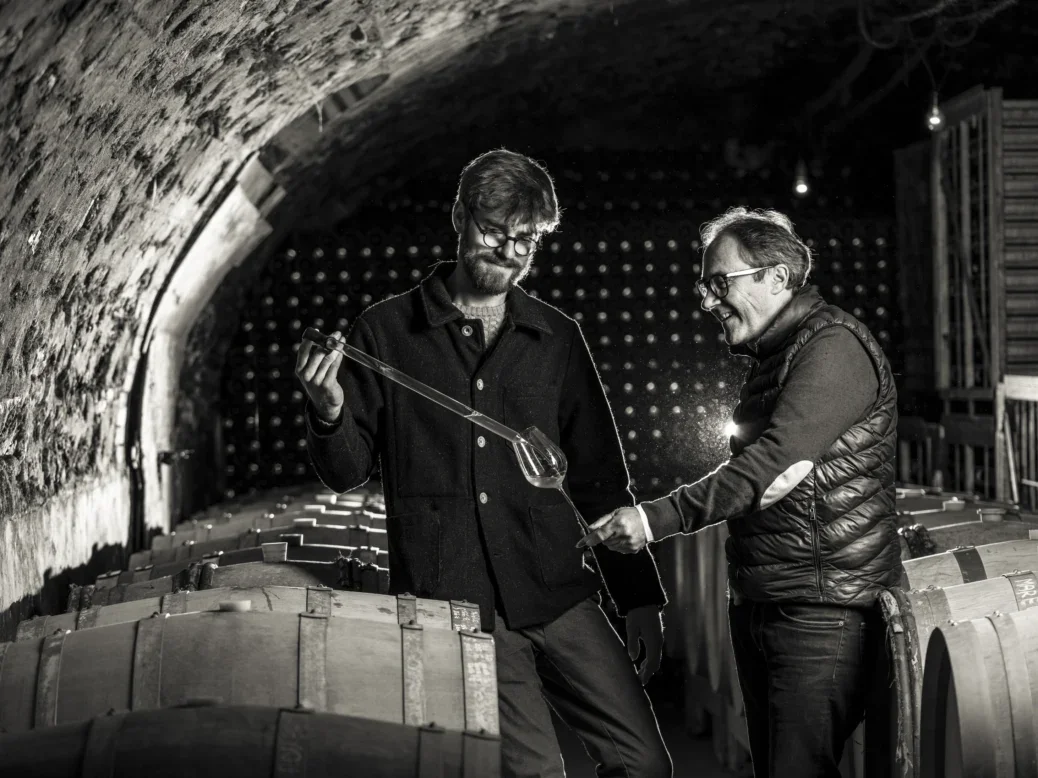
Terry Theise tastes the latest releases from Champagne Hébrart, one of his favorite Champagne producers.
Normally when I taste “my” Champagnes (ie, those in my former portfolio in my importer days) I have all the background information at hand. That is, what vintages went into the assemblage and in what proportions, the blend of grape varieties, the parcels from which the fruit hailed (and failing that, the communes at the very least) the essentials of vinification and tirage, and finally the disgorgement date and dosage levels. The last of these I keep to myself, so as not to play into the hands of the many ignorant and fatuous tasters who decide prior to tasting whether they’ll “approve” of a Champagne based on their, ah, *opinion* regarding the “acceptable” amount of RS.
That information has reached me but only after I tasted the first six wines. I thought I’d show both sets of notes, those when I knew the details and those where I was just guessing. I’ll do this with all the wines, including the final flight of four. Perhaps it will be revealing, perhaps not, but it’s interesting at least to me. There was some info on the back labels, but it only whetted my appetite.
The subject of oak arises. It’s a running joke between Jean-Paul (aka JP) and me; he thinks I don’t like oak at all. This isn’t true. I don’t like oak when it isn’t called for, or is blatant, or tastes as if it were plastered on. JP’s two wood-made wines are both excellent, each a tiny bit less excellent than the wines surrounding them, and each makes me wonder whether they wouldn’t have been even better with less (or subtler) wood. To some degree this is also true of the two still wines: the Pinot Noir wears its oak perfectly (and beautifully) while the Chardonnay wears a blazer that doesn’t match the rest of the ensemble. But I like it anyway!
Related

Besides, if I were reflexively anti-oak, why do I dote upon Vilmart’s Champagnes, let alone the purringly tender old (and old-school) Riojas that I absolutely crave? Oak has a place, obviously, but many of the places it appears are places it doesn’t actually have. And I reject the idea that oak as such confers any sort of high-status on a wine.
2023 Coteaux Champenois Vin Rouge de Mareuil Sur Aÿ +
Made in old casks foir one year, neither fined noir filtered.
Content from our partners
My first taste of a still wine from JP, though I’d heard rumors….
The HEADLINE is, this wine continued to improve the longer it was open, and by the 4th-5th time I tasted or sipped it, it was three times the wine that first was poured. But as always, I’ll show you the note as it was written.
Color and aromas are all on-the-money. The miniscule reduction is fleeting. Funny how much this tastes like what I *thought* Mareuil tastes like. This isn’t a terroir with a strong signature, such as Bouzy, Ambonnay, Aÿ, or Verzenay; rather it seems to give a dusty vinosity the French often call “carpentry” to a cuvée, and which we might call structure or backbone.
It smells like rose hips and like tomatoes when you’re heating them, just as they release their fragrance. It’s both elegant and countrified. The tannin is almost fluffy. It’s a lovely elegant mid-weight wine with greater length than you anticipate. The finish introduces the taste of tomato leaves.
Nor does it strive to make a point about “what might be possible” for Pinot Noir in Champagne. What it does is deliver entire contentment as you drink it with a meal. I’ve written about my gratitude for wines that know the job and do it, and this is a perfect and delicious example of exactly that.
The wine was also superb with a late-summer dinner of lamb chops with cherry tomatoes, peppers and green beans. But by the final drops, I was wishing pitiably that I had a case of it in the cellar.
NV Coteaux Champenois Blanc +
Well this is interesting. Hand-picked, made in wood, 18 months on the fine lees, no malo. Bottled on May 3rd, 2018. From which I infer the wine may be a 2016? (No info-sheets from the domain, who are probably occupied with a ridiculously early harvest, and alas, the importer doesn’t seem to offer it.)
It smells like a superb Chablis from a wood-friendly grower. Tastes that way too! An ambitious 1er Cru or even a Grand Cru, one of the more delicate ones. A wonderful length both strait-laced and creamy (how does that even happen?) leading to a deliberate finish in which the wood predominates.
It’s clear I like the wine. I think it is a great success, especially based on what I theorize JP wanted to do with it. But….the most interesting facets of the wine are those that speak of the soil and not the cask. The latter is louder than the former, such that the soil notes are frustrated by their lesser volume. And remember, I say this in the context of a wine I like, and which I could envision liking even more if wood took its supporting role rather than being the loudest voice in the chorus.
Marc Hébrart Blanc de Blancs Premier Cru, Brut, NV +++
Oiry, Chouilly (GC), and Mareuil (1er Cru; disgorgement date smudged and illegible but based on the cork it’s probably over a year ago. The importer’s website is out of date.
I’ve been known to claim this is/was the best NV Blanc de Blancs I offered, true even in my Pierre Péters days.
Put it this way: I’ve never tasted a better one than this one from JP. It’s the perfect Chardonnay! Happens to have fizz. It’s like a higher register of Sicilian lemon-blossom honey. And using David Schildknecht’s definition of “perfection”—itself perfect—as “better than which cannot at this moment be imagined,” I’m here to tell you this is perfect wine.
But let’s describe it in terms of Ideals. It has the ideal dialogue among chalk and cream and flower. It has the Ideal blend of the vintages that contributed to such seamlessness. It has Ideal dosage. It scolds the body that dares to spit. It caresses you with sheer deliciousness, offered with improbable articulation.
Finally, as always I’m tasting from two iterations of Richard Juhlin stems, and from the smaller one the wine is almost too fruit-forward. Almost! The larger original stem emphasizes saltiness and minerality, but I can’t imagine a glass from which this wine wouldn’t be gorgeous.
THE DEETS: 45% 2022, 25% 2021, 30% 2020 (with six months in cask—here is a deftly perfect use of wood. Purely cuvée (e.g., the free-run juice).
Marc Hébrart Cuvée de Réserve Premier Cru Brut. NV ++
Deg March 20, 2025, and as (almost) always it’s 90-10 PN/CH.
The fragrance offers an exegesis of Pinot Noir. Curiously, it is a firmer stiffer wine than the BdB—it has to be the assemblage, and the importer’s website is out of date (though it does quote me, for which I am thankful); overall a more sinewy version of this wine than I’ve grown to know over the years.
This isn’t a criticism nor a damning with faint praise—just an observation. And the smaller Juhlin, the one that emphasizes fruit qua fruit, is better, showing more of the wine I know. But it comes on from either glass.
In a way this is a strong argument for stainless steel, because in this case it offers a glimpse into Pinot Noir from an oblique angle, taking a wine that might have been merely fruity and turning it into a compelling essay analyzing an element of PN we probably never thought of.
The wine unfurls spectacularly over the ten minutes I have been struggling manfully to keep from swallowing. JP is a wizard of Pinot Noir, among his other gifts!
THE DEETS: 45% 2022, 25% 2021, and 30% reserve wines from 20-19-18-16; the 10% Chard was a first-pressing; everything else is cuvée.
Marc Hébrart Sélection Premier Cru, Brut, NV ++
A curious assemblage for this usually-Chardonnay dominated cuvée: 70% PN to 30% CH, disgorged 3/20/2025, and “vielle vignes” is also absent from its normal place on the label.
That said, the wine smells like a million bucks (or 893,714 Euros), like the above NV but richer and thicker, with a vinosity so tactile you think you’d need an immersion blender to liquefy it. It has the richness of stature of many Tête-du-Cuvées, and is what we used to call, quaintly, a “mealtime Champagne” before we understood that all Champagne was “mealtime Champagne.”
I would say, though, that it strikes me as cold-weather Champagne, with its generous filling of the gob. Its force is such as to tilt it drier than Hébrart’s norm, though I won’t be surprised if I’m wrong (as indeed I was). It also has some of the phenolic chew of hot vintages (though none of the grassiness of drought years), and I wonder whether it’s a 1-off exception based on the available material.
Whatever it is, it’s superb Champagne, and while one is tempted to anticipate such things from this grower, one shouldn’t dare to. JP’s wines offer a paradigm of the object, something to which others aspire and seldom reach. They’re love-at-first-sight Champagnes, and this one, with its unlikely poise of melon-y freshness, tomato-water, and capacious richness, is a masterpiece of classical beauty.
THE DEETS: 40% 2022, 30% 2021, 30% 20-19, and all cuvée, as are the remaining wines.
Marc Hébrart Rosé Premier Cru, Extra Brut, NV +
50-44 CH-PN, with 6% still PN from Mareuil; disg (again) 3/20/2025 (and it’s the second dubious cork from that day’s disgorgements, FWIW).
Initial aromas are earnest and strong. The color seems a bit darker than usual, also.
This has usually been a “pretty” rosé that shone from its amazing articulation and (strongly) implied minerality. But this one is Serious Business. The smaller stem clarifies the flavors, which tilt in a green direction (tomato-leaf, artichoke, marigold leaf) while there’s a counterpoint of white peach. (And I do wonder whether these would be my associations were I tasting in, say, February instead of late August, when the markets are ecstatically groaning with fresh produce.)
It’s a wine of plenitude, a bushel of flavor concentrated in a sack barely large enough to hold it. I like a stern, sumptuous rosé, and am only a little surprised to receive it from this producer. Whether it’s a harbinger of things to come is imponderable at this point. What is clear is how excellent the wine is. And what is remarkable is how it slimmed down over the days, until at the end it was lissome, albeit sturdy.
THE DEETS: the CH is 2022—the PN is 19-20, and the still red is ’20.
Marc Hébrart Mes Favorites Vielle Vignes, Brut, NV +++
Disg 1/30/2026. A frothy little bugger. Old vines from JP’s favorite parcels in Mareuil, nine in all, identified on the back label, and if you had Peter Liem’s Champagne book you’d have the Larmat maps and could spot the parcels.
90-10 PN-CH, and smells like it. A wine that asks the question—can Champagne really actually be this beautiful?
It asks another, more provocative question. Given the blazingly clear expression of Mareuil-sur-Aÿ terroir this wine demonstrates, is there any justification for not “promoting” the commune to Grand Cru?
The smaller Juhlin shows a little disgorgement sting; the larger one does not. The larger one compels the questions, how much sheer terroir can a “made” wine show, how specific can a Champagne be and still answer to the Ideal of “Champagne,” and finally, how are we to reckon with the fact that Champagne doesn’t have a privileged place among the world’s most beautiful wines? I sometimes think it’s been ghetto-ized as a world unto itself. It is both that, and also this, and it’s this that is too often overlooked.
It isn’t only the hundred flavors singing in harmony here; it is also the remarkable dispersal of weight, whereby the wine is both solidly rich and complex yet also lithe and lucid and light on its feet. Not to mention it tastes like brioche made with double the amount of butter.
THE DEETS: 65% 2022, 15% 2021, 20% 2020—old vines, Massale selection.
Marc Hébrart “Rive Gauche, Rive Droit,” Extra Brut, 2018 +
Disg 4/18/2024; This is a GRAND CRU from Aÿ, Chouilly, Avize, and Oiry (parcels shown on the back-label), 50-50 PN-CH.
We have wood flavor to contend with, which JP believes I despise but which I meet with a question regarding its necessity, insofar as wood always tastes like … wood.
(Incidentally, the importer’s website is a bit of a mess for this wine. Should you happen to need to consult it.)
Up front: The Champagne is excellent. That has never been in question.
My thought is, it is possible that in time, the wood will retreat and we’ll have an old-fashioned rural wine with lots of umami and atmosphere. It is also possible that we’ll have squandered a chance to really explicate these terroirs without the wood-gravy napped over it. It boils down to one’s vision for the cuvée. What does JP see, what does he steer toward, what is his Ideal for this wine? He does not need to please me, he needs to please himself.
The smaller stem reduces the wood’s impact and shows what this wine may yet become. From that glass it is a thoroughly lovely Champagne. And even the larger glass, as the wine takes in oxygen, lets the wood soak into a larger picture of vinosity. I also think I have the tasting sequence correct; at the winery this often followed the Special Clubs, after which it could seem, let’s say, a little blatant.
But tasting it at this moment, one appreciates its length, poise, and ambition. It’s fine to be a black-haired child in a family of blondes. And it’s fine for me to wonder what train we may have missed, standing on this particular platform.
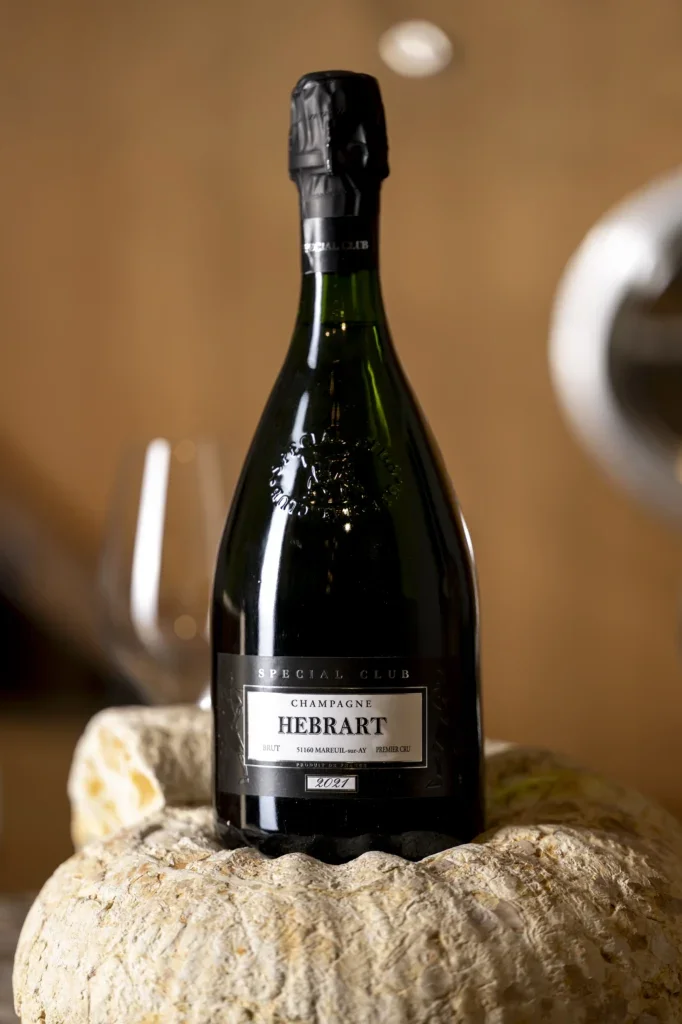
Marc Hébrart Special Club, Premier Cru Brut, 2021 +
Disg 3/20/2025, a 65/35 blend of PN/CH, from GC Louvois (new to me) and Chouilly, and 1er Cru Mareuil.
It smells classy and classic, reminding me of the spellbindingly ethereal 2013. It’s a crisply articulated cool-vintage Club, the kind I just melt over, but you’ll be nonplussed if you need volume and impact. Instead you get a wine drenched with petrichor.
It’s ridiculously beautiful from the smaller stem. A logical wine, it “makes a case” by persuading with its clarity rather than enticing with its allure. The vividness of chalky terroir reminds me of some vintages of Chiquet’s Club, and both of these are like watercolors of Clos des Goisses.
It’s a wine of rhetoric, of elegantly organized argument. (I’d love a brain-scan while tasting this, to see what parts light up….) It’s both a puzzle and the solution to the puzzle. Finally it is a sort of template for what “Champagne” is essentially, an essay of its singular virtues.
It feels like a superb aperitif; just take care what you serve afterwards—you don’t want an anticlimax!
I wonder whether there were producers who opted not to make their top wines in 2021. I can sympathize if you need those wines to really belt it out. But I admire JP for his willingness (and acumen) to appreciate the loveliness of this airy, unearthly type.
THE DEETS—for both Clubs—a Coeur-du-cuvée (heart of the free-run juice), Massale selection.
Marc Hébrart Special Club Premier Cru, Brut 2019 ++
Disg 5/15/2025; otherwise same blend as above.
The ripe vintage announces itself.
Now we’re all brioche, hawthorn, caramel, maize, masa harina. The ’19 fragrance is amazingly consistent across northern Europe. And in this case it’s poised against a splendid raciness so that “gold” is in counterpoint with “steel,” the result being a wine of paradox—and paradox is the early marker of greatness.
It is a pure classic, this wine! It is Champagne writ large, pure and vigorous. That we’ll “understand” it better makes it no less amazing. You may wonder, as I do, that a wine can convey such a clement nature while maintaining a hair-trigger vivacity. Finally, it’s a vintage of Club where Pinot Noir’s the boss.
From the beginning of my acquaintance with this domain, I’ve been impressed by their understanding that the Club, ostensibly (and often actually) their crowning wine, should excel by its class and finesse rather than its intensity. It’s more exceptional than you may suppose. A closing thought; taste this (if you can) alongside the “Mes Favorites” and you’ll glean the essential nature of Mareuil-sur-Aÿ.
Marc Hébrart Noces de Craie, Grand Cru Extra Brut, 2019 ++
A Blanc de Noir entirely from Aÿ (parcels identified on the back label), disg. Jan 11, 2023.
Take a single sip, just one, and learn why Aÿ is such a privileged Grand Cru. For me it is the Musigny of Champagne.
At times I have wondered whether I ever tasted a better BdN than this. The 2012 gave rise to such thoughts. They arise again now.
In essence this is a magnetic PN Champagne, clearly from great land, balanced ideally, a sort of “Real-ID” for Aÿ, and a glorious thing to drink. It is, also, something of an outlier, in that I find myself wondering whether 10% of Chardonnay would have given this a “conversation” it is….not missing, but rather “could have used.” As such the idea of Aÿ is perhaps even more important than the brilliance of the wine.
Or I am spoiled and foolish. Or the wine could be even more amazing in a cooler vintage. Or I am tasting so many stellar Champagnes I’m peering about for nits to pick. By any sensible measure of stature and quality, this is supernal wine, especially from the smaller stem where a sideways minerality peeks out from the chomping vinosity.
DEETS: a Coeur-du-cuvée and massale selection.
Marc Hébrart Clos le Léon, Dizy (1er Cru) Blanc de Blancs, Extra Brut , 2016 +
Disg 11/27/2024
A privileged (and renowned) parcel in Dizy that would surely be a Grand Cru if the Champagne classification were parcel-specific. JP was mega-stoked to obtain it. I do not know if there’s a more recent vintage than 2016—though I adore 2016.
I’ve tasted it several times but don’t seem to have published about it. The first time, tasting at the domain, JP was sure I’d be cool toward the wine because he made it in wood, yet I’ve liked this wine each time.
I like it again now, and I also wonder whether 2016 is too slim a vintage to carry this vinification, especially in its current phase of development, when it’s moved on from its primary fruit. This argument is weakened by tasting from the smaller stem. And I must confess, I don’t have a template for how wines from this site “ought” to taste.
Choice of stem seems to be decisive, and when I taste it again I’ll whack it into one of those odd “Krug” glasses Riedel made. (I did in fact try this, and the wine showed best from that glass. A unity was achieved and the wine “made sense” from this stem in a way it didn’t quite from either Juhlin.) But I do have to question the assumption that “important” wines must be made in wood—or that wood must be prominent in such wines. Wood is fine when it is discreet and knows its proper place. Tell me, how often does that happen?
It should be a voice in the chorus, not the loudest voice, and never to sing a solo. I assume it’s not easy to get this right. Yet plenty of vintners do it, all the time, and I also have to wonder whether it entails a degree of virtuosity to get the balance right in “northern” wines. There’s also the question of Pinot Noir versus Chardonnay—which we saw addressed in the two still wines.
I think this is ambitious and excellent Champagne. In the fullness of time I imagine future vintages will obtain a more seamless harmony; this one will too, if that showing in the Riedel stem was any indication. Meanwhile, the salty suavity from the smaller stem signals another way this fine wine might yet be.
I may also be impatient as a taster today, as the wine improves markedly as it warms in the glass—both glasses.
DEETS: Coeur-du-cuvée, no malo.