On a rare visit to London, Paul-Vincent Avril of Clos des Papes chose Berry Bros & Rudd cellars to present a selection of vintages of both his red and white wines. He spoke about the philosophy and techniques that guide his work in the vineyard and the cellar. Returning to the family estate in 1987 after studying enology in Burgundy, he worked closely with his father, Paul. His great-grandfather was a key figure in the creation of the Châteauneuf-du-Pape appellation in 1936. For 25 years, Paul-Vincent and his father worked side by side, the son preserving his father’s methods. “We both love the finesse and elegance of Burgundy,” he said. “The challenge for us has always been to achieve balance and freshness.”
Paul-Vincent’s goal is simple: to make wines for the table, not for competitions—“The wines I personally enjoy drinking,” he says. Clos des Papes produces just one cuvée each of red and white. There is no new oak and no small barrels; instead, larger casks are used to avoid imparting oak flavor. “I want to taste the grape,” he explained. His Burgundy training sharpened his attention to phenolic maturity, which he considers far more important than sugar levels. “You have to wait for the best tannins,” he said. “I check that by taste.”
Climate change has made that pursuit more complex. Since 2003, the wines have naturally gained power, and the gap between sugar accumulation and true ripeness has widened. Yet Paul-Vincent feels the biggest shifts are not in heat alone but in extremes of storms, drought, frost, and hail. The estate lost 40% of its crop in 2017; frost struck again in 2021, hail in 2022, and coulure and mildew in 2024 (a good vintage nonetheless). “We must adapt and sometimes hold wine back,” he said. Warmer conditions may benefit Mourvèdre and Cinsault, though Syrah is more concerning.
Clos des Papes Rouge is typically 55–65% Grenache, with the balance made up of Mourvèdre, Syrah, Muscardin, Vaccarèse, and Counoise. “Eighty percent of the wine is made in the vineyard,” Paul-Vincent said. “We are lucky with our soils, but we must respect them.” The estate comprises 35ha (86 acres) across 24 parcels, with a cooler-climate 4ha (10 acres) dedicated to the white. Ripening can vary widely between sites, which is not surprising given that the composition also varies, with rocky, sandy, clay, gravelly, and limestone soils. Even two Grenache parcels can differ by ten days, with grapes on clay and sand usually producing more powerful fruit.
Related
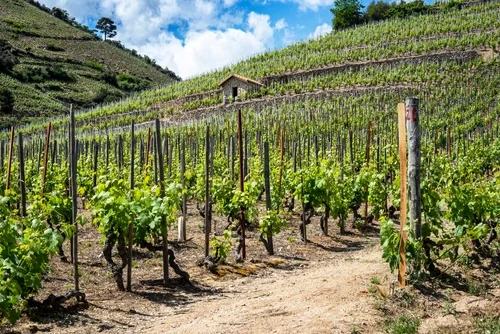
The domaine is certified organic. Paul-Vincent adds no manure; pruned wood is returned to the soil. With an average vine age of 40 years, roots naturally find the water they need. If required, he conducts a green-harvest in July and removes small berries in early August to aid ripeness. Leaves are taken from the morning-sun side in late August. Yields average 20hl/ha. Harvest is entirely manual, guided by tasting, and finished with a sorting table. “I can’t bring grapes to the winery that I don’t like,” he said. “In that sense, I’m like a restaurant chef.”
In the cellar, he believes firmly in co-fermentation: “Fermenting together creates a unique symbiosis.” Since 1992, he has removed stems—he finds them too green at harvest—and the wines ferment in concrete tanks for three to four weeks, with twice-daily pump-overs for color and tannin but without heavy extraction. Temperatures peak around 90°F (32°C), after which he presses, then adds the press wine. He considers the pneumatic press one of modern enology’s most important advances.
The wines spend winter in tank, with malolactic fermentation also in tank. He fines with egg whites but does not filter. Aging is in large, neutral casks (15–55hl) for 10–12 months—shorter now than the previous 18 months, to preserve freshness. Clos des Papes Rouge sees 10–12 months in wood, never new, while Le Petit Vin d’Avril sees just one third wood. “I’m not against wood, but we don’t want its tannin or flavor,” he said. After one year, he performs a final assemblage two months before bottling, done by gravity.
Content from our partners
The white wine comes from six varieties, each contributing something distinctive: Grenache for richness (though sometimes low in acidity), Roussanne for power, Clairette and Picardan for finesse, and Bourboulenc for acidity—“increasingly important,” Paul-Vincent noted. Vinification is traditional: a slow three-hour press, overnight settling at 54°F (12°C), then fermentation with natural yeasts, starting at 55°F (13°C) and finishing at 70°F (21°C).
Seeking a full-bodied style, he avoids oak and keeps the wine on its lees until February. There is no malolactic fermentation; pH averages 3.3. “I often get pear and peach flavors, sometimes floral, aniseed, or grapefruit notes, and a touch of bitterness. They’re very mineral, almost Riesling-like.” The whites can age as long as the reds, with phases moving from honey and dried apricot, to quince, then back to mineral. He particularly likes them at five years and beyond.
Clos des Papes produces around 100,000 bottles of red, 10,000 of white, and 20,000 bottles of Le Petit Vin d’Avril, which come from vines not classified as Châteauneuf-du-Pape. Half the production is exported to 50 countries. “I’m lucky to have an allocation system,” Paul-Vincent said. “I try to make wines for aging, ideally for ten years or more, but they’re also drinkable young, with tannins arriving only at the end. I like to carafe the wines. Each year we start with a blank canvas; the painting is different, but the signature the same. I’m not aiming for consistency.”
Tasting
Berry Bros & Rudd, London, with Paul-Vincent Avril
Reds
2023 Clos des Papes Rouge (15.5% ABV)
Deep ruby. Beautifully fragrant and spicy and, on tasting, instantly elegant and textural, with opulent black berry fruit and generous richness balanced by juicy acidity. Youthful yet approachable, with tannins kicking in only at the end. Needs 10–15+ years for best expression. | 95
2022 Clos des Papes Rouge (15.5% ABV)
Deep ruby. Aromas of fragrant cherries, spice, and pepper. Ripe cherry flavors, with silky texture and near-imperceptible tannins, allowing the fruit and spice to shine. Juicy acidity frames a refined, almost Pinot-like finish. Seamless and elegant. Age for 8–15 years. | 94
2021 Clos des Papes Rouge (15.1% ABV)
From a late but successful harvest (16hl/ha), this is showing a deep ruby hue. Fresh, spicy dark-cherry aromas, with a note of mint. Silky and concentrated yet subtle, with tannins dissolving on the tongue and seductively sweet red-cherry and spice notes. Finishing fresh despite its evident power, and it will age 10–20 years. | 93

2019 Clos des Papes Rouge (15.5% ABV)
Deep in color, reflecting a higher Mourvèdre component (40%), evolution now starting to bring out the fragrance. Powerful red and black fruits, richly spiced, with fine-grained tannins and fresh acidity. Concentrated yet elegantly balanced, with long aging potential, for up to 20 years. | 96
2016 Clos des Papes Rouge (15.5% ABV)
Deep, youthful red. Ripe, spicy red cherries and peppery fragrance. Still youthful and powerful, with opulent red and black cherry fruit supported by firm tannins and juicy acidity. Beginning to close slightly yet still remarkably youthful, well balanced, and fresh. This will be very good for another 8–15 years. | 95
2010 Clos des Papes Rouge (16% ABV)
Still good depth of color, developing into its secondary phase with licorice, spice, and dark cherries. Opulent, juicy, and intense, with ripe, grainy tannins supporting real power without heaviness, underpinned as it is by fresh acidity and savory dry notes. Ready to drink now, yet still youthful, with a good 10–12 years of life ahead of it. | 95
2005 Clos des Papes Rouge (15% ABV)
Deep red even after two decades. Complex bouquet of herbs, pepper, spice, and black fruits. Rich, dark-cherry fruit, with licorice, evolving toward savory dryness on the finish. Elegant, complex, and still with 8–10 years ahead of it. | 94
Whites
2023 Clos des Papes Blanc (14% ABV)
Super-fresh; floral, with acacia and aniseed hints. Primary and opulent, with peachy richness and juicy acidity. Beautifully balanced but very young; needs 5–8 years for secondary complexity. | 93
2021 Clos des Papes Blanc (14% ABV)
Deeper in color. Aromas of dried fruits; concentrated, fresh, and evolving toward dried-apricot and light honey notes. Balanced and textured, moving toward savory. This is worth cellaring for five years or more. | 91
2020 Clos des Papes Blanc (14% ABV)
Youthful lemon hue. Fresh aromatics, with floral notes. Still extremely youthful, with fine stone-fruit and melon flavors, touches of honey balanced by lively grapefruit acidity. This has 5–10+ years of life ahead of it. | 93
2015 Clos des Papes Blanc (14% ABV)
Pale gold. Fresh with a hint of smoke, evolving into dried apricot and honey. Powerful and opulent, classic southern Rhône richness balanced by super-juicy acidity and finishing elegantly savory and bone-dry; 3–8 years of life ahead of it. | 94