

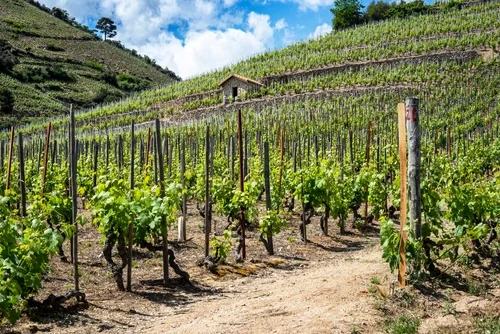
John Livingstone-Learmonth introduces an informative tasting of the wines of Cornas shared with Simon Field MW and Andrew Jefford comprising numerous vintages and variations on darkly fruited Syrah
Over the 50-plus years I have known Cornas, it has moved from unruly supplier of dark, vigorous, demanding wines followed and drunk by a limited few, through to being something of a rock star, taken up by hipsters and hailed for its expression of unbridled, dark Syrah fruit, with comfortable tannins increasing its appeal to a wider audience. It no longer lurks in the shadows of Hermitage and Côte-Rôtie.
The granite-based vineyards have increased in the time I have known them: 53ha (131 acres) in 1971, via 102ha (252 acres) in 2005, on to around 150ha (370 acres) today. The surge of the past 20 years has come from the heights out of view of the village, with old meadow and pasture lands burrowed out, vines planted at 8ft (2.5m) apart to allow tractor work. Scuffing the soil, one finds sanded granite on these areas, the lieux-dits of Chaban—named after the main stream running through Cornas—and Les Rieux most notable.
This has created a form of two-speed Cornas—one made from young vines whose cost of upkeep is around five times lower than the hillside venues, along with a windy exposure and ripening that in cool vintages such as 2016 or 2021 can lag three weeks behind the most noble sites that rise just above the village’s extremity—Syrah at 10.2% ABV on October 2, 2021, for the admirable Guillaume Gilles’s Les Rieux, for example. This amounts to Cornas-lite, if I am being severe: fruity, direct, and early drinking; good also in wine bars.
Related

The heart of the appellation
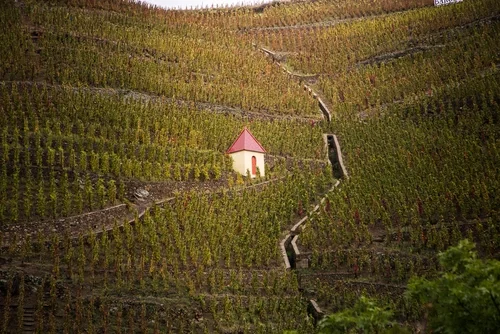
The heart of the appellation centers on a broad hillside that faces largely south with views across to the ruined Château de Crussol opposite Valence. This is the Reynards axis, with plots such as Tézier, Genale, and Le Pigeonnier part of it. Reynards is the basis of Thiérry Allemand’s cuvée of the same name and also a substantial influence on the Clape cuvée.
Soils here are granite-based, with Tézier marked by very decomposed, sandy granite, and pockets of clay and gore in the southern area. Genale (on which I own some vines, worked by Vincent Paris) is granite-gneiss with a few stones, a slippery surface. Guillaume Gilles used to work this vineyard when Paris’s uncle Robert Michel owned it; he describes the granite as “not acid, unlike the granite of Tournon, and more like Les Bessards on Hermitage.” South-facing, it gives ripe wines with a feather-velvet quality to its tannins. Pigeonnier, which features in the Allemand Chaillot cuvée, has clay present, the wines ripe and lowish in acidity.
Chaillot, a little to the north of this cluster of sites, is of interest, with varied soils and character in its wines. There is a floral-violet quality in them in the vintages that have avoided overt sun rays and consequent masking.
Content from our partners
All the above lieux-dits contribute to the wines of the leading names—Clape, Allemand, Guillaume Gilles, Franck Balthazar, Domaine Lionnet, Domaine Alain Voge, and the up-and-coming Emmanuelle Verset.
Supporting sites Les Côtes and Sabarotte are on two parallel hills, granite again with some clay lower down, along with Mazards, Patou (exemplified by Dumien-Serrette), and Pied la Vigne, all near the village and lower-lying. There is a tickle of limestone at the most northeasterly extremity, the vineyards on Les Arlettes there mostly worked biodynamically these days by Matthieu Barret since Jean Lionnet’s rental with the Barret family ended.
North to south, the vineyards run for less than 2 miles (3km)—but the fact that they are tucked in and sheltered from the main north-wind-dominated River Rhône corridor means that they ripen early; recent start dates have tended to be in the second half of August.
Whole-bunch fermentations are still practiced by some, while élevage—traditionally in 12hl or 600-liter casks, with Allemand favoring used 228-liter barrels—runs for 12 to 18 months.
Prices have risen pretty sharply over the past 10+ years, so Cornas is now more recherché than it used to be—found in collectors’ cellars rather than in the venues of rootsy enthusiasts.
Different styles and vintages
Our tasting spanned several vintages so was not strictly like for like. Andrew Jefford led the charge with his lyrical appraisals, being versatile in praising different styles, excited by the Northern Rhône Syrah expression. Simon stayed more closely to the “good traditional” line, with a certain naughtiness in liking the more accessible cuvées.
I felt somewhat frustrated by the mix of styles; tasting new vintages since 1971 has a definite impact on one’s image of an appellation, so I was not in favor of wines that I deemed to be lush-plush, savory, or international in style.
A Cornas must combine iron-mineral tones or spine with freshness and clear-cut fruit. A violet-floral tremor is permitted, too, and there must always be a good tannic frame to house the wine. From the domaines that presented, bang on the money as a rule for these qualities are those of Clape, Lionnet, and Franck Balthazar.
At the same time, there is now a good level of competence in the selection of harvesting dates and vinifications of Cornas made by names such as Chapoutier and Paul Jaboulet Aîné, for whom Cornas was previously either not present or low priority.
It was encouraging that the oak-modern Colombo wines from the sunswept, tricky 2018 vintage had moved toward genuine Cornas expression, while the 2019s duly showed the apex of sunshine and Mediterranean influences riding into the Ardèche. They require much patience to prompt the terroir to move ahead of the vintage imprint.
I was less harsh on the 2021s, which I felt allowed access to the terroir—bar the Clape, which was a rare write-off. A year of stunted growth in the vineyards due to the heat and drought, 2022 was saved by mid-August rain. Its wines are good bets, gaining in depth and length since I first tasted many of them in October 2023. As for 2023, it is an accessible, pretty open, easy-to-please style of vintage, a “comfortable” year for medium-term cellaring.
Looking ahead, beyond our tasting, 2024 has given wines with delightful fruit; and 2025 is magnificent: rich wines with enormous length, though the harvest was very small.
Simon Field MW on Cornas
I remember, a decade or so ago, thinking that I was very clever to write an article titled “Cornas Turns the Corner’’ or some such; this was the appellation to watch, the cradle of the new generation, influenced—but not too influenced—by the new ideas of aging enfants terribles such as Jean Luc Colombo but not prepared to compromise on the virtues of a distinct, and distinctly warm, terroir.
Go back another decade, to my first regular visits to the region, and every lunchtime in Le Chaudron in Tournon one would be privileged to espy the doyens of the region—Messrs Michel, Juge, Verset, Clape, Voge, et al—several of them octogenarians à l’époque, surveying their children’s labors from behind a plate of entrecôte de boeuf, ensuring that not too much by way of modernity was introduced to undermine the granitic soul of this small enclave. I had high hopes, therefore, in 2025, for a spectacular tasting to underline the progress, itself informed by a liturgical adherence to traditional values.
It was not to be. The wines were good to very good, some on the verge of excellence, but many seemed to lack the aromatic elegance that one can detect in top Côte-Rôties or, more significantly, the controlled power that marks out a fine Hermitage. Some of my top marks were, maybe ironically, bestowed on the arrivistes, with the wines of Colombo and Chapoutier, both sailing under organic colors, showing well. In terms of the so-called new generation—represented by Stéphane Robert, Matthieu Barret, and Vincent Paris, among others—the wines were solid and workmanlike, more “modern” than of yore, for sure, but not necessarily more interesting. Syrah has to be aromatically challenging, haunting even, and sinewy yet silky on the palate—a fine weave of decorous contradiction, in other words. It was a very felicitous consolation that it was the estimable Franck Balthazar, with his superlative 2022 Chaillot, who showed us what can be done in this austere appellation. Let us, at least, celebrate the work of the magus of Cornas.
Andrew Jefford on Cornas
I loved this tasting and thought that many of the wines we scrutinized showed very well indeed—only 11 of my scores rated 89 or below. In a field of 32 wines, that’s impressive.
When Northern Rhône Syrah is on song, it furnishes (for me) France’s most distinctive regional red-wine style: hugely and unmistakably characterful (part angel, part gargoyle, and lovable in both guises), perfumed and pungent, packed with energy and fruited exuberance, and striding out confidently along the ridge line between freshness and wealth. I enjoy these wines most of all when there is a significant textural presence, too—and therefore I relish Cornas, naturally well endowed in this respect, and rate it as highly as any of the sibling appellations, Hermitage and Côte-Rôtie included.
Our tasting suggested (to me) two firm conclusions. The first is that the growers as a cohort have made great progress in recent years, and the reputation Cornas has for toughness and rusticity is now historic. The second is that this grand yet undulating, dipping, and slope-shifting hill seems to have little to fear from climate change. Perhaps the opposite: The ripest wines remained balanced and poised but had taken that warmth and wealth and transformed it into a resonance and grandeur I don’t recall tasting and sensing in the past.
A quick word on vintages. Our first look at 2023 was encouraging: These were not only wines of impressive energy, impact, and fruit definition; they were deliciously generous, too. The 2022 vintage is clearly outstanding and classical, and the best wines are potential cellar references. The 2021s, for me, are unpleasantly thin, shivering, and weedy; just too difficult a vintage, and one I avoid. The 2020 vintage is a variable one, but at best it’s vivaciously good. I thought our three 2019 wines were magnificent—reds I would love to own and drink. The same goes for the two 2018s. All five have much to offer and were a wonderful way to end this fine tasting.
To view the panel’s reviews of the wines of Cornas, sign-up for access to the WFW tasting note database or subscribe to The World of Fine Wine.


