


Martin’s Lane winery, in British Columbia’s Okanagan Valley, seems out of step with many current trends. Unlike at so many wineries that are, now more than ever, desperate to attract wine tourists, members of the public wanting to visit Martin’s Lane must make an appointment and pay well for a tour and tasting. There is no public tasting room, no retail shop, and no restaurant. It speaks not only to the very limited production of wines that are almost entirely spoken for before release, but also to the heads-down, highly focused posture they’ve adopted to produce some of Canada’s finest wines—wines acclaimed there and abroad.
Martin’s Lane is one of seven wineries owned by Anthony von Mandl, who opened his iconic Mission Hill winery in 2002. The von Mandl stable now includes—in addition to Mission Hill and Martin’s Lane—CedarCreek, CheckMate, Road 13, Liquidity, and Red Barn. They are all distinctive. Mission Hill, with its Renaissance-inspired arch, belltower, and loggia, is one of the few destination wineries in the valley, and its wines represent every grape variety that does well here—from Chardonnay and Pinot Gris, to Syrah and Cabernet Franc. CheckMate, by contrast, produces only Chardonnay and Merlot in multiple chess-themed cuvées.
For its part, Martin’s Lane makes wines from only Pinot Noir and Riesling, typically about three quarters of production from Pinot Noir. The first commercial vintage was 2014, when there were three cuvées of Pinot Noir and two of Riesling, and a harbinger of what was to come was an experimental 450-case lot of Pinot Noir from the 2011 vintage. The first wine to bear the Martin’s Lane label, it won the award for best Pinot Noir under £15 at the 2013 Decanter Wine Awards. A commentary noted that the success “was something of a surprise” because while other red wines from Canada had performed well in earlier competitions, no Pinot Noir ever had. Since that time, Pinot Noir has taken off in British Columbia and Ontario (see “Pinot Noir in Canada: A Patchwork of Styles and Successes,” WFW 79, pp.132–39), and Martin’s Lane is one of the two leaders of the pack. (The other is Ontario’s Thomas Bachelder winery.)
Only supreme and precocious confidence in Pinot Noir on the part of Anthony von Mandl could have justified the scope of the Martin’s Lane concept and the financial investment needed to realize it. The winery was designed by Seattle-based Tom Kundig, the same architect who had designed Mission Hill, but there’s no echo of the Renaissance at Martin’s Lane. This is a definitively modern structure that catches and holds the eye, not least because of the tension between its two conjoined components—the winemaking module whose roofline follows the steep slope of the hillside, and the part that holds offices and public areas, which sits on a horizontal plane. Viewed from the front windows, the land falls away dramatically until it ends at Okanagan Lake, giving observers the impression of being in a cantilevered structure.
Related

Throughout the building, steel, concrete, and wood are the order of the day, just as they are in the cellar, where you’ll find stainless-steel tanks, concrete vats, and oak barrels, all used in various combinations. The winemaking area is generous, a six-level, gravity-fed facility with the capacity to make 10,000 cases of wine a year. To date, the average has been about 7,000 cases, with 2025 production coming in at 6,000.
Among the artistic features outside the building is a massive (about 6.5 x 10ft [2 x 3m]) bronze sculpture of Vincent van Gogh’s head, installed with its left side—the side without an ear—facing the ground. Commissioned by Anthony von Mandl, an avid collector of fine art, as well as fine wineries, it was executed by Canadian artist Douglas Coupland. It is modeled on the head of an English man who won a worldwide contest for a van Gogh lookalike (two ears were allowed) and who was flown to Vancouver to have his head scanned for the sculpture. The rationale for the sculpture at Martin’s Lane is that both red-headed men (like van Gogh) and Pinot Noir grapes result from genetic mutations, and that each represents about 2% of their respective populations. The van Gogh theme was pursued in the Missing Ear Magnum Release, a limited collection of four magnums of single-vineyard Pinot Noirs from the 2022 vintage. Each bottle bears, somewhat unnervingly, a high-density resin ear in a different vibrant color for each of the vineyards.
Consistency, quality, and specificity
The building and the art would look like foolish extravagances if they were not backed by high-quality wine. But they are, and it’s easy now, with the benefit of hindsight, to see the exceptional 2011 wine as the beginning of a lineage. Moreover, if there’s a continuity in the quality of Martin’s Lane’s wines, there’s also a continuity in their making, because one winemaker has overseen the winery’s Pinot Noirs and Rieslings for more than a decade, from the beginning of commercial production.
Content from our partners

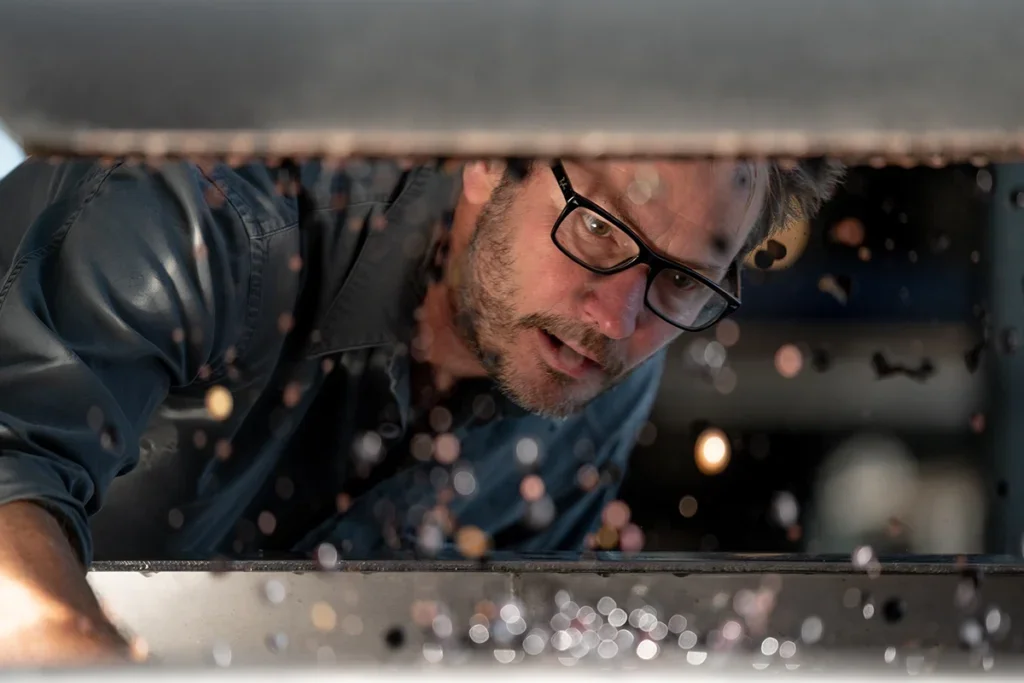
Shane Munn, a New Zealander, worked in his home country—in Central Otago, Hawke’s Bay, Gisborne, and Nelson—and in Piedmont, before coming to Martin’s Lane in 2014. Now winemaker and general manager, Munn sports the look of a distracted, eccentric academic, with thick-rimmed glasses and permanently tousled hair. But he’s anything but distracted. He’s focused and intense when he talks about wine, and he evinces a relentless, uncompromising drive to make the best wine from his grapes. At the same time, he’s animated and clearly happy when talking about whole bunches, tannins, and vineyard orientations, while presenting and tasting his wines.
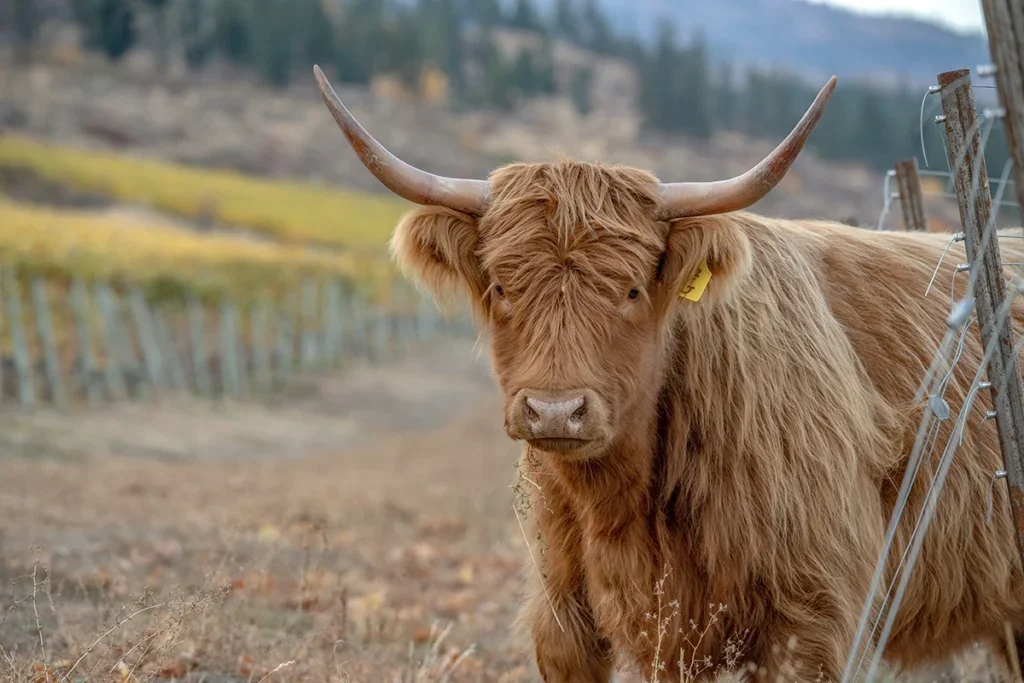
The viticulturist for Martin’s Lane is Kurt Simcic, also a New Zealander, who earlier worked at two acclaimed wineries there: Bell Hill in North Canterbury and Clayvin in Marlborough. Building healthy soil is his goal, and he draws on elements of organic, biodynamic, and regenerative farming to create a synthesis that suits Martin’s Lane’s combination of sites and climate. Practices that ensure that vines integrate into their environment include growing cover crops to attract pollinators and maintaining beehives to provide key pollinators and nesting boxes for kestrels—small falcons that feed on insects and small birds. Simcic also looks after a small herd of Scottish Highland cattle—whom he knows by name and temperament. They are released among the vines, where their hooves break up the soil, and their manure not only provides fertilizer but attracts insects beneficial to the vineyard.
The vineyards that Martin’s Lane draws from are farmed organically, and the vines are dry-farmed as far as possible—they’ve managed to get through most years with only two or three waterings. The irrigation philosophy is to give vines occasional heavy waterings rather than more frequent, lighter doses, to ensure that the water penetrates deep into the soil. They irrigate at night to minimize evaporation and maximize the volume of water available to the vine roots.
Managing the vineyards and bringing his vines to harvest, Simcic keeps his ear to the ground (unlike van Gogh) and draws on his experience: “We do more tasting than fruit analysis.” He talks of his vines as if they are his children; of Riesling vines planted in 1997, he says they are “of an age where they can look after themselves,” and he describes the Simes Vineyard as “a vineyard that just behaves well.”
Simcic looks after several vineyards that provide grapes for von Mandl’s wineries, including the four from which most of the grapes for Martin’s Lane wines are sourced. The Okanagan Valley runs north to south, and it encompasses several different growing conditions, recognized since 2015 by a growing number of official sub-appellations based on distinctive topological and climatic characteristics. These variations are particularly relevant for Martin’s Lane’s Okanagan Valley wines, because all of them are single-vineyard or site-specific cuvées.
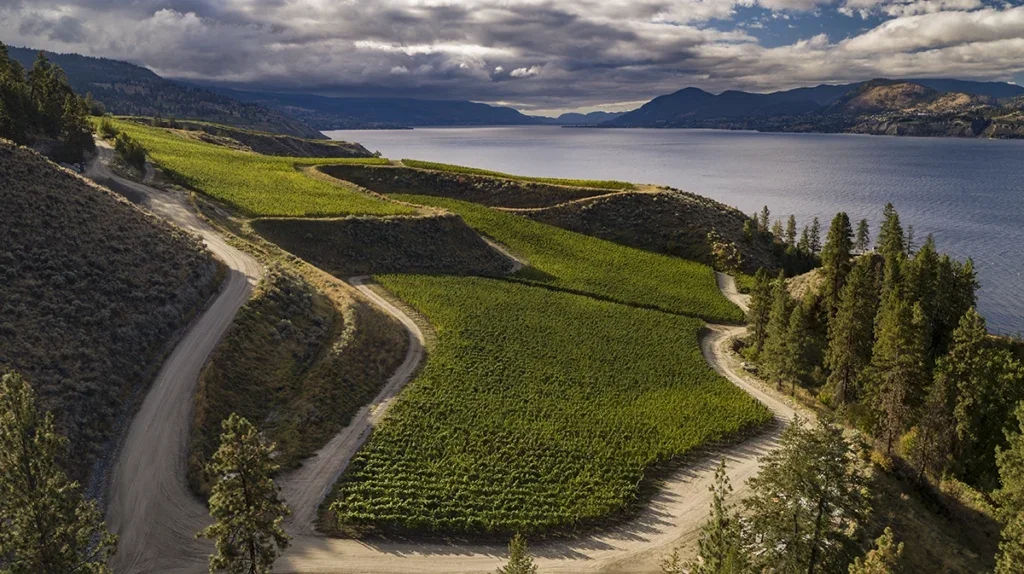
The coolest of the four main vineyards is the Simes Vineyard, located in the East Kelowna Slopes sub-appellation, and named for John Simes, Mission Hill’s founding and longtime winemaker and yet another New Zealander. Located near the lake, its vines are mostly Pinot Noir planted in 2008, with parcels of Riesling vines of the same age planted close to the water, where they benefit from onshore breezes. Overall, says Kurt Simcic, this is a low-vigor vineyard that promotes balanced growth in the vines. Nearby is the DeHart Vineyard, also a cool site, where the Pinot Noir, also planted in 2008, ripens early.
The two most important vineyards, in terms of wine production, lie farther away from the winery. The Naramata Ranch Vineyard is at the southeast end of the Okanagan Lake, in the warmer Naramata Bench sub-appellation, and it provides Martin’s Lane with Riesling and Pinot Noir from vines planted in 1976 and 2008, respectively. In balanced years such as 2025, the Pinot Noir vines here produce small dark berries with plenty of concentration, but in vintages such as 2022—“a true cooler season,” says Simcic—the wines maintain their balance and finesse, but they’re lighter and less intense.
A single block in the Naramata Ranch Vineyard provides the grapes for Zenith, one of the winery’s iconic cuvées that was made in 2019, 2020, 2022, and 2025. The vines are planted on a south-facing slope 650ft (200m) above the lake and reach budbreak two weeks later than the vineyard as a whole.
The other main vineyard is Fritzi’s Vineyard on the Mission Hill estate, planted with Pinot Noir and Riesling in 1997. This is the only site Martin’s Lane draws from that’s on the warmer western side of the lake and the only one not (yet) in an official sub-appellation. Being on the west bank, the vines get the morning sun and grow vigorously, and they are often the first to be picked. The Pinot Noir grapes from here make for dense, powerful, tannin-saturated wines (“our most rustic,” says Munn) that take time to open up and that age well. The 2014 vintage (Munn’s first at Martin’s Lane) is showing beautifully after more than a decade: layered, rich, all dark fruit, and balanced from attack to finish, with some age character just beginning to peek through.
Although the clones of some of the oldest Riesling vines are not known, there are nine clones among the more recent Pinot Noir plantings and two among the Riesling. Clonal variety, vine age, site characteristics, and growing conditions provide the basic pieces that Simcic works with in the vineyards to produce the first-class fruit that Munn fashions into his stellar wines.
Elegant and perfumed single-vineyard wines
Munn oversees the winemaking in a style that many would call “minimal intervention.” From the first vintage, fermentations have been spontaneous, and commercial yeasts have never been used in the winery. The wines are always unfined and unfiltered after maturing during the winter. As for specific practices, he always uses whole clusters, between 50% and 100% depending on the cuvée, “purely to add detail and complexity to the structure, never to dominate it.” Focused on tannins, Munn ferments his wines in concrete to complete their tannin profile. Making Pinot Noir this way gives him the style he aims for: “Elegance with perfume—bold red fruit robed around a complex yet fine tannic structure.”
In 2025, Martin’s Lane produced seven vineyard-specific cuvées, four Rieslings and three Pinot Noirs, with Pinot Noir accounting for three quarters of the volume. The market for high-end Pinot Noir remains robust in Canada, even though it appears to have softened elsewhere. Nodding to his seven cuvées, Munn quips that “things are getting out of control,” then adds that he could have made nine or ten cuvées of Pinot Noir alone from the “exciting” and “dynamic” 2025 vintage. Some of the wines, such as the Simes Vineyard and Naramata Ranch Pinot Noirs, are especially important because they end up in several different sales channels. Both are key to the roughly 10% of production that is exported, mainly to the UK, the US, and Europe.
There’s also an outlier in the Martin’s Lane lineup—a wine that’s not only a blend of two vineyards but also a blend of the two grape varieties. Julius, first made in 2021, is 75% Pinot Noir from the Simes Vineyard and 25% Riesling from Fritzi’s Vineyard—the same varietal ratio as Martin’s Lane’s overall production. The grapes are harvested on the same day, co-fermented, spend three months in barrels, and are bottled soon after, so to emphasize the fruit. Julius is, Munn says, “our most overthought wine.”
An enforced but exciting twist in the plot
Yet no amount of thinking and planning can deal with some of the challenges wineries in the Okanagan Valley have faced in the short time since Covid disrupted the industry everywhere. In the summer of 2021, forest fires tore through the southern parts of the valley, and the resulting smoke taint led some producers to abandon bottling all together and others to release only a small part of their usual production. Even then, some must seemed clean and the smoke taint appeared only after it was fermented and bottled. In December of the following year, a cold snap drove temperatures down to –22°F (–30°C) in some places. Even where the temperatures were only in the low –10s°F (–20s°C), the 2023 yield was down by about half. But another period of very cold temperatures in January 2024 was worse—not because it was colder but also because the cold temperatures lasted longer. Many vines were killed outright, and the 2024 harvest in the Okanagan Valley was down overall by more than 95%. Some wineries had no local grapes at all to work with.
The Okanagan Valley produces about 80% of British Columbia’s wine; and to avert a financial disaster, the province’s wine authorities allowed producers to import grapes or must from outside the province. Some turned to Ontario, others to Europe and even New Zealand, and many looked to Washington and Oregon, the two American wine-producing states immediately to the south of British Columbia. At Martin’s Lane, Munn immediately thought of Oregon, where the Willamette Valley is well known for Pinot Noir but less so for Riesling. “Knowing the best producers of the Willamette Valley well, first I wrote my wish list of vineyards.” Some prestigious vineyards sell their fruit to highly regarded producers who label the wines by the names of the vineyards. “Our aim,” says Munn, “was to somewhat muscle in and do exactly the same.”
Munn and Simcic contacted growers, visited vineyards, ensured that the growing standards aligned with their own, and then contracted to buy a small volume of grapes for the 2024 season. One site they selected was the Hyland Vineyard in the McMinnville AVA, whose more than 50-year-old, organically farmed Riesling vines Simcic describes as “amazing vines, managed thoughtfully.” The two traveled to Willamette Valley every three weeks during the growing season, oversaw the harvest, and had the grapes shipped in refrigerated trucks to the crush pad at Martin’s Lane. Munn talks of the amazing aroma the botrytized Riesling grapes gave off when the doors of the truck were opened, and he notes that they hardly lost a bunch during shipping.
For Munn, the Oregon venture “was an incredibly exciting addition to my winemaking travels—a plot twist in the short history of Martin’s Lane, you could say.” He says he wants to continue to draw on Oregon for Pinot Noir and Riesling, and there’s one cuvée of each in the 2026 lineup. They offer, he says, “a stark contrast to the wines made from our own Okanagan vineyards.” Yet although importing grapes from outside the province made sense financially in 2024, and the wines are an attractive addition to the portfolio, there were marketing questions. Most of Martin’s Lane’s wines are sold to the winery’s “members,” private individuals who subscribe to receive an annual quota of wines and other benefits. Would they be receptive to wines made from grapes sourced elsewhere? The members were surveyed, and they were overwhelmingly positive about the idea.
A second issue arose because, for many years, some big Canadian wine producers have sold blends of Canadian and imported bulk wine that have been labeled less than transparently. Seeing a bottle with the front label of a Canadian winery, many consumers overlook the statement “A blend of Canadian and international wines” in small print on the back label and assume they are buying Canadian wine. It’s a practice that has gone unaddressed properly for decades, and Martin’s Lane was determined to be transparent with its Oregon-sourced wines. The front labels of Martin’s Lane’s sport “The Oregon Project” in bold print and show the name and location of the Oregon vineyard. The back labels tell the story—the cold snap in January 2024, the selection of vineyards in Oregon, trucking the grapes in, and making the wine in the same way as if grapes were from the Okanagan Valley.
Martin’s Lane and other Okanagan Valley wineries continue to face challenges. In the summer of 2026, there were serious forest fires in the north of the valley and in vineyard areas on the west side of the lake, while more extreme weather resulting from climate change has increased the likelihood of more disastrous cold periods in the future. Events like these are unpredictable, but Martin’s Lane has the predictable firmly in hand. Its wines reliably deliver superb quality, elegance, and finesse vintage after vintage, and they sell to a stable and loyal base of appreciative wine lovers.
Much of this is down to Shane Munn who, despite the massive van Gogh head that greets visitors, is the face of Martin’s Lane. With Kurt Simcic’s grapes in hand, he has put his stamp on the exquisite wines that bear the winery’s label, and he acknowledges his contribution with characteristic modesty: “I’m pretty proud of what we put in the bottle.”
Tasting Martin’s Lane
2024 Hyland Vineyard Riesling McMinnville AVA Oregon USA
This is a gorgeous Riesling that fits into Martin’s Lane’s Okanagan Valley range as a stylistically related rather than a seamless addition. The nose and palate evince the 40% of the grapes that were botrytized, and it delivers beautifully detailed and pungent fruit (with peaches, apricots, sweet citrus to the fore), complemented by bright, fresh acid. This is a wine to linger over. | 94
2025 Tombolo Vineyard Riesling Lake Country Okanagan Valley Canada
Located in the cool, northernmost sub-appellation in the Okanagan Valley, this low-yielding vineyard delivers elegant, balanced Rieslings. This is an off-dry example with 35g of residual sugar, much of which is offset by the 9g of acidity. The result is a delicious flavor profile that highlights tropical and citrus fruit, supported by laser-keen acidity that’s astonishingly drinkable. | 94
2025 Naramata Ranch Vineyard Riesling Naramata Bench Okanagan Valley Canada
This gorgeous wine, sourced from vines enjoying their 50th anniversary this vintage, is essentially dry but far from bone-dry. After a subdued but aromatic nose of floral and tropical fruit, there’s a burst of ripe soft stone fruit to launch the palate, and the fruit stays focused and solid right through. The core of fresh, clean acidity, which is perfectly calibrated to the fruit, contributes a little astringency to the finish. | 95
2025 Simes Vineyard Riesling East Kelowna Slopes Okanagan Valley Canada
Sourced from 22-year-old vines and having 17g of residual sugar and 8g of acid, this elegant Riesling is not dry, but it won’t frighten anyone afraid of sweetness, because the acid efficiently takes care of most of the sugar. The aromas alone—all floral, tropical, and citrus—are enticing enough, but the flavor profile, which is led by ripe stone fruit and sweet citrus, is a clincher. It’s perfected poised and balanced throughout. | 95
2025 Fritzi’s Vineyard Riesling Okanagan Valley Canada
The vines lying behind this Riesling are just coming up to their 30th anniversary, when they can be thought of as “old vines.” Ironically, perhaps, this is a vibrant Riesling whose lively acidity and bright flavors of flowers, soft stone fruit, and citrus all speak to youthfulness rather than maturity. But then it has a very serious, quite steely structure and a mature bearing. Dry and refined, it’s apparently as timeless as it is delicious. | 95
2025 Julius Pinot Noir/Riesling Okanagan Valley Canada
Resist trying to balance two varietal characters in your mind or on your palate as you taste this 75% Pinot Noir and 25% Riesling blend. Instead, embrace the seamless synthesis where the acidity of the Riesling takes charge: a bracingly crisp, linear texture, with fruit driven by sweet and tart red berries and fruit. The fruit and acid are in perfect harmony, making this the ideal wine to raise in a toast with your friends. | 93
2025 Sperling Vineyard Riesling East Kelowna Slopes Okanagan Valley Canada
Sourced from vines planted in 1978 and farmed organically and biodynamically, this is a stunning, slightly off-dry Riesling, its 20g of residual sugar more than balanced by the acid. It delivers concentrated, layered flavors of yellow stone fruit and perfectly calibrated, vibrant, and gripping acidity that underpins the juicy texture. The fruit and acid replay seamlessly through the palate—from the attack, to the lingering clean, fresh finish. | 96
2022 Simes Vineyard Transcendence Pinot Noir East Kelowna Slopes Okanagan Valley Canada
Sourced from a single parcel in an outstanding, slow-ripening vintage, Transcendence underwent 100% whole-cluster fermentation in concrete. It achieves an astonishing balance of structure, intensity, and power on the one hand, and sheer elegance and finesse on the other. The nose is a perfumed entrée and it’s followed by a palate that delivers layers of deep, dark fruit and spiciness. The tannins are fine, sleek, and resolving. This is a beautiful, generous wine. | 98
2025 Naramata Ranch Zenith Pinot Noir Naramata Bench Okanagan Valley Canada
Zenith is sourced from a single block of vines in the Naramata Ranch Vineyard, which was planted in 2008. To the eye, it’s dark-hued, and to the nose it’s deeply pungent. Appropriately, the flavors are layered dark fruit—cherries, plums, berries—through and through, but it’s the texture that captures your attention: generous, serious, the ripe tannins making their youthful presence known, but full of vibrant energy. Fruit, acid, tannins—they’re here in fine balance, and they set Zenith up for aging beautifully. | 98
2025 Naramata Ranch Vineyard Pinot Noir Naramata Bench Okanagan Valley Canada
From a warm, evenly paced growing season, this impressive and generous wine shows precision, depth, and breadth in the flavor profile and wonderful balance among the components. Look for sculpted and pungent dark fruit, accented with spiciness in the leading role, all supported by finely calibrated acid and fine, lingering tannins. This is the sort of wine that demands you pause and think about it. | 97
2025 Simes Vineyard Pinot Noir South Kelowna Slopes Okanagan Valley Canada
The grapes are from vines planted in 2008, and they produce a beautifully structured wine that’s generous in texture and fruit. The fruit profile is led by sweet, dark cherries, plums, and berries, accented by herbs and spices, and it swells across the broad, textured mid-palate before gathering fine tannins and slowly dissipating. The acid is bright and fresh and perfectly tailored to the fruit, and it lifts the palate to another level. This is a beautifully harmonious wine. | 95


