

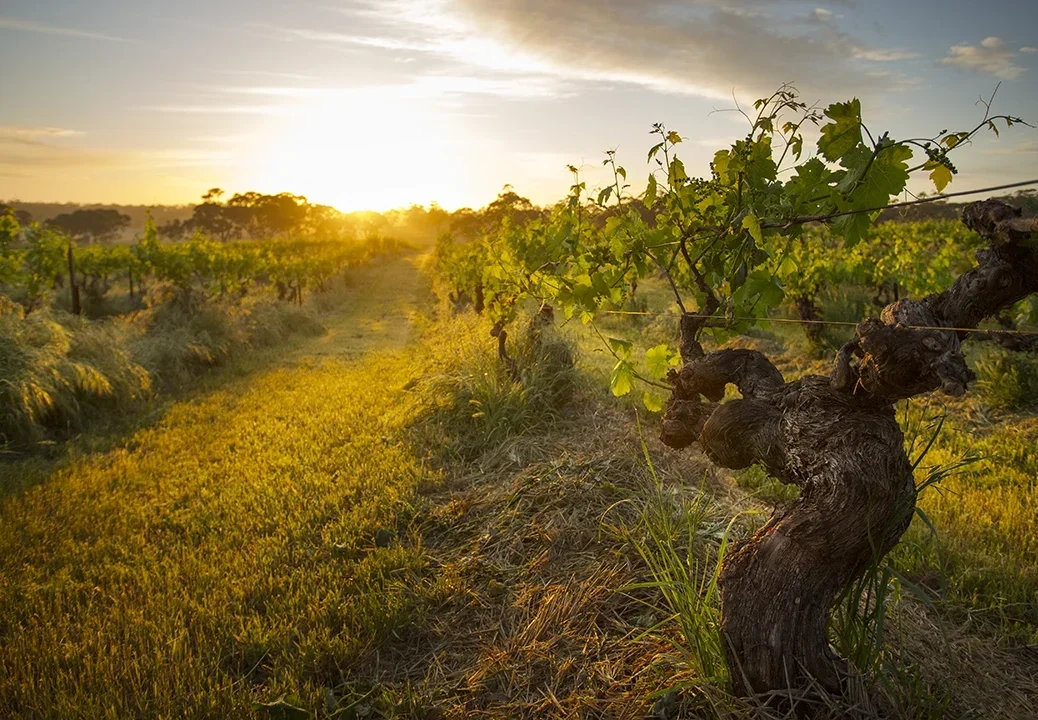
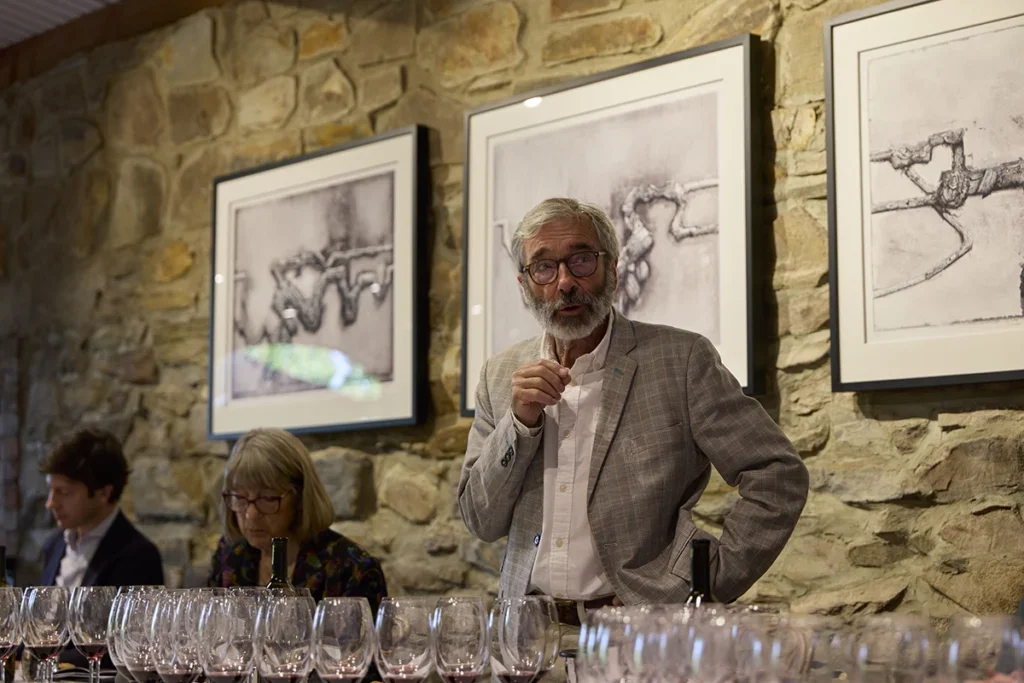
An extensive vertical tasting of Henschke Mount Edelstone, held to mark its 70th vintage, showed once more that the Eden Valley single-vineyard Shiraz deserves to share the spotlight with its more famous sibling, says Ken Gargett.
It seems a little unfair, the divinities bestowing not one but two of Australia’s most famous single vineyards upon the one family (plus plenty more, though we’ll leave all that for another day). As if the extraordinary Hill of Grace vineyard were not enough, the Henschke family, based in South Australia’s Eden Valley, also offers wines from the majestic Mount Edelstone Vineyard. Indeed, the family was releasing wines from Mount Edelstone well before Hill of Grace. Both wines are 100% Shiraz.
These days, Hill of Grace steals the limelight, but there was a time, not so long ago, when the perception was that the wines were both great, just different. A much-elevated price (A$1,100 v A$300), scarcity, and some truly stunning wines under the Hill of Grace label have contributed to Mount Edelstone’s relegation from wine’s English Premier League to the Championship in the minds of some wine lovers. It deserves promotion. As an example, in The Wines, Vineyards, and Vignerons of Australia (1968), André Simon speaks of the distinctive character and the quality, in comparison to the reds of the Barossa, of Mount Edelstone but makes no mention of Hill of Grace at all. Max Lake, in his Classic Wines of Australia (1966), has the pair linked and gives the nod to neither. That said, the consensus is that Hill of Grace sits alongside Penfolds Grange as Australia’s greatest red. Mount Edelstone is surely very close. Andrew Caillard MW perhaps puts it best when he describes the two wines and refers to Hill of Grace as “first among equals” and the wines as “kindred souls.” During the celebrations for Mount Edelstone’s 70th anniversary, Stephen Henschke mentioned that this was Cyril’s favorite wine, his “hero wine” (and the 1959 was his favorite vintage).
While the old vines in the Hill of Grace vineyard date back to the 1860s, the wine made its debut almost a century later, with the 1958 vintage. The Mount Edelstone vineyard is a little younger, planted in 1912 by Ronald Angas, but the first release was the 1952. Indeed, Andrew Caillard MW, in his seminal The Australian Ark, suggests that it was the success of Mount Edelstone that convinced Cyril to proceed with the creation of Hill of Grace.
Related

Deep roots
The Angas family is considered by many to be the founding family of the state of South Australia, though the first moves were by two gentlemen, Robert Gouger and Edward Gibbon Wakefield, back in the 1820s. They were keen to establish a colony on the basis on free settlement with no convicts transported there; it does seem that both Gouger and Wakefield may have not grasped the concept of hypocrisy, given that they were both was in prison at the time of the original negotiations (Gouger for unpaid debts and Wakefield for abduction), but no matter. Prison was where Gouger first heard of southern Australia. Even today, South Australians are quick to remind the rest of us that they alone avoided the potential stigma of convict ancestors. Gouger would become the first colonial secretary of South Australia and Wakefield a parliamentarian in both Canada and New Zealand.
George Fife Angas had joined the South Australian Colonisation Commission in 1835 and when, a few years later, bankruptcy loomed, stepped in and rescued the project. In control of a banking monopoly, he was able to orchestrate “frenzied land speculation,” but he also had limits and was opposed to the inclusion of “Irish Catholics and poor women.” He fully supported German Lutherans, the effects of which have reverberated through the wine industry ever since. In 1840, he accepted seven land selections as part payment of a debt, on most favorable terms. The family was the largest landholder in the state. No prizes for guessing where the local town of Angaston got its name.
Ronald Fife Angas, grandson of George, planted the Mount Edelstone vineyard on part of their land in 1912, shortly before he joined the Royal Field Artillery as a lieutenant to serve in France during World War I. The name Edelstone is the translation/anglicization from the German word Edelstein, referring to gemstones. The region was once known for its small yellow opals. Ronald had become enamored of quality red wine during his time at Oxford. Family connections had allowed him to source Shiraz vines from cuttings, from vines believed to have been brought to Australia originally as part of the legendary James Busby selection. These, in turn, had been sourced from the very best vineyards in France, including “the Hill of Hermitage.” Those “connections” stretched back to Joseph Gilbert, who had planted the first vineyard at Eden Valley, at Pewsey Vale in 1847. These vines were, of course, pre-phylloxera and, even today, are still on their own roots.
Content from our partners
The friendship between the Angas and Henschke families dates back many decades, and after World War II, the Henschkes were buying fruit from Angas—the vineyard was planted to Shiraz—for inclusion in their wines.
Earlier, Paul Alfred Henschke (known as Alf) took over the family farm in 1914. In 1907, he had married Johanne Ida Selma Stanitzki. This turned out to be fortuitous in many ways, not least in that she was the granddaughter of Nicolaus Stanitzki, the man who first planted vines at Hill of Grace Vineyard around 1860. It was fifth-generation Colin Angas who first offered the grapes to Cyril. Alf had 12 children. Unlikely as it might seem, it was the youngest of the dozen, Cyril, who took over from Alf in 1950. (His brother Louis worked as a viticulturist.) Stephen, Alf’s grandson, is the current custodian, along with wife Prue, a highly renowned viticulturist.
As was common throughout the Australian wine industry at the time, the focus in 1950 was on fortified wine. Cyril was very much an early pioneer in moving to table wines and released what appears to be Australia’s first single-vineyard red, certainly one of the longest, if not the longest, consecutively produced single-vineyard wine in the country. (Conditions prevented the family from offering the 2011.) Courageous stuff for a 28-year-old winemaker. The initial release of Mount Edelstone was the 1952 vintage. He followed this in 1958 with the first Hill of Grace.
It was only in 1974 that the Henschkes finally had the opportunity to purchase not just the fruit but the vineyard itself from Colin Angas. In 1986, Prue began extensive work on the vineyard, looking to regeneration, vine performance, and the introduction of organic and biodynamic practices. In the winery, Stephen—who looks not completely unlike Hayao Miyazaki and is just as talented in his field—has never stopped working on improving any and every aspect of the winemaking, not just for Mount Edelstone but across the board.
Futureproofing in the vines
Under the vineyard, which has an easterly aspect, is what is known as the “laminated siltstones of the Tapley Hill formation.” Fine sandy loam sits on deep, gravelly, medium-red clay. These are 500-million-year-old soils. As one goes further toward the center of Earth, one encounters schists of the Cambrian era. Metamorphosed, mineral-rich sediments, once part of a shallow sea, had been buried but have reemerged and weathered into a thick soil layer. The altitude of the vineyard is 1,300ft (400m) above sea level. The annual rainfall averages 24in (600mm).
The rows in the vineyard run east–west. Dry-grown, the average yield is around three tons per hectare. The vines are spaced 12ft (3.66m) apart and the separation between rows is the same distance. This would have allowed for the use of horses in the vineyard. After trials by Prue in the late 1980s, the entire 16ha (40-acre) vineyard has been moved to Scott Henry trellising. The vineyard is handpicked, with harvesting across various lots varying by up to two weeks, depending on the desired ripeness.
As Prue has done with other vineyards in the family portfolio, Mount Edelstone has been carefully delineated into numerous blocks and lots, with all fruit characteristics meticulously noted. She has also planted, in 2017, a Nursery Block with the best vine selection available from the old vines. To achieve this, Prue mapped out more than 11,500 vines to ascertain their individual qualities and make the final selection for the next stage. Prue selected just 150 vines from Mount Edelstone and a further 390 from the Hill of Grace vineyard. After a 30-year project, in 2017, Prue chose four vines from Hill of Grace and 16 from Mount Edelstone. As well as ensuring that the family has access to the very best possible vines for future generations, they are also futureproofing the vines against the perils of climate change as far as possible.
Caillard notes that when Prue was doing this work in the Mount Edelstone Vineyard, which is fully planted to Shiraz, she came across ten vines of Bastardo, which are believed to have originated at Camden through the Macarthur family, which in turn had vines brought to the colony of New South Wales by Busby. This does throw up questions as to the original origins of the vines.
As well as maintaining 109ha (270 acres) of vineyards, Prue also looks after 32ha (79 acres) of native trees and a further 150ha (370 acres) of bushland. They have planted many thousands of trees across their properties, as well as other native vegetation. The family employs organic and biodynamic practices across all vineyards.
Ever finer, gentler vinification
Winemaking in Cyril’s era was based on handpicking the grapes, which were then destemmed through an old beater-crusher, with some whole berries sneaking through the cracks, all pumped through to open fermenters. Natural yeasts developed, a submerged cap was used, headed down. If anyone might be wondering whether the use of natural yeasts rather than commercial yeasts was a conscious choice, the latter were not available until the 1980s. It was all natural.
When fermentation was under way, cross-seeding was employed from fermenter to fermenter. Cooling, in those days, was largely restricted to bore water pumped through a copper coil that had been pushed through the boards. Pumping-over by hand occurred several times a day. Fermentation would be finished in five or six days. The wine was racked at “dryness,” into underground tanks, then drained overnight to ensure they had as much free-run juice as possible. Most of the pressings were returned to the wine, though by the 1970s, these were mostly sold to other producers. The wines then went through natural malolactic fermentation in tank, before the addition of sulfur dioxide and then gelatine fining. Maturation was in old, oval barrels, around 250 to 500 gallons, for more than two years. Hogsheads were employed to ship the wine interstate, by rail, to wine merchants, who would then bottle it. Bottling at the winery was from barrel, rather than a blending tank, until the late 1970s, and it was only then that Cyril started keeping museum stocks.
Today, each parcel of fruit is handled separately throughout the winemaking. The various designated blocks in vineyards are hand-harvested discretely, based on ripeness. (The team has mulled over whether that was always the case, since some vintages would have seen pressure from birds and may therefore have needed picking before optimum ripeness.) After destemming, the grapes are sorted, both by hand and by optical sorter. A decision will be made as to the proportion of whole berries to be retained. Open fermenters, submerged caps, and the “pure culture yeast” are still used. The temperature is maintained at 64°F (18°C) at this stage, ensuring that fermentation will not start for a few days. As fermentation does begin and temperatures rise, they employ twice-daily pump-overs. The temperature is dropped to 64–75°F (18–24°C), to extend fermentation to seven to ten days on skins. They do not engage in extended maceration on skins. Free-run juice and pressings—obtained in a much gentler manner than in the past—are separated. Pressings are usually returned, but this will be a vintage-to-vintage decision and based on an organoleptic assessment. Fermentation will be completed in barrel, a mix of new two- and three-year-old French oak and possibly some American. After three weeks, the wine is racked off gross lees before it is returned to the same barrels for the next 18–24 months. There is no fining, and blending occurs just before bottling, based on a tasting assessment. Not every barrel makes the final cut. The move to smaller oak vessels, especially hogsheads, came in the late 1960s/early 1970s. These days, obviously vintage dependent, the wine sees around 80% French oak and 20% American oak. Approximately 20% of the oak will be new.
This is a wine that now sits with the finest made in this country, and one suspects that if it did not have to compete with its close sibling, Hill of Grace, it would receive more of the accolades it is surely due. If one had to sum up the essential character of Mount Edelstone, it might be: dark fruits, spices, and a veritable herb garden, with notes of sage to the fore.
Earlier this year, the family celebrated 70 vintages of Mount Edelstone, a quite extraordinary achievement for a New World single-vineyard wine. There are certainly older vineyards, some many decades older, but none in Australia has been producing wine under the same label for so long.
If one thing became apparent from this tasting—aside from the sheer quality of the wine—it is that anyone who thinks New World wines cannot exhibit terroir at least as effectively as their Old World cousins is fooling themselves. The Mount Edelstone DNA was crystal clear from start to finish.
The tasting
Naturally, not all 70 vintages were available, but the team had assembled an array of vintages that crossed decades and provided a thorough representation of the evolution of the wine over the course of its history. And they offered some wonderful drinking, though the team did confess that the final selection also depended somewhat on what was available. Vintage conditions are from Henschke’s notes, which apply to the region as a whole, not just the vineyard. Alcohol levels are noted where Henschke has records. It is worth noting that the 1956 came from Colin Gramp, the legendary winemaker from Orlando. Colin and Cyril used to swap wines, and Colin had returned this bottle to Stephen before he died in 2020, a year short of his century. Colin’s grandfather, Johann, famously made the first Riesling in the region, at Jacob’s Creek, in 1850.
The Henschkes do like to label things, and accordingly, Stephen has decreed the 1950s to be “Cyril’s Leap of Faith.” The 1960s were the “Decade of Natural Expression.” The 1970s have been dubbed the “Decade of Euro-Style Elegance,” which was influenced by a certain negativity afflicting reds in that decade and, hence, the move to elegance (and why, as mentioned above, the winery was selling its pressings to other producers rather than incorporating them). The 1980s saw the introduction of technology, filtration, and improvements in oak quality, including extended seasoning. The 1990s saw the conversion to Scott Henry trellising and the introduction of bunch-thinning. The 2000s brought about an aim for refinement, greater consistency, lower yields, and a change in closures. The decade beginning 2010 saw the biggest influence from the vineyard, especially increased health and the influence of biodynamics. The aim was more purity while they worked on better balance of the oak in the wines.
The only year from which a wine has not been released is 2011,though Stephen did question why they bothered with 1974.
Tasting Mount Edelstone
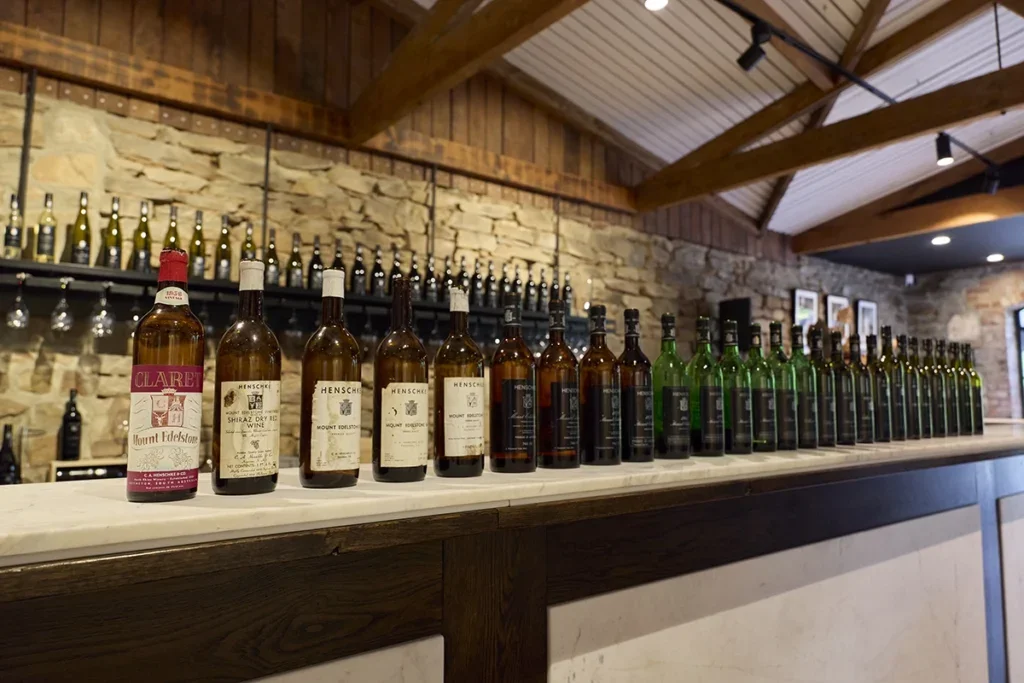
1956 (13.7% ABV)
Average rainfall was followed by a dry, hot February and March, leading to low yields and “an excellent year.” This was the wine that lifted Mount Edelstone from relative obscurity, winning first prizes at the Sydney, Melbourne, and Adelaide wine shows.
Brick red with a fading rim. This is still beautifully perfumed. Obviously very mature but there is still life here. Quite a meaty style, with notes of cigar boxes, leather, and beef stock. Aromatic, seamless, and with a soft texture, the wine is of medium length, with a pleasant, lingering fade. It really is in amazing condition for a wine of this age. So much to like. | 96
1958
A drought year with spring frosts. The yields were well below normal.
One of those wines where there was some debate over whether there was maybe a touch of TCA. Some felt it was just perhaps a little dirty. A deep russet red, certainly more earthy and herbal than anticipated, with hints of black olive and warm soil, with dried herbs. Medium length at best, it does seem a little stretched, perhaps a touch simple. There is some grip. Fascinating to see, but it is certainly not a great Mount Edelstone. The score may be a touch generous. | 86
1965
Considered a great vintage, good winter and spring rainfall followed by a dry ripening period. The records note “high temperatures in February, averaging 22.5°C [72.5°F],” which suggests that 60 years ago, the perception of high temperatures may have been rather different to ours today.
Orange/brick red. On the nose, we have hints of animal fur, florals, teak, orange rind, cold tea, bergamot, raisins, and caramel. There is still a touch of life here, but it is time to drink up. The age is really starting to show on the finish. A very mature style that, one suspects, is on the edge of starting to fall apart. Fair at best. | 88
1966
A dry, hot year with a frosty spring, all leading to low yields. The drought did not break until after April.
The color is pale brick red. An intriguing nose, rather lifted, with notes of charcuterie, florals, sandalwood, hints of beeswax, spices, warm earth, and a character not unlike a freshly baked mince pie—not unpleasant at all. Finely balanced, with a very soft and supple texture, through to satiny tannins on a lingering finish. This is certainly mature, but it is rather gorgeous drinking. I really like this wine. | 95
1967 (14.1% ABV)
A hot year with average rainfall.
Another wine where there was some debate as to whether the tree bark had failed and we had a touch of TCA. Fair to say that this was not a contender for one of the wines of the day. The color was a brown/red with an orange rim. The wine is doing its best to hold things together, but it seems likely to fall over any minute. Smoked meats, handfuls of warm earth, beef stock, animal skins, and mushrooms, but it also seems to have a hint of a bilgy character (not what one seeks in a mature wine). There is a hint of caramel emerging at the end of the palate, which is bit too short, not to mention slightly hot and harsh. | 84
1972 (14.3% ABV)
Considered “a classic year with near-perfect conditions,” when the vineyard experienced “reasonable winter rains, with moderate summer temperatures and rainfall.”
Pale red, with a fading orange rim. The alluring aromatics are a wonderful start to this rather elegant, if mature, style. Hints of smoked meats, spices, a flick of chocolate, florals, fresh earth after rain, and even that curious touch of diaper poop (not anywhere near as horrendous as it must sound). Seamless in structure, there is still freshness to this wine—quite an achievement after all this time. Good focus, a fine line of acidity, and everything so well balanced, this is delicious drinking. A cracker. | 95
1973
A moderate to cool summer, good rainfall, high January temperatures, a wet February, and then cooler in February and March. Average yields, with “ripe, rich wines.”
After the highs of the 1972, it was back to earth with this vintage. The color was a teak/red, with an orange rim. The wine was much more reticent on the nose than one might have expected, but we have hints of mushrooms, root vegetables, and a flick of gum leaf. There the wine is a touch savory in style but at the end of its drinking window. The flavors are all very much up front, and the wine fades, leaving little but a grippiness. Drink up. | 88
1978 (14.2% ABV)
Considered excellent, the vintage was dry, with low yields and high quality. This was the first vintage that Stephen and Prue, fresh from their studies at Geisenheim in Germany, joined with Cyril in making the wines.
A russet-red hue with a faded rim. On the nose, we had aromas weaving through leaf litter, orange rinds, freshly unearthed root vegetables, and smoked meats. An earthiness emerged with time in the glass, along with hints of dried herbs. The palate had a stewed-plum character. The wine was of medium length through to slightly gritty tannins, though it did linger. Fair. I thought this might be a smidge more exciting, given the reputation of the vintage and previous encounters. | 91
1979 (14% ABV)
A warm summer with good rains, followed by a hot vintage period with high yields.
A garnet/russet hue, with a faded rim. There is a most appealing, lifted nose here, with notes of charcuterie, aniseed, red berries, hints of beeswax, and a curious but not unpleasant teak character. A supple, seductive texture, the wine still offers good intensity but is well balanced throughout. A fine line of acidity provides freshness, and there is a long, lingering finish. The wine has a degree of elegance, but there is also underlying power. Impressive. Certainly ready for drinking, but on this evidence, it is not urgent. | 94
1982 (12.5% ABV)
Described as “exceptional,” a very wet winter followed by a mild spring and summer. Above average yields of “full-bodied reds.”
If one may be allowed to insert a personal digression, this was the first vintage of Mount Edelstone I ever purchased, while I was still a youthful student, buying a full case at just $7.50 a bottle. (It’s a bit tragic that I could afford these wines when a student but not so much decades later, the recommended price of the current release being A$300/bottle.) Needless to say, the bottles are long gone, but I remember when I moved to Sydney many years ago, for a stint with a new law firm (previous life), I took one of the last remaining bottles with me. Friends invited me to a dinner with some of my new colleagues at a local BYO. A perfect time to open it, I thought, hoping to impress. When the time came, the waiter poured it for the host at the far end of the table, who blanched and declared it awful, undrinkable. I was mortified, embarrassed beyond measure, thinking no further invitations would ever be forthcoming and wondering if I would still have a job Monday. Then I heard our host declaring that he would take one for the team. Everyone else could drink the good wines and he would suffer this dreadful bottle. Of course, we all immediately wanted a glass, and it was proclaimed the wine of the night. If it taught me one thing, it’s that lawyers are the same the world over.
Deep red, with an orange/garnet rim. The nose reveals aromas of truffles, coffee beans, a hint of chocolate, cold tea, a touch of red cherries, and dried herbs. There is good balance here, while a hint of old leather emerges on the palate. A wine of elegance and focus, there is some real complexity, perhaps more than what has been encountered in any of the wines to date. Seamless and seductive, there is excellent length, and the intensity is maintained for the full journey. Mature, yes, but there is certainly still time ahead. Wonderful stuff. Love it. | 96
1984 (12% ABV)
Good winter rains, a warm and wet spring, a mild summer, and a dry harvest; the team rated the vintage excellent to exceptional.
Garnet red, this is a spicy and rather earthy style, quite aromatic, with notes of bay leaves, dried herbs, root vegetables, coffee grinds, and something rather reminiscent of what was known as strawberry swirl when I was much younger. Quite fleshy but seamless in structure, and there is a fresh flick of acidity. A refined style, with good length and a juicy finish, sitting alongside very fine tannins. It does fade a touch quicker than the very best, but there really is lots to like here. | 93
1986 (12% ABV)
This vintage has long been considered as the pick of the ’80s for the region. A dry winter, late rain, mild spring, cool summer (rudely interrupted by a brief heatwave, including the hottest March day since 1943, at 108°F [42°C]), then excellent conditions through harvest. Overall, considered exceptional.
A shimmering blood red, with a garnet rim. The nose exhibits aromas of dried herbs, smoked meats, tobacco leaf, cold tea, and bergamot. There is an appealing spiciness throughout this wine. Seamless, with a creamy texture, it finishes with very good length and a gentle fade. We see ever so slightly powdery tannins at the very end of the wine, but the balance is good throughout, and we can certainly consider this one of the more elegant efforts from the first three or four decades of production. Most impressive and a wine that lives up to the legendary reputation of the vintage. | 96
1988 (13.5% ABV)
Described as an eventful year—rarely a good thing—but overall the team found the vintage to be excellent. Hail damage in spring, rains during flowering, a very hot summer with a “week of intense heat” at the end of January, then a cool and misty February before a ten-day heatwave at the end of March. And yet…
Brown-red, with a gentle orange rim. A wine of earth and spice. This is quite mature, the nose revealing hints of soy and orange rind, along with aniseed, beef stock, sage, florals, and a sweet core of blackberry fruits. Neatly balanced, there is focus and energy here and the wine lifts on the palate. Quite an exciting style, with really serious length. For drinking now, but there is no frantic hurry. | 93
1990 (13.5% ABV)
This has always been considered one of the greatest vintages in Australian wine history, and the team calls it “exceptional, a picture-perfect season.” Good winter rain, a perfect spring, mild summer, and excellent ripening conditions all led to the largest yields on record. The vintage has been compared to 1959, 1982, and 1986.
Pale garnet red. The nose reveals aromas weaving through dried herbs, bay leaves, animal skins, dark fruits, cigar boxes, spices, and a touch of menthol. The wine is certainly mature, but still very much alive. There is good complexity here and fine balance. Quite refined; there is a creamy texture with immense length. Dark fruits emerge on the palate. A lingering finish, with satiny tannins—this is quite impressive. There have long been arguments around this era of the Henschke’s production, with those particularly sensitive to Brettanomyces taking issue. For me, it seemed more a problem that occurred with certain barrels/bottles, rather than across the board. Perhaps those we refer to as the Brett Nazis in Australia might not have enjoyed this as much as I did. The caveat, for me, is that there is undoubtedly bottle variation. Good ones will definitely excite. | 95
A magnum served at dinner that evening did exactly that. So fragrant, with notes of florals, cherries, kirsch, tobacco leaves, coffee beans, aniseed, five-spice, and cranberries. Pristine, stunning, with immaculate balance, a seamless structure, the silkiest of tannins on an amazingly long finish, and an ethereal texture. Exquisite. Another 20 years won’t be a problem. | 100
1991 (14% ABV)
This vintage has always lived in the shadow of 1990, not just for this vineyard but around the land. A shame, because otherwise it would surely rank with our greatest. The team calls it great to excellent. The below-average rain, mild spring, early flowering, and warm/hot summer gave low yields of great concentration.
No hiding in the shadows here. A gleaming deep red. There is a savoriness to this wine that is most appealing. Earthy notes, with charcuterie, tobacco leaves and dried herbs, dark berries and smoked meats, along with beef stock, truffles, and coffee beans. Very good length here, with good intensity throughout and powerful, powdery tannins on the very long finish. The longer the wine spent in the glass, the better it looked. | 97
1994 (14.2% ABV)
The team describes this vintage as exceptional. (And yes, there is an argument that the Henschkes have not quite grasped the concept of the bell curve when it comes to ranking vintages below, average, and above.) A mild, dry summer meant a late start to the harvest, with March providing high temperatures. “Fruit quality was fantastic.” The Henschkes see 1994 as “one of the best years on record.”
Blood red, with a russet rim. A wine of fragrance, refinement, and elegance. The nose reveals aromas of dark fruits, freshly unearthed beetroot, beef stock, soy, and spices. The palate moves to a more savory style, with notes of soy and aniseed emerging. There is very good length here through to velvety tannins. A line of juicy acidity provides freshness. A wine of direction, finesse, and energy. So much to like here. | 94
1996 (13.5% ABV)
Another extremely highly regarded year, which the team ranks excellent to exceptional. Average winter rains, mild spring, a mild and cool summer, and an “exceptionally long and slow ripening period.”
The color was very much that of a brand-new cricket ball before bat has been laid upon it. A wine of elegance and complexity; there were notes of animal skins, campfires, spices, bay leaves, cigar boxes, and dark fruits. Seriously exciting stuff, this is seamless, with the intensity maintained throughout. Wonderful complexity is evident, and the finish is staggeringly long. Love it. Well-cellared examples have a future that will stretch well beyond the next decade. 1996 has always been seen as a great vintage in the region, and this provides compelling evidence why that should be the case. | 97
2001 (14% ABV)
Excellent to exceptional, one of the hottest summers on record, alleviated by “timely storms,” according to the reports from the team. Vintage was three weeks early.
Magenta/maroon. The nose reveals aromas of sage, old leather, cloves, aniseed, cassis, hints of dark chocolate, a touch of vanillin oak, blackberries, spices, and dried herbs. Really impressive stuff. This is bold, fresh, and in many respects still quite youthful. Good complexity is evident, as are a seamless palate, a creamy texture, and silky tannins. There is serious length to this wine. An absolute cracker. I can’t honestly say that I recall 2001 being considered as one of our great vintages, but this wine suggests that it just might have been. | 96
2002 (15% ABV)
Much cooler, this is considered one of the region’s “most exceptional vintages to date.” A small crop, three weeks delayed.
If 2001 sneaked under the radar, 2002 was always highly regarded. The wine has a very dark red hue, with a ruby rim. The nose exhibits notes of animal skins, herbs, leather, black currants, and cocoa powder. A slightly more rural aspect to it than with some, but time in the glass saw it open up and improve. A wine of moderate length with reasonable grip and juicy acidity, this still has time ahead of it. This was the first Mount Edelstone under Stelvin. (Actually, it was bottled partly under Stelvin and partly under cork.) | 95
2005 (14% ABV)
The team describes this vintage as “fast-paced, one of the best on record, with fantastic quality fruit and good yields.”
A deep red/bruised-plum hue. On the nose, we have aromas of aniseed, charcuterie, black fruits, cold tea, bay leaves, sage, cloves, and spices. This is slightly fleshier in style than some, and slightly more herbal. Normally that is not my favorite thing, but in this case it’s a really impressive wine. Very good length here with a lingering finish, exhibiting fine, satiny tannins. | 94
2006 (14% ABV)
“Another high-quality year, average yields.” Shiraz did suffer a little from poor fruit-set.
Dark red/maroon in color. A glorious nose, which continued to excite the longer it was in the glass. 2006 is normally considered one of the great years, and this wine shows that there really is no reason to revise that. Complex, rich, and finely balanced, this is a complete wine. Utterly harmonious. We have notes of chocolate, cassis, blackberries, spices, kirsch, and dark plums. Great length through to velvety tannins, with a gorgeously creamy texture. This is a brilliant wine that, if well cellared, surely has 10 to 20 years ahead of it. | 98
2010 (14.5% ABV)
The wettest year since 2005; heat spikes and cool changes during summer meant an early vintage “producing exceptional-quality fruit with great acid balance.” It has always been extremely highly regarded.
For me, this most impressive wine did not, perhaps, quite reach the high level one would have expected from this legendary vintage. Dark maroon in color. The nose offers aromas of charcuterie, animal flesh, bay leaves, spices, dark fruits, and dried herbs. A wine of maturity, concentration, and complexity; there is freshness on the palate and appealing juiciness. Of medium to good length, with a gentle fade and decent balance, and it finishes with sleek tannins. If one is looking to pick faults, one could argue that the intensity was not quite what we might have hoped. Overall, though, a most enjoyable wine. | 93
2012 (14.5% ABV)
After conditions meant no Mount Edelstone in 2011, there was considerable wet weather right through this vintage, but a mild summer saw a recovery, and again, the year was rated as exceptional.
Another vintage considered absolutely first class, and in this case the wine more than lives up to what we might hope. Deep red-crimson. On the nose, we have notes of black fruits, plums, tobacco leaves, chocolate, sage, black cherries, warm earth, and coffee grinds. The integration of the oak is immaculate. Fresh, lifted, and seamless, the palate is stunning, with the emergence of leather notes and the reinforcement of those black cherries. The wine walks the tightrope of power and elegance well, maintaining balance and offering great length. A fine line of juicy acidity applies the energy. This is a wonderful wine that surely has at least 20 years ahead of it. | 97
2016 (14.5% ABV)
Below-average winter rain, a warm and dry spring, low disease pressure, but one of the hottest Decembers on record before things cooled down in the New Year. The result was average yields of very high quality.
The region had an extraordinary series of vintages throughout this decade, especially if one largely sticks to the even years, and this was one of the all-time greats. Again, the Mount Edelstone has more than lived up to what we might hope. Magenta-purple. This is still fresh and seemingly very young. Bold it might be, yet there is finesse and refinement here. On the nose, we have notes of chocolate, plums, cassis, and vanilla from deftly handled oak. Great length and immaculate balance. There is also a touch of white pepper sitting alongside sage and bay-leaf notes. On the finish, we see the emergence of some sour-cherry notes. A wonderfully creamy texture through to cashmere-like tannins, with a line of juicy acidity providing the energy. A stunning wine with 20 to 25 years ahead of it. | 98
2018 (14.5% ABV)
A superb year throughout the region, especially for Shiraz, since conditions were largely ideal throughout. Yet another extraordinary vintage from that period—there really was something almost supernatural about the way the even years performed—and it has continued beyond that decade, with one exception, not present in our tasting (2021).
Opaque maroon. This is still very young and fresh. It provides the first indication of still-integrating oak. We have notes of chocolate, mocha, spices, herbs, tobacco leaves, cassis, vanilla, sage, and licorice. But it really is so youthful. Beautifully balanced, this is seductive in the extreme, with a seamless structure and a creamy texture. Wonderful length through to silky tannins. Perhaps more than any other wine in the tasting, this has an incredibly long future ahead of it—30 years would seem to be a doddle. Love it! | 96
2022 (14.5% ABV)
For the 70th anniversary, a vintage the team describes as… wait for it… exceptional. Rain in late January came at the ideal time. A later-than-average vintage, but it produced wines of “great elegance, flavor intensity, and wonderful aging potential.” With this vintage, the Henschkes celebrate an astonishing 70 years of releases from this legendary Eden Valley vineyard. Maturation for this vintage is for 20 months in French oak hogsheads, 8% new.
Blood red/maroon. The nose is a veritable herb garden. There are aromas weaving through tobacco leaves, sage, chocolate, cinnamon, and nutmeg, with a touch of vanilla from the immaculately handled oak, bay leaves, black olives, and black fruits. The balance is knife-edge and the tannins as silky as one could wish. A wine of great length that will surely sit among the very best from this extraordinary vineyard, when we look back in the years to come. Recent experience has confirmed that there is no reason to think this will not last for 30 years at least, though there is also no reason to wait that long. | 97


