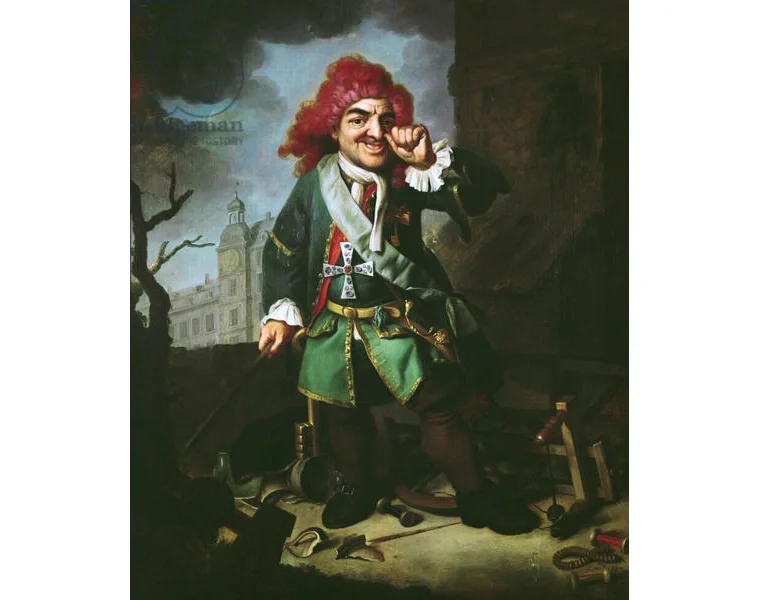
Stuart Walton on the legendary 18th-century figure of Perkeo, who, as guardian of the “gigantic” Heidelburg Tun, “combined the duties of cellarmaster, with the extraordinary liberties of court jester.”
One fine day in around 1718, the Habsburg governor and Elector Palatine, Charles III Philipp von der Pfalz, was visiting one of his domains at Salurn (now Salorno), a little to the southwest of Bolzano in the South Tyrol. There, he set eyes on a curious figure, a dwarf button-maker still in his teens, who stood at barely more than three foot six. He was fascinated by the little man and seems to have enjoyed a lively conversation with him, with the result that he extended an invitation to him to become a member of the court retinue in Heidelberg.
The button-maker had been born Clemens Pankert, although in the culturally liminal zone of the Südtirol, he also went by the Italian name of Giovanni Clementi. Charles thought that his ready wit, issuing in voluminous waves from a tiny physical frame, would be a hit at court dinners, and he was to be proved right. As well as delivering sparkling anecdotes about his life, Pankert was appointed cup-bearer to the Elector and his guests, and made guardian of the famous Heidelberg Tun, the gigantic wine cask that sat in the cellars of the Castle.
By the time of Pankert’s appointment, the Tun was on its second iteration, its predecessor having been vandalised by marauding French troops in the 1690s. What there was to guard was the barrel, itself and its reputation as one of the sights to see in Heidelberg, since it never actually contained any wine. Nevertheless, its outsize dimensions had an ironic echo in Pankert’s story.
Related



He was a legendary drinker, possessed of an astonishing capacity for wine. It was said, apocryphally or otherwise, that he could put away something in the region of thirty litres on a good day, a feat all the more amazing for his diminutive stature. As he glided around the table topping up the wine, court guests delighted in inviting him to drink another cup too. His invariable response— “Perché no?” (Why not?) —became his catchphrase, and in due course fixed him with a stage-name, Perkeo.
His massive capacity for wine was not just the indulgence of a little bibber. He was evidently knowledgeable enough about its origins and the relative quality of the vintages to be put in charge not just of the great barrel, but also of the extensive wine stocks at Heidelberg. He combined the duties of cellarmaster, overseeing filling of the casks and maintaining them to prevent spoilage, with the extraordinary liberties of court jester, and was by all accounts an accomplished and hilarious raconteur at great banquets. His travels and mishaps made for entertaining stories, always punctuated by the screams of laughter that greeted his every utterance of that irresistible catchline, “Perché no?”
Perkeo’s antics and his towering presence at court saw him inevitably pass into legend. Victor Hugo memorialized him in an account he wrote of his visit to Heidelberg in 1840. A drinking song was composed in his honor, and his memory is celebrated every year in wine festivals in both Heidelberg and Salorno. A statue of him in blue frock coat, raising a cup to his lips, stands before the present (fourth) version of the Great Tun, and another on a second-floor plinth at the corner of the hotel that bears his name at Hauptstrasse 75. Here too, he grips the cup on which his fame depended, and again on the hotel’s signboard.
Content from our partners



In the portrait of him in a green coat and red fright wig by Johann Georg Dathan, done around 1720, he is not drinking, but is thumbing his nose in the classic satirical gesture of defiance—“more fool you!” Like any good jester, he ensured the joke was always on his audiences. Despite the swashbuckling costume, he is depicted not with sword, but with the key to the Heidelberg cellar.
Hearsay claimed that Perkeo lived into his eighties, only submitting to an inglorious demise when the court doctor told him he had to cut down his drinking, prescribing a long glass of water instead of the day’s gallons of wine. He drank the water and expired the next day. The story is sweet nonsense. He actually died, as court records show, in 1735, in his early thirties, doubtless of the undiagnosed chronic alcoholism that popular legend has never heard of.
His story reminds us nonetheless of the power of wine to dissolve social boundaries. In a work on intoxication composed in his mid-seventies, the German memoirist and philosopher Ernst Jünger wrote this: “In the realm of wine, an equality prevails throughout, despite and beneath all the differences: from the winegrowers of Tübingen to its university rectors, from the dwarf Perkeo in the cellar of the Heidelberg castle to the brightly lit ceremonial hall of the Pfalz counts.”1 Every proffered cup says as much. Why not?