


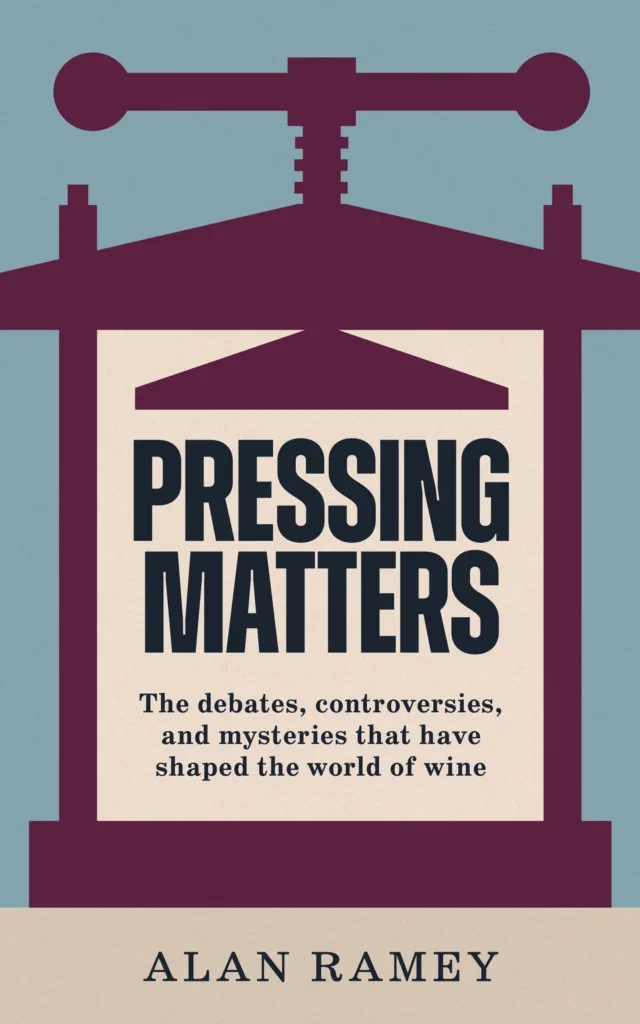
Neal D Hulkower reviews Pressing Matters: The Debates, Controversies, and Mysteries that Have Shaped the World of Wine by Alan Ramey.
Don’t read Pressing Matters: The Debates, Controversies, and Mysteries that Have Shaped the World of Wine expecting to find definitive answers to such questions as “Is terroir detectable?” or “Which produces better wines—organic, biodynamic, or conventional farming?” Instead, read Alan Ramey’s text to learn about the range of opinions expressed about some of the most contentious issues in the wine world, then probe deeper, raise your own questions, and make up your own mind. This is its defining feature, not a fatal flaw. Although they all rely on hard science to challenge false notions, Pressing Matters contrasts with Jamie Goode’s books, Sunny Hodge’s award-winning The Cynics Guide to Wine, and Gus Zhu’s Behind the Glass in its dialectical approach and inclusion of social as well as physical scientific perspectives.
Ramey is co-president and co-owner of Ramey Wine Cellars, founded by his parents. “As I grew up in wine, I was able to ask questions of world experts, blazing minds, and experimental practitioners […]. As a result of this upbringing, I also became deeply interested in debate.” He honed his skills as a debater in high school and “brought an approach of intellectual discourse back to the winery after graduating.”
His approach is especially appealing to this former high-school debater who also relishes the give and take of verbal wrestling. It also reminds me of the two parts of the Talmud, a collection of books on Jewish law, with much about wine. The Mishna is the written record of oral law, whereas the Gemara is the collection of analyses and commentaries on the Mishna, including debates and discussions. Think of Pressing Matters as the Gemara of secular wine-related discourse without the pronouncements of the Mishna.
Related

Each of the eight chapters focuses on a single unsettled issue. These are terroir, definition, and regulation of wine regions, organics, biodynamics, climate, assessment of quality, determination of value, and the definition of naturalness. Believing that the heart of any valid claim is evidence, Ramey consulted the literature and had conversations with numerous experts who are quoted throughout. He presents the results in an “on the one hand, on the other” format that requires the reader to remain alert and engaged lest nuances are missed. While he makes no claim to completeness, the 23 pages of notes containing references including interviews with the experts show that he did his homework.
From economics, to terroir
One doesn’t get very far in learning about wine before bumping into the term terroir. Similarly, one doesn’t have to read more than a very few tasting notes without encountering “mineral” or “minerality” as a descriptor. Since various definitions of terroir mention earth or soil, the search for it in the glass is really equivalent to attempting to taste and smell the ground in which the vines grow. Unsurprisingly, Ramey cites geologist Alex Maltman, author of Vineyards, Rocks, & Soils and Taste the Limestone, Smell the Slate. Maltman is the foremost debunker of the notion that the minerality someone claims to detect comes from the soil, since minerals don’t dissolve in water, thus are unable to pass through the roots of a vine. Also, they have no taste.
On the other hand, I was surprised that Ramey does not reference “Terroir and vintage discrimination of Malbec wines based on phenolic composition across multiple sites in Mendoza, Argentina,” a 2021 paper in Scientific Reports by Roy Urvietal et al, which contends the “results are strongly related to terroir features of wines.”
Content from our partners
Throughout the book, members of the American Association of Wine Economists—an organization of which I am a member—weigh in on whether organic or biodynamic wines garner higher prices, the effect of climate change on markets, the differences between professional and untrained tasters, the correlation between price and quality, and even what constitutes a reasonable measure of the latter. Harry Truman would be happy to learn that they are “one-handed,” grounding their findings on experimentation, research, and analysis.
“Willingness to pay” is a key concept in wine economics, a subfield that frequently though reluctantly relies on it as a viable if flawed measure of quality. Each of the topics in the book relates to creating differentiators on wine labels to justify higher prices that enough consumers are willing to pay. Terroir is manifestly used as a marketing tool. Whether it should be is debated in the book, but there is certainly evidence that it works.
Omer Gokcekus—professor of international economics and development at Seton Hall University and also a member of the AAWE—has demonstrated that the premiums accrued for six American Viticultural Areas within the Willamette Valley AVA over the larger AVA were evident immediately after their designation and compounded over time, showing that subdivision into smaller AVAs, which can be viewed as terroir proxies, pays off.
This benefit of having a more specific designation on a label highlights a major bone of contention in defining wine regions: “Where to draw a line is necessarily an act of picking winners and losers,” stresses Ramey. He goes on to cite examples in California and Burgundy.
The comparisons among the three types of farming mentioned above were enlightening, reinforcing doubts that I already had about the superiority of organic farming over traditional, and biodynamic over organic. For example, I had no idea that the sources of organic fertilizers in California were feedlots, or that it takes longer for them to work.
An octopus of opinions
To this applied mathematician with an interest in decision analysis, one glaring blind spot in Ramey’s exposition, albeit an arcane one, is the methodology used to arrive at a consensus ranking of wines (or anything else). He accepts without question the universally publicized results of the 1976 Judgment of Paris tasting that have California wines topping French in both the red and white categories. In a paper that I published in 2009 in the Journal of Wine Research, I use the Borda count, a method that has been proven uniquely to satisfy four rational properties and eliminates the distortion inherent in averaging points, the way the announced tasting rankings were obtained. With Borda, the California Chardonnay still topped the list, but the 1970 Château Haut-Brion took first place among the reds. Ramey even acknowledges the flaw but didn’t realize that it affected the results: “Differences in human taste perceptions are so common that taking the average of a group is a misleading measure because it ignores the element of unique genetic predetermination in our tastes.”
Bragging rights that accrue from such competitions can have a large economic impact. To this day, tastings including the International Wine and Food Society Judgment + 50, still average points to arrive at the consensus ranking, giving high-scoring judges disproportionate influence. Once again in this case, Borda yielded a different “winner.” Wineries that choose to compete should demand that the most defensible method be used.
As noted above, the extent to which Ramey researched and substantiated assertions in the book is laudable, but there are still a few instances where I wish references were given. One such is to climate-change skeptics who are alluded to but whose literature is not cited. Since this is a possible existential threat to parts of the industry, all reasonable voices should be identified, even if they represent an unpopular minority.
Most of my comments and questions are not criticisms per se but rather evidence of the success of Ramey’s work in encouraging us to challenge the concepts so many hold dear in the wine world. Ramey emphasizes, “If this book can play even a small role in helping its readers move towards a better understanding of wine and of life, and encourage more curiosity to question what we know, holding our urge to jump to an opinion and asking questions first, then it will have been worth it.”
As the moderator of the debates rather than arbiter, he has gone to great lengths to give all sides an opportunity to state and defend a position, resulting in not just a two-sided point/counterpoint exposition but an octopus of opinions. However, in fewer than 200 pages, there is only so much that can be covered. He acknowledges that “perhaps the most important theme is a questioning of how much knowledge to seek before assuming we know the truth in a world filled with so much distorted information.”
Pressing Matters would be a valuable read for any member of the wine community but especially for knowledgeable consumers and marketing and sales staff. It reveals not only that beliefs we might take for granted are more complicated than one might think, but that there continues to be disagreement on the validity of many of them. I learned a surprising amount that gives me plenty of food and drink for thought. I suspect you might, too.
Pressing Matters: The Debates, Controversies, and Mysteries that Have Shaped the World of Wine
Alan Ramey
Published by Académie du Vin Library; 224 pages; $25 / £20


