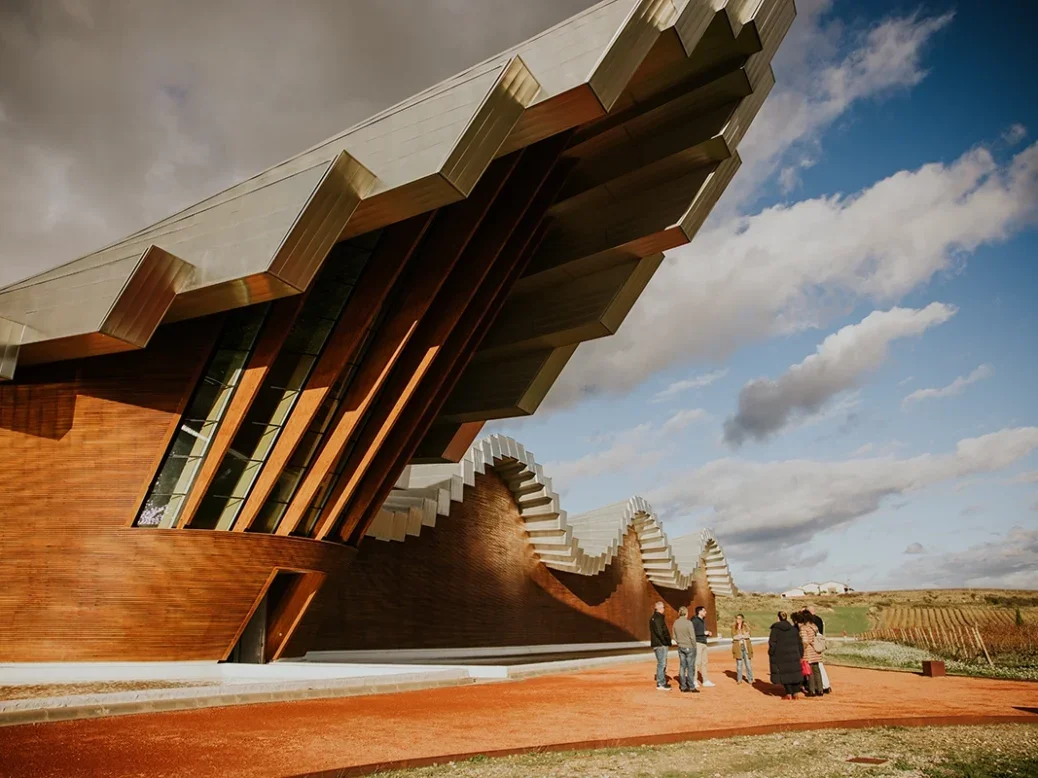
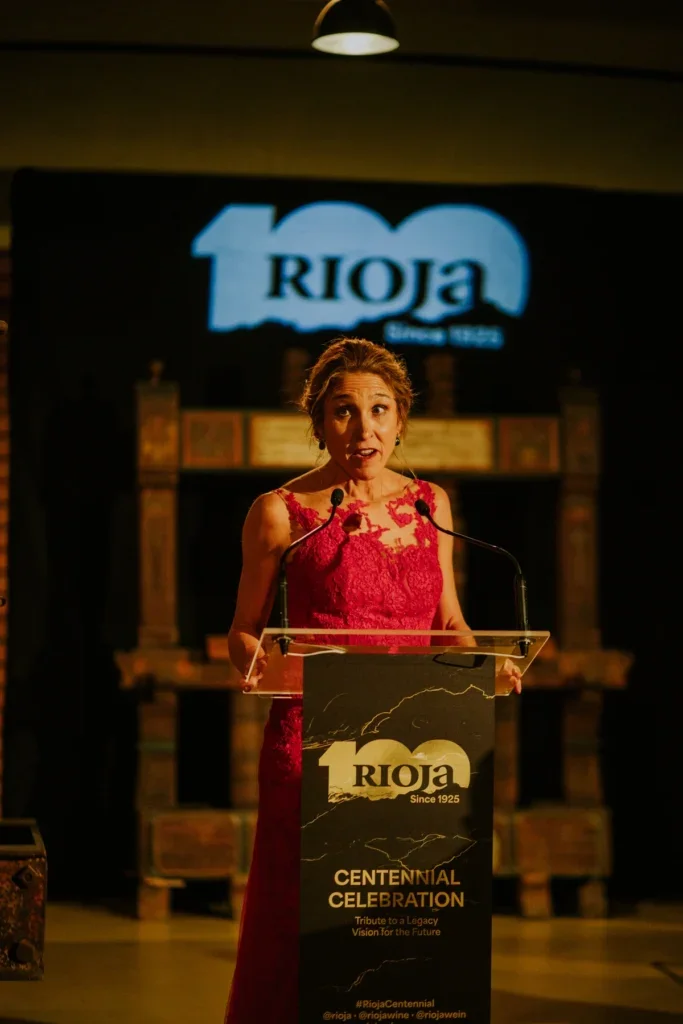
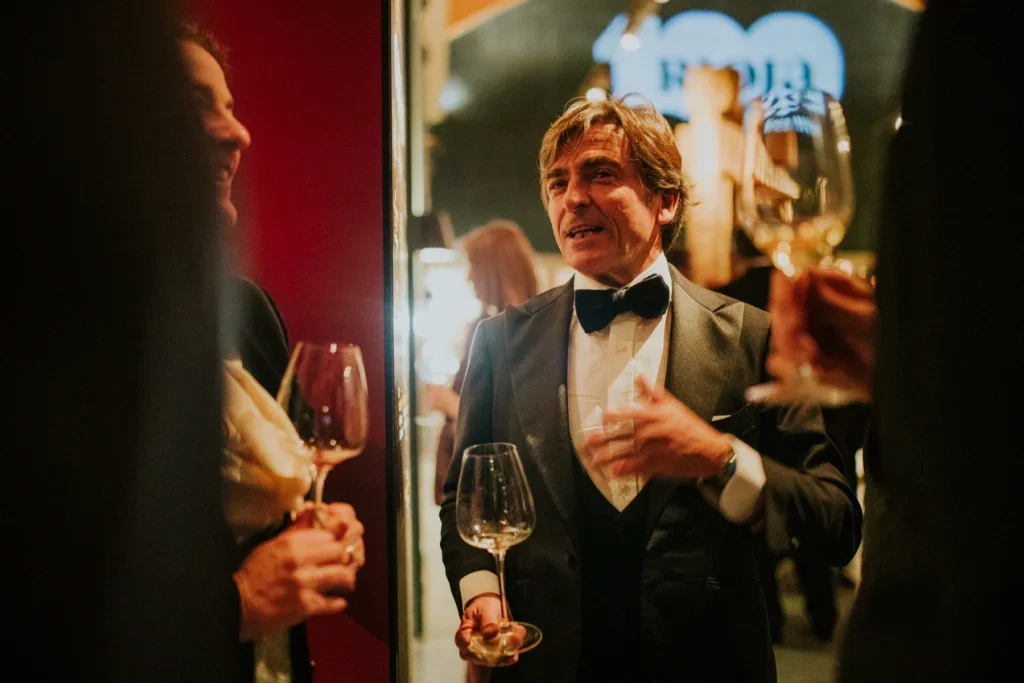
A three-day fiesta in Logroño and Briones marked the triumphant conclusion of a year of centennial celebrations for Rioja, with a magnificent banquet, extensive tastings, and multiple winery visits providing suitably flamboyant spectacle for more than 70 international delegates and many more from Spain. The mood music was positive, personified by the spirit of the new president of Rioja’s Consejo Regulador, Raquel Pérez Cuevas, the first woman to take up this post, whose appreciation was both anchored in the values of legacy and illuminated by a sense of optimism for the future, itself personified by the conspicuous support of those who may once have been described as mavericks, including Telmo Rodríguez and Álvaro Palacios.
Telmo and Álvaro were among the 16 winemakers who presented at the concluding dinner, held in the Vivanco Museum of Wine Culture in Briones. And very cultured it was, too, the museum housing works of art by Dalí, Miró, Gris, Picasso, and others alongside its more vinous displays. Earlier in the day, there had been the opportunity to taste from a selection of 100 wines, curated with care to demonstrate the incredible diversity on offer in modern Rioja.
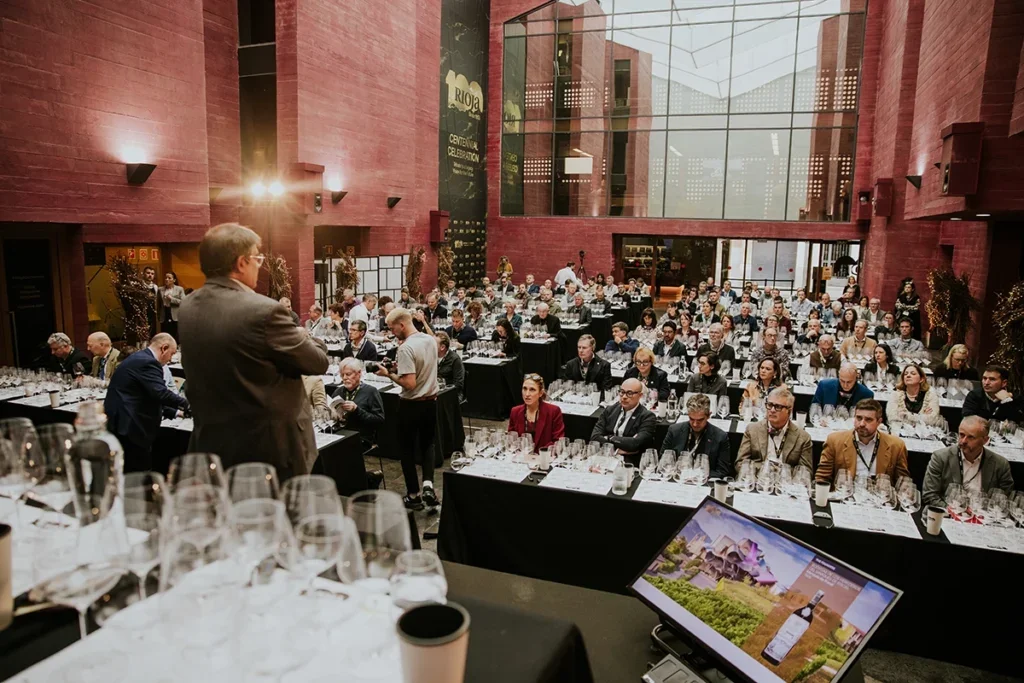
Just in case that was not enough, we were also treated to a tutored tasting of another 26 wines, half of which were shown to represent the modern and diverse face of Rioja, the other half to underline its historical legacy. Included in the former were wines from high altitudes (2023 Añadas Frías from Bodegas Pujanza), wines from rediscovered grape varieties (2024 Recuperacíon Varietal Benedicto from Luis Cañas), wines from the new geographical indications (2022 La Loma, Vino de Zona , from Miguel Merino), wines from “super-selections” (2010 Cirsion from Bodegas Roda), wines from multi-vintages (Santalba Veinticinco Vendimias from Bodegas Santalba), wines from rediscovered styles (the 2019 Clarete Valcuerna), and many more. Diversity writ large, in other words, peppered with excitement and a sense of purpose. And room full of articulate winemakers, to boot.
The second half of the tasting embarrassed with its riches; a quite magnificent rehearsal of a distinguished heritage, which served not only to underline the historical imperative but also to demonstrate a rare capacity for aging, shared with only a few other regions in the world. The selection included Marqués de Riscal 1956, Castillo de Ygay Blanco 1986, CVNE Imperial 2001, Viña Tondonia 2004, Faustino I 1964, Contino Vino del Olivo 2008, and Yjar 2021—an encyclopedic canter around some very famous landmarks, each providing a dignified counterpoint to the excitement of the first half of the tasting and its incredible diversity. Well judged and well curated.
Related
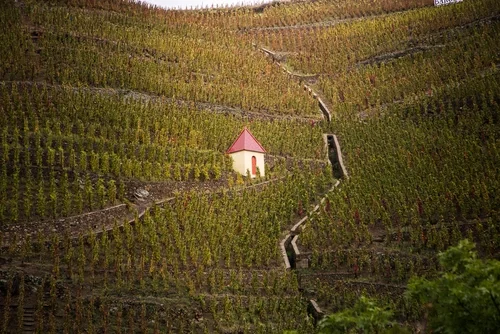
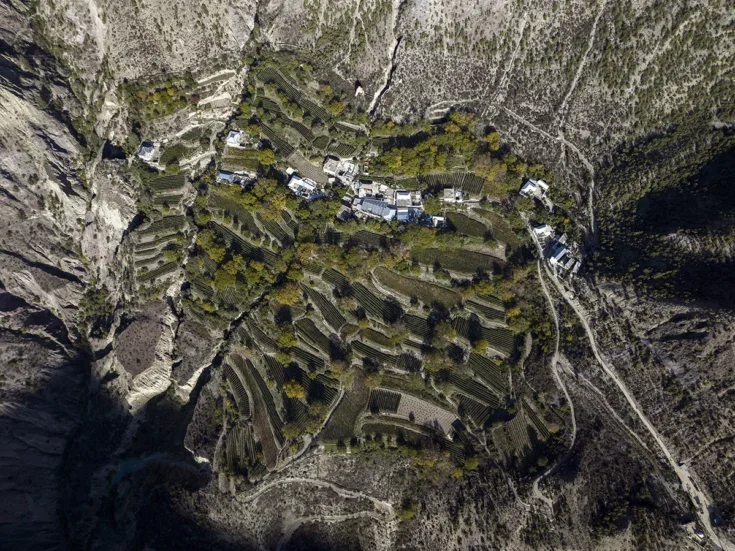

Our compère, if that is the correct word, was the irrepressible Pedro Ballesteros MW, who was able not only to describe each wine but also to put the whole region in context. The bald statistics remind us of its scale; 328 million bottles, 586 wineries, and 66,639ha (164,668 acres), with 43% of all wine exported. I was reminded that there are now no fewer than nine permitted white varieties (the future writ large underscored by Maturana Blanco and Turruntés maybe!), the hegemony of Tempranillo thus at the very least challenged; also that there are more than 13,000 individual growers and 1.3 million barrels lining the bodegas. When I chat to Victor Urrutia, CEO of CVNE, he underlines similarities with the Champagne region, similarities that come into stark focus when one learns that the 25 largest Rioja houses control more than 70% of the sales, and similarities that also teach us, for better or for worse, the merits of branding. We should not forget, however, that it was CVNE that initiated the single-vineyard concept with Contino, thereby signaling an all-encompassing approach that now has many adherents.
The interface of time and place
Pedro offered a magisterial historical perspective, from Roman beginnings, through monastic developments (Logroño is on the pilgrimage route to Santiago de Compostela), to the influence of the “three Marquéses” importing Bordeaux savoir-faire post-phylloxera and underlining the significance of the railways to help mitigate the “tyranny of geography for an inland location. […] We were lucky, however,” he recalled, “in that Rioja, unlike Champagne or the Mosel, has never been blighted by invading soldiers drinking all the wine.” The depredation was more subtle, though, and included the Spanish Civil War and the long period of isolation, gradually eased first by the death of Franco in 1975 and then Spain’s joining of the European Community in 1986. The political schism, however, between the Basque (Alava) and the Castilian (Alta and Oriental) enclaves remains potent and potentially toxic. Further significant landmarks, other than the establishment of the DO in 1925, which we are all celebrating, included the promotion to DOCa (denominación de origen calificada) in 1991—Spain’s first—and then, somewhat controversially, 2017’s initiation of new geographical indications. Significant personalities along the way—characters such as the Fournier family at Marqués de Cáceres and Isaac Muga—have helped to crystallize and refine one of Rioja’s defining characteristics: its relationship with oak and its interpretation of the concept of aging.
The key interface is the one between time and place—and here we come to the nub of the issue. The region’s qualitative taxonomy has for so long been dictated by time in barrel, with provenance of fruit almost secondary to the dominion of the virtues of aging. This, of course (consider Champagne again) favors the large houses, which source their fruit widely and are able to extol the virtues of blending. One controversial stipulation, indeed, obliges bodegas to demonstrate ownership of a certain number of barrels (400 initially, but now reduced to 50) before they can even participate in the consejo. A focus on time rather than place thus inevitably leads to a struggle between smallholders and négociants, and this ongoing debate is at the heart of Rioja’s challenge to renew and revitalize its self-definition.
Content from our partners

Things were brought to a head in 2015, when one of the most celebrated terroirists, Artadi, abandoned the denominación altogether—a brave move and one that, paradoxically, served to energize the consejo. The defection prompted the introduction of new zonal identifiers (Vino de Zona; Vino de Municipio, which has since morphed into Vino de Pueblo; and Vino de Viñedo Singular), theoretically intended to be able, if required, to run in parallel with the traditional age descriptors (genérico, crianza, reserva, and gran reserva).
Is this the best of all worlds or a parable of inevitable confusion? At the moment, there are 162 wines labeled as Viñedo Singular (covering a mere 25ha [62 acres]), with only a few “famous” growers represented (Luis Cañas and Bodegas Bilbaines among them)—so it’s hardly a glittering endorsement. How many of Rioja’s 144 villages are well known, one may legitimately ask. A far cry from the Burgundian system, where villages and crus have evolved over hundreds of years.
That may be true, but one has to start somewhere, and if the extant chronological system is there as a backstop, there appear to be strong safeguards for the reputation of the region. I spoke to Álvaro Palacios, and despite his presence at the event, he cites it as a “pity” that Rioja, having made initial steps, does not wish to go down the “village” route. He cites the 2019 adoption of a village system in his beloved Priorat as a template and sees no real reason why such a clearly defined pyramid could not be introduced in Rioja. I also spoke to Juan Carlos López de Lacalle from Artadi, and he, despite not attending the event, is positive about the region as a whole: “Diversity is fundamental to this great region, and diversity should be more clearly represented, with the villages becoming the center of the narrative”—a view also shared by Telmo Rodríguez, who maintains that Rioja has had to pay heavily for its “short cuts,” with oversupply and the shame of cheap gran reserva listings in supermarkets. Telmo advocates that “the traditional Rioja modus operandus is over” but does not lack optimism in the face of the more “positive” outlook now adopted by the refreshed consejo and in the diversity that we have seen so richly demonstrated in our tastings. His dream is for a UK consumer to be able to distinguish wines from the villages of Labastida and Villalba with as much ease as they currently do with wines from Cornas and Hermitage in the Rhône Valley. One day, maybe…
I also speak to three of the “traditionalists”: winemaker Mercedes López de Heredia; Guillermo de Aranzabal, chairman of La Rioja Alta; and Victor Urrutia. Victor is a little nervous about the ongoing struggle between the “commercially and advertising-led brands and the quality-driven houses” but does not lack confidence in Rioja’s overall determination to face up to such a challenge. Mercedes is excited about the developments in Rioja but points out that López de Heredia was farming quality Tempranillo from the banks of the Ebro long before the creation of the denominación. Fair enough. Guillermo underlines the values of constancy and heritage, mentioning that his family never changed their style of wine in the “dark days” (maybe initiated by Robert Parker) when French oak power threatened Rioja’s distinctive identity. “We need to follow trends and to forget fashions, at the same time ensuring that our wines evolve, too. Maybe a little more fruit, maybe a little less oxygen.” A recognition, in other words, that things have to change (albeit modestly) for things to stay the same. Rosana Lisa Oliva at Lalomba/Ramón Bilbao echoes this sentiment: “The next hundred years must allow the coexistence of heritage with important contemporary movements”—the latter, in her case, focusing on winemaking techniques using egg-shaped vessels and amphorae and the juxtaposition of concrete and foudre with barrique for aging.
Everyone—albeit often approaching things from slightly different directions—is aware of the complex issues in play while also being optimistic about the future. “Rioja is 100km [60 miles] of diversity,” Pedro concludes; “a glorious mosaic,” to borrow from Juan Carlos’s paean. Our three days have outlined both the challenges and the opportunities presented by such glorious diversity.
Tasting
TRADITIONAL
2022 Remelluri Blanco Crianza Field Blend
The irony of wild child Telmo Rodríguez—serial iconoclast and defender of terroir above all else—being able to make such a fabulous and classically oriented field blend, is delicious indeed. A warm vintage is captured in a deep gold and generous aromatic of quince, tilleul, and beeswax, with honeysuckle and Amalfi pith further back. The palate is textured, fulsome, and yet far from overindulgent; mint and even star anise run in tandem with bright but not overbearing acidity, with hints of hazelnut and guava on the back opening up the structural weave to accusations of unnerving complexity. | 95
1986 Castillo de Ygay Marqués de Murrieta Blanco Gran Reserva (97% Viura, 3% Malvasia)
Don Luciano Murrieta, the eponymous marqués, not only helped to put Rioja on the map but also established one of the greatest of all the traditional styles. The 1986 Blanco, celebrated in the same vein as the 1946 and the 1964, is almost bronze in color, its reassuring Rembrandt glints defiant of senescence. The aromatic is gently caramelized, with sour honey, walnut, and a hint of the hearthside. Only on the palate, with a gentle swirl, are we permitted to sense the enduring beauty of the ensemble, its balletic acidity lifting the spirit and ensuring that the prose of dried fruit and crushed stone assumes a poetic resonance. | 96
2001 CVNE Imperial Gran Reserva (85% Tempranillo, 10% Graciano, 5% Mazuelo)
One of the greatest of recent vintages, 2001 has now, for me, pulled ahead of 2004, and the grandest of the gran reservas are starting to drink beautifully, especially this imperious legend. Still deep of color, with only marginal fade at the rim, the wine seduces immediately with notes of wild strawberry, forest floor, soft spice, and bergamot, any vestigial vanillin now subsumed in a web of liminal complexity. The secret of the best 2001s lies in the buttress of acidity, well illustrated here, as it supports the ornate, high-church structure with an almost austere grip recalling Zurbarán or Ribeira (the painter, that is, not the region). Almost… | 97
1964 Faustino 1 Gran Reserva (85% Tempranillo, the rest made up of Graciano, Mazuelo, and Viura)
Bordeaux had 1961, Rioja has 1964, and Faustino has an impressive range, broad in scope and, some may say, of varying quality. No fears at the top of the pyramid, however, and a privileged tasting of a wine from more than 60 years ago, when white grapes were traditionally included in the field blend and when subterranean aging was longer than today. A few of the bottles remain, their high levels and lively, smoky aromatic underlining the quality at work. The color is amber now, the nose redolent of autumn meadows and herbs, white pepper and flint stone behind that—a Keatsean mellow at its heart. There is minimal volatility here, and merely the vestige of stewed fruit. What remains recalls cacao and toffee apple, damask and bergamot; a svelte and delicate reminder of bygone triumph. | 93
1956 Marqués de Riscal Reserva (100% Tempranillo)
It seems appropriate that a scion of the family should pull the cork for us all—pulling, in this instance, not quite the right verb, since Señor Riscal uses Port tongs, with no little ceremony. Quite a lot of applause. The wine is delicate, vulnerable, slightly volatile; the color fulgent, a soft tawny; the aromatic leafy, reticent, whispering. We are advised that there is probably a little Cabernet Sauvignon in the blend (the Bordeaux legacy hard to shake) and that the wine barely reached 12% ABV. Its gentle ethereal lift on the finish is, in itself, worthy of quiet contemplation. | 95
2004 López de Heredia Viña Tondonia Reserva (75% Tempranillo, 15% Garnacha, 10% Graciano and Mazuelo)
Described by Mercedes López de Heredia as a “sacred” quartet, the four constituent grape varieties would initially have been co-planted. The modern assemblage is more precise, but the lengthy maturation has ensured integration. 2004 is a great vintage, starting to open up two decades on. A bright ruby color, then notes of tobacco leaf, cèpe, and sloe, the faintest hint of black pepper and bacon rind recalling, but for a moment, a Côte-Rôtie. The palate is broader, more layered and nuanced; the dry extract and tense, vigilant acidity are hallmarks of this great estate, providing a perfect backdrop to the dark fruit itself. Emblematic of all that is good in the Barrio de la Estación and run by the most delightful of families, López de Heredia is a national treasure. | 96
2021 Marqués de Cáceres Gaudium Reserva (100% Tempranillo)
The legacy of Enrique Fournier is twofold; first, appraising Rioja of the philosophy of French oak, and second, opening up Rioja to international markets. The progress, for bodega and region alike, has been compelling. A worthy ambassador, from one of this decade’s more interesting vintages thus far, the Gaudium 2021 is deeply saturated and beautifully expressive on the nose and palate alike, the grip of the oak serving to underline the inherent power of this beautifully temperamental, or should that be versatile, variety. The palate has a smoky, meaty intensity, but no shortage of charm on the finish, which is precise and poised—and promising. | 94
2011 La Rioja Alta Gran Reserva 890 (95% Tempranillo, 3% Graciano, 2% Mazuelo)
The flagship of this magnificent estate recalls its origins in 1890, an almost Sicilian convergence of five families, whose mission to preserve the inherent quality afforded by traditional methodology has not wavered for a moment. Of all the Barrio de la Estación bodegas in Haro, Rioja Alta’s production is, to me, the most consistently luxuriant and silky. The cooler 2011 vintage is starting to drink beautifully, now fully integrated after its initial six years in American wood. Ruby, with hints of amber, the wine is sturdier than its younger sibling (904) and less overtly influenced by Garnacha than the Ardanza label. For all that, it has a velvety texture and a rich, creamy palate, mature strawberry, blueberry, and sloe bolstered by soft spice and Cantabrian herbs, a deft weave of acidity and a powerful, youthful finish. | 96
2018 Marqués de Vargas Hacienda Pradolagar (75% Tempranillo, 25% Mazuelo)
Pelayo de la Mata is the 13th Marqués de Vargas. The name may be a little less familiar than Murrietta or Riscal, but the influence has been extensive, with the traditional Logroño-based Vargas canon of classically aged wines complemented by this outstanding Viñedo Singular, which has been aged for 28 months in new French oak and draws a distinctive black-tea and licorice character from its relatively high proportion of Mazuelo. The tannins are tight and authoritative, the fruit brooding and rich. More time required. | 92–93
2019 Bodegas Valcuerna Valcuerna Clarete (70% Garnacha Tinta, 30% Viura)
From the small village of Cordovin, this marks the reintroduction of the most traditional method of vinification, which predates presses and involves whole-bunch maceration of grapes of both colors in a feast of skin contact. The wine is appropriately amber, luminous almost, with a distinct nose of summer flowers and mountain herbs. Garnacha fruit supports the palate discreetly, the ensemble soft in its seduction, lingering on the palate and memory alike. | 93
MODERN
2023 Bodegas y Viñedos Pujanza Añadas Frías (100% Viura)
A distinctive Vino de Pueblo from Laguardia, this wine has been made from vines high above the medieval village. It is both refreshing and dense, with notes of lavender and grapefruit ceding to a richer, more savory palate; an eloquent demonstration of Viura’s teasing complexity and inherent versatility, both often overlooked. | 93
2018 Remírez de Ganuza Olaga Gran Reserva (100% Viura)
Although relatively young, Remírez de Ganuza has come to exemplify the qualities inherent in the wines of the Alavesa region, its reds with high acidity and its whites cherishing the freshness of the Cantabrian environment. Winemaker Jesús Mendoza is one of the most exciting in Rioja today, and his skills are beautifully illustrated within the complex weave of this oaked Viura. Polished yet with salinity, elegant but with oaky depth, this is a fascinating twist on a very traditional style, perched on the shoulders of a worthy tradition. | 95
2016 Contador (100% Tempranillo)
Benjamin Romero’s picturesque sloping vineyard in San Vincente de Sonsierra boasts old-vine Tempranillo, planted at a relatively low density. The wine is characteristically deep of hue, with primary aromatics of blackberry, sloe, and dark chocolate; behind that, herbal notes that initially recall dill or coriander. The palate maintains a tight-grained clasp, even a decade on from the vintage, French oak, as usual, taking far longer to release the full and fulsome potential. Well worth the wait, it would seem, such is the latent power on display. | 94
2020 Yzar Finca Allende Rosado (100% Garnacha)
A delightful twist on the rosado template, and one would expect little else from the ebullient Miguel Ángel de Gregorio. All the savory depth of its rosado from Tondonia, but with more by way of red-fruit energy, and a strong herbal foundation lending gravitas to the generous, red-berried fruit. Fermentation has taken place in old barrels, the fruit sourced from Alava soils rich in calcium and iron. The wine is both tense, in the best possible sense of the word, and substantial enough to bear ongoing gastronomic scrutiny. An exciting prospect… | 93
2020 Bodegas Ramón Bilbao Finca Valhonta (100% Tempranillo)
The modern face of Ramón Bilbao, cultivating Tempranillo at an altitude of 2,130ft (650m) at the northern limits of the Alta region, thus with persuasive Atlantic influence. The impressive Rosana Lisa Oliva has brought up the wine in concrete tanks then French 500-liter barrels. The result is aromatically complex: Garrigue jumps from the hedgerow as sloes fall from the bush. There is chocolate and tobacco, too; and all is held in check by a persuasive strand of acidity and a rich, balsamic finish. | 94
2021 Bodegas Paco García El Mirón del Humilladero (100% Garnacha)
An outstanding Viñedo Singular from a small bodega at the meeting point of the Oriental and Alta zones, its Garnacha farmed at 1,970ft (600m) and beautifully aromatic. Black cherries, white pepper, and blueberries, violets, mint, and coriander. Tank-fermented and with only six months in cask, this is fruit-forward and accessible, yet with tannic complexity weaving the palate into a quietly assertive crescendo. One of the most exciting wines of the trip. An humilladero is a roadside altar, apparently, so only indirectly, if at all, linked to a reflection of Catholic guilt. | 95
2010 Bodegas Muga Aro (Mostly Tempranillo, with some Graciano)
Just as Hermitage used to be spelled Ermitage, Haro, it seems, was historically prepared to drop an H or two. A good name, therefore, for one of the great vinos de autor of the Rioja Alta, its philosophy capturing all the innovation of the founder Isaac, nearly a century ago. Key here is the inclusion of Graciano (we are not told the proportion), which lends a powerful, herbal character, and the fact that nearly one third of the 18 months of aging has been carried out in terracotta. French oak, mainly new, has framed the tight, almost angular, tannic structure. The fruit lurks beneath, also powerful, also full of dark potential. | 94
Bodegas Santalba Veinticinco Vendimias [NV] (100% Tempranillo)
Flagbearer for a trend for multi-vintage bottlings, this magisterial Tempranillo blends barrels from the past 25 years, with particular focus on 1999, when the bodega was founded, and 2004, a particularly strong year in the region. Eschewing a solera-based philosophy, Santiago Ijalba has created a masterpiece. Almost polychrome, the wine marries aromatics of blue and black fruit, with savory spice in support, very fine, chalky tannins, and a long, enigmatic finish that rolls back the years on the smoothest of red carpets. | 94
2022 Bodega Miguel Merino La Loma (90% Tempranillo, 10% Garnacha)
Representative of the new(ish) category of Vino de Zona, La Loma is a blend of different plots, all from within the Alta zone and focused on the town of Briones. Most of the vines are very old, much of the Tempranillo having achieved centenarian status. Deep ruby, with an allusive nose, cassis and bilberry to the fore; hints of damask and iris, mint even. The palate is equally uplifting, despite surprisingly grippy tannins and an appreciable alcoholic kick. Substantial and satisfying, this is a distinctive modern wine that will age beautifully. | 92–94
2010 Bodegas Roda Cirsion (100% Tempranillo)
Roda was founded in 1987, its winery and its philosophy differing significantly from other residents of the Barrio de la Estación in Haro. Roda describes the primacy of site in terms of blending—in other words, the small plots (plural) are preselected for Cirsion, and the blend has effectively been completely by the time the wine starts to ferment. The 2010 is characteristically bright, almost translucent, its fruit aromas lifted and captivating, its palate rejoinders assuming a savory complexity, with notes of fig, dark chocolate, and eucalypt complementing the red fruit. Eight months only in oak, therefore labeled as genérico; despite this, or maybe because of it, there is real purity here and no lack of ethereal charm. | 94