Margaret Rand meets the team behind Squerryes.
The reason we’re making money,” says Henry Warde, “is going direct to consumer.”
Is that the secret? Maybe it is. With about 1,500 club members and around 80,000 bottles a year from 55 acres (22ha) of vineyard, the wine part of Squerryes, including the restaurant, accounts for just over half the turnover of the 2,500-acre (1,000ha) estate, the rest being arable, dairy, and woodland. The Westerham Brewery is based there and feeds its spent grain to the cattle. Buildings are rented out to small businesses: The estate is a classic example of diversification. And it comes with ancestors
—nearly 300 years of them at Squerryes. If you want to launch an expensive wine, ancestors come in awfully handy.
The one they’ve picked on is Sir Patience Warde, 1629–96. He was so called because his father wanted a daughter, and he sounds a tiny bit charmless and Puritan, even though his motto is now the family motto: Licet esse beatis (“It is permitted to be joyful”). Perhaps being given a girl’s name scarred his psyche? He regarded the Protestant ministry, for which he was studying at Cambridge, as “unholy and ungodly” so instead became a merchant, Member of Parliament, and Lord Mayor of London. (Yes, quite.) He blamed the Great Fire of London (1666) on the dreadful, wicked Papists, an opinion that was certainly a crowd-pleaser at the time. He fled to Holland after being convicted of perjury, got a pardon from Charles II, and returned after the possibly even more charmless William III and his unfortunate wife Mary II took over. He died childless, so the estate passed to his brother, Sir John Warde I. From him, the estate—with its beautiful house and remarkable collection of paintings and furniture—descended to the Henry who is now in charge.
Related

The Wardes bought Squerryes in 1731 (the name is French in origin), and Henry is the ninth generation there. He studied agriculture at Newcastle University and became an accountant at Deloitte, cofounded a renewable energy business, Estover Energy, and now manages the estate.
The wine project started, sort of, when he was on honeymoon with his wife Claire. “There I was in Thailand, and I needed to transfer more money; it had got slightly out of hand. I spoke to my father, who said that Duval Leroy wanted to come and have a look.” The heat of 2003 had inspired concern about acidity in Champagne, and they were very specific, says Henry, about the terroir they wanted. “They came here and loved it, though we thought they were a bit nuts, and we went to them and loved it and thought it was like Squerryes. We had not considered the possibility of planting vines.”
But Duval Leroy pulled out and, says Henry, invested in the newly expanded Champagne area instead. The idea, however, took root. Two years later, in 2006, the first vines went in at Squerryes. Henry’s father John, who was then running the estate, went to Plumpton to learn viticulture and some winemaking. And here we are, with a £225 wine called Patience—which comes with a gold-plated agrafe and with a “bespoke brass opener” and is a restrained, graceful wine of lovely breadth and depth—alongside a brut, blanc de blancs, and rosé, all of elegance and complexity.
Content from our partners
All are Vintage wines. The 2014 Patience is the brut, with extra bottle age, put aside for the purpose after any particularly good vintage. “We sold some that went a bit too autolytic or whatever, and four wines got through; they’re the apex of Squerryes. The 2013 got too bready and rich; we wanted the clarity of Squerryes, understated in style.” Primary expression is not the aim.

Instinct and Excel
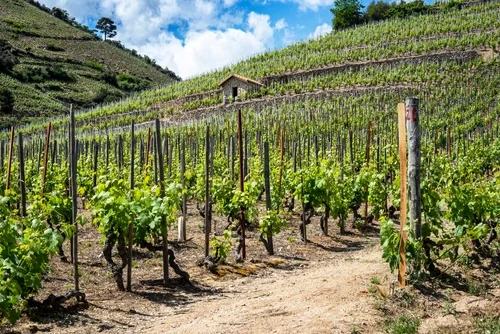
The land is on the Pilgrim’s Way, the route that medieval pilgrims took to the shrine of St Thomas Becket at Canterbury, which is itself based on a much older trading route, and it’s on the Lower Chalk, which is older than the Middle and Upper Chalk and has more clay. (Chalk, as an aside, proved its worth in the drought summer of 2026.) What is now vines used to be orchard; in fact, the earliest block is called Orchard. Another is called Plum, and it has those too, around the outside (they attract fruit flies, unfortunately); others are Charmans (which has some greensand, is more vigorous but colder and windier, and produces wine with a very different profile from the others) and Hoggins, which was the last to be planted, in 2019. There is also Square and Westfield, and the names tell you something about them. New Zealander Tom Barratt-Jones is head winemaker and in charge of the vineyards, aided by Canadian Amy Hudston, whose secret power is finding four-leafed clovers.
They both arrived in 2024 and found a vineyard in need of a bit of TLC. Tom retrained the team in the Simonit & Sirch method of pruning (see WFW 51, 2016, pp.128–35) and reduced the use of insecticides. “We haven’t stopped them, but we haven’t started them this year [this was in early July 2026]. We have to be pragmatic. Humidity is the biggest thing for us, so we open up the canopy and reduce spraying. We’re as sustainable as we can be. I’ve experimented with biodynamics in other parts of the world, but conditions here are the most challenging I’ve found. We have ladybird monitors, and we get constant feedback on soil moisture and humidity, and powdery and downy mildew.” Orchard is particularly humid, because it has hedges or trees on all sides. There are pheromone traps to gauge populations of those fruit flies, and there’s always a breeze, which helps with lots of things. There’s natural ground cover, and they keep all the natural growth under the vines for competition, with no weedkiller. Different blocks have different natural cover; in one block, there are dandelions everywhere. Bumblebees love them, says Amy. They also make calcium more available. “We’re not seeing any calcium instability,” says Amy, “but we must be careful.” And last year they experimented with a seaweed spray in Plum: “In 2024 we kept the canopy, but there was no sugar accumulation. The seaweed helped, and we got insane levels of sugar.” They’re experimenting with worm-cast sprays, too.
There are Babydoll sheep in the winter. Frost isn’t usually too much of a problem, and the crop is normally about 7–8 tons per hectare. “We’re not aiming for more.” Would they like to prune later, if spring frost becomes more of a problem? Yes, says Tom, ideally in mid- to late January, but with 55 acres they wouldn’t be finished in time. Another solution to a possible frost problem is that the buds at the end of a cane burst first, and those nearer the crown burst last, so you add three buds to your normal count and chop them off later, if budburst is too early. Putting in frost protection is a no-no: It’s difficult in an established vineyard and, in any case, is terribly expensive.
The highest spot is 560ft (170m): “In the vineyard, you have the impression that you’re at the bottom of an escarpment,” says Henry. “But just above is Betsom’s Hill, which is the highest point in Kent. It’s Lower Chalk but with the highest altitude of Lower Chalk, so we get a longer hang-time. We’re always ten days behind, and we’re the last to pick, so we can mature grapes for longer than many. Being higher up can mean being on the High Chalk, which is a less generous terroir. We have escarpment and altitude.”
The first 10 acres (4ha) to be planted had what Henry calls “a certain rotation of rootstocks and clones”; the next 10 acres had another rotation of clones and rootstocks. It might not be how you’d plant a vineyard now, and it makes it impossible to keep clones or rootstocks separate in the winery; they keep blocks separate instead. This multiplicity of clones and rootstocks shapes the style, as does the acidity (usually 15–16g/l TA). “I was working with 11–13 in other places,” says Tom. He does a lot of work with turbidity, acid management, malolactic, protein structures, and types of yeast. They’d love to find a good indigenous yeast in the vineyard: “A viable one would be amazing.” He continues, “I love the apothecary approach. I’m instinctual, but I also love Excel spreadsheets. I’ve gained experience with the site, and I know what the vines are doing, but I can also run tests.”
The Brut and Patience more or less reflect the balance of grapes in the vineyard, which is one third each Pinot Noir, Chardonnay, and Meunier, with slightly more than one third Chardonnay in Patience. It’s becoming clearer now which bits of the vineyard stand out. There’s some Chardonnay in Plum that always goes into the Blanc de Blancs, for example; the Blanc de Blancs always gets first pick at blending time.
Evolution and engagement

Winemaking is pretty straightforward, in a winery built in an old dairy barn and designed by Tom to fit the vineyard blocks and the style of the wine. (It was made at Henners initially, with some of the fruit sold to Henners as well; financially, that was a useful way to start.) He doesn’t mind too much about a bit of chaptalization but very much minds about acid manipulation—“it sticks out”—so acidity is paramount at picking and is, in any case, characteristic of the terroir.
The fruit doesn’t have to travel far—just 440–550yds (400–500m)—and the cutoff points in the press are pretty typical of Champagne, with about 51% cuvée for Pinot Noir and 52–53% for Chardonnay, and Tom will blend some of the tailles together to use for the malolactic culture. The malo is not something he does for the sake of it, and he rather likes a touch of malic acid in the finished wine; in 2025, he left a gram or half a gram of malic, for extra length on the palate. At 2g/l, you start tasting it and it feels like too much, he says, but having a bit helps with elegance.
He loves data as well as instinct, and there wasn’t much data when he started, but now he’s building up enough, year by year, to do a blend and then see where it sits with previous blends. There are probably 1 or 2 or 3% changes every year, he says: evolution rather than the sort of revolution that might upset the club members. And the members are very engaged: Tom does masterclasses with them on blending and other topics, and they get very involved, he says. “The power of words is the best marketing ploy.”
Everything is in steel, though Tom toys with the idea of oak—English oak from the estate, that is—and is gently working on Henry to bring him round to the idea. English oak is, he says, a bit more angular—on the palate—than French oak, but that could suit the Squerryes profile. But it would be to add weight, not flavor, and in fact he adds a bit of weight with a lees-stir after sulfuring, so there are other ways around that.
Everything usually gets a minimum of three years before disgorgement and some months under cork, but the question of precisely how long for each is one of the great skills of the winemaker. It’s not a linear relationship, and so much depends on the year and the individual wine.
They could produce more, but Tom points to the estimates for English wine that were being bandied about when he arrived in England in 2017 (he’s originally from New Zealand and arrived here via a stint in Australia): 50 million bottles per year. “Overinvestment has been a problem for many producers, if they estimated sales based on that. And when it started to tail off, they got caught out.” He’d be happy to cap Squerryes at 100,000 bottles a year. “We can sell that, and we’re building to that.”
About 50–60% goes direct to consumer, via the club or the website or the restaurant. The rest goes to the on- and off-trade in the UK; they don’t export.
The restaurant happened because they decided to have a tasting room, and Henry says, “The British need food, or it’s not an occasion. So, we had to build a restaurant.” The idea was to be somewhere between a gastropub and a starred restaurant; the restaurant is in the nearby town of Sevenoaks, but there’s a cellar door, deli, and café at the estate. Licet esse satiatis. ▉