Recent scientific research appears to have confirmed a piece of received wisdom among wine growers: Old vines serve to enhance not only concentration and complexity but also terroir character. But the phenomenon remains unexplained.
In November 2025, findings published by the Garnachas Históricas project in collaboration with the universities of Navarre and Zaragoza created a stir when presented at the international Old Vines Conference in California. A comparative analysis of grape musts from young and very old vines was undertaken on the basis of expansive Grenache plantings in the Campo de Borja. This confirmed not only that musts from old vines contained a much broader array of aromatic compounds (and, in instances where these overlapped with musts from young vines, at much higher concentration) but that in the case of old vines these compounds varied far more depending on subregion and terroir, whereas the aromatic makeup of musts from young vines was comparatively uniform.
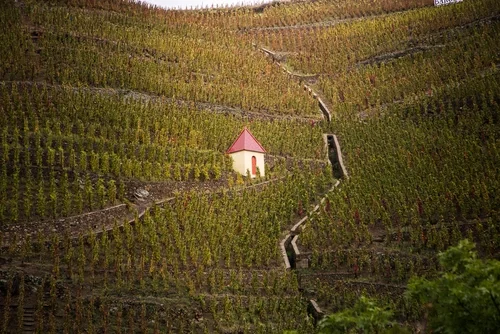
That older vines under otherwise (NB: including genetically) identical conditions generate better and more concentrated wine has long counted as a commonplace among most wine professionals. Old vines tend to be less productive and to bear smaller clusters, which inherently leads to greater flavor concentration. It is, for example, on the basis of such observations that Austria’s Domäne Wachau—having been determined comprehensively to orient its members’ plantings toward Grüner Veltliner and Riesling—accomplished this between 2005 and 2010 largely by grafting over existing old vines. Similar concerns apply in the case of many prominent plantings, such as star vintner Klaus Peter Keller’s Morstein Pinot Noir, which issues from septuagenarian Silvaner vines that were grafted over to precious Burgundian selections, thus eliminating, as he perceived it, a long struggle for vine roots to penetrate notoriously adamant underlying limestone.
The similarly widespread association of vine age with the emergence of terroir character is also routinely attributed to root depth. The association of 42 prominent California and Oregon wine growers that since 2004 has been proselytizing on behalf of dry-farming not only styles itself “The Deep Roots Coalition” but professes having been “founded largely on two principles. First, we have a profound respect for the concept of terroir, [the idea] that wine should reflect the ‘place’ from which it emanates.” (Sustainability is cited as Principle #2.) But if deeper roots indeed lead to enhanced terroir character, the mechanism by which this happens remains a riddle.
Related

For what are deep roots searching?
Virtually any hypothesis connecting the flavor profile of wine with root penetration runs counter to a consensus in the fields of plant physiology, soil science, and geology, as illustrated in the syllabus of the internationally influential Guild of Sommeliers by the following quote from Professor Alex Maltman, who is also responsible for entries on geological themes in The Oxford Companion to Wine: “[Once] the root skeleton becomes established in the first few years of growth [the vine’s] humus-based macronutrients will be derived from the topmost part of the soil and the other nutrients are usually available from not far beneath. Any deeper roots are chiefly seeking water. Similarly, there is no basis for the common assertion that a complex geology leads to complex flavors in the wine.”
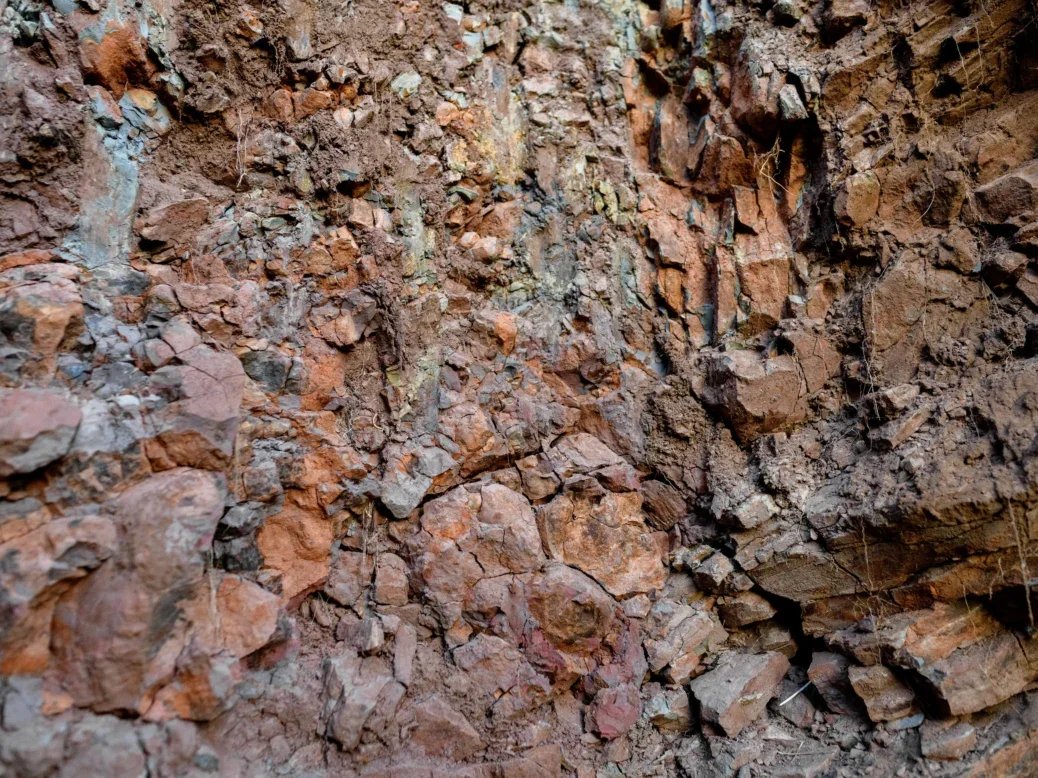
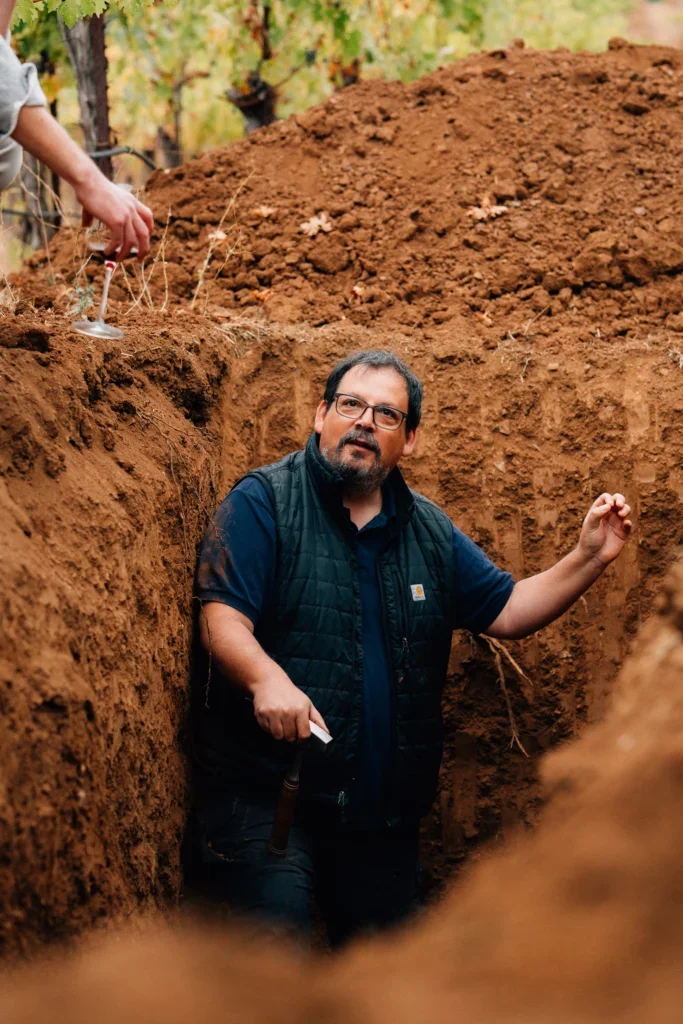
Prominent vineyard consultant Pedro Parra operates from an opposite viewpoint. Often referred to as “Doctor Terroir”—and, indeed, holding a degree in terroir from the Institut National Agronomique Paris-Grignon—Parra begins every consultancy with excavations 6–10ft (2–3m) deep throughout a vineyard in order to assess the potential of its geological conditions. And whether that potential is realized is, as he sees it, determined by root penetration. What attracted Parra to Hamel Family Wines in the Mayacamas Mountains, California—at a time when he was looking to shed clients, not add a new one—was underlying basalt rock sufficiently fractured that vine roots could penetrate. But such penetration, he insisted, presupposed terminating the regimen of drip irrigation common to most high-value California vineyards. (Steve Matthiasson, who advises Hamel and has become a guru among California wine growers, is known, inter alia, for his expertise in using highly selective irrigation to gradually wean vines off irrigation and promote deep roots.) Young vines, suggests Parra, are like young people—“addicted to McDonald’s” for the first 15 years of their life. But if the terroir is good, a vine’s roots will penetrate to the point of, in Parra’s analogy, dining at a Michelin-starred restaurant, provided irrigation has not condemned them to perpetual adolescence.
“I agree with Maltman’s assertion in general,” says proprietor John Hamel, perhaps surprisingly, since he credits Parra with an impressive recent increase in quality from his Cabernet-dominated Nuns Canyon bottling. He qualifies that “if you have oxygen in the fractures and humidity [that] start the rock weathering to smaller particles like clay, my guess is that you will have some level of minor nutrient uptake in these fissures. There are two things that I taste that correlate with root depth. The first is a stronger and more resonant mineral expression, more energy […]. The second thing is equally dramatic: the length on the palate. I do not know the answer as to why—I just know there is a correlation.”
Content from our partners

Eric Fournier, former proprietor of Château Canon, liked to offer a similar observation in the realm of calcareous soil when pouring for visitors his second wine alongside his grand vin. “Only once their roots have reached the calcaire [limestone],” he insisted, “can the vines express the essence of Canon.” And indeed, only from older vines did the floral perfume and—for lack of any more apt descriptor—“mineral” nuances that characterize this great St-Emilion emerge. Today, Canon’s website offers a gloss on geology with which Maltman would not quibble—“porous rock of the asteriated limestone plateau absorbs rainwater,” while “thousands of clay cracks run through the limestone, holding water”—but one that leaves the phenomenon noted by its ex-proprietors unaddressed.
Parra relates what might at first glance seem to be an opposite experience with underlying limestone, also from Bordeaux—namely, with Château Lafite. Wine from certain parcels seemed to be taking on characteristics that displeased the régisseur. Parra explained those gustatory features in terms of a localized underlying seam of chalk in what is otherwise soil deep in sand and gravel. Chalk, he averred, has a negative influence on Lafite’s dominant Cabernet Sauvignon, every bit as much as its influence on Canon’s thoroughly dominant Merlot is positive.
Riddles behind the riddle
Interestingly, Parra believes that the clearest markers for any specific geological influence are not to be found in aroma or flavor per se, but rather in the tactile realm. He speaks of mouthfeel. But these latest findings from the Garnachas Históricas project reveal distinct aromatic differences depending on terroir. Hamel finds the most obvious influence of his basalt cashes out as “ferrous,” which seems to suggest something sensorily midway between flavor and texture. But whatever the differences experienced by tasters or registered by chemical analysis, any explanation of a correlation with root depth will have to find its place within some more general account of how geology influences the flavors of wine. And this matter—indeed, the terroir phenomenon as a whole—is as yet frustratingly little explored by scientists possessing what would be the relevant expertise.
Meanwhile, wine growers and wine journalists will continue to claim that “minerals” are transmitted to the grapes—a notion not only biologically untenable but conceptually incoherent in its equivocation on “mineral”—while skeptics like Maltman are content to ridicule these growers and journalists and to deny any influence of geology on flavor, a contention that appears to contradict their tasting experience.
Parra contends that scientists who concern themselves with viticulture are apt to overlook terroir influence because they concentrate exclusively on quantifiables. “Terroir is not mathematical,” he has often been quoted as saying; “it’s about feeling.” In whichever sense he may have intended that word to be taken, we should count ourselves lucky that “feeling” was neither the guiding principle nor the subject matter of those researchers who, thanks to a study of Grenache from the Campo de Borja, have brought us a step closer to understanding the mysteries that connect the vine with flavor. And one can speculate—or at least hope—that a similarly painstaking approach will help us understand more precisely what it is that deep roots bring to the taste of wine.