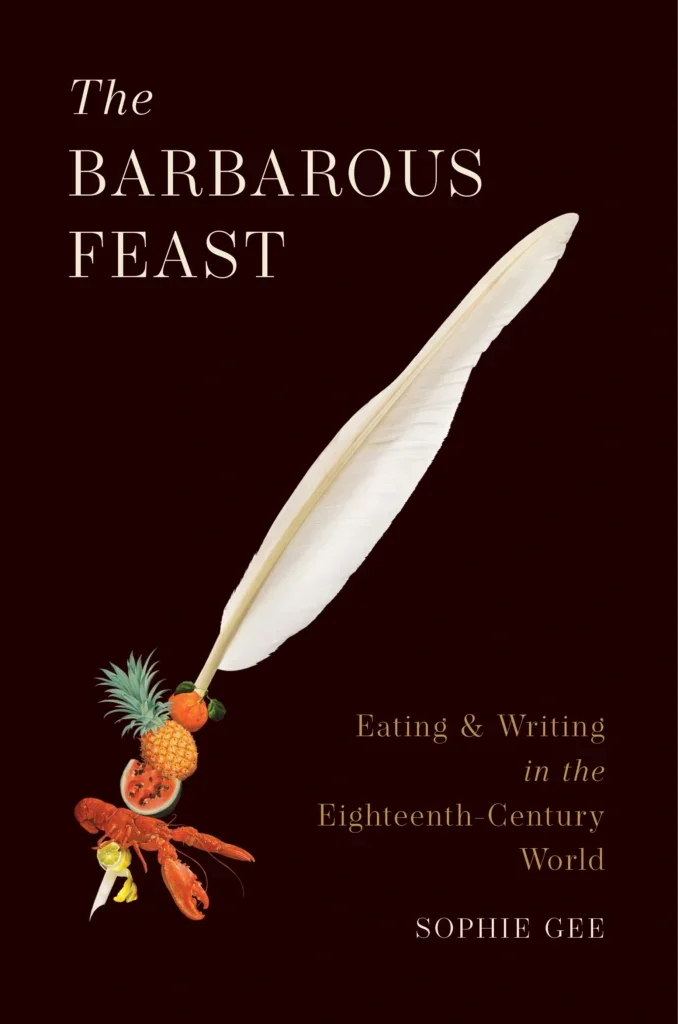
Stuart Walton reviews The Barbarous Feast: Eating & Writing in the Eighteenth Century World by Sophie Gee.
The eating habits of the 18th century have much preoccupied social and cultural historians of the most recent generation, as we noted when discussing Peter Ross’s Insatiable Appetites (reviewed in WFW 92). A period in European history that coincided with the expansion of colonial adventurism produced—for those who could afford it, at least—a conspicuous enlargement of the repertoires of fashionable dining. In The Barbarous Feast, Sophie Gee of Princeton and Sydney universities takes another approach altogether, setting the business of everyday eating and drinking against the historico-political background of the 1700s and tracking them through their representations in Georgian novels.
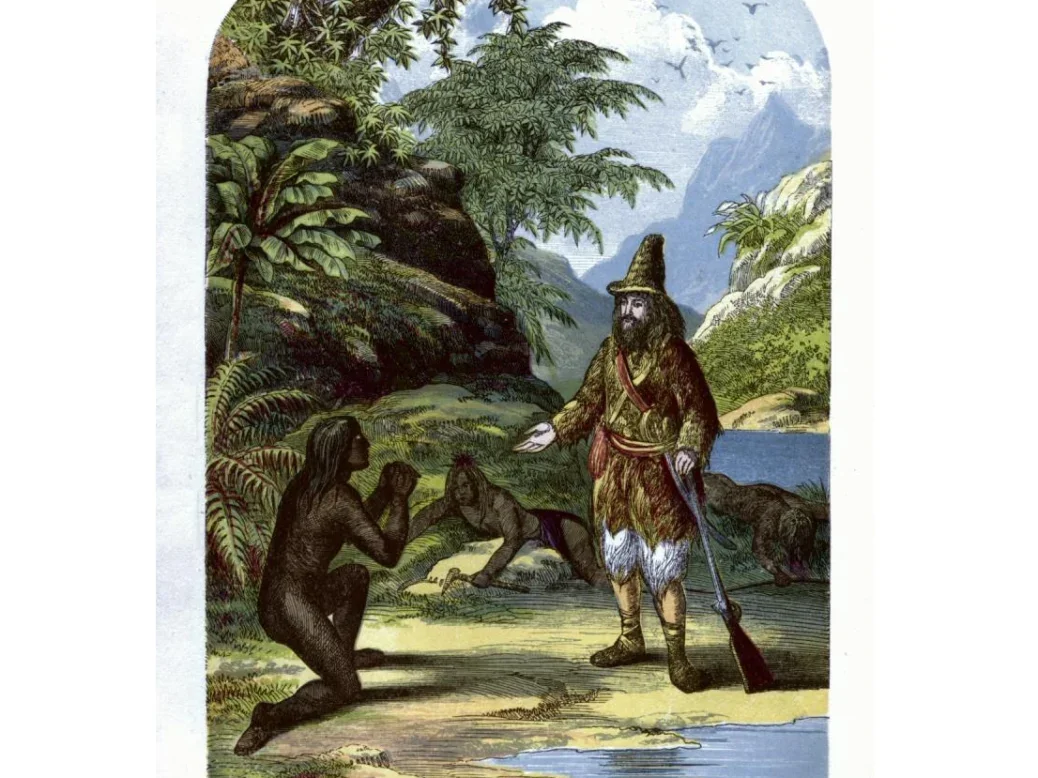
Mining curriculum English texts for their episodes of consumption turns up many perceptive passages of analysis. It is irresistible to repair once more to Robinson Crusoe (1719)—and nor does Gee resist the impulse—for what it shows about the comparative attitudes to eating, as between what was thought of as the civilized and the savage diet. Fallen among marauding natives, whether in West Africa or South America, Crusoe is always at risk of being killed and eaten. Everything changes, however, when he rescues Friday from another tribe of cannibals, a pseudo-biblical encounter in which he both names and tames the Black man who will become his servant.
Gee’s reading of the developing relationship between the two men makes the consensus point that the colonial mission is depicted here by Defoe in microcosm. Crusoe both civilizes Friday and sets him on the road to socialization in the European manner, by asserting universalist ideals against the cultural relativism that was inclined, even then, to view the ethnology of Indigenous peoples in its own light. But Gee complicates this by asking whether Friday’s willing servitude to Crusoe is not in itself an act of sovereign subjectivity. His exploitation as a worker remains just that, but is he entitled to choose that role over the life he has left behind?
Related

In any case, Friday does not always prove tractable to Crusoe’s tuition. He discovers a taste for bread dipped in hot goat milk, but when it comes to the seasoning of meat with salt, the Indigenous preference for unseasoned flesh prevails, and he mimics the performative spitting and sputtering over the unsalted mouthful by which Crusoe has tried to instruct his palate.
There is a finely nuanced chapter on Henry Fielding’s Tom Jones (1749), “a work of literature,” Gee says, “obsessed with the getting and eating of food.” Fielding’s resourceful use of alimentary metaphors would be on display in the journal he later edited, the Champion, when he called for the hated administration of Sir Robert Walpole to be subjected to a great purgative digestive cleansing, and he opens Tom Jones with a preface in which he compares the job of the novelist to that of a restaurateur serving up a tempting bill of fare. Feeding themselves legally and sufficiently was a bitter challenge for people living in rural England, where the action of the novel originates. The laws on shooting game discriminated sharply between rich and poor, and Gee makes the point that the inability of peasant communities to hunt wild game legally was another of the drivers that impelled migration to the cities, where food systems might still be meager for those with few resources but were at least a matter of commercial organization.
The hearty appetites of simple folk are either the means of their healthy self-husbandry, as in Tom’s own case—he can polish off several pounds of beef or a half-shoulder of mutton when occasion presents itself—or they are comical in their insatiability. His associate Partridge, whose very name marks him hazardously as a potentially tracked and hunted creature, is “more inclined to eating than to sleeping, and more to drinking than to either,” as the narrator puts it. Meanwhile, the fair Sophia, object of Tom’s undying and self-sacrificing devotion, has an exquisite fondness for the eggs of wild birds—pheasants and, of course, partridges. When she is served a pullet stuffed with its own eggs, a genuine Georgian recipe that appears in Hannah Glasse’s cookbook of 1747, the tenderness of the meat seems to echo her own emotional tenderness.
Content from our partners
Colonization and cannibalism
This was the emergent period of the realist English novel, which, as Gee observes, could construct an orderliness out of daily experience while also reflecting its unpredictable disorder. The mission with which the European nations tasked themselves in this era was to bring precisely that sense of order to the startling worlds they discovered beyond continental borders. Inevitably, The Barbarous Feast reminds us that, in seeking to bring a rationalized system to the agricultural lives of the Indigenous, they unwittingly, or else deliberately, trampled on local knowledge, respect for the land, and the seasons. Two years of intensive oyster-harvesting in Gippsland, Australia, between 1843 and 1845 came to a juddering halt through overexploitation.
Not every extractive enterprise was cruelly insensitive. Gee points out the continuities that existed between the amphibious farming of poor settlers in Australia and the smallholdings of the enslaved in the Caribbean and North America. History has cyclical habits, though, and not always in the sense that Indigenous time was famously measured in rotation rather than linearly. The Angasi oyster beds of the Sydney shoreline were depleted by shell-burning for the construction industry, and when Gee combs the bays and coves around the harbor area for residual colonies of them, she finds their shells are “crinkled and creviced […] they look melancholy.” But what is an oyster’s melancholy?
There were alimentary practices in the newly discovered worlds that profoundly upset Christian colonizers. Dirt-eating in the Caribbean was both repulsive and also a way of rejecting the consumption habits of the European sugar economy. Libations of grave dirt and rum, accompanied by oath-taking, attended obsequies for the dead despite settlers trying to stamp it out, and the perpetual phobia of cannibalism led white settlers to reassure themselves—never quite convincingly—that the plantation economy had put an end to it. People who eat each other are repellent but also useful for distinguishing oneself from, just as Othello, a Black soldier sufficiently adept in English social mores to charm and marry a white woman, once wooed her by telling her that he survived a spell among such savages, “the Anthropophagi.” Prior to that, Montaigne’s essay “On Cannibals” had taken the enlightened view that not everything foreign to European experience was barbaric. (In a rare lapse, Gee misdates this text to 1509, 24 years before the writer was born.)
Heroic and heterogeneous
This is a distinctly amphibious book. Gee interleaves her chapters of historical and literary analysis with shorter sections of vivid personal journaling. Anglo-Australian by heritage, she has known the lands and waters of southern Australia since childhood. Her understanding of the languages and cultures of the Indigenous peoples of these regions is impressive indeed, and there are things to learn on every page of these sections. At one point, she finds herself in the Beechworth enclave in northeastern Victoria and refers glancingly, if anonymously, to the illustrious wineries in the vicinity. Giaconda? Savaterre? Castagna?
A good deal of space is expended on discussing the Christian Eucharist, or the Lord’s Supper to use the preferred term of the Georgian age, as a paradigm of eating and drinking. The more extended the analysis, the more one feels that a metaphorical point is being stretched, even though skepticism about the sacramental Test Acts, which stipulated that attendance at the Church of England was a requirement for holding public office, stole into the writings of some of the 18th-century literati. Defoe’s incendiary satirical pamphlet “The Shortest Way with the Dissenters” (1702), for which he would be fined, pilloried, and imprisoned, lacerated the hypocrisy of the occasional conformity of non-Dissenters, in a style that, Gee argues, was at once too opaque and too candid for successful satire. A lengthy appendix, which feels a little extraneous to the book as a whole, traces the history of changing conceptions of the sacrament from Calvin to John Locke.
Some readers may feel The Barbarous Feast is attempting too much. Comprised of unequal parts of cultural history, literary analysis, an examination of Indigenous foodways, and elements of a personal odyssey through once-contested landscapes, haunted by the author’s own atavistic memories, there are a lot of oysters to shuck. But the best academic writing is about raising the blinds that keep disciplinary areas screened off from each other, forging connections, trying out alignments that may or may not come into focus, in provocative ways. For this heroic enterprise at least, Sophie Gee’s heterogeneous work deserves adventurous readers.
The Barbarous Feast: Eating & Writing in the Eighteenth Century World
Sophie Gee
Published by Princeton University Press; 332 pages; $39.95 / £35