

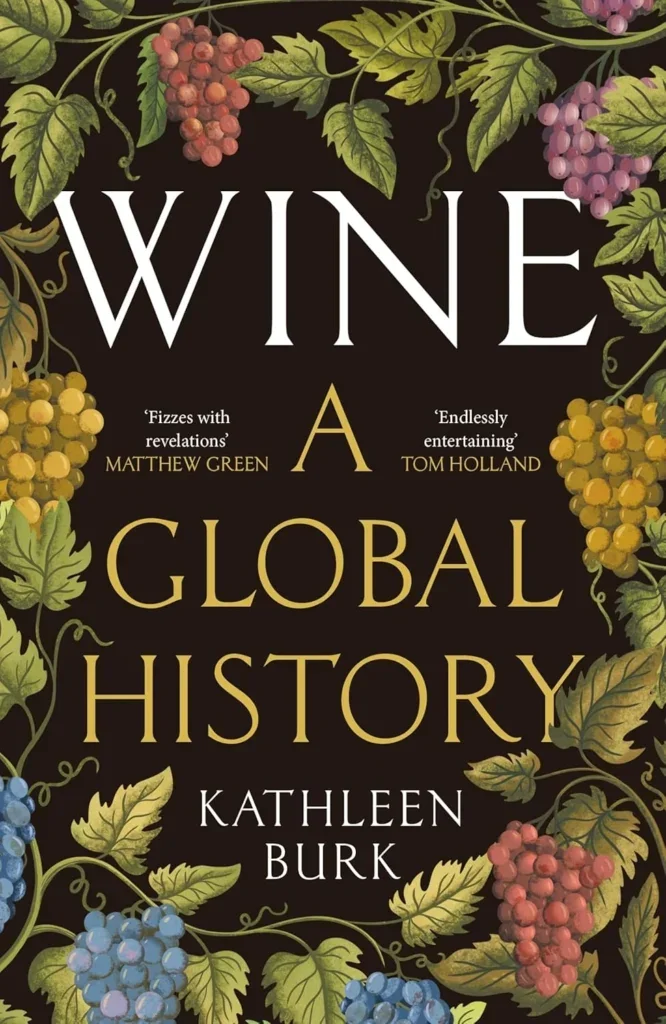
Raymond Blake reviews Wine: A Global History by Kathleen Burk.
I have wine in my bones and have shared a significant part of my life with it.” This is how Kathleen Burk concludes her introduction to Wine: A Global History. However, given the obvious effort, in terms of impressively wide research, that went into the writing of this book, she surely has wine in her blood also. Across 18 chapters and some 600 pages—more than 100 of which are devoted to appendix, notes, bibliography, acknowledgments, and index—she sets out on a broad sweep across wine’s millennia-long story, all the while maintaining a sustained narrative that starts about 8,000 years ago in the Neolithic age, when wine was most likely discovered by accident, its essential component—alcohol—as yet unidentified.
Its first imbibers reveled in the effects of the alcohol, rejoicing in its transformative powers—surely the work of a divine being—celebrating its power “to banish care,” as Hugh Johnson once wrote, perhaps until the inevitable hangover drew them up short. Burk takes the reader from that hazy point in time right up to the present when, perplexingly, the once-celebrated component is now demonized, with considerable effort being exerted to remove the very thing that makes wine so attractive in the first place. The wheel has come full circle, and as ever greater efforts are made to put the genie back in the bottle, Burk writes on the penultimate page, “The fundamental question is, is no-alcohol wine really wine? One argument is that because it has been made in the usual way—fermenting the grape must, making the wine, deciding between barrels and stainless steel—it is wine. The other side argues that without alcohol, which is the essence of wine, it is not wine, so let’s not pretend that it is. This is an argument that only the consumer can resolve.”
Kathleen Burk’s credentials are impressive: professor emerita of modern and contemporary history at University College London; author of an impressive oeuvre of historical titles, including a biography of her doctoral supervisor at Oxford University, AJP Taylor; and perhaps most pertinently, Burk’s childhood was spent “on a farm in California where the house was surrounded by vineyards. It was a family farm, and as my five siblings and I grew older, we had to play our parts: tying vines to the trellises; picking grapes in the heat while flies and wasps buzzed around our faces and spiders drooped down; and driving the tractor.” She could hardly be better qualified to tackle this mammoth topic, though one cannot help but feel that a historian of her distinction might cringe at the press release’s assertion that her book is “the untold story of wine, from the Stone Age to the present.” Untold? Hugh Johnson’s The Story of Wine, published in 1989, told the story in majestic fashion. Wine: A Global History does a commendable job of bringing the story up to date.
Related

That said, the coverage is a little uneven—inexplicably so, unless it is an effort to rebalance a narrative that was considered too Western-centric until now. Perhaps Burk’s intention was to tell a new story, concentrate on those areas that have escaped serious scrutiny in previous works. If so, she has been successful but at a cost, because it skews the book’s center of gravity away from wine’s traditional heartland and toward other areas, most particularly the Far East. It is a commendable initiative, but perhaps the pendulum has swung too far. By way of example, China warrants a full chapter of 40 pages, while the penultimate chapter sees Austria, Germany, England, Israel, and Fortified Wines shoehorned into 27 pages. In a one-volume work that throws the net so wide, it is understandable that the coverage might be light in places, and perhaps with the finishing post in sight, the pace had to be upped and a catch-all chapter included, but this is a hard-to-fathom lacuna.
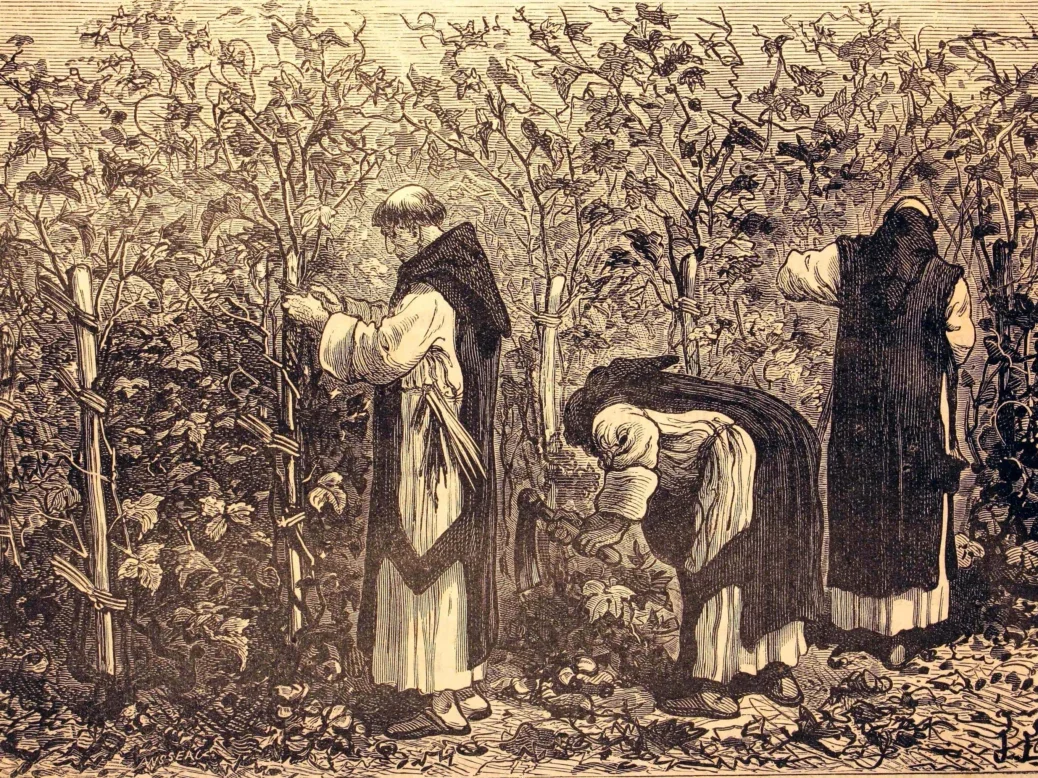
Such omissions are offset by a commendably sure-footed treatment of the roughly 1,000-year period from the fall of the Roman Empire to the 16th century. Step back in time with Burk to chapters four and five, which, taken in tandem, form the most compelling section of this book. The narrative skips easily across the centuries, never feeling rushed or patchy, nor losing the reader’s attention thanks to the easy flow of the prose and the engaging subject matter. Emperor Charlemagne features regularly, along with the monastic orders such as the Benedictines and the Cistercians, whose influence has carried down the centuries to the present day.
Nuggets, nuance, and depth
Closer to our own time, Burk tells the tale of the tortuous, 200-year gestation that eventually gave birth to Bordeaux’s 1855 Classification, tracing the labyrinthine machinations that followed the first attempt at a ranking of the wines: “The first known classification was that of the Bordeaux Jurade, dated 27 October 1647. The Jurade was made up of the jurats or magistrates and a number of the nobility. They took firm control of the production and sale of wine, tasting each barrel and smashing and burning those containing bad wine.”
Content from our partners
More than two centuries later, following much wrangling between vested interests, the 1855 Classification first saw the light of day, yet the ink was barely dry before it was challenged: “An interesting conflict was that between the brokers and the widow Mme Caroline Villeneuve-Durfort of Cantemerle, who was dedicated to protecting and increasing the quality of her wine, and who was very active against any challenge to its reputation. The wine had for decades achieved fifth-growth prices, but by a bureaucratic accident it was left off the classification list. When she learned this, she appealed to the classification’s source, the Union of Brokers. They agreed, and Cantermerle [sic] was squeezed into a tiny space at the end of the fifth growths in the handwritten list of the already completed classification. This was the first of only two changes to the list, and few know about this one. The second, considerably more famous change—and thus far the last—was the ascension of Mouton Rothschild from second to first growth in 1973, a change which had taken from the 1850s to effect.” Nuggets of information such as the narrowly known elevation of Cantemerle serve to enrich this book, adding nuance and depth to an oft-simplified narrative.
It is not, however, all plain sailing for France’s prestige wine regions. Some 370 miles (600km) northeast of Bordeaux, Burgundy gets less sympathetic treatment, as Burk raises a verbal eyebrow at the efforts, almost a century ago now, to spur economic recovery by attracting tourists to the region. The concoction of faux traditions centered on “the hardworking but jovial peasant with his roots deep in the Burgundian soil,” and relying for their authenticity on conveniently lost-in-the-mists-of-time origins finds no truck with Burk as she bluntly concludes that “they made up historic traditions.”
A less savory historical note concerns the question of Burgundian support for the Vichy regime during World War II, including the gift of the Beaune Les Teurons vineyard to Marshal Philippe Pétain. None of this is untrue, but it draws a somewhat one-dimensional picture of what is now the world’s most celebrated region and sought-after wine.
A greater explanation of how that came to pass would be welcome, and in that regard contemporary Burgundy has been well served by writers such as Clive Coates MW, Anthony Hanson MW, and Jasper Morris MW. Yet a perusal of the extraordinarily wide-ranging bibliography, which spans two dozen pages, referencing every source no matter how tangential, makes no mention of any of their works. Another glaring omission is Andrew Jefford’s The New France, a book of commanding authority and sublime execution.
Unsullied by PR spin
A more positive note is struck at the conclusion of each chapter of Wine: A Global History, where Burk profiles a wine chosen to best represent the subject matter: “I have included at the end of each chapter a short history of a symbolic wine, selected either because of the grape or because of the wine’s relevance to a country in the chapter. They are all delicious, and this sums up my belief that the pleasure provided by the drinking of a good wine, particularly with friends, is difficult to match.”
Taken together, these 17 wines would make an interesting mixed case, ranging as they do from Château Mukhrani 2019, made from the Shavkapito grape and hailing from the Kartli region close to Georgia’s capital, Tbilisi; all the way to Chrysalis Vineyards Locksley Reserve 2011, made from the Norton grape in Virginia, USA. Of the former, Burk opines, “This particular red wine is medium-pale, has an alcohol level of 13 per cent, and is of medium body, not too heavy. It is dry, fruity, and can be a bit smoky.” The latter warrants some cellaring, she suggests: “With some ageing, the Norton makes a somewhat Rhône-type wine, dark, complex and fruity when young, even more complex and more savory as the vintage ages in bottle.”
Were I to select three of them, I would plump for a more mainstream trio of a white, a red, and a fortified, starting with the excellent Weingut Bründlmayer Ried Loiserberg Erste Lage Grüner Veltliner 2022, one of Austria’s finest wines; then the Gaston Hochar Chateau Musar Red 1999 from the Lebanon, a wine that fully deserves the descriptor “legendary”; finishing with a flourish from southern Spain, the Lustau Almacanista Manuel Cuevas Jurado Amontillado de Sanlúcar Sherry.
For the reader, these wines act as pleasant staging posts throughout the book, allowing the mind to wander far and wide as they are enjoyed vicariously. He or she is then brought up short by a subheading three pages from the end that signals Burk’s clear-eyed view of the contemporary wine world, unsullied by PR spin: “Does Wine Have a Future?” she asks. Discuss.
Wine: A Global History
Kathleen Burk
Published by Profile Books; 614 pages (hardback); £30


