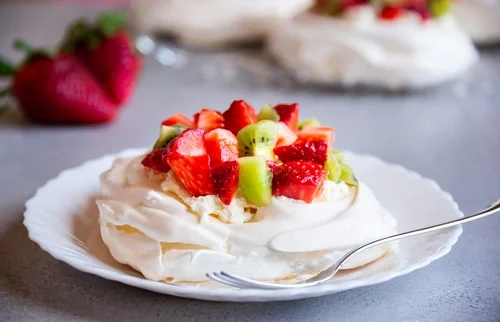
In ascribing pavlova to New Zealand, I am treading on eggshells (forgive the avoidable but irresistible pun), so, I shall start by back-tracking and say that I am not taking sides. While pavlova is New Zealand’s national dessert, garnished with kiwifruit, usually together with strawberries and/or, sometimes, other berries, it is also Australia’s national dessert, with passionfruit replacing kiwi as the principal fruit.
Another difference often cited is the texture of the cooked meringue. The centre of the New Zealand version is said to be soft and marshmallowy, whereas Australia’s is said to be drier and crunchier, even though both country’s recipes invariably contain cornflour and vinegar, ingredients which help achieve a marshmallowy result. And not everyone agrees. In her magisterial The Cook’s Companion (2004), Australian Stephanie Alexander writes that the meringue “needs a short period of high heat to set and crisp the exterior and then a long period of cooling heat to set but not dry out the marshmallowy interior.” Characteristically practical, she goes on to say: “Experiment with your own oven. Every oven is different and some adjust faster than others.”
What is widely accepted on both sides of the Tasman Sea is that pavlova was named after the Russian prima ballerina Anna Pavlova, who toured Australia and New Zealand to great acclaim in 1926 and then again in 1929. It could even be true that the airy, cloud-like shape was based on her tutu. It’s a pretty story anyway.
The real controversy is about which side of the Tasman Sea created the large, round fruit and whipped-cream-topped meringue known as pavlova (the concept itself wasn’t new: similar confections can be traced back to the 18th century in noble households across German-speaking countries, and German-speaking immigrants brought meringue, whipped cream, and fruit desserts known as Schaum torte to the US in the 19th century).
Related

Backtracking again, I’m going to come down on the side of the land of the long white cloud as having the earlier claim—even after discounting a recipe titled pavlova for a multilayered, multicoloured jelly in Davis Dainty Dishes published in 1927 by the Davis Gelatine company and an even earlier recipe for an iced dish or sorbet called Strawberries Pavlova which appeared in a November 1911 edition of the New Zealand Herald. The online OED (Oxford English Dictionary) cites the latter as the earliest known use of pavlova as a noun. That leaves the first known Australasian recipe for a “pavlova cake,” a meringue, cream and fruit dessert, albeit something layered more like a dacquoise, as the one contributed by a reader, under the pen-name Festival, to the 1929 New Zealand Dairy Exporter Annual. The next recipe was from the Canterbury region in New Zealand, in the 1933 Rangiora Mother’s Union Cookery Book of Tried and Tested Recipes.
Australia’s claim dates from 1935, when Bert Sachse, a Western Australian chef at the Esplanade Hotel in Perth, was asked to create something new for the hotel’s afternoon tea. The manager Harry Nairn apparently described the resulting meringue cake as being “as light as Pavlova”. A descendant of Bert Sachse has suggested that he may have got the date muddled, as Anna Pavlova had died in 1931. Even if he had, in a magazine interview a year before his death in 1974, he said that he had adapted a recipe that had been contributed by a New Zealand resident to an Australian women’s magazine. The debate will doubtless go on, but let’s move on to wine.
Very sweet meringue (there’s really no other sort), contrasting crisp and soft marshmallow-like textures, airy, but nonetheless dairy-rich, whipped cream, and fruit that’s both tart and sweet: how difficult can that be for accompanying wines? Quite difficult. Or, to be more accurate, quite difficult to get a pairing spot on, in part because, although the sweetness of meringue isn’t in question, the degree varies according to recipe and taste. While most New Zealand recipes specify 330–335g caster sugar (1.5 metric cups) for 6 egg whites, I found Australian recipes varying from 295g to 375g. I’m using the New Zealand norm here.
Content from our partners
The best wines to pair with pavolova with kiwifruit and strawberries
I hardly need to say that pavlova demands sweet wine and that obvious tannin is a no-go area, although red isn’t (more of which in a moment). It also requires lively acidity to stand up to the fruit’s acidity, especially the kiwifruit. Levity rather than richness and power is generally an asset, which is why the crisp freshness, light frame, gentle effervescence, and floral apricot/peach fruit with a hint of ginger of a good Moscato d’Asti usually works better than the heavyweight concentration and sweetness of Sauternes. Moscato d’Asti is, though, at the less sweet end of the sweet-wine spectrum, so you need to be alert to an extra-sweet meringue heavily laden with cream. Two fine Moscato d’Asti for pavlova are Ceretto Vignaiolo di Santo Stefano and Vietti Cascinetta.
The red wine that can be paired successfully with pavlova is Piedmont’s strawberry-accented Brachetto d’Acqui frizzante, which in its way is a red version of Moscato. It comes in fully sparkling spumante versions, too, for example, Banfi Rosa Regali, but a frizzante, such as Giacomo Bologna’s Braida, has the edge with pavlova. It’s also very good with mixed summer-berry pavlovas.
If you have a cellar full of Sauternes, I recommend relatively young vintages and vibrant, more mineral styles, especially Barsacs from the likes of Châteaux Doisy-Daëne, Climens, and Coutet, but there are other botrytis wines that sit more readily alongside pavlova, especially Riesling, Loire Chenin Blanc, and Tokaji Aszú, although they can feel a little too intense.
Mosel Beerenauslesen is the ideal German style, but they are few and far between, so I simply suggest any that you can lay your hands on. From the southern hemisphere, Seifried Sweet Agnes is an appropriate New Zealand alternative and Paul Cluver Noble Late Harvest would be a good South African option when it’s produced, which is not very often (last release: 2021).
Loire sweet Chenin appellations to consider are Coteaux du Layon, but not necessarily the greater intensity and complexity of a Premier Cru Chaume, and Montlouis and Vouvray moelleux. When it comes to Tokaji Aszú, 5 puttonyos is a better match for pavlova than the greater sweetness and concentration of 6 puttonyos. Disznóko’s laser-cut purity is my style of choice here, in either the 2013 or 2014 vintages, and Disznókö’s 1413 Édes Szamorodni also works well.
There is, I realise, one thing I’ve got wrong all the way through this piece. I’ve referred to pavlova rather than pav. Of course, it’s a pav.