

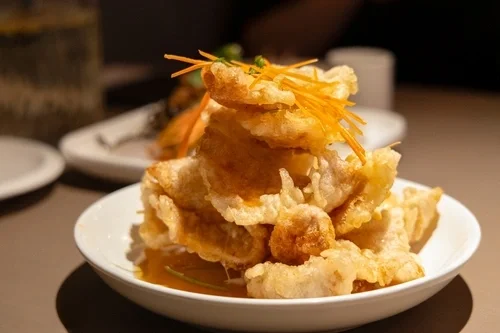
The rise of regional Chinese cuisines has opened up a new world of wine-pairing possibilities, say Fongyee Walker MW and Edward Ragg MW.
Twenty years ago, the narrative for a wine dinner in China was simple: book a five-star international hotel’s Western restaurant, pick food to match the suggestions put forward by the imported winery, bring in the winery owner or representative, and deliver a fine-wine dinner that would cookie-cutter others around the world. It was partly a reflection of the times; with international wineries unsure of Chinese cuisines and Chinese importers eager to please—or, at least, not lose face on—both sides of the cultural equation. It was also, back in 2006, a scenario where wine was associated mostly in Chinese minds with Western etiquette and customs to begin with.
But such a situation represented a significant missed opportunity, not only failing to engage with or localize wine culture but also manifesting a reciprocal lack of bravery and confidence. For one of us (Fongyee), having grown up with her mother’s Chinese cooking frequently accompanied by wine, such a situation was frustrating. Prior to moving to Beijing ourselves, we had also racked up experience steadfastly pairing wines from around the world with Chinese cuisines, both home-style cooking and in combination with restaurant dishes. Nonetheless, in 2006, fine dining in China was just beginning to unfurl its splendor. There was, understandably, a lack of familiarity with non-traditional pairing, and consumers were attending such dinners as an expression of face—of which luxurious Western food was an important part (even if many an attendee went home to have a bowl of noodles afterward).
Pleasure over prestige
Fast-forward to 2026, and what a sea change. New-wave Chinese consumers are buying less for prestige and more for pleasure; this is reflected in both the wines and the on-trade options they choose. Indeed, the most dynamic trend in the fine-dining world has been the emergence of so-called lesser regional Chinese cuisines redefining the limelight. Traditionally, the star of the posh restaurant scene has been Cantonese cooking. But arguably, with its emphasis on umami seafood and delicate flavors, it was not the easiest to combine with at least diverse ranges of wines. But as restaurants like Xinrongji have achieved three Michelin stars with its Taizhou cuisine (a subset of Zhejiang cuisine) and Lustyle has brought greater focus to Shandong cooking, the emergence of regional cuisines in the fine-dining scene has combined with greater adventurousness in food-and-wine pairing.
Related


Recently, at a Domaine de la Romanée-Conti dinner in Beijing, the La Romanée was paired with Shandong-style braised donkey hoof, where the gelatinous skin and tendons, in its deeply savory braise, was a truly eye-opening pairing, marrying different textures and flavors in extraordinary ways. It is precisely this rediscovery of gourmet Chinese regional delicacies that has been at the forefront of adventurous dining.
Indeed, such confidence in matching has also given rise to a greater self-assuredness in wine selection. In the newly opened SommsTable—another Beijing venture—the cuisine is focused on home-style Dongbei food, a branch that has long been regarded as rustic. But as with the emergence of cucina povera in Italy, this overlooked country cooking is being rediscovered in a new space, and the wine selection—curated by sommelier Meiyu Li—is exciting and bold, including, for example, aged Madeira pairing with 锅包肉 guobaorou, the Dongbei riff on sweet-and-sour pork. Meiyu Li passionately believes that this type of food-and-wine pairing is essential to drive wine sales of more challenging fine wines. She has found, in particular, that her ultra-premium wine pairings in Michelin-starred regional cuisine restaurants have encouraged fine-wine sales in categories that have previously been challenging to sell.
An exciting new era
The fact remains that most Chinese people prefer to dine out with the manifold options of China’s cuisines. Therefore, by expanding food-and-wine pairing to these high-end regional specialty restaurants, the wine trade has an opportunity to grow and expand. This was indeed part of the discussion at a recent Vinexpo Asia panel where Ian Ford (Nimbility), Oscar Nagore (EMW), Yang Lu MS, and journalist Nimmi Malhotra addressed precisely this area of development in what is otherwise a stagnant or declining on-trade scene.
Content from our partners

Matching wines with Chinese food does, however, require a degree of bravery itself hard for the fledgling sommelier community to embrace. Since many wine staff receive Western-focused training—where one dish is paired with a solitary wine—it takes confidence to abandon this model and instead pair wines to the flavors of specific regional styles, be that the sour-spice of Guizhou, the salty savoriness of Dongbei, or the chili-infused dishes of Hunan.
But when wine confidence is matched with delicious dishes, it cannot fail. Recently, a Yunnan rice-noodle restaurant hit the headlines by matching all its noodles with various Champagnes (hardly the most popular wine category in China, at least historically speaking). In collaboration with Lei Meng, who heads a Champagne specialist importing company, this is just one fairly luxurious “hole in the wall” example—notably, a Yunnan venture in Shanghai, the most adventurous market, with Chengdu not far behind. And perhaps this provides a clue as to what could be the start of a truly exciting era for fine wine and food in China, be it in the high-end on-trade or in more “modest” establishments.


