

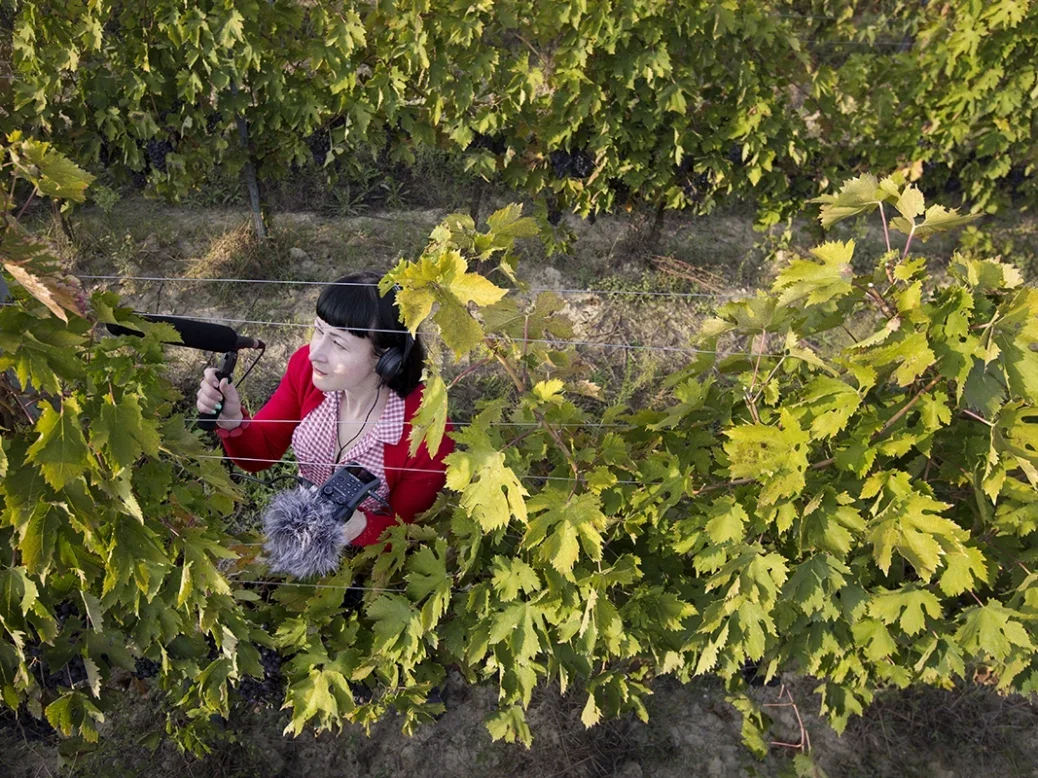
Wine writer and sound artist Jo Burzynska explores the concept of sensory terroir, the subject of her newly published book.
My wine journey has always reverberated with sound. At first, it was simply enjoying a glass of wine with the music that is so often part of the drinking occasion. Then, two decades ago I realised my perceptions of wine were being remixed by the sounds around me. This was disquieting for a wine critic, but discovering this might be a universal phenomenon offered both reassurance and intrigue. Wine started to trickle then flow into my parallel career as a classically trained musician and sound artist, revealing a growing confluence that I directed into a PhD and a book. Understandings from wine’s relationship with sound even changed the way I taste and write about wine.
Wine is a potent connector. True not only of the conviviality it induces, but also in the experience of its complex aromas, flavors and textures that resonate with specific times, geographies, imaginative locations, and emotions. As noted by the wine-loving philosopher, Michel Serres, a great wine “mimics the world … coloured, luminous, radiant, tactile, velvety, profound and caressing, suave, orchestral, a composition of brass and woodwind, spiritual,”
Yet in the initial stages of my career, I maintained a strict separation between my two primary passions. On one hand, I was tuned into the frequencies and timbres of the experimental music I was making. On the other, I was mapping wine characters to place, and the stories behind them, while intuitively conducting all my professional tastings in silence. I then encountered the work of Clark Smith, a winemaker whose tastings demonstrated what I’d had an inkling was happening, that different pieces of music alter our perception of the flavors of a wine. This was followed by the first studies using wine and music in psychology that started to clothe the evidence of the senses with theory, and suggested the phenomenon of crossmodal correspondences might be behind the sensory shifts I was experiencing.
Related
Curiosity ignited, I began conducting my own informal experiments, first on myself, then on friends and colleagues. Certain sounds appeared to consistently amplify or diminish specific attributes of a wine. My sound practice emerged as the perfect laboratory in which to further explore these insights. I started to run wine and music matching workshops, create installations and performances that integrated taste and smell with sound and have now composed music for individual wines, styles and regions. I also established the world’s first “wine and sound” bar at The Auricle Sonic Arts Gallery in New Zealand, where I curated a wine list paired with the venue’s sound art exhibitions and music playlist every month.
I started to map links between wine characters and sonic properties at a time when research in this area was nascent. So much was still to be discovered, while most studies were being conducted from the field of psychology, rather than in wine and the arts. To answer some of the many questions my early forays were raising, I embarked on a PhD that spanned the fields of wine, sound, art, sensory science, and psychology. This doctoral research and findings from my subsequent studies became the basis for The Sensory Terroir of Crossmodal Art.
Making connections
From this blend of professional skills, creative experimentation, and scientific inquiry, the concept of sensory terroir began to crystalize. Just as wine terroir describes the symbiotic environmental and human factors that combine to create the character of a wine from a specific place, sensory terroir extends this philosophy to the broader landscape of perception. It keeps us constantly mindful that our sensory experience of anything, particularly an aesthetic encounter with something as complex as wine, is not the product of isolated inputs. Rather, these are an interwoven system in which all our senses, our environment, and our personal and cultural backgrounds converge to shape our experience.
Content from our partners

Echoing the interconnectivity inherent in terroir, in The Sensory Terroir of Crossmodal Art I engage with multiple disciplines. Its research spans analysis of wine and sound combinations presented in performance venues to tasting rooms, Oxford University’s Crossmodal Research Laboratory, and in the wine sensory laboratories of the University of Adelaide. My compositional practice, which mixed intuition with existing crossmodal understandings, provided a fertile ground for experimentation, while scientific collaborations provided methods to measure shifts in experiences that can appear ineffable. At a time of extreme specialization that often sees us working in silos, I have become increasingly convinced cross-disciplinary approaches have an important role in accelerating knowledge.
As well as gaining insights into the questions that launched the journey of writing this book, other revelations occurred en route. I realised that some perceptual crossmodal mappings were hiding in plain sight in the language and metaphors that I and my wine writing peers use in our wine descriptions. Due to the inherent limitations of many Western languages in describing wine’s aromas, flavor, and mouthfeel, wine descriptions frequently borrow from sensory domains beyond taste and smell.
For example, when the late wine critic, Michael Broadbent described a German Riesling as “not exactly shrill, more like a high note on a violin,” he reflects the crossmodal association of high acidity with high pitch. In my own research, I found that a wine when tasted with a high-pitched soundscape was rated as significantly more acidic than when tasted in silence. Supported by contemporary scholarship in cognitive linguistics, using analogies in wine descriptions that are also linked in perceptual experience, shows promise for resonating more widely and deeply with readers.
Applying crossmodal understandings
The Sensory Terroir of Crossmodal Art is published at a time of proliferation in wine and music matching events and marketing—from immersive sound and taste experiences in the restaurant to the art gallery—of varying quality and rigour. Inspired by contemporary crossmodal science, Maison Krug has an ongoing wine and music project. While some of these compositions can be a little overpowering, successful collaborations—such as the sensorially attentive approach of film composer, Ryuichi Sakamoto—demonstrate how specifically composed music can intensify the appreciation of a wine. Elsewhere, Argentinian mathematician and musician, Bruno Mesz has developed innovative digital devices that blend art and science, including a “cross-modal” wine glass where sensors synchronize drinking movements with custom sound compositions.
These diverse examples are testament to the growing recognition that flavor perception is multisensory, not only involving the interplay of taste and smell, but that of vision, hearing, touch, and likely some of the dozens of other senses it is now proposed that we possess. By understanding and consciously manipulating these elements, it is possible to shape, deepen, and enrich the wine-drinking experience. To this end I have developed methods and tools that can be used by anyone interested in better matching sound/music with wine. These include the “Oenosthetic Mapping System” that I share in my book, which was tested using original works that I composed for individual wines.
My investigations into responses to wine and music/sound combinations on hundreds of people, highlighted consistent synergies between specific wine and music characters. The role of emotion within wine and sound pairings emerged as important when I examined the impact of emotional dimensions, such as pleasantness and intensity. While finer-grained aesthetic emotions might be limited or denied in some discussions of the aesthetic value of wine, these were perceived in the wines of my studies and exerted reciprocal influence with those of music. Synchronizing the sensory and emotional elements of a wine and piece of music can heighten and shift both the sensory perception of a wine and its emotional qualities. Furthermore, a well-chosen or specifically composed piece of music can help stimulate our underused olfactory and gustatory imaginations, and deepen engagement with a wine even in those with lower levels of wine interest and knowledge.
Wine experts are also not immune to the influence of sound on their appraisal of wine. Nearly all my studies included participants that had varying expertise in wine and music, with these different levels of involvement exerting little or no influence on the results. The one study that I conducted with wine professionals, impacted the way a wine’s quality was scored. This reinforces my own vow of professional wine tasting silence, and raises some serious questions about the playing of music at trade tastings and wine competitions.
Rethinking tasting
Even with this knowledge, my own expertise emerged as something I had to confront in the book. Like a sensitive vigneron who gently coaxes, rather than forces, the vineyard to express its unique voice, a light but attentive touch emerged as most appropriate for attending to correspondences between sound and wine. Given the analytical tasting methods that I had long used and taught were not best suited to multisensory appreciation, I was forced to reassess and change my entire way of tasting. Consequently, I have developed a tasting technique that draws on contemplative practices that better focus attention on the holistic, crossmodal experience of a wine. Reconnecting with the raw, embodied perception of wine, has revealed clearer relationships between wine and its environments, while eliciting new levels of personal enjoyment. It is an approach that is liberating to all wine drinkers, guiding even those with less knowledge into a more sensorially and emotionally nuanced appreciation.
Operating within the rich, multi-perspectival domain of the arts and sciences, it is my hope that sensory terroir provides a framework that promotes a more holistic understanding of sensory experience. I’m convinced that this union of subjective exploration and scientific rigor shows the most promise to unlock a deeper comprehension of the complexities of our sensory world, which might ultimately make us better appreciate wine, music, and the indivisibility of all things.
The Sensory Terroir of Crossmodal Art: Connecting the Senses through Wine and Sound by Jo Burzynksa is published in the UK by Routledge; £155 (hardback); £34.49 (ebook).


