

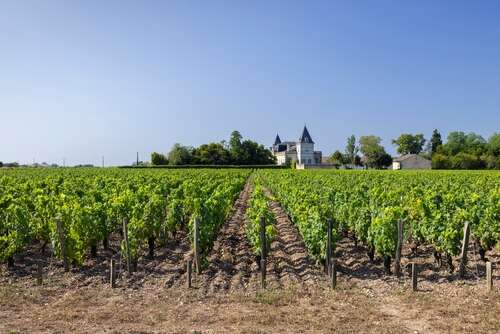
Raymond Blake reviews Saint-Julien: Vineyards, Cellars, People, and Place by Marc Bouffard.
Marc Bouffard’s Saint-Julien is a substantial tome, weighing in at a tad over 4.5lb (2kg), making it a hefty reference work to be dipped into in search of specific information rather than a volume to be read through. It’s not quite a coffee table book, though it leans that way and the production standard is such that it would not be shamed by being displayed thus. It is the first in a series that will eventually encompass all the major Bordeaux appellations, building into a comprehensive reference library. And once the final volume is published it might well be time, given the current pace of change that seems likely to continue, to tackle Saint-Julien again, Forth Bridge style. It is a conclusion Bouffard himself reaches in the final chapter: “I’m sad to leave Saint-Julien for now, but Saint-Estèphe, Pauillac, Margaux, Pessac-Léognan, Sauternes, Pomerol, and Saint-Emilion await! By the time I’m done with those, it will be time to come back to Saint-Julien.”
Perhaps it’s the name—Saint-Julien—but for me, the soft ring of “Julien” calls to mind elegance and harmony first, structure and strength second. It might be fanciful to see this appellation as a bridge between the grace of Margaux a little to the south and the gravitas of Pauillac, immediately to the north, though that is how I have always considered it and Bouffard agrees: “Nevertheless, Saint-Julien still somehow manages to convey a character of equilibrium, borrowing some of the power of Pauillac and some of the elegance of the better Margaux properties, to create what could reasonably be perceived as an archetype of Bordeaux. Even more meaningful than the character of the appellation as a whole is the individual character of each of Saint-Julien’s Grands Crus Classés, their complexity reflecting the geologic complexity of their origin.”
But why start in Saint-Julien? Would it not have been more logical to start up north in Saint-Estèphe and work down the Left Bank, finishing in Pessac-Léognan, with a sweet stop in Sauternes and Barsac, before crossing over to Saint-Émilion and Pomerol on the Right Bank? “I imagine that many will wonder why a series like this should start with Saint-Julien. After all, neighboring Pauillac, with three of the five first growths, seems more star-studded. The primary reason is personal: the Barton-Sartorius family of Léoville and Langoa Barton, Bruno Borie of Ducru-Beaucaillou, and Matthieu of Lagrange were friends before I started this work. The access into the inner world of Saint-Julien that these friendships granted gave me a view of the châteaux that I thought others would be interested to share…” Interested to share, yes, but what of a conflict of interest that such friendships might generate? “If you suspect that a close personal relationship with some of the proprietors and winemakers at these properties might introduce bias, you’re right. For what it’s worth, some of my earliest friendships grew out of my love for the wines, not the other way around… That said, the source of that bias is more of an asset than a liability for the purposes of this particular book. There’s plenty of good wine criticism out there and this book isn’t intended to fill that role.”
Related
Microscopic intensity
Thus apprised, the reader can follow Bouffard as he brings his gaze to bear, usually with microscopic intensity, on the 11 classed growths of the appellation. Each warrants its own lengthy chapter of 30 or so pages, starting with some facts and figures, before continuing through sections headed The Story, Terroir, Vineyard, Winery, Cellar, Looking Back and Looking Forward, concluding with comprehensive tasting notes that stretch back beyond World War II in some cases. These chapters form standalone, in-depth profiles with analysis and comment, and just about all the information that an interested reader—from wine lover, to wine student—could want. Given the comprehensive nature of the work, the pace of assimilation slows at times, but persistence pays off, as the châteaux are subjected to scrutiny with little or no flannel to muddy the message. Every possible topic is dealt with—from canopy management, to cover crops; Brettanomyces, to closures; cold soak, to vineyard biodiversity; yields, to food pairings.
This latter topic throws up some interesting suggestions, some conventional, others more adventurous: veal tenderloin with Beychevelle, civet of venison with Ducru-Beaucaillou, tournedos Rossini with Léoville Poyferré, pigeon with Lagrange—“a favorite pairing of general manager Matthieu Bordes”—Alain Passard’s beetroot ravioli with a young Branaire-Ducru, and flourless chocolate cake with “a young Saint-Pierre from a vintage that isn’t too tannic.” Most mouthwatering for this reviewer was: “A rosy, lavender-rubbed loin of lamb and a bottle of Léoville-Las Cases that has a couple of decades behind it make for a perfect combination.” The couple of decades is the clincher.
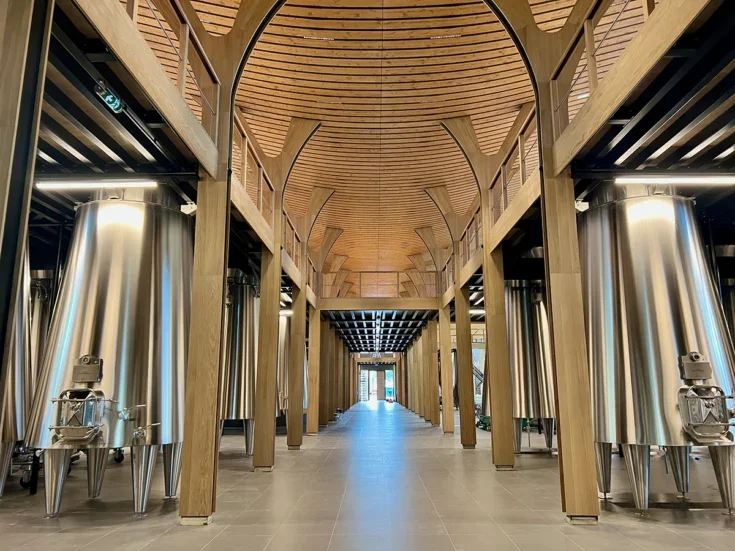
Such is the density of engaging detail in Saint-Julien that the time spent on this review stretched pleasantly toward an ever-receding horizon. Many minutes were spent poring over the maps (by Alessandro Masnaghetti and Cosmographics) and the photographs, the majority of which are Bouffard’s own. A significant number of them feature the new cellars or wineries that, in the space of a decade, have come on stream at a host of châteaux, chronologically: Saint-Pierre 2015, Talbot 2016, Beychevelle 2016, Langoa and Léoville Barton 2021, Branaire-Ducru 2022, Léoville Las Cases 2024 and Ducru-Beaucaillou 2025. The accompanying text is replete with tales of renewal and revival that these new buildings most visibly illustrate. Similarly impressive investment in vineyard renewal may not be so noticeable but it has mirrored the bricks and mortar improvements at the châteaux, most especially at Château Lagrange.
Content from our partners
When it was acquired by Suntory in 1983, Lagrange was the laggard of Saint-Julien: “… half the vineyard lay fallow and the winemaking facilities were in a state of grave disrepair.” A comprehensive assessment of the massive improvements effected since then lies beyond the scope of this review, though Bouffard encapsulates it neatly: “The total overhaul of this estate (the largest of Saint-Julien at 118 hectares under vine), has really been a monumental undertaking.” Suntory, along with the Castel Group, also own Château Beychevelle, which has seen a similar renaissance in recent years, a circumstance that rather undermines the sometimes knee-jerk reaction, complete with muttered forebodings, when big outside money comes into a wine region.
Bouffard remains commendably clear-eyed in his châteaux profiles, despite counting several owners as good friends, though he is less so when it comes to a sweeping assessment of Bordeaux in the preface, speaking of, “the region’s golden era between 1920 and 1961.” This was surely a qualified “golden era.” Yes, there were outstanding vintages such as the pair of 1928 and ’29, and the great trio of 1945, ’47, and ’49. Those peaks were high, but the troughs were commensurately low: 1922, 1925, 1927, 1930, 1931, 1932… the latter three referred to by Michael Broadbent MW as “the terrible trio.” Beyond Bordeaux, the world was hardly a receptive place for her wines in that period, given that there was Prohibition in the US in the 1920s, worldwide economic crisis in the 1930s, world war in the 1940s, and a hugely destructive winter frost in 1956. It is hard to see how this period can be called golden; gold leaf rather than 24-carat perhaps.
A topic that receives but passing consideration is the en primeur system of selling the Bordeaux classed growths as wine futures. Given Bouffard’s keenness of thought and the acuity of his pen on other topics, I expected a more resounding critique of a system that is so obviously struggling and no longer fit for purpose. The raison d’être that once held for the consumer—securing a wine at a never-to-be-repeated price—has evaporated in recent years. Apart from noting that the system is “under serious threat,” Bouffard does not subject this topic to his usual scrutiny. It is my hope that we will hear more from him about en primeur in future volumes. By the time he points his pen toward Saint-Emilion, might he even be writing its obituary?
A long-term treat
Marc Bouffard is an Assistant Professor of Neurology at Harvard Medical School, whose “academic interest in wine began in college where he became fascinated by the uniqueness and personality of the great wines of the world, and the factors that account for their individuality.” That dry statement barely captures the energy and enthusiasm he brings to his subject, which is manifest on every page of this book. He has worn out the shoe leather on his readers’ behalf and possibly even his taste buds, too, and has set himself an ambitious target, with the eventual aim of covering all the major appellations in similarly comprehensive fashion. This will be a marathon, not a sprint, though he is off to an impressive start and, at time of writing, is working on Saint-Estèphe.
Bordeaux lovers are in for a long-term treat as the series builds into what will ultimately be an indispensable reference library. If a new work is published even every two years—still an ambitious target—then we can look forward to at least another dozen years of Bouffard’s opinion and wisdom. This series will be the gift that gives and gives. Saint-Julien is a must-have reference work that has already been granted a prominent position on my bookshelves. Be sure to make space on yours, too.
Saint-Julien: Vineyards, Cellars, People, and Place
by Marc Bouffard
Published by Wine Education Council and Académie du Vin Library; 368 pages; €76.95


