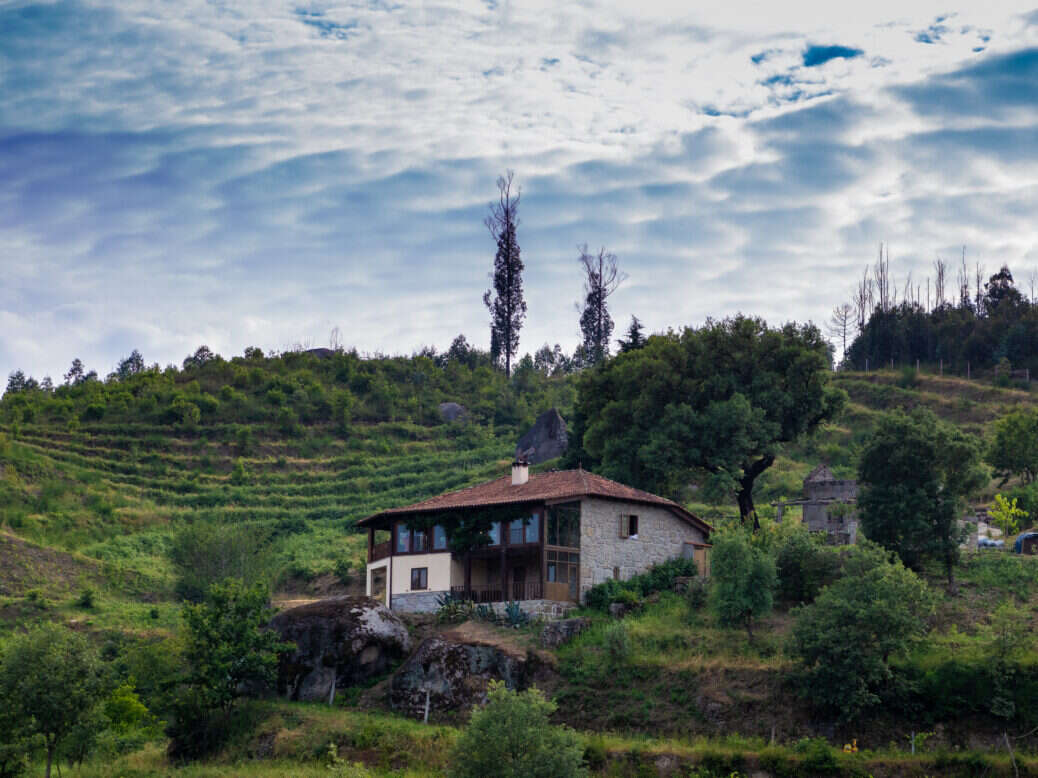
Sarah Marsh MW visits the six producers of the New Dão.
I chanced upon Marcelo Villela from Textura at Vadio while visiting Bairrada’s Baga Friends group last year. A newcomer to neighboring Dão, Textura’s elegant wines had caught my eye in London. Villela proposed gathering three or four producers with similarly refined wine. Fast forward to March 2026. The inaugural dinner for a new fraternity of six Dão producers hastily assembled in the days before my visit. The group’s name “New Dão” was under discussion. Their reference point and inspiration is Quinta da Pellada, where Álvaro Castro pioneered a restrained approach to Dão winemaking—a contrast to the overextraction and new oak of the 1990s and 2000s. (The fluidity and finesse of Pellada Alto 2019 is entrancing.)
The six producers share a passion for Dão’s terroir. Envisage an inland bowl of weathered granite with a hilly centre surrounded by mountains. So while Dão has warm inland summers, a strong diurnal keeps the wines fresh. The six producers are equally devoted to the diversity of traditional varieties used to reflect this terroir. Each has revived old vineyards, some also planting new vineyards respecting historic field blends. All recall exciting bottles made during the dictatorship when it was mandatory to sell grapes to state-sanctioned co-operatives, the quality and longevity of which they attribute to the vineyards, notwithstanding the winemaking was industrial.
Sadly many old vineyards were swept away during the dictatorship, often replanted in varietal blocks, but the rot really set in from 1986 in the wake of EU subsidies which prescribed clonal material and mechanised viticulture aimed at producing volume; a system which introduced Tinta Roriz (Tempranillo) and proliferated Touriga Nacional, which now dominate the centre and western side of Dão and contribute to an overly alcoholic, astringent, and tannic style.
Related
Beyond Touriga
Touriga Nacional probably originated in the foothills of Serra da Estrela—at 2,000m (6,650ft) Portugal’s highest mountain lies on the eastern side of Dão and forms a barrier to continental heat and winds. The 480–620m (1,310–1,970ft) foothills are home to the majority of truly old vines and origin of an astonishing diversity of varieties—as many as 50 in a field blend. Touriga Nacional is a minor player. The mainstays are Baga and Jaen (Bierzo’s Mencía). António Madeira describes Baga as vertical and thin in Dão’s granite soils, so it needs Jaen’s, which is soft and super-fruity in the Dão, to bring the fruit and width to complete the palate.
Madeira’s parents, who emigrated to France, still can’t comprehend their son’s decision to leave a successful career in engineering in Paris to return to agriculture in Serra da Estrela. “I changed my life to help maintain the genetic diversity of material and to promote the region following organic and (since 2018) biodynamic principals,” says Madeira with an evangelical gleam in his eye. He keeps three horses to work his 7ha (17 acres) spread across 20 parcels and uses little, sometimes no, sulfur. He worked rom a garage for eight years before selling his flat to build a winery.
“Dão should be fresh with fine tannins,” says Madeira who makes three single-vineyard reds. I especially liked the pure, super-straight, and dynamic Os Granitos 2023 (a nicely balanced vintage) from a 0.3ha (0.75acres) northwest-facing parcel on thin granite planted with twenty-odd varieties on vines aged 50–100 years. He clearly favours Vinha da Serra which is 70% Tinta Amarela (Trincadeira). “Ethereal. The Pinot Noir of Portugal,” says Madeira. We visited the 0.1ha (0.247 acres) parcel. The 2023 is intense with porcelain texture and herbal aromatics which carry the finish.
Content from our partners

“Mono-varietals don’t work here,” Madeira proclaims. I’d agree that blends seem to produce more complete reds in Dão, but many producers make attractive single-varietal reds including Jaen from young Daniel Niepoort. Recently made head of winemaking for Niepoort, Daniel is honing their Dão operation and experimenting to explore the potential here. Low-acid Jaen needs picking early in Dão and Daniel lifts the sensation of freshness with 100% stems gently pressed down by hand. It’s aged in amphora and so pretty.
Niepoort purchased Quinta da Lomba in Serra da Estrela’s foothills in 2012, with 10ha (25 acres), including a parcel with barely any vines, nurtured as a resource of genetic material. There’s a mixed white parcel, age uncertain, which is exceptional, since whites were traditionally planted in red field blends, even if most producers now pick and produce them separately.
Quinta da Lomba Garrafeira 2020, a blend of Jaen, Baga, Tinta Pinheira et al, is a taffeta-crisp and complex red still aging in 2500-liter foudres, showing Dirk Niepoort’s delicate touch. Generally, the Dão six have few barriques, more 500l, and some foudres. Any new oak marks Dão’s reds.
When Carlos Raposo, previously head oenologist at Niepoort, established World Wild Wines in 2018 he was criticised for using no oak. Definido 2022, a Bag- led field blend aged in concrete, is surprisingly light and gauzy given the hot and dry season and the variety. Raposo (like Bairrada’s Baga Friends) finds Baga’s finest expression, and he likes single-varietals. Tinta Pinheira 2023 is certainly refined and long, but maybe misses intensity mid palate.
New Dão: The newcomers
While Raposo and Madeira have family roots in Dão, albeit not in winemaking, the other figures of the “New Dão” are incomers and relatively recent ones at that. Brazilian Marcelo Villela brought his family from Rio to establish Textura Wines in 2018, producing from 28ha (70 acres) of certified organic vineyards vinified in a renovated textile factory.
Textura Encoberta eloquently illustrates the influence of a little clay in predominately granite soils. It’s rounder, fuller, with thick, smooth tannins, than wines from the fine granite of Vila Nova de Tazem parcels in Serra da Estrela which are straighter, energetic, and crisp. Textura also make single-varietal Tinta Pinheira. The super-light 2023, vertical and pinging with sour cherry, goes down well in Japan.
Textura’s elegant single-vineyard Pura (old vine field blend) contrasts with Textura da Estrela, which is more austere, reserved, and edgy and includes 30% deftly managed Touriga Nacional. My favorite is the super-svelte and gliding Tinta Negrosa from a pure granite parcel at 600m (1,970ft), a blend of low-acid Jaen and high-acid Alfrocheiro.
I tried a lively, light tank sample of Alfrocheiro with viticulturist Nuno Mira do Ó who came to central Dão to make Encruzado, but thought “what the hell. Let’s try reds too.” It’s warmer than the Estrela foothills. The Caramulo mountains block any Atlantic influence and the deeper granite soils are mixed with clay. Here you’ll find the concentration of Touriga Nacional and Tinta Roriz plantings. Touriga Nacional contributes sturdy tannic grip to Mira do Ó reds even when de-stemmed and blended with soft Jaen or light Alfrocheiro. I prefer his whites. Have I mentioned that Dão whites can be very good, arguably better than reds? But that’s for another time.
Staying central, but moving south to the lowest (200–300m [660–980ft]), driest, and warmest terroir near Carregal do Sal between the Rivers Dão and Mondego, Domínio do Açor was purchased by a group of Brazilian investors in 2021 on the recommendation of Luís Lopes, formerly at Quinta da Pellada.
Working with terroir consultant Pedro Parra, Lopes and fellow winemaker Costa have mapped the texture, depth, compaction, and life of the topsoil in this 22ha (54 acres) parcel. This informs viticultural decisions, most significantly grafting over existing vines, and winemaking; where the texture is siltier, less degraded, and the water retention is greater, stems don’t lignify and are removed.
More than 60 fermentations were made in the first two years. It’s a fascinating project. Tinta Pinheira here is sweetly raspberry, crisp, and crunchy. They produce Jaen from two parcels. Alterita 5 (silty) is rounded, juicy, and loosely textured, while Jaen Alterita 3 (sandy/30% stems) is fine-textured, straight, and vibrant.
I tried as much as possible with far too little time, including old varieties from mountainous Estrela with high acidity and longer growing cycles useful to combat warmer seasons. “Varieties for the future from the past” muses Luís. The diversity of varieties is Dão’s great strength.