Sarah Marsh reports from Bierzo, where the red Mencía wines are at a moment of transition, but the best are already among Spain’s most ethereal.
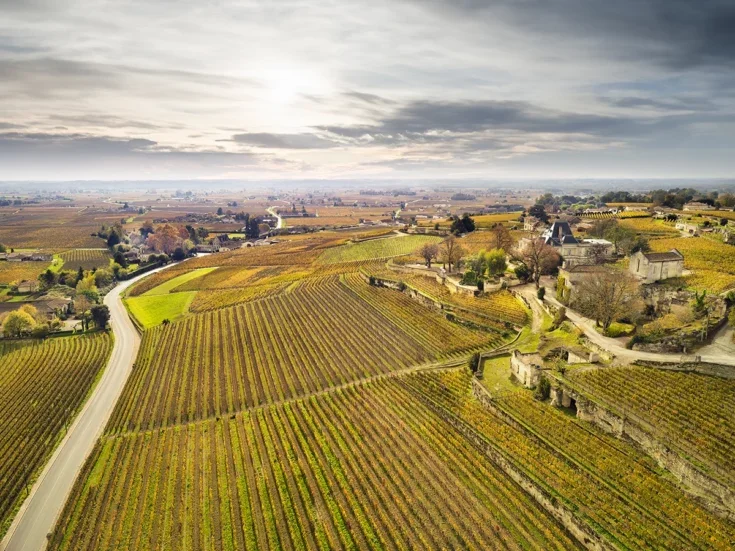
On the mountain slope in Corullón, Álvaro Palacios has recently completed his new winery, a cathedral of polished concrete designed by Rafael Moneo. It overlooks Bierzo’s valley of rolling vineyards encircled by hills and mountains. Vineyards on Corullón’s precipitous slopes, including Palacios’s acclaimed Faraona, are tortuous to manage. Unsurprisingly many were abandoned, but Bierzo is enjoying a renaissance which began when Palacios arrived from Priorat in 1998 to establish Descedientes de J Palacios with his nephew Ricardo Pérez. Meanwhile Raúl Pérez recognised the true potential of the vineyards worked by generations of his family. In 2003 he established Ultreia, took over Castro Ventosa in 2010 with his nephew César Márquez and subsequently encouraged talented locals and incomers alike. Palacios and Pérez were the catalysts for change.
On the far west of León province in northern Spain, Bierzo has a continental climate, but benefits from some Atlantic influence. Historically Bierzo’s minuscule vineyard parcels were used for home production. Following WWII, many growers supplied the local cooperative and subsequently commercial wine producers, some in neighboring Galicia thirsty for Bierzo’s reds produced from Mencía. Having low acidity and color, Mencía is typically co-planted with white varieties Godello, Doña Blanca, and Palomino, which contribute acidity while Garnacha boosts colour.
In the 2000s Bierzo’s red from over-cropped vines gave way to rich wines aged in new barriques. Properly managed old bush vines of Mencía yield concentrated fruit, but sugars quickly sore while acidity plummets (at 13.5% wine can reach pH 3.7). I’d been intrigued by these gnarly old Mencía vines walking the Camino Francés with my son during Covid and determined to return. Bierzo’s Consejo Regulador claims the region has the highest concentration of centenary vines worldwide. Retracing my steps from St-Jean-Pied-de Port in 2025, they obligingly arranged a generic tasting.
Related
Although there has been a change in approach among a cohort of producers to make lighter (12–12.5%) refined wines, the generic tasting revealed a region in transition. Although well made, many showed over-generous oak, extraction, and alcohol (14–14.8%) for my palate. Others hovered inbetween. Mencía has a delicate structure and oak easily dominates.
Terroir-driven wine is achieved by precise/early picking, kid-glove extraction, and for some the inclusion of whole bunch, the latter trend led by Raúl Pérez. Such wines are likely to be matured in used puncheons and foudres. Verónica Ortega uses 100% whole bunch and amphora “for finesse and to preserve the pure fruit character.” “I now use larger barrels for all my top wines,” comments César Márquez who is the first to harvest in Valtuille. “Co-fermenting with whites makes reds more elegant, fresher; gives floral notes and length.” It seems their inclusion is integral to the expression of Bierzo terroir, which as ever I was on a mission to understand.

Exploring the Bierzo terroir
In 2017 Bierzo DOC established a pyramid classification of regional, village, and single vineyards (parajes), which supports and encourages a terroir focus. I visited ten producers, cross-referencing their description of terroir with my tasting notes.
Content from our partners

The territory can be divided into valley and “mountain.” In the roly-poly valley (400–600m [1,310–1,970ft]) where vineyards are planted on slopes of every aspect, wines lean into a fruity and rounded profile showing the generosity of clay, but there are variations of soil and style within this. My visit to César Márquez was enlightening. César makes his own wine, eponymously labelled, and Castro Ventosa—independently since 2017. He is located in the village of Valtuille de Abajo, the epicentre of the valley encompassing 643ha (1,589 acres) of Bierzo’s 2,395ha (5,918 acres) of vineyard.
César divides Valtuille into three bands: clay with significant sand (eg la Cova de la Raposa and Villegas); clay and stones; and clay with quartz and iron. There’s iron in El Rapolao paraje where several producers have parcels confirming a somewhat sturdy, earthy profile. By contrast Villegas paraje is sandy. Castro Ventosa and César Márquez produce floral wines with red fruit and fine-texture, the former more fragrant. What sandy soil lacks in structure it compensates with charm and fluidity.
There are rare (under 1%) patches of calcareous soils. Limestone gives César Márquez Sufreiral (620m [2,030ft]) taffeta crunch and salinity. Cool and silken Careo is Verónica Ortega’s most refined wine.
The slate and schist in the encircling hills and mountains are of much older origin than the clays. Lightness with intensity can be achieved in this terroir. In Alto-Bierzo’s Cobrana village Veronica produces Kinki, which is amphora-aged, and includes 35% Garnacha. 2023 is high-wired and powdery textured. A Bruxa 2023 has greater depth; straight, sapid, neatly edged from slate and sand.
At 700–1,000m (2,300–3,280ft) viticulture can be extreme in Corullón, both a village and a district. (Some 30.6% of Bierzo’s vineyards lie between 600–800m [1,970–2,620ft] in altitude; 1.46% lie above that band). Wines are typically straight and lively; sparse and edgy.
The most ethereal is César Márquez Pico Ferreira, which is racy with lacy-fine texture from Paraje Zagalin at 700m (2,300ft): a favorite. José Antonio Garcia blends 16 parcels for Vino de Village Corullón, which is showing vibrancy and tension in 2022. Monica Gonzalez Dineiro 2020 Vino de Villa de Hornija is pretty, bright, and snappy.
Santiago Ysart of Cantariña discovered the abandoned east-north/east parcel at 550–650m (1,800–2,130fft) on a 60% slope while walking his dog. Nobody wanted it. After 2017’s crop was scoffed by wild boar, it cost more to fence than to buy. 7 A Freita 2022, which includes 13% Palomino, has crisp texture, tension, and salinity.
Descedientes de J Palacios’s steep, single-vineyard wines, which are matured principally in 1000-1500-liter foudres, demonstrate the diversity of Corullón terroir. Moncerbal is tantalizingly chilly, chiffon-delicate, swift, and saline. In contrast, clay mixed with schist in Las Lamas bestows generosity and velvet texture; so seductive in 2023. The complex soils of La Faraona which include iron and basalt, produce compact, layered, vigorous, and age-worthy wine.
At 700m (2,300ft) in Alto-Bierzo’s Arganza, young Grégory Pérez from Bordeaux created a small fiefdom by painstakingly assembling parcels that ranged from 0.004–0.16ha (0.01–0.4 acres) of abandoned vines on slate soils. Planted in the 1940s, some are so low-yielding and so backbreaking to work he’s replanted them, based on the premise that “terroir is more important than old vines.” I can’t argue with that. Gregory’s label is Mengoba. From the rare Estaladina variety (0.1% of Bierzo’s total planting), Gregory produces a delicate rose-petal, shimmery red which slip-slides to a mineral finish.
Only a small vanguard produce wine with such translucency to terroir, but there are signs of change. At Luna Beberide, Oswaldo Pereira separated from Ribera del Douro producer Mauro which favors a richer style of Bierzo. “We have re-focused on single vineyards and more restrained wine.” At 700–900m (2,300–2,950ft) on poor slate slopes in Corullón Paixar Paraje, 2023 A. Serra combines red fruit and salty austerity, while Paraje Viña de Vacca is floral, razor-sharp, and herbal-fresh and, like Palacios’s north-facing Al Chelo, which pings with tension, it probably benefits from warmer summers.
Incidentally Grégory Pérez also makes bright, pithy, savory-salty whites from old-clone Godello. With demand escalating, many are planting Godello or grafting over old Mencía vineyards. I must return to write about the whites, but maybe not on foot.