

Michael Schuster joins UK agents Corney & Barrow to taste 2023 Domaine de la Romanée-Conti, the latest releases in what is well on the way to being a golden decade for the Domaine.
A golden quintet already in bottle: 2019 to 2023. A golden DRC decade in prospect: 2015-2025?
Drinking dates
Corney & Barrow, the UK’s DRC agents, always recommend rather earlier drinking dates than I do—based on considerable experience, they are at pains to point out. And it’s true, the wines are so beautifully made, and these days so finely textured from the word go, that they will indeed reward early broaching. Indeed, one of the most eye-opening takeaways for me, from a remarkable DRC dinner in 2024, was just how rewarding these wines can be in their relative youth. That said, if you can afford to wait those few more years, I would suggest the rewards will increase exponentially, in terms of bouquet especially but also in terms of overall ease, harmony, polish.
The growing season
2023 was yet another “hottest year since the turn of the century”—that now-annual mantra, and adaptability across the season was the watchword. After a very dry, warm winter there was welcome rain in March, and with budbreak came the first indications of quantity. April and May were sunny but cool, and flowering took place very successfully from May 20 to June 10, in dry, hot conditions, confirming the likelihood of a substantial crop. There was welcome rain in June and the first yield-management measure was bunch-thinning in early summer, followed later by green-harvesting of less than perfectly ripening clusters. July, especially, as well as early August, were cooler than average (so the harvest would not be early) and there was plentiful summer rain when and where needed, avoiding drought stress and phenolic blockage in the ripening vines. As in 2022, a key to both the quantity and the quality of 2023 was the quantity of rain, and the moments in the viticultural year when it arrived.
Related

The moderate summer temperatures limited ripening progress and while, as a matter of principle, the Domaine don’t like to green-harvest, they later removed clusters that were ripening unevenly, beginning to rot, or likely to become sunburned from exposure, thus allowing the remaining crop, still plentiful, to ripen more easily, healthily. A surprise, perhaps, was that while the grape bunches were large, the grapes themselves were not—which explains the unlikely combination of high yield on the one hand, allied to the concentration and structure of the wines on the other.
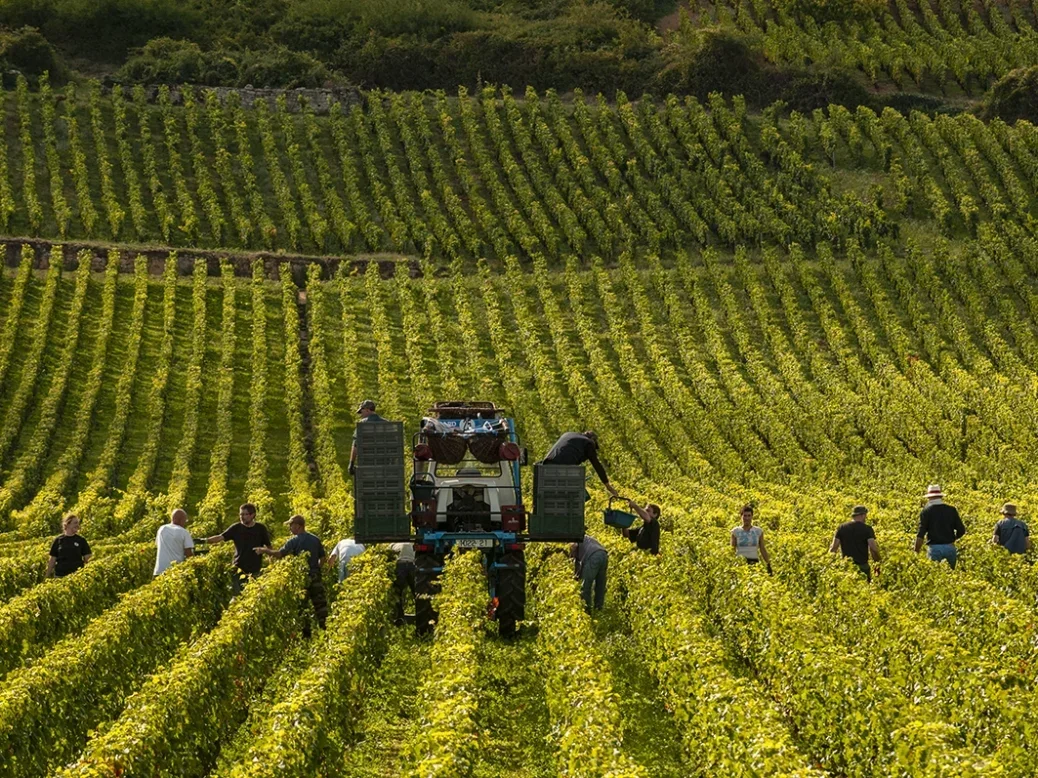
The fruit in this “hot year” ripened later than in 2022, initially because of the very large crop on the vines, followed by the noticeably cooler than average July and early-August temperatures. The mature crop was in excellent health, with the harvest starting a week later than in 2022, taking place between September 7 and 17, and initially in a very hot early-September heat wave. Crucial to the final quality of the wines was picking according to plot, and taking particular care to avoid overripeness.
The grapes were nonetheless notably sugar-rich, resulting in the “highest levels of maturity ever at the Domaine,” with all the wines at 14%+ ABV. Of 2022, co-director Perrine Fenal had noted: “We have never seen this level of quality from a vintage of such abundance”—a comment she might equally well have applied to 2023.
Content from our partners

The warmest year on record notwithstanding, what mattered in the end for the character of the fruit, was the precise juncture of the cool spells in the viticultural cycle, which go a long way to explaining the lack of an extreme wine style, from a growing season of more than a few weather extremes.
Vintage style and quality
2023 was a second prolific year, following on from the Domaine’s most abundant vintage ever—2022. And as with quantity, so with quality, 2023 is every bit as grand and classy as its predecessor. Wines that, despite being born of high yields, considerable heat, and a high level of ripeness, show no signs of excess in style. Part of this really does seem to be down to the vines adapting themselves, becoming more resistant in particular to greater extremes of temperature.
At the February tasting in London, the Domaine and the Corney & Barrow team were at pains to point out that there was “no resemblance” between 2023 and 2022. Well, yes …. and no. What they have in common: They are both distinctly solar expressions of their origin, the product of copiously sun-nourished grapes; they are both the product of notably abundant harvests; they are both of outstanding quality. Solar, copious, qualitatively illustrious. That is already a great deal shared. But stylistically, they are certainly different.
The 2023s are all at least half a degree higher in natural alcohol. It is barely noticeable as such, other than as the occasional touch of flattering warmth in the throat on the finish. This is, these are, one of the great back-to-back pairs in the making, which will inevitably beg comparisons. And for all the similarities in the growing season between the two years, 2023 does seem to paint its year very differently—perhaps as more of a challenge to survive, making for fruit of greater firmness, imposing a certain strength of character to cope. They are wines that are distinctly less luxurious than the 2022s, and their clear, if very fine, tannic substance and structural presence is what, for me, defines the principal difference between these two superb years. Above all, a sense of matter and gentle, but clear, firmness. It is another magnificent vintage, qualitatively absolutely on a par with 2019 and 2022. But yes, stylistically, very individual.
I wrote last year that for the few lucky enough to have the opportunity, what a pair 2019 and 2022 will be, to delight in side by side in due course… to which we should now add 2023, as the third in the notably grand style. 2019, 2022, and 2023, the trio of substance and imposing bearing flanking 2020 and 2021, vintages of an equal quality, but with an emphasis rather on finesse, delicacy. A golden quintet already in bottle: 2019 to 2023. And, looking back ten years, from the perspective of 2026, for all the climate change challenges and quantity vagaries, from a quality point of view, the decade from 2015 to 2025 looks likely to be particularly special for the Domaine. A golden DRC decade in prospect then: 2015 to 2025?
Scores
Well, needs must. But, as usual, these can be little more than indicative—and the most important point to make is that the 2023s are on a par, qualitatively, with 2022 and 2019. Any wines from these three grand vintages will taste absolutely wonderful at any stage of their lives. When the question will be (should be?) not, “Which is better?”—a “scores,” a hairsbreadth question—but what are the the diversities to celebrate and savor?
Tasting 2023 Domaine de la Romanée-Conti
Corney & Barrow, London; February 2, 2026
2023 Domaine de la Romanée-Conti Corton-Charlemagne Grand Cru
(1,134 dozen [1,757 in 2022]; 14% ABV)
Very pale gold; a particularly persistent nose: fresh, subtly citrus, hawthorn floral, mineral-suffused, fruit-profuse, too—captivating; a rich, vital, concentrated wine, superbly constituted. And with a beautiful flavor, very ripely dry, freshly defined, so long and graceful across the palate, fruit-packed, aromatically complex, gloriously resonant as it coats the palate. All this, and yet … surprisingly fresh, elegant, vivid, much less “fat” than the year’s climate might suggest, and with as much Corton spine as you could want. Great wealth beautifully contained. A most complete, refined, taut Corton-Charlemagne, with striking complexity and length. Given its tension and definition, you’d never guess, blind, that this was from one of the hottest years ever. It will be immensely rewarding immediately, but with the constitution to last, and gain in subtleties, for decades. Magnificent. Now to 2043+. | 98
2023 Domaine de la Romanée-Conti Vosne-Romanée Premier Cru Cuvée Duvault-Blochet
(316 dozen [228 dozen in 2022]; 14% ABV)
This cuvée is now reserved for Corney & Barrow’s restaurant customers, and is released later than the other wines. It is not made very often (though it was also made in 2022) and in this case the decision was made because in 2023 the wines from the young vines—while clearly tasting good enough for premier cru—were not really up to grand vin status. This was a function of the year’s yield and, especially this year, of some younger vines in the different grand cru parcels, just not ripening in quite the same way as the rest.
Mid-red; ripe red-fruit fragrant to smell, with a clear whole-bunch, faintly peppery, herbal character; fullish, fresh, quite firm in tannin, full of strawberry-sweet succulence, with matter, definition, a nice length of flavor and a fine, scented, fruit-cored finish. The tannin is firmish so, while you could of course enjoy it early, if you like your red Burgundy silkier, I’d give it a bit of time. 2029–40+. | 92+
2023 Domaine de la Romanée-Conti Corton Grand Cru
(34hl/ha [40hl/ha in 2022]; 809 dozen [946 in 2022]; average 2010–17: 413; highest since 2009: 946 in 2022; 14% ABV)
Dark red; a dense, fruit-packed impression to smell, black-cherry ripe with the whole-bunch herbal element, too; rich, vital, finely firm in tannins, with a delectable fruit core; taut, elegant wine, with considerable matter, long and ample in the mouth, distinctly Corton sinewy and with fine, spicy aromatic persistence. Classic Corton proportions and style. 2032–43+. | 93+
2023 Domaine de la Romanée-Conti Echézeaux Grand Cru
(38hl/ha [43hl/ha in 2022]; 1,694 dozen [1,966 in 2022]; average 2010–17: 1,195; highest since 2009: 1,966 in 2022; 14% ABV)
Mid-purple; a really lovely nose—initially whole-bunch peppery/herbal, but spicy and complex, with a ripe black fruit rapidly dominant, persistent and glass-filling; generous to taste, firmly structured, both from a lively acidity and a firm tannin; long and notably aromatically complex on the palate, softer and more elaborate than the Corton, long and racy and mouthcoating, with an excellent spice and strawberry-sweet persistence. A fine expression of the vineyard, in a firmer style. You notice, as with the Vosne-Romanée and the Corton, a residual impression of tannin on the palate after tasting, swallowing. An Echézeaux of considerable scope, a fine long-term proposition. 2033–45+. | 94+
2023 Domaine de la Romanée-Conti Grands Echézeaux Grand Cru
(44hl/ha [43hl/ha in 2022); 1,474 dozen [1,566 in 2022]; average 2010–17: 991; highest since 2009: 1,566 in 2022; 14% ABV)
Mid-red in color; initially reluctant on the nose, but rapidly red- and black-fruit ripe, and much more subtly spicy and complex than the straight Echézeaux; a notably rich, generous wine, freshly defined, finely firm in tannin, yet also an immediately flattering Grands Echézeaux, almost “fleshy” in the firmer 2023 context; ample, long, spicy, with a great tenacity of flavor, marked black-fruit ripeness, and with great, fruit-cored aromatic length. A stellar expression of the vineyard, very much asserting the “Grands” in this vintage. 2036–48+. | 96+
2023 Domaine de la Romanée-Conti Romanée-St-Vivant Grand Cru
(38hl/ha [40hl/ha in 2022]; 2,064 dozen [1,975 in 2022]; average 2010–17: 1,250; highest since 2009: 2,064 in 2023; 14% ABV)
Mid-purple; on the nose, that minerally-limestone suggestion that always seems to be part of this DRC vineyard’s expression, alongside fine, subtle, complex scents, so tempting, one to linger over, with its considerable spectrum of ripe fruit and fragrance; full, vivid, with superfine but present tannins, a rare impression of matter (restrained) and structure (gentle, but clear) for RSV; very long and close-grained across the palate, with (no surprise) superb length. Mozartean clarity, with the year’s growing season weaving through a fine, tautening thread. Gloriously refined. Needs at least a decade. 2036–50+. | 95
2023 Domaine de la Romanée-Conti Richebourg Grand Cru
(45hl/ha [43hl/ha in 2022]; 1,246 dozen [1,211 in 2022]; average 2010–17: 848; highest since 2009: 1,311 in 2009; 14% ABV)
Deep mid-purple; very dense to smell, you sense the fruit mass, whole-bunch-touched, complex, spicy, persistent; that profusion of aroma is then projected on the palate with great finesse, length of flavor, and an imposing aromatic echo. Ripe, yes, abundant, yes, but a fruit charge nonetheless, entailing the year’s firm, if enriching tannins, whose structural embrace says let me sleep a fair while. Tauter and more mineral than the Grands Echézeaux, this year clearly parading Richebourg’s typical muscular bearing. Substance allied to scope, a most complete, classic Richebourg. 2038–53+. | 97
2023 Domaine de la Romanée-Conti La Tâche Grand Cru
(38hl/ha [38hl/ha in 2022]; 2,241 dozen [2,227 in 2022]; average 2010–17: 1,386; highest since 2009: 2,241 in 2023; 14.5% ABV)
Deepish mid-purple; a rich and complex nose, packed with subtleties of pepper-spice, whole-bunch herbs, red- and black-cherry ripeness, expansive and persistent; very rich, concentrated, and vital, finely firm in tannin, a wine of splendid long-term proportions. An enormous presence on the palate; scope, mass, sinew, warmth, aromatically generous, wonderfully ripe black-fruit-suffused, all firmly framed in the structural fingerprint of the year. A great late-Brahms “mass” of a wine. Majestic. Give it time. 2038–53+. | 97+
2023 Domaine de la Romanée-Conti Romanée Conti Grand Cru
(38hl/ha [37hl/ha in 2022]; 675 dozen [694 in 2022]; average 2010–17: 432; highest since 2009: 694 in 2022; 14% ABV)
As always, it is difficult to know how to convey this wine in words. Coming after the power of Richebourg, the wealth of La Tâche, it regularly seems reticent, less immediately impressive. Often when first encountered the primary, the predominant response is: I can’t see why this is the “greatest” of the DRC wines? Because it is, by comparison, so quiet-spoken. Less strong, less imposing. But it simply demands time, time to contemplate, to read, to scan, to appreciate. And, in terms of what we put in our mouths, wine is unique in that its transparent, liquid nature allows us to do this over time, without overly altering its composition. As with a great work of art, we need time … to see what there is to see. 2023 RC more than exemplifies this.
The nose is immediately impressive: heady, complex, exotic, oriental spice-boxed… glass-crowding, alluring, astonishing. The palate, by contrast, seems low-key initially, but it doesn’t take long for this hush, this quietude, to stir one’s emotions intensely, to sense its capacious, its expansive quality, to relish the tactility of its close-grained textures, its amazing finesse and detail. But all this is played mezzo-piano, mezzo-forte at most. It seems endless to explore and tease in the mouth, to taste and retaste. And finally, of course, there is a length of aftertaste to more than mirror all before. Yes, the year’s firmish tannins linger, too, but this is utterly magnificent. And how much better can it be, can it get? 2040–58+. | 99–100
Something similar to a great composer’s late compositions, which seem to have a more profound emotional impact from an apparently greater economy of means? Think Verdi’s Falstaff, Beethoven’s late quartets … Less can be more? Thus Romanée-Conti in contrast to La Tâche. Romanée-Conti, as so often, the apotheosis of Pinot Noir voicing itself, its winemakers, its vineyard, its year. Pseud’s corner stuff? I understand that. Wine writers grapple with this regularly. But DRC’s market value—deserved or not, depending on your point of view—indicates a broad, if specialist, perception of its monetary worth. There is little of it, and it is very highly “appreciated”… the Latin appretiare meaning, literally, “to price.”


