

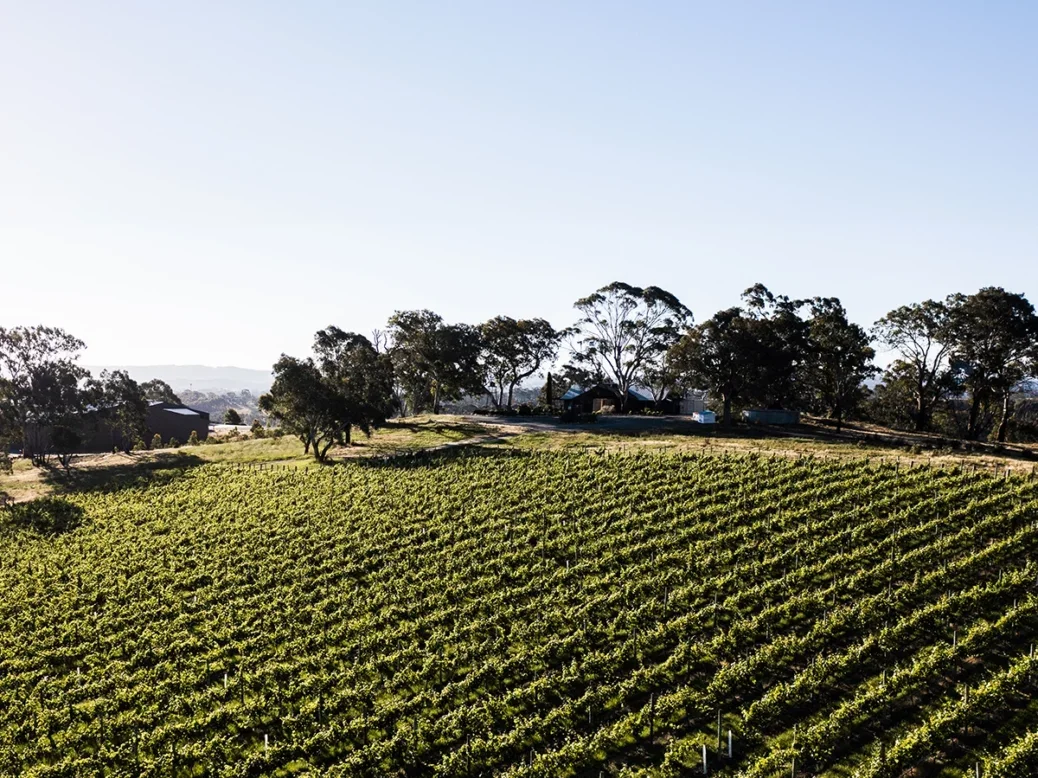
The Adelaide Hills owes much to some of the biggest names in Australian wine, with producers like Michael Hill Smith MW and Martin Shaw from Shaw & Smith and Brian Croser, who planted the Tiers Vineyard, established Petaluma, and now has his own Tapanappa operation. Chardonnay from here is focused and intense, showing great length and an array of flavors, including citrus and stone fruit. Complexity seems to be a given.
Tapanappa
When the megalithic Lion Nathan swooped on one of Australia’s more famous wineries, Petaluma, in 2001, founder Brian Croser was able to retain the Tiers Vineyard. For many, this was the vineyard that established that Australia really could make first-class Chardonnay. It is still proving that today. It was also the first vineyard planted in the Piccadilly Valley in the Adelaide Hills since the 19th century. Few people in this country know more about Chardonnay than Brian Croser, and he is always generous in sharing his thoughts and the history in which he played such a crucial role.
Brian has noted that he learned about the “uniqueness” of Chardonnay while at Davis in California. The name Petaluma came from a local town in California. It helped inform his choice of site for a vineyard when he returned to Australia in the late ’70s. At that time, “to grow great Chardonnay became a life’s mission.” The first fruit, for their 1977 Chardonnay, came from Cowra. By 1980, they were including fruit from Coonawarra, and in 1988 incorporated a percentage of Piccadilly Valley fruit. The first Petaluma Chardonnay that was 100% from the Piccadilly Valley was the 1990. The first single-vineyard Tiers Chardonnay was from 1996, and the first Tapanappa Tiers was from 2005. Over the years, replanting has seen the introduction of French clones on rootstocks and closer spacing of the rows.
Winemaking? Brian describes how it has gone full circle—“from totally protective Riesling-like processing at the beginning, preserving all of the native fruit, through full malolactic and lees stirring with 70% new oak in the ’90s, to finally no malolactic since 2017, no lees stirring, and 30% new oak, retaining the protective winemaking.” Site has always been a critical element in Croser’s wines, long before most gave it a second thought. He believes that Tiers “is a very special vineyard in the Australian context. It is the epitome of a ‘distinguished site,’ delivering wines of distinction, unique to the vineyard and conforming with all of the parameters of wine greatness. Still fresh and intense at age, with complexity and an identifiable Tiers aroma and flavor. Great texture, tastes as it smells, complex flavors, balanced and long aftertaste. Tiers Chardonnays age for at least 20 years and are at their best at about 10 years.” He believes his latest five releases have been his best wines but that the site will provide even better in the future. He is slowly replanting the vineyard—a project that he notes will finally be complete in another 60 years.
Related


Brian had always believed that his vineyard consisted of the “University of California, Davis, clone known in South Australia as OF.” The vines sold to him in the early ’80s were identified as such. A long story for another time—but it appears they were no such thing and were “as far away from the California and French clones as Australia is from those locations on a map of the world. Looking backward through the supply chain as it was in 1982, it seems the Tiers was planted with a selection of Chardonnay that came illegally into South Australia, via Mudgee, Cowra, and Mildura, but was originally from Busby’s brother-in-law’s Kirkton Vineyard in the Hunter Valley. James Busby had imported Chardonnay from France and planted it at Kirkton in 1832.” As mentioned elsewhere, it if works…
Tiers Chardonnay 2024
A wine of elegance and intensity with impressive persistence. The nose gives notes of cinnamon, grapefruit, florals, citrus, a flick of banana, and early evidence of the quality oak used throughout. Terrific energy radiates through the entire wine, which is finely balanced and offers a lingering finish. In time—and it surely has at least 15 years ahead of it—this should be an absolute classic. | 97
Content from our partners

Tiers Chardonnay 2023
From the famous vineyard. Fermentation was in French oak barriques, one third new. Deft oak handling throughout. The nose offers hints of nutmeg and cashews, spices, lemon pith, florals, grapefruit, and lemon curd, the latter especially on the palate. There is a tiny tropical note edging in, with a flick of pineapple. An immaculate structure here, with oyster-shell acidity, knife-edge balance, and incredible length. Wow, this is a good Chardonnay. Enjoy it over the next 10–15 years. 575 dozen. | 97
Tiers Chardonnay 2017
The wine shows just how well Chardonnay from this vineyard can handle aging. A wine of complexity, elegance, and finesse. There is an exquisite nose here, with notes of peaches, figs, mango, honeysuckle, mandarins, florals, and spices, with exemplary oak integration. Juicy lemony acidity runs the length, and the intensity never wavers. It should handle another 12–15 years with ease. | 98
Petaluma
The story of Petaluma is very much the story of Brian Croser, at least until the turn of the 21st century when the multinational Lion Nathan took control. No matter how much LN may have tried, it was always going to be difficult to follow one of the great acts of Australian wine. In fairness, it has taken considerable time, and no doubt part of the wines’ current popularity relies on those with long memories. We are, however, seeing a greater focus on quality than we have for some time.
Today, the focus is on handpicked fruit that is whole-bunch-pressed. Lion Nathan flirted with wild ferments but has gone with selected yeast strains. Malolactic fermentation depends on vintage conditions. As well as the famous Yellow Label Piccadilly Valley Chardonnay, the team has now released a new flagship, the Anova Chardonnay. The latter will incorporate fruit from other parts of the Adelaide Hills, if deemed of sufficient quality. The team has moved toward larger, 500-liter puncheons rather than the smaller barriques used for many years. Small components will also be fermented in 1,000-liter amphorae. Closure? “With the reliability and consistency of screwcap over cork as evidenced in many vertical tastings of Australian wines, we are without a doubt staunch supporters of screwcap.”
It is a new era for the Chardonnays of Petaluma and a most welcome one.
Anova Chardonnay 2023
Understandably, this is very youthful, and the oak is still coming together. Given time, it should impress. There are hints of nutmeg and a touch of splintery oak, along with peaches, nectarines, florals, grapefruit, and notes of oatmeal on the palate. Impressive length. The wine is well balanced and should provide pleasure for the next decade. | 95
Shaw & Smith
Given the Shaw & Smith investment in Tasmania in the Tolpuddle Vineyard, we won’t go into any further depth here, other than to say that this operation has been crucial to the production of quality Chardonnay in the Adelaide Hills. The main reason for its inclusion is that it simply would not seem right to offer an article on Australian Chardonnay without including M3.
M3 Chardonnay 2015
From the Adelaide Hills, this is almost every Aussie’s go-to Chardonnay when looking for quality at a great price. As we can see, it can also handle plenty of time in the cellar, and I would defy anyone to pick this as a decade old without a sneak peek at the label. Notes of lemon sponge cake, stone fruits, ginger, lemon curd, nectarines, and a hint of flint. There is beautifully integrated oak still evident in the background. This is a wine of complexity, depth, energy, and focus, with a lingering finish. One suspects it will easily handle another ten years. | 95
Penfolds
Penfolds simply turns winemaking on its head. Every other producer aiming to make quality Chardonnay looks first and foremost to site if not a single block or vineyard, then certainly a region. Penfolds flagship Yattarna takes fruit from anywhere across Australia, provided the winemakers believe it to be of sufficient quality. Of course, over the years, we have seen the regions narrowed down, but the wine is still very much a blend—it always has been, right from the first vintage released in 1998 (the 1995), and it probably always will be. Adelaide Hills is ever-present, and it is rare for Tumbarumba not to be represented. Since 2006, Tasmania has played an important role, proving a more pure and pristine style. Other regions tend to come and go. There are even the occasional surprises, such as a small quantity of McLaren Vale Chardonnay in the very first offering, but these days cool climate is very much the theme.
Penfolds does, of course, make other Chardonnays, like its Reserve Bin A (introduced in 1994), which highlights Adelaide Hills fruit, and very occasionally the Cellar Reserve (first released in 2007), if a vintage is good enough. But the company is very much about house style first and foremost. While many winemakers will talk terroir until the proverbial cows come home, Kym Schroeter identifies the reality of the winemaker’s involvement. Chardonnay “is the most versatile wine grape variety, with so much potential for trial and experimentation. Oak, no oak; malo, no malo; pick early, pick riper; warm ferment, cool ferment… Chardonnay is a real winemaker’s wine, with so much opportunity to add a distinct stamp to it. Quite often you can tell who made a Chardonnay just by the style and subtle nuances that it possesses.”
Kym Schroeter is Penfolds’ white-wine maker. Like most producers, Penfolds is always tinkering to improve Yattarna. In recent years, fermentation temperatures have been allowed to become a little warmer, which enhances texture and complexity. It has refined the use of French oak and identified five cooperages for consistent use. Oak trials are ongoing. Kym’s aim for Yattarna is “all about purity, finesse, elegance (but with intensity), power, and linearity. [Also] multiregional, with more emphasis on Tumbarumba and Tasmanian ultra-cool-climate characteristics, including a citrus edge.” Penfolds whites are bottled under screwcap, “to retain freshness and the fruity character of the wine.”
Some will recall the extraordinary multi-vintage Chardonnay, Penfolds V, released a few years ago as a one-off. It was a blend of five of the very finest vintages of Yattarna—2011, 2012, 2014, 2016, and 2021 (the 2021 not having seen the light of day at that stage)—a wine that did not reflect any specific vintage and came from all over the place. It was almost enough to have the Penfolds winemaking team drummed out of the union, and yet it was one of the greatest Chardonnays ever made in this country. There is much to say about the intricacies of terroir, but it is not the only way.
Yattarna Chardonnay 2023 (from the Penfolds Collection Preview)
It seems no time at all since the very first Yattarna, the 1995, released in 1998, created such intense interest and seemingly endless fuss. Since then, it has firmly established itself as one of our very finest Chardonnays. The wine is referred to as Bin 144 in Penfolds circles, because it made 144 trial blends before releasing that first vintage. The fruit hails from Tumbarumba, Adelaide Hills, and Tasmania, and the wine spent eight months in French oak barriques, 60% of which were new, the remaining 40% just one year in age. The stunning quality of the 2022 means that this release has a very tough act to follow, but it is a standout for the vintage.
The color offers hints of straw. There is perhaps more oak evident at this early stage than we sometimes see with Yattarna, but it is deftly handled, and integration is proceeding apace. There is a spiciness already apparent and notes of stone fruits, citrus, and peaches, along with fresh oyster shells and limes. The wine has that exemplary Yattarna refinement. On the palate, those alluring lemon and peach notes are even more to the fore, while the oak fades to a minor supporting role. The wine has focus and serious length and is already exhibiting the first hints of the complexity that will surely continue to emerge. A ten-year proposition, and there is plenty of room for this wine to improve even further. It might not be a great Yattarna, but it is an extremely good one. | 97
Yattarna Chardonnay 2018
Even with considerable age under its belt, this wine is still youthful, with coiled power, seemingly waiting for the chance to be unleashed. A refined style, beautifully elegant, with immaculate balance, a silky texture, and extensive length. The oak has integrated so well that it is effectively invisible. On the nose, there is a flick of mandarins along with lemongrass, stone fruits, river stones, florals, and citrus. Grapefruit acidity runs the journey. A wine of such promise that to suggest it will easily handle another 15 years seems almost self-evident. | 98


