David Schildknecht on the fate of vineyards in a world of falling demand for wine.
Wine crisis is the topic du jour—with reason. Waning demand, rising production costs, and decades of denial on the part of individual winegrowers, the collective wine industry, and governmental bodies, have reinforced one another to engender a doom loop of daunting proportions. Jancis Robinson MW titled her January 17 Financial Times column: “The world has too much wine. What will happen to it?” In one sense, the answer is clear: Either the wine will find its price, however low, or it will be destroyed. A more complicated issue is: What will become of the vineyards?
In Germany, the president of the Weinbauverband, Klaus Schneider, estimates that an eradication of 30,000ha (74,000 acres)—one third of the country’s vine surface—should be reckoned with “in the near future.” Even renowned regions are affected. “Skeptics consider it possible,” wrote Frankfurter Allgemeine wine correspondent Oliver Bock recently from the Rheingau, “that up to 700ha [1,700 acres], nearly a quarter of vine surface, could be grubbed up in the next few years.”
The California Association of Winegrape Growers reports that more than 15,000ha [37,000 acres] of wine-producing vines—7–8% of the state’s total—were ripped out between the end of harvest 2024 and the commencement of harvest 2025. Even so, anecdotal evidence suggests as much as 20% of fruit from 2025 having been left on the vine, including in prestigious places like Napa Valley. And based on available yield figures, one can surmise a 10–15% shrinkage of vineyards since 2024 in America’s second-largest wine-producing state, Washington.
Related



In Australia, 2023 was the smallest harvest since 2000, yet was accompanied by unharvested grapes and vine removal. By some estimates, 12,000–20,00ha (30,000–50,000 acres)—8–13% of Australia’s vine surface—will disappear. In November, 2025, South Australia’s Prime Minister received an open letter from growers and producers in the 20,000ha (50,000-acre) Riverlands region warning of “catastrophic” economic conditions, and a need “to address vineyard abandonment, biosecurity threats, and long-term land devaluation.”
Ten days after that appeal, France’s Agricultural Ministry convened a summit to address a crisis that attendees were calling “not just economic but existential.” According to governmental plans, by the end of 2026, 27,500ha (68,000 acres) of vineyard—principally in Bordeaux and the Languedoc—are to be eradicated (with reparations of €4,000 per hectare). Bernard Farges, president of France’s Comité National des Interprofessions des Vins, estimates that a total of 100,000ha (247,000 acres)—some 13% of his country’s remaining vine surface—needs to go if supply and demand are to reach an approximate medium-term equilibrium. A headline in the internet portal Vitisphere proclaimed “The Languedoc’s Impending Wine Desert.”
But while eradication is needed for the health of the industry, its impact on the health of remaining vineyards is a major concern. Bock warns of a “patchwork in which eradicated parcels become feral” and thus “hotspots for pests and diseases.” Last month, California passed Bill 732 threatening with fines growers who neglect their vineyards—an approach that deserves widespread application as a stick where the carrot of subsidies is not on offer.
Content from our partners



Threats to the best
Back in seemingly halcyon 1999, Austrian, Georg Schörner foretold today’s peril at a convention of his country’s Geological Institute: “In contrast with the controlled realignment represented by removals of earlier times, the elimination of vines today manifests itself in an entirely different way. It is happening without consideration for the site and its quality.” And in 2026, it’s taking place under duress. Bock distilled this concern, asking: “Are we eradicating the best vineyards?”
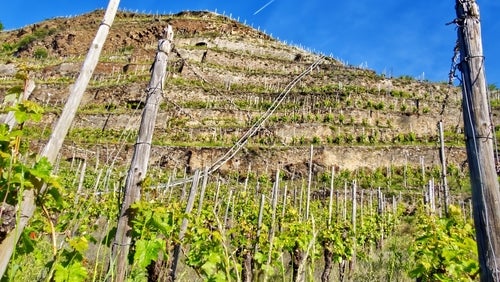
In many regions where steep slopes are prominent, there has been increasing awareness and alarm around how to make such hard-to-farm surfaces pay, and promoting the unique vinous qualities that such slopes confer—precisely the sort of recognition on which a flourishing culture of fine wine depends. But from the standpoint of a wine producer trying simply to make ends meet, or weighing abandonment, steep vineyards are liabilities. In many regions, their disappearance involves a costly “negative externality”: decay of tourist-generating signature vineyard landscapes.
Old vines, too, are likely casualties. Ask those Barossa winegrowers who fought a 1985 vine-pulling scheme in which the South Australian Government succeeded in subsidizing the removal of irreplaceable centenarian Syrah and Grenache vines. Often, not only is fruit from old vines superior precisely for having reached old age, but also thanks to genetic diversity and multi-generational selection. And it is doubtful whether the deep roots that permit these vines to resist heat and drought could ever be replicated.
In many countries—Australia, Austria, the US—a major share of vines are irrigated. Perversely, there are incentives to shed the dry-farmed, frequently planted with less fashionable grape varieties. And irrigations systems themselves represent an investment that growers are loathe to abandon. But what happens when the source—be it California’s aquifer, the Murray River, or the Danube—cannot sustain the load? And does it make sense to rip out acid-retentive, drought-resistant Zinfandel and Petite Sirah in California, Carignan and Cinsault in the Languedoc, or Roter Veltliner or Welschriesling in Austria, even as vintners increasingly demonstrate their quality potential?
Barring concerted new initiatives, market forces, together with blanket, hastily conceived legislation, risk consequences that will look, long-term, to have stemmed from gross irresponsibility and negligence.