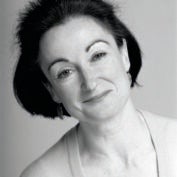
Robert Dougan was already a successful musician when he made the deliberately “non-sensible” decision to acquire a vineyard with his French wife Karine Ahton in 2004. Margaret Rand follows the trail from Melbourne to La Pèira in Terrasses du Larzac via London and the score of 1990s sci-fi classic, The Matrix.
The best way to introduce Robert Dougan is in his own words. So here are a few:
“I’m going to be less self-deprecating, because I’m not very good at it.”
“Being a really bad student at school is a curse. You coast. I’ve had the luxury of not being in demand. It’s so important to feel like a failure all those school years, and believe everything will go badly, because when they do go badly, that’s okay.”
Related
“I felt the trap of marriage closing. This [buying a wine estate] was not very sensible. I wanted to do something not sensible.”
“There have been times when I’ve woken up in the middle of the night in cold sweats, for months. There’s always a cost. I’d do it again because I like to torture myself.”
‘‘My winemaker said that if the 2009 is even partly acceptable, then this is a grand terroir.”
Content from our partners
“I’ve failed at everything: at writing songs, at films—and now I’m failing at wine.”
All this might feel like a smokescreen, an invented persona to hide the real Robert Dougan, but I have never interviewed anyone more brutally self-revelatory yet more unwilling to answer actual questions. But the answers are there; they’re just touched on, like a scent trail, invisible unless you pay attention. He had researched me: He’d read other pieces I’d written, and he knew where I went to school. “Half the time, my head is in the clouds,” he says. But only half the time. (Another thing he says is, “I’m Australian; I can’t be mysterious.”)
He wrote a track, “Clubbed to Death,” for The Matrix, “considered to be among the greatest science fiction films of all time,” according to Wikipedia, which knows more than I do about film. I could also refer you to his own Wikipedia page, which will tell you more than there is space for here. We have to focus on wine. Dougan makes wine at La Pèira, in Terrasses du Larzac. It is beautiful wine: tense, expressive, detailed.
But looking at that Wikipedia page, how would you imagine a man who in 1995 “teamed up with Rollo Armstrong to remix the U2 song ‘Numb’; the remix was titled “Numb (Gimme Some More Dignity Mix)”? Anonymous gray suit, pale blue shirt, black tie, black lace-ups, neat mustache? Lives in south London (one of the leafier parts) and is absolutely delightful if elusive company? No, me neither.
Try to pin him down—try to get him to say, for example, why he decided to make wine at all; how he found that particular estate; what made him think that this spot on the earth’s surface was what he wanted—and he slips away into a tangent. The only answer he will give is, “The real reason, the on-the-record real reason is [Millais’s painting] The Angélus.” It’s a profound painting, and a cryptic answer.
He says repeatedly that his memory is unreliable (it seemed remarkably good to me), but this is what he recounts.
New worlds opening up
He’s Australian, though to the English eye and ear the only bits of that remaining are the very faintest of faint accents and the mustache. “My father says I haven’t lost my accent. It depends on how many drinks I’ve had. It depends who I’m speaking to. As a man speaking to other men—not maybe to Adam Brett-Smith [MD of his UK shipper, Corney & Barrow]; maybe in France.” Presumably you speak French in France? “Presumably.”
He was born in Melbourne and grew up in Sydney; he says his father was a doctor, and he says his father was a scientist. “I was quite stupid at school. It’s wonderful when you get a teacher who opens up a world. He asked us to go home and write a melody. We had a piano; I hadn’t had lessons, but I’d practiced by myself and I could play chords and a melody.” This was when he was 12 or 13 or 14. Then he had fantasies of being like Noël Coward or Irving Berlin or Cole Porter. “I envisaged myself sitting around in a dressing gown, in rooms like theirs, going over to a grand piano and writing a love song that rhymed moon and June. I haven’t succeeded in rhyming moon and June yet; I’ve failed in that, and I’ve failed to write pop songs… When I confessed my life’s ambitions to my father, he said I was useless, and he said I might be good at acting. I took him at his word and auditioned for the National Institute of Dramatic Art in Sydney. They auditioned about 3,000 people, and I was almost not going to turn up. I felt nondescript, pretty un-self-confident, and I could see crowds of glamorous people waiting in queues. I don’t know how I got in. They only took about 18 people.”
He says he wasn’t interested in acting; he was interested in Shakespeare. “I’d turn up at 10:30, go to the office, not know where the classes were, and go to the library.” There he picked up a book about Ralph Richardson and the Old Vic in the 1930s, “but in the 1990s this was not a career path.”
Then he had his heart broken and fell apart. “I’m very emotional, and was more so at 19. It plunged me into despondency, and I started behaving badly.” He was thrown out of NIDA and came to London “with someone I knew who had inherited money and wandered through the world; he paid me £10 an hour to write songs. He was very charismatic. His sister became a singer, called Dido.” This was Rollo Armstrong.
He worked as a dishwasher and shared a “basic studio in Waterloo, near the Old Vic, with terrible kit. I used to write terrible music, all electronic. It was shared with another person, also doing crimes against good taste. I was clueless, but he was definitely doing criminal activity when it came to offending people’s ears.” And then, eventually, he “started doing things I quite liked.”
Something dangerous to do
From here, in a leap of time and space, we go to wine, and to the Languedoc. Dougan’s wife, Karine Ahton, was born in Montpelier; they met in a pizza place in Store Street, London. “Don’t call it a pizza place,” he says—but offers no alternative.
La Pèira is in Terrasses du Larzac. They bought it together in 2004; Corney & Barrow quotes him as saying, “You could say La Pèira was bought for a song.” He says now, “I wanted a personal problem. Marriage is a safe harbor; permission to do things might not be granted in the future. It was something dangerous to do. At school in Australia my heroes were bushrangers, crucified saints, martyrs. I didn’t want an easy life. If I had a 4×4, I’d like to take it into difficult terrain to see if the axle broke. You have to see if you would crack; I thought this might make me crack.”
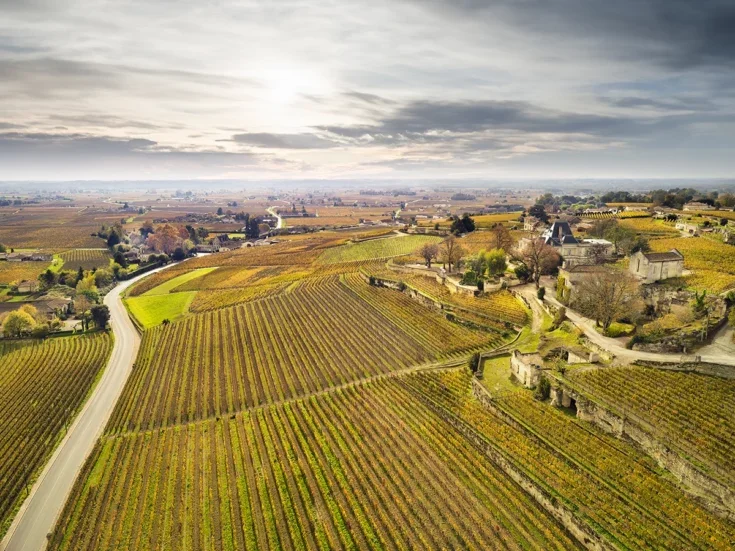
Finding it was a matter of looking around and drinking in local bars, wandering around and reading a lot. Hugh Johnson, in The Story of Wine, talks of the area as being the oldest viticultural region in France—there were vines there before the time of Christ—“but it’s not regarded as such by most people,” says Dougan. It shares two villages with “the world’s oldest AOC, which is Rocquefort. Northwest of La Pèira is France’s oldest-known winery, dating from 10 ce. It’s in the Clairette AOC, and we’re also in that AOC. We planted Clairette, which hadn’t been planted there before.” There is also Viognier, Roussanne, and Marsanne, and for the reds, Syrah, Mourvèdre, Grenache, Cinsault, and Carignan. There are 15.3ha (38 acres) under vine, and the wines are compelling, focused on complexity rather than on ripeness. It was already planted, apart from the Clairette, and well planted. Benjamin Lureau makes the wines.
The grapes came in, and the wine was made, but he didn’t have a name for it. “For three vintages, the barriques piled up, waiting for a name. Eventually I started looking at Occitan.” Occitan has got under his skin. “Languedoc is an insulting name. It means the langue [language] of yes… If I was a millionaire, everything would be in Occitan. Dante wanted to write in Occitan. The language was Occitan before the French decided to destroy half of France. It’s now the most despised and rejected of regions and they esteemed it not. La Pèira in Occitan means ‘stone.’ My wife said, If you make it that long I’ll divorce you, so I did.” The full name of the wine is La Pèira en Damaisela. “The place shone with the most beautiful face and exterior. But nobody could pronounce it, and most of my life now is spent telling people just how to say La Pèira. Pèira for St Peter. But La Pèira to show them—I wanted to confuse people.
“Ever since then, my life has been destroyed; it’s been a life of suffering. It was a huge risk, and it was what I asked for; I wanted an unstable life, and I got what I asked for.” Since he was looking the very picture of stability (gray suit, blue shirt, as above), I asked him where he gets his suits. “I’m too poor to have a tailor. I’m too poor for a tailor, but I can have nice shirts. I like things like that; I’m from the Outback.” Um, Sydney? “All Australians wanted to be from the Outback when I was growing up. My mother bought a place in the countryside when I was young, and I’m following in her footsteps. She grew walnut trees and built a house; there were redback spiders and funnel-webs and the nearest hospital was three hours away, so if the tourniquet didn’t work, you wouldn’t make three hours.”

Happy accidents, wonderful wines
He has owned La Pèira for more than two decades now. There are 15.3ha under vine, on infertile, rocky soil “with Sauternes-level yields, about 15hl/ha,” and quantities are small: 4,000–6,000 bottles of red grand vin and 6,000–8,000 bottles of red second wine, Las Flors de la Pèira. There is even less white: 600–1,000 bottles of grand vin and 3,500–4,500 bottles of the second wine, Deusyls de la Pèira Blanc. The farming is organic, without certification, and “with the feeling that we could intervene if we had to.” He’s pro-organic but not to the point of losing a crop. He quotes Yeats: “‘The worst are full of passionate intensity.’ I think it’s okay to have an agnostic approach.”
It clearly hasn’t been easy. He wrote music for films, television, advertisements, “and it led to earning a living. I’m not a very good musician, and it’s very hard when you have a wine domaine that takes up all the money. For the first ten years, I wasn’t sure how I would make it through the end of the month.” He remembers, in the early days, the wine “going into tanks that we hadn’t paid for and didn’t know how to pay for.”
The winemaking hasn’t greatly changed in that time: they had a few more new barriques in 2008 than now. “Like people you see every day, you don’t notice the changes. There have been no dramatic decisions. Maceration might be a bit shorter. I don’t want anything to change, ever. I believe change is a failure of nerve.” The 2008 has aged well—it’s poised and graceful. Do the wines close up? “I’m too poor to follow them month after month. I’m not so obsessed with the minutiae.”
“Music is like water, except water is probably more expensive. Music is like the tapwater business, and wine. You can’t succeed, and if you do, you’ll probably lose money. I’m not the brightest spark. I’m in two of the least profitable businesses.”
When he writes music, “I approach it as a mission, a military mission. I start with a title. I see a phrase and write it down. I write a song and a melody… I’m an accidental musician, and also an accidental owner of a winery. My great love is Shakespeare, books; I would listen to Beethoven for a year. There’s never enough to read, and you never know enough about music, about wine. For me it’s part of the grand pattern, an accumulation of different aspects; even music is not an isolated thing. I listen to music from the region and read old books from the region. It’s never just one thing.”
As a finale: “In the first year, I almost hoped it would be ghastly, that I could say that we had worked as well as possible but probably no vineyard in France had made such terrible wines.” But it wasn’t, and he couldn’t. The wines are wonderful. The music isn’t bad, either.