Sarah Ahmed marks the first 20 years of António Maçanita’s Portuguese project by tasting his latest Alentejo, Douro, and Atlantic island releases.
In 2004, rookie winemaker António Maçanita challenged David Booth, a viticulturist, to create a new wine project in Portugal’s Alentejo (his mother’s home region; his father was born and raised in the Azores). The former British Army captain and landmine clearance expert’s reply could have come straight out of a Hollywood buddy-cop movie. Maçanita recalls him saying, “[Y]ou’re in your machine-gun phase—you can fire as many shots as you like, you’ve got plenty of bullets. I’m in my rifle phase—I’ve got only two or three shots, and I need to choose them wisely. This is one I want to take.”
Precocious
The astute viticulturist agreed not only to cofound Fitapreta with Maçanita in 2004, but also entrusted his consultancy clients to the young winemaker, who was (and remains) a veritable sponge for information. By the time I visited the duo’s rented winery five years later, Fitapreta was making waves with wines that ran the gamut from fun and fruity to terroir-driven; orthodox to experimental.
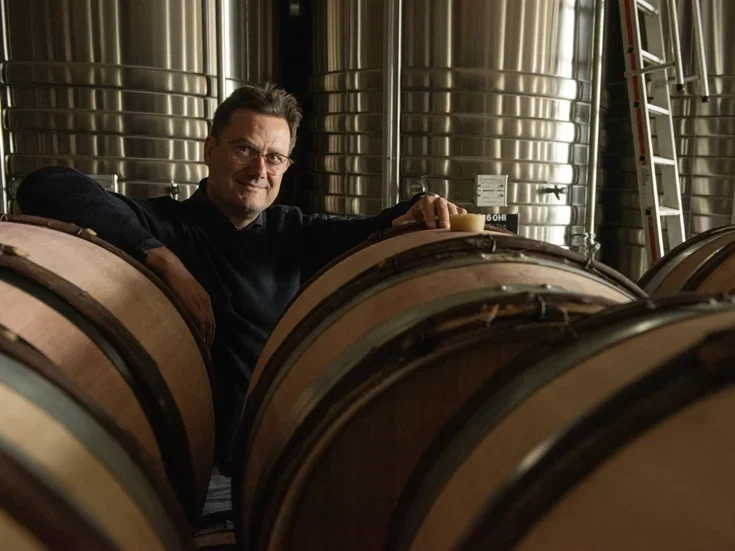
“If only everyone had a David in their life,” reflected Maçanita during my visit to celebrate Fitapreta’s 20th anniversary, this time without viticulturist Booth, who died far too young in 2012, aged just 47. Booth had often remarked on Maçanita’s rare ability to blend science with an artistic sense, which the winemaker underpins with copious experiments and research. Who else routinely commissions multidisciplinary academic teams from agronomists to historians in their bid to understand terroir, native grapes, and local wine culture?
Related

Medieval inspiration
While Portugal’s accession to the EU in 1986 sparked a boom in Alentejo of irrigated vineyards planted to popular Portuguese and French grapes, when Maçanita acquired his own, he favored historical vineyard sites, which Fitapreta dry-farms and cultivates organically. Often named for watercourses or plants associated with them, such as louredo (laurel), the vineyards are, Maçanita asserts, “natural, sustainable places in Alentejo where vineyards can be comfortable without irrigation.”
Located on the left bank of the River Xarrama, within a micro-terroir known as Louredo since the Middle Ages, Morgado de Oliveira (acquired in 2017) is a case in point. According to art historian Francisco Bilou, the 14th-century estate—which is home to Portugal’s largest surviving rural Gothic manor—has a distinguished history of wine production. Its pedigree shines brightly (and precociously) in Fitapreta’s new flagship white, Morgado de Oliveira NV, sourced from vines that Maçanita planted in 2017.
Fitapreta’s most prestigious red, Enxarrama (the medieval name for the Xarrama), originates from neighboring Louredo vineyards. Described by Maçanita as “a more powerful, structured style that benefits from extended aging before release,” it was inspired by the writings of Ferreira Lapa. The 19th-century authority on viticulture described red wines from the Enxarrama River locale as “strong and robust,” with “character and renown.” It is launched after a decade’s aging, when it is ready to be enjoyed, and Maçanita expects it to reach its prime after 10–20 years.
Content from our partners

Conversely, the attraction of the old low-yielding field-blend parcels that Fitapreta acquired in 2018 and 2020 at Chão dos Eremitas (meaning soil of the Eremite monks) is the scope to produce wines that age gracefully but are also approachable in youth. Here, at the base of the Serra d’Ossa mountains, two streams water and cool the land, which perhaps explains why wine production has been uninterrupted since the 14th century. As for the vines’ obscure traditional grapes (and clonal material), Maçanita rates them for being naturally low in alcohol and not overtly fruity or aromatic; this makes for emphatically terroir-driven, gastronomic wines.
Ordnance survey
Alentejo is not the only region to benefit from Maçanita’s “machine-gun” zeal to unlock the potential of historic terroirs and grape varieties. Bullets have similarly found their mark in the Douro some 250 miles (400km) to the north of Morgado de Oliveira, and 620 miles (1,000km) or more away on the Atlantic islands of Pico in the Azores, and Porto Santo, Madeira.
Following the cofounding of a Douro label in 2011 with his winemaker sibling Joana Maçanita, the pair began accumulating old field-blend parcels in 2019 for their Letra F range. Letra F alludes to lower-grade vineyards for Port-wine production. In contrast with A-graded Port vineyards from the warmest (lower) sites, F-graded sites are typically higher and, in the Maçanitas’ case, on granite soils rather than schist. Correspondingly, they produce the fresher, less concentrated profile sought by the winemakers for (unfortified) Douro wines, like Pala Pinta Red 2021, whose elegance and perfume put me in mind of Burgundy. Made in partnership with Filipe Rocha (of the Azores Wine Company) and Nuno Faria (Profetas e dos Villões) from unique old-vine grapes and island terroirs using press fractions, Maçanita’s innovative flagship Atlantic whites are breathtakingly visceral.
As I accompany him on his journey, Maçanita pays tribute to the support of his partners and team (notably Sandra Sárria, alongside whom he makes the Alentejo wines). Twenty years on, they have helped this insatiably curious winemaker choose wisely and nail his target, injecting “soul” and a sense of place into his wines. None more so than the flagship wines under review, which are among Portugal’s most audacious and distinctive.
Tasting
Fitapreta 2023 Os Paulistas Chão dos Eremitas White DOC Alentejo
(12.5% ABV)
Sourced from an old (1969) field-blend vineyard on granitic soils at an altitude of 840–876ft (256–267m), planted to Alicante Branco, Roupeiro, Tamarez, and Rabo de Ovelha. Placing the emphasis on freshness, not fruit, these traditional varieties deliver a surprisingly racy, youthful palate, with mouthwatering (traditional) bitter-lemonade intensity and delicate Sencha green-tea nuances. Fermented (full malolactic fermentation) and lees-aged for 12 months in old barrels without bâtonnage, followed by 6 months in stainless-steel tank. 828 bottles produced. 2025–32+. | 94+
Fitapreta 2021 Os Paulistas Chão dos Eremitas Red DOC Alentejo (14% ABV)
Not so much fleshy as all red fruits close to the skin and stone, this diaphanous wine is sourced from a field-blend vineyard planted in 1970 at an altitude of 840–876ft (256–267m) on particularly well-drained granitic soils with active limestone. Long and layered, with sheer tannins and nuances of coltsfoot, charcoal, and crushed rock, this slow-burn “soft power” blend of Tinta Carvalha, Castelão, Moreto, Alfrocheiro, and Trincadeira has intensity, line, and length. Naturally fermented with 30% whole bunches and, following 25–40 days’ maceration, aged 18 months in three-year-old French oak barrels. 4,636 bottles produced. 2025–31+. | 95+
Fitapreta 2021 Preta Homenagem David Booth Vinho Regional Alentejano (14.5% ABV)
A rich but sleek best-barrels selection from 20- to 50-year-old vines planted on schist and granite soils, comprising 30% Alicante Bouschet, 20% Aragonez, 20% Castelão, 10% Trincadeira, 8% Tinta Miúda, 7% Tinta Carvalha, and 5% Baga. Inky, with concentrated, velvety black- and red-cherry and berry fruit and cut-finger, tobacco-pouch, summer-truffle, and bitter-chocolate undertones. Exotic spices and heady damask rose add lift. Iron-filing tannins and fresh, balanced acidity lend precision and persistence. Following a 40-day cuvaison, it was aged 24 months in French oak barrels (30% new). 4,784 bottles produced. 2025–35+. | 95+
Fitapreta Morgado de Oliveira NV DOC Alentejo (13% ABV)
This complex, well-structured Arinto—a new white standard-bearer for Alentejo—is a blend from 2021 (80%), 2019, and 2020. Yellow gold, with ripe lemon, lemon-curd, dried-fruit, and smoky, nutty undertones, it cleaves waxily to the palate. Cleansing, sluicing acidity makes for a long, penetrating finish. Planted in 2017, the granitic parcel sits at an altitude of 1,007–1,030ft (307–314m). Whole-bunch-pressed and aged on fine lees for 15 months, without bâtonnage, in French oak barrels. 1,919 bottles produced. 2025–35+. | 96
Fitapreta 2014 Enxarrama Vinho Regional Alentejano (15% ABV)
“With richness and complexity, you need time for pleasure,” says Maçanita. Released ten years after the vintage, the maiden 1,218-bottle flagship release delivers. Sourced from 25- to 30-year-old dry-farmed Louredo vineyards on predominantly granite soils with schist, it comprises 85% Alicante Bouschet, with 15% Aragonez, Castelão, Moreto, and Trincadeira. Still a deep hue, with layers of spice, garrigue, graphite, and roast chestnut to the velvety, juicy black plum. With fine-grained tannins, harmonious freshness, and seamlessly integrated alcohol, it is fluid and long, intense but never dense. This polished red spent 36 months in 228-liter French oak barrels, then 12 months in 500-liter vats, followed by six years in the bottle. 2025–34+. | 95+
Maçanita Vinhos 2021 Letra F Pala Pinta Red Douro DOC (13% ABV)
Sourced from the siblings’ first Douro parcel, a well-exposed 110- to 130-year-old field-blend vineyard on granitic soils at an altitude of 1,755ft (535m) in Carlão, Cima Corgo. Light ruby hue. Red licorice and coltsfoot spice scent the joyous sour red-cherry and berry fruit. Yin-and-yang rhubarb and sweeter fruit leather lend tension. Sweeping, chalk-fine tannins and cool, crystalline mica acidity make for a long, elegant finish. Partly whole-bunch-fermented; and following 40 days’ maceration, it aged in neutral French oak barrels for 18 months. 665 bottles produced. 2025–36. | 96+
Azores Wine Company 2023 Vinha dos Utras 1st Jeirões DO Pico Açores (12% ABV)
Sourced from a 62- to 82-year-old 0.89ha (2.2-acre) parcel in the “1st Jeirões” on the frontline of the ocean, less than 200ft (60m) away, this field blend of Arinto dos Açores (95%), Verdelho, Boal, and Alicante Branco captures the Atlantic terroir perfectly, with its sea-salt and iodine-etched yellow plum skin and stone palate. Laser-beam acidity (a trait of 2023) drives the rock-pool flavors long and hard, making for a powerfully resonating, crashing-waves finish. Viscerally compelling, this concentrated white was fractionally pressed. The first presses (40%) were vinified in horizontal stainless-steel vats, the second in three-year-
old French oak barrels. Aged on lees without bâtonnage for 18 months. 700 bottles produced. 2025–40+. | 97+
Profetas e dos Villões 2023 Crosta Calcária dos Profetas DOP Madeirense Ilha de Porto Santo (12% ABV)
This sensational blend of Listrão (aka Palomino) and Caracol hails from Porto Santo’s compacted limestone crust to the island’s north. Phenomenally flinty, tight, and salty, it has an electric, spiraling acidity that propels the sea-shell/salt-lick minerality to infinity and beyond on an intensely retronasal finish. Delicate floral, green-tea, and cedar notes lend nuance, but the ocean owns this wine. Fabulously so. Sourced from 40- to 80-year-old vines, protected from strong winds by reeds or “crochet” walls, the grapes were whole-bunch-pressed and vinified in three press fractions, then lees-aged in 250- to 1,000-liter horizontal stainless-steel tanks and barriques for 11 months. 933 bottles produced. 2025–38+. | 98