Simon Field MW meets Axel Heinz to discuss his plans for Château Lascombes and taste the latest wines, including the first vintage of a new single-vineyard Merlot.
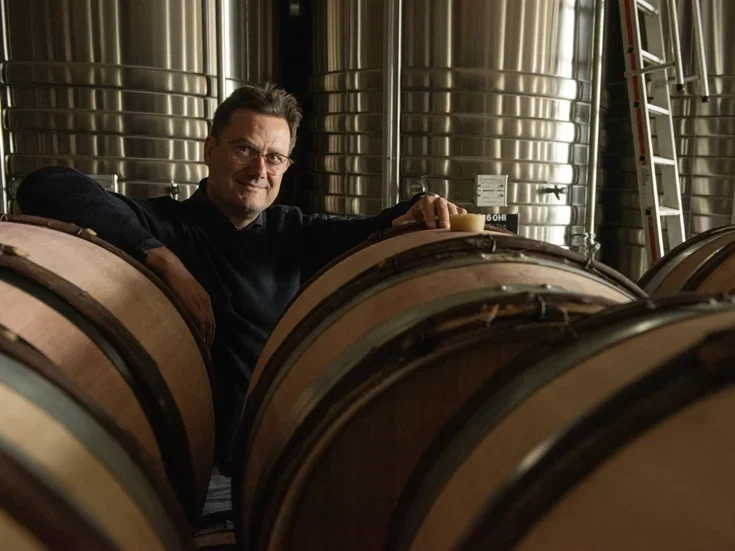
Axel Heinz speaks English with the ironic confidence of an Oxford don yet has never, to the best of my knowledge, lived or worked in an anglophone environment. He dresses like a Bavarian aristocrat but left Germany at the age of 12. Even more mysterious, perhaps, was his parting company, after 18 years, with the Super-Tuscan pair of Ornellaia and Masseto, the reputation of which he had developed almost singlehandedly. This took place in 2023, to considerable media speculation, and saw a move back to Bordeaux, where he had spent formative years putting an enology degree into practice. His mother is French, explaining yet more linguistic fluency, to which can be added, more recently, Italian and, of course, German. Impressive, indeed. A Renaissance man.
A return to Bordeaux does not appear inherently illogical, but why choose the perennially underperforming Château Lascombes? The property had been bought a year earlier by a very wealthy American businessman and farmer, Gaylon Lawrence, keen, it seems, to restore the reputation of this Margaux second growth. “When I arrived,” says Axel with appreciable understatement, “there was room for improvement,” adding, “I am as ambitious as the owner wants me to be, which, it turns out, is very ambitious indeed.” Heinz praises the “return to dynastic stewardship,” brought by the family, together, no doubt, with healthy financial investment.
Lascombes was one of the largest and therefore most influential properties to be classified in 1855. It sits as a second growth in Margaux alongside Rauzan-Ségla, Rauzan-Gassies, Durfort-Vivens, and Brane-Cantenac, and above its neighbor Palmer, as well as d’Issan, Giscours, and Kirwan, together with several others from the putative third rank. Quite a crowd and quite a wide stylistic range to fall under that most evocative of names: Margaux. That makes it all the more difficult for a property such as Lascombes, with its broad canvas of terroir and eventful history.
Related
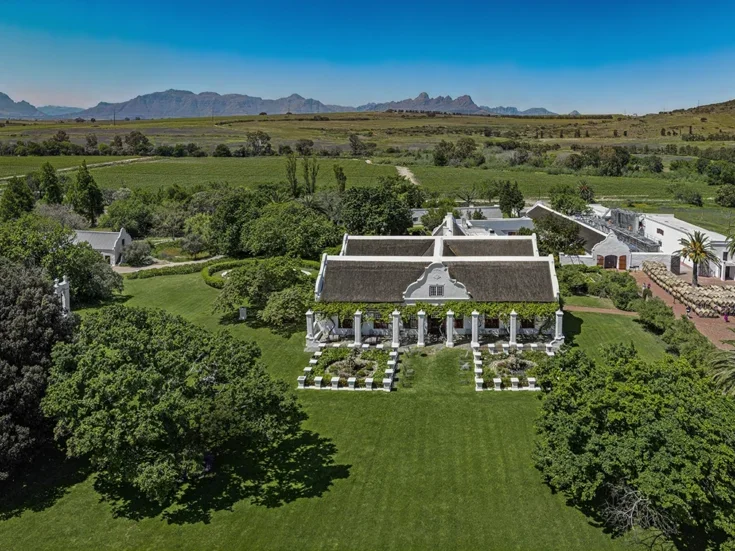
The property’s existence is documented back to 1625 and the tenure of Chevalier Antoine de Lascombes, an extrovert version of Hermitage’s Chevalier de Sterimberg perhaps. The vineyard finally took his name in 1805, having previously been known as Château de Ségonnes. A colorful catalog of owners has included a lawyer who successfully defended Charles Baudelaire against charges of poetic indecency, and a quick-thinking aristocrat who managed to discourage the Nazis from taking ownership of the château by erecting scaffolding, thereby pretending that the building was in a state of disrepair. Now the building is ivy-clad and exudes a Grimm air of mystery. Less mysterious was the flamboyant Alexis Lichine, a well-traveled Russian who bought Lascombes in 1953, thereby setting a trend for transatlantic ownership. Less auspicious, perhaps, were the corporate tenures thereafter of Bass Charrington and Colony Capital, neither of which achieved very much by way of reinvigorating a moribund reputation. That task now falls to messrs Heinz and Lawrence.
And how do they plan to achieve this? By a respectful yet challenging combination of historical simulacrum and radical disruption; the former, in essence, centered on a focus of the core 1855 sites and the advocacy of Cabernet Sauvignon, the latter with the creation of a single-vineyard Merlot to offer a new autonomous cuvée to the market.

Overarching aspiration
The 2022 La Côte (possibly not the most original name ever conceived but arrived at after due reflection) was released in September 2025. The fact that it commands twice the price of the grand vin reflects both the limited supply (the 4.5ha [11-acre] vineyard has yielded 20,000 bottles) and an overarching qualitative aspiration. At the same time, Axel has conducted extensive geological research that has convinced him of the value of restoring Cabernet Sauvignon to the key 1855 vineyard. The same process, however, has also identified plots closer to the Gironde, where erosion has revealed a subsoil made almost exclusively of blue clay, its water-retaining capacity and qualitative potential not unlike the similar terroir on the plateau of Pomerol. Too good to ignore. “This Merlot is different, however,” Axel maintains, “both texturally and ultimately structurally. I am looking for a taut rigorous intensity, more linear than opulent—and not at all like a Pomerol.” Axel goes on to explain why potassium deficiency has increased levels of natural acidity in La Côte. It may appear rather counterintuitive to introduce an expensive Merlot while at the same time underlining the primacy of Cabernet Sauvignon in the first wine. “I would never make a single-vineyard Cabernet Sauvignon,” he confirms, “since that would detract from the character and quality of the grand vin.” There is logic here if one searches hard enough. And good marketing material, because the single-plot wine prevalent elsewhere is a virtual stranger to the Bordeaux hierarchy at this level—especially on the Left Bank, which is conservative of temperament.
Content from our partners

And what is the style and quality of the grand vin? “I want the wine to speak spontaneously of Margaux. But I am still learning…” Axel blended the already vinified 2022 and has been fully responsible thereafter. He underlines the enigma of the maritime temperament; one year the climate is continental, 2022 say, but the next may be distinctly “oceanic,” as was the case in both 2023 and, even more so, 2024. The latest, 2025, is a perfect illustration of the juxtaposition of the two voices, with a hot and dry core to the season but a rainy “Atlantic” influence closer to the harvest. This tension is to Axel’s liking and provokes what he describes as the “Margaux aromatic,” which, unsurprisingly, he did not encounter in Tuscany. Axel sees the gradual replanting moving from the current 50/50 Cab/Merlot split, with the latter used more and more for the second wine, Chevalier de Lascombes, and the former to make up a greater majority of the grand vin. In 2023, it stands at 60%; in 2022, interestingly, it was 67%. Lascombes is slowly rediscovering a distinctive Margaux style, with less Merlot and less flamboyant oak intervention. “Energy rather than opulence” is Axel’s pithy summary.
Climate change is also predicted to result in increased plantings of Cabernet Franc, which now covers 15 of the 115ha (285 acres), alongside 3% of Petit Verdot. The flight to quality is already evidenced in the fall in volumes produced—now at 200,000 bottles, significantly lower than the 350,000 regularly achieved in the past.
Fifty hectares (125 acres), all within the 1855 boundaries, have been identified as core to the project. Minute analysis has been carried out and preferred plots benchmarked; they include Les Régies, Les Doumens, Curton, and Terrefort. There is a Burgundian introspection at work here, even if there are no plans to broaden the range. That honor and responsibility fall now to La Côte, its genesis, it seems, breaking none of the labyrinthine rules of the AOC. Future projects will focus on yields and densities; also, eventually, the expansion of organic viticulture, thus far only covering 30% of the domaine. In the winery, the extraction methodology will continue to focus on a delicate “infusion” system, and the élevage itself will be modified, probably at the expense of
new wood. The work in progress here is progressing well.
Axel is aware, however, of the challenges for both Bordeaux and Lascombes, the former struggling to reenergize its en primeur model, the latter also suffering from the decline of its key Chinese market. “In the appellation of Margaux, we are missing a golden age of mythical vintages,” he concludes, citing 1961 Château Palmer as a far-from-controversial point of reference. Palmer is next door to Lascombes and also has significant Merlot plantings but has enjoyed more recognition for nearly a century. It remains to be seen whether Axel can restore Lascombes to its hierarchical significance, but the focus on the 1855 vineyard and the gradual restoration of the primacy of Cabernet Sauvignon in the grand vin seem to be very good places to start.
Tasting
Tasting with Axel Heinz at Trivet, London; September 16, 2025
2022 Château Lascombes La Côte (100% M)
A deep, saturated purple, then a rich aromatic: plush yet restrained, generous yet svelte. Wet coal, mulberry, and bay leaf, a pleasingly Left Bank interpretation of Merlot, and far removed from a gregarious Pomerol style, despite shared blue clay soils. The rigor upholds the palate, too, its intensity belied by the grip of youthful, finely grained tannins and a refreshing furrow of acidity. Harmonious already and intense to foreswear potential; standing out from the crowd and maybe on the cusp of being outstanding. | 93–94

2023 Château Lascombes (60% CS, 37% M, 3% PV/CF)
Axel’s first complete vintage, a year less “Tuscan” than 2022, therefore not without challenges. More focus than recent Lascombes, more aromatic precision (graphite, sloe, and peat) and more definition on the palate, as manifested by a fundamental linearity, cushioned by a pleasingly sinewy texture and buffeted by delicately infused fruit. More Merlot than in 2022, but the blend engages neatly. If the aspiration is to be “more Margaux,” especially in terms of aromatic precision, then Axel is clearly on the right path. | 92–93
2022 Château Lascombes (67% CS, 30% M, 3% PV/CF)
Blended, if not made, by Axel—an early opportunity to focus on the historic Cabernet Sauvignon at the center of the 1855 Classification. A joyful and generous vintage, its spirit captured in a rich yet complex aromatic, with lesser players Petit Verdot and Cabernet Franc lending notes of tapenade and bay to an already overflowing fruit basket of potential. The blackberries and the plums take pride of place. A firm linear structure controls and orchestrates nature’s benevolence. | 93–94
2016 Château Lascombes (50% CS, 47% M, 3% PV)
The blend reflects the overall vineyard holding, as it generally used to do. Only the faintest hint of garnet on the rim. A beguiling aromatic of graphite, autumn leaves, and dark fruit, the transition from a secondary to a tertiary personality thereby flagged. The palate is still broad, generous, and almost precocious, marked by a stentorian tannic grip and an unyielding block of dark fruit at its core. The aromatic and the palate appear to be slightly out of sync, therefore, at the moment. | 92
2010 Château Lascombes (55% CS, 40% M, 5% PV)
Selected on the day both for the quality of the vintage and for the fact that the blend tilts toward Cabernet Sauvignon, the 2010 is now fully mature, with wood smoke and peat joining the dark cassis fruit and violets on the nose, which is beautifully perfumed. Mature, finely grained tannins and a rich, savory mouthfeel add to the ensuing enjoyment. A highly successful wine and an interesting harbinger of Axel’s reign. | 94
1985 Château Lascombes (Jéroboam) (50% M, 45% CS, 5% PV)
Axel does not have the precise blends for these ancient treasures but offers a steer based on precedent, underlining once again the historically high proportion of Merlot in the grand vin. Holding a deep ruby magenta color, with only a hint of garnet on the rim, this is a powerful advertisement of wine and vessel alike, the luxury of a slow, large-format evolution evidenced by rich notes of cèpe, soy, and black truffle, dark fruit lurking in the wings. A slightly volatile nose, itself indicative of agility, dissipates quickly, enabling the happy few (tasters) to revel in the potency of this sprightly 40-year-old. | 94
1970 Château Lascombes (magnum)
(50% M, 45% CS, 5% PV)
The 1970 is, unsurprisingly, paler, leaner, and more reticent than the charming 1985, its nose recalling the hearthside and school libraries. The palate is eloquent, however—elegiac maybe—its whisper of acidity providing a subtle balustrade for savory, mushroom-laden tertiary notes. Autumnal but not winter