

Each year in which Château Smith Haut Lafitte produced a good vintage, Daniel and Florence Cathiard purchased or commissioned a new work of art for the Parcours de Sculptures scattered across their Pessac-Léognan estate. As Roger Morris relates, it all began in 1990 with Barry Flanagan’s leaping hare. Now, 30 vintage sculptures later, the hare has been joined by an enigmatic owl.
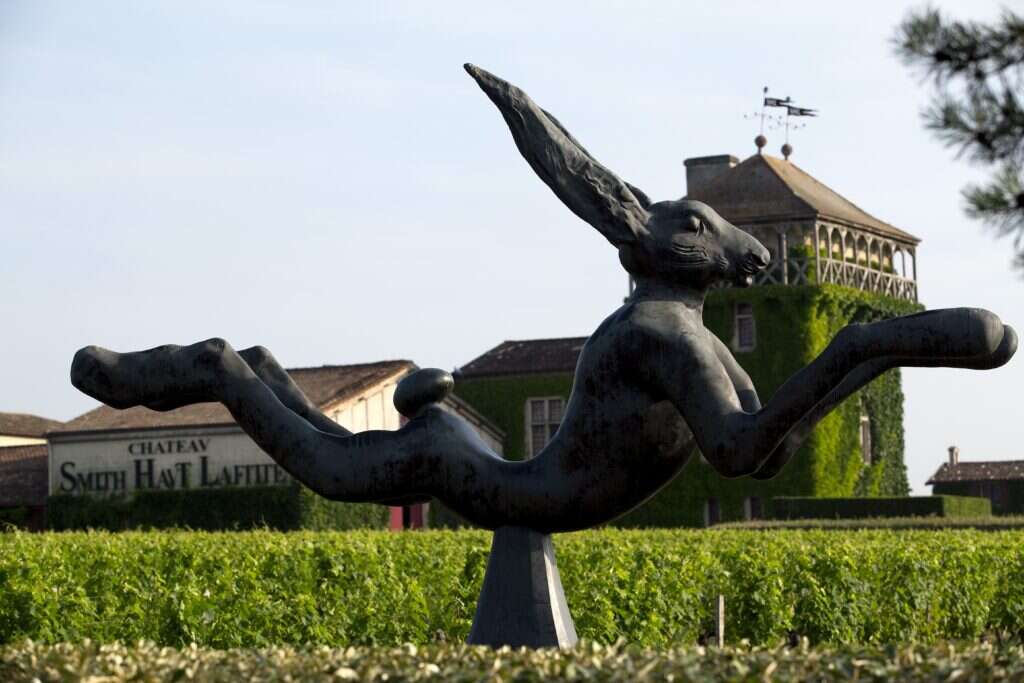
Of all the iconic welcoming vistas of the great châteaux of Bordeaux—the ancient stone dovecote at Latour, the three arches along the exterior wall at Mouton Rothschild, the hillside facade of quarried limestone at Ausone—can any be more instantly memorable, and more photographed as a background for wine-tourist selfies, than the gigantic bronze sculpture of an exuberant hare, leaping across the vines, greeting visitors to Smith Haut Lafitte?
Since the 1990 acquisition of the flying hare—officially named Hospitality and created by Irish-Welsh artist Barry Flanagan—the number of sculptures interwoven into the vineyards and grounds that surround Smith Haut Lafitte, as well as within the château itself, has over those 35 years multiplied like… well… like rabbits.
Even so, this explosion of artwork does not represent profligate spawning and is actually a vintage case of planned parenthood. “Since we acquired the property in 1990, Daniel and I have cultivated a passion not only for crafting great wines but also for celebrating art as a timeless expression of beauty and meaning in our landscape,” says Florence Cathiard, co-owner of the historic estate in the Pessac-Léognan region of Bordeaux’s Left Bank.
Related
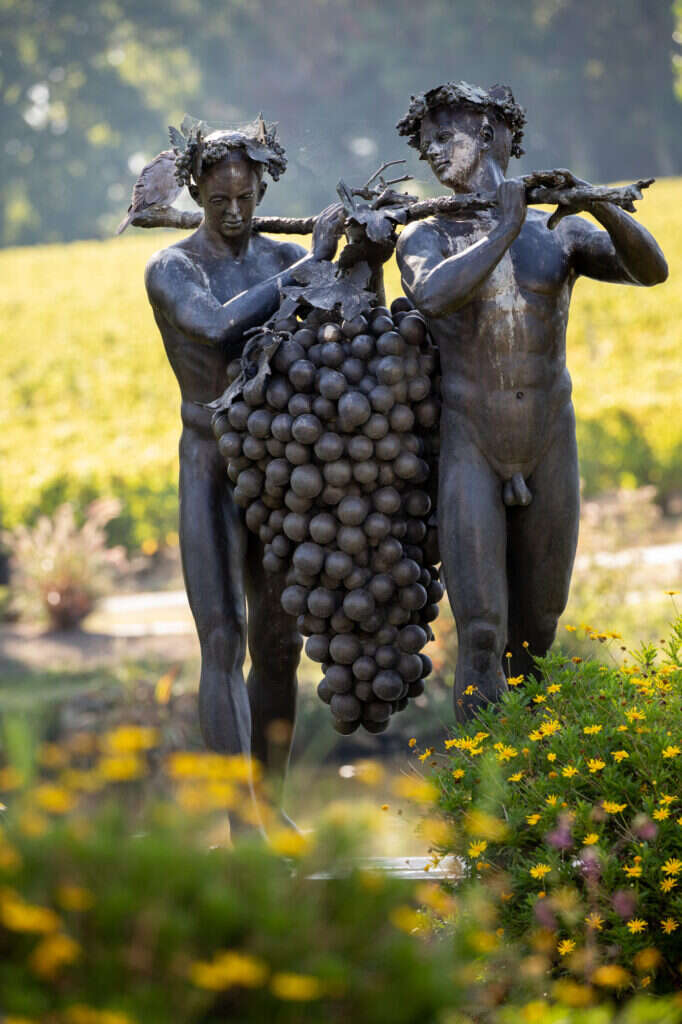
“Over the years, it has become something of an unspoken tradition that when we are particularly proud of a vintage—when the vineyard, the climate, and the team have brought forth something exceptional—we often mark this moment with the acquisition of a new sculpture. These works become part of our evolving open-air museum, the Parcours de Sculptures, weaving art and nature through our vineyards and woods.
“The dates listed for each sculpture [in the parcours catalog] correspond to the year they were created by the artist rather than the year of acquisition,” she explains. “However, in most cases, we did acquire them during or shortly after a particularly successful vintage. The scale, the medium, and the artist we choose each year are influenced by both the emotional and financial ‘fruit’ of the vintage. For example, larger works in bronze or enduring recycled materials reflect the means and the message of a great year—both in quality and in spirit.”
For the Cathiards, the creation of the parcours—where Smith Haut Lafitte now puts its curated visitor tour on an equal footing to those offered to explore the château and taste its wines—is only the latest example of the couple’s wide-ranging interests and their ability to succeed at each of them.
Content from our partners
To begin, Daniel Cathiard and Florence Richard were both very accomplished skiers, first meeting in 1965 when they were members of the French national ski team. Later, Daniel even trained the Iranian alpine team and was part of their delegation at the opening ceremony of the 1968 Winter Olympics in Grenoble, Daniel’s hometown, after he had quit skiing professionally to manage the family’s Genty supermarket group.
Later, the couple, now married, launched the Go Sport chain of sporting-goods stores, and Florence also founded her own advertising firm before becoming vice president of the McCann Europe advertising agency. But in 1990, the couple changed course again by entering the world of wine, acquiring Smith Haut Lafitte and leaving conventional merchandising behind them.
Conviviality and shared pleasures
My own introduction to the Cathiards’ passion for sculptures was in February 2017 at the beginning of en primeur week, when I was invited to the château for lunch and a tasting of the emerging 2016 vintage wines. Having arrived early, I met Daniel outside the tasting room, where he was examining what looked like a vertical whale jaw, a jarring sculpture created in 2015 by Chinese artist Huang Yong Ping and titled De Celui Qui Mange Est Sorti Ce Qui Se Mange. Daniel explained that the work is symbolic, its title borrowed from an Old Testament parable known as Samson’s enigma: “Out of the eater came forth food, and out of the strong came forth sweetness.”
I recently asked Florence, the unofficial curator of the collection, to discuss some of her favorite vintage sculptures. She began with their first and best-known vintage contribution. “Barry Flanagan’s joyful hare [Hospitality, 1990], the eternal symbol of Bacchus, today watches over our old Cabernet Franc vines. It reminds us that great vintages are ultimately about conviviality and shared pleasures,” she said. “We shared the same vision with Barry, who wanted to have his hare ‘flying’ above our vineyard. Today, his work is so iconic that we wouldn’t be able to afford this sculpture!”
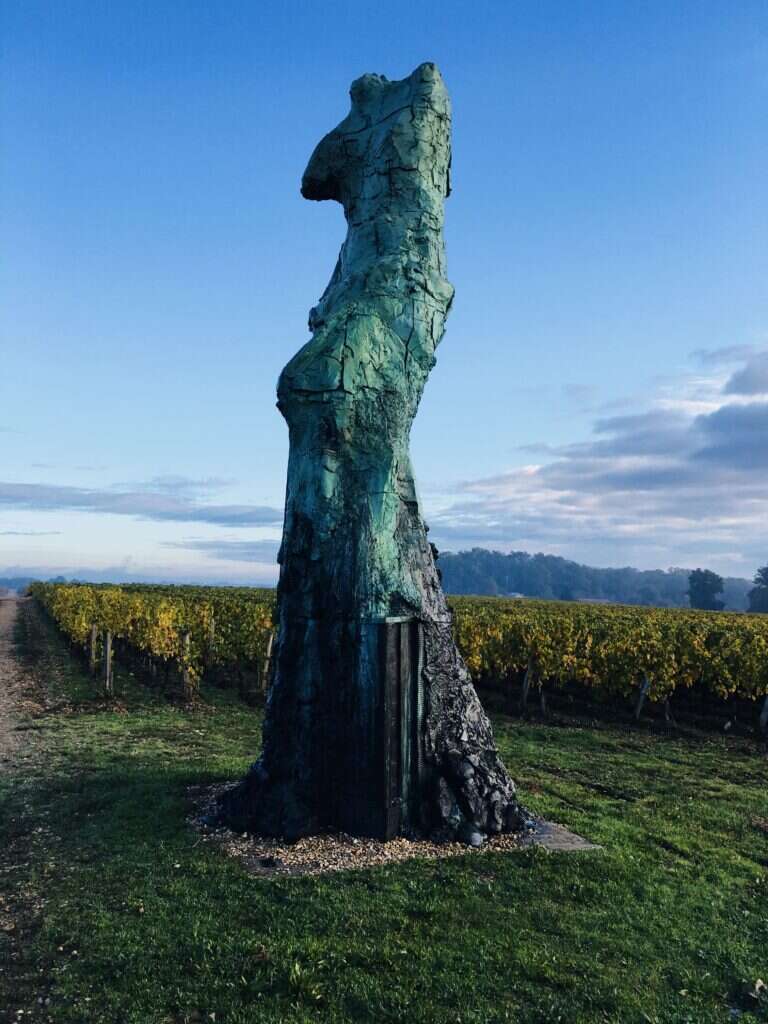
In 2001, she says, American sculptor Jim Dine created Vénus Bordeaux, a draped Greek-style goddess rising out of the vineyards, but he later altered it. “This sculpture was reworked by the artist after [the attacks of] September 11, to add some extra 2.5 meters [8ft] height to the sculpture,” Florence says. “Venus is emerging from chaos as an act of resilience in a world of cruelty. For us, it resonates with vintages born under difficult climatic conditions—triumphs of hope and patience.”
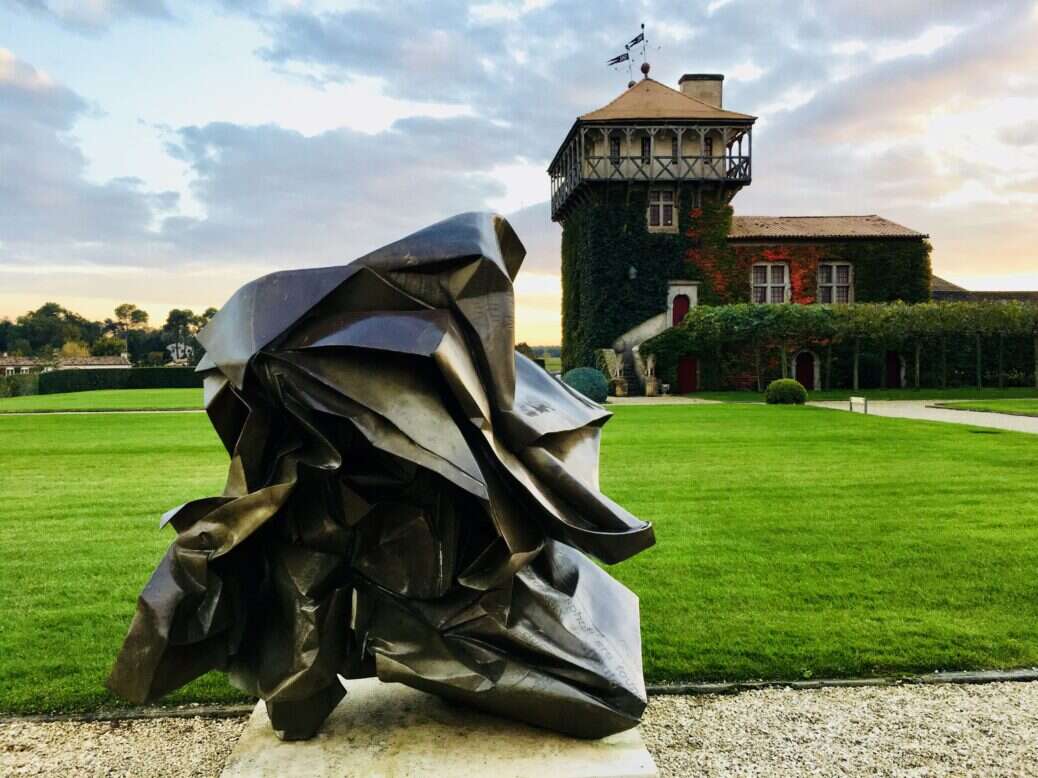
Continuing her discussion of the collection’s high spots, Florence expresses both the Cathiards’ shared sense of humor and their willingness to engage in analytical criticism: “Perhaps our most symbolic example of translating a vintage into a sculpture,” she says, “is WA [2008] by Chinese artist Wang Du. After Robert Parker gave us a 93–95 rating for our 2005 vintage—a score we felt was below its true merit—Daniel invited Wang Du to create a crumpled bronze sculpture of an actual page from The Wine Advocate. It’s a tribute to the impermanence of public opinion and the folly of obsessing over scores!” she says with a laugh. “Ironically, when Parker later reevaluated the same vintage at 98 points, the sculpture became a joyful tribute to perseverance and time.”
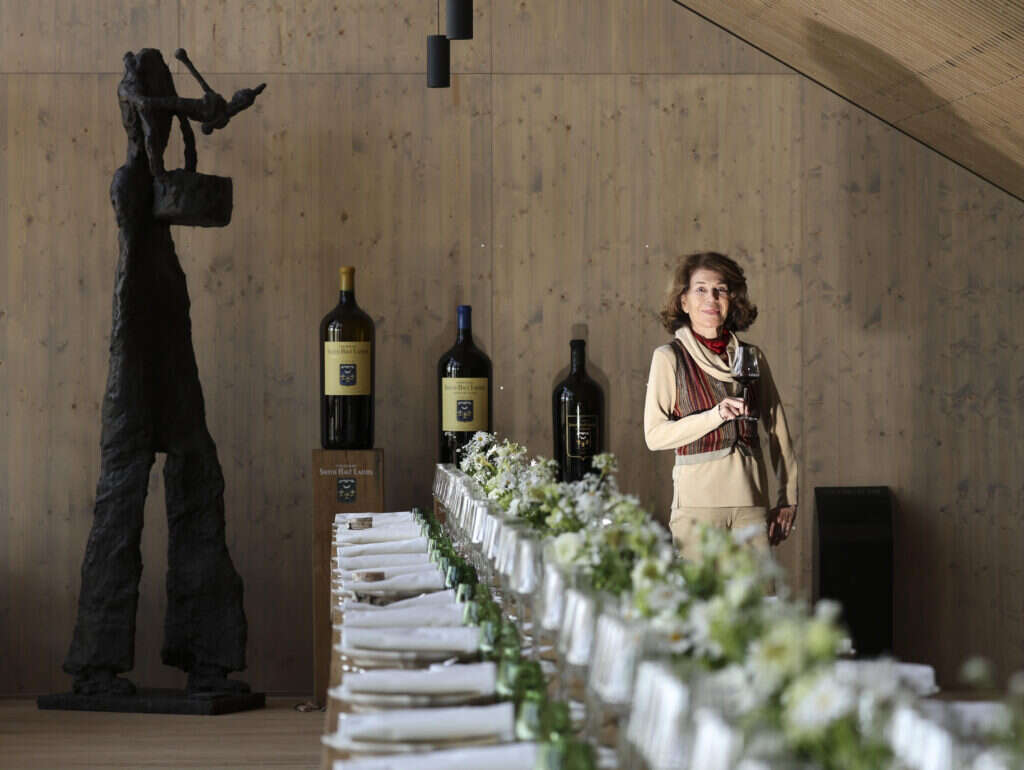
Another gentle jab at wine critics is represented in Caduto a Ragione (2008) by Italian artist Mimmo Paladino, in which a man, perhaps St Francis of Assisi, is covered by perched birds, much like those lured to a feast of grapes at harvest. It is that, but Florence provides it with an additional take, calling the sculpture “an elegant metaphor for the en primeur week—birds pecking at the figure, as wine professionals and journalists taste the new vintage from barrel. A subtle nod to the biblical ‘This is my blood’—transforming the feeding frenzy of tasting into a spiritual reflection on the life of wine.”
In 2009, Daniel Cathiard attended a U2 concert and met American engineer Chuck Hoberman, who had designed an expanding screen for the show. Intrigued, Daniel commissioned Hoberman to construct another expanding sculpture for Smith Haut Lafitte—an ornate, circular figure that blossoms out in size, depicting the flowering stage of grape development. It was titled Nouaison and debuted at the winery in 2012, “representing,” Florence says, “the critical stage when grape berries form, a poetic echo of each vintage’s potential.” Another vineyard metaphor is Le Puits sans Fond (2014) by South Korean Chul Hyun Ahn, “an infinite mirror ‘well’ incorporating a great vintage bottle, an homage to the depth of time and the patience of winemaking.”
For the 2021 vintage, French sculptor Raymond Jacquier carved in situ a huge obelisk from Savoyard marble, one side of it tranquil, the other rough: La Mémoire du Temps. “The sculpture mirrors the duality of [our] characters,” Florence says in a moment of self-analysis: “Daniel’s serenity and my energy—much like the complexity of a great vintage.”
Summarizing, Florence says, “Each piece in the collection not only reflects our personal tastes but also resonates with the themes of time, terroir, transformation, and the vitality of life—values we find equally in the art of winemaking.”
The 2025 vintage and beyond
Soon there will be another sculpture—one of another animal—to join the collection. “For the 2025 vintage—which we consider exceptional, we are preparing to install a new monumental piece,” Florence told me as 2025 wound down and the vintage was sleeping in Smith Haut Lafitte’s cellars. It is, she says, an 18ft- (5.5m-) tall contemporary sculpture by Lionel Sabatté, a French artist who sometimes resides in the US, of an owl, to be installed in the vineyard just before the en primeur tastings.
It is a gigantic piece, part of the artist’s Chouette (“Owl”) series. It has a tilted head—almost quizzically so—piercing eyes, and a rugged body that seems to morph into the tree where it perches. “We like to imagine this majestic creature watching over the guests as they discover our superlative 2025,” Cathiard says.
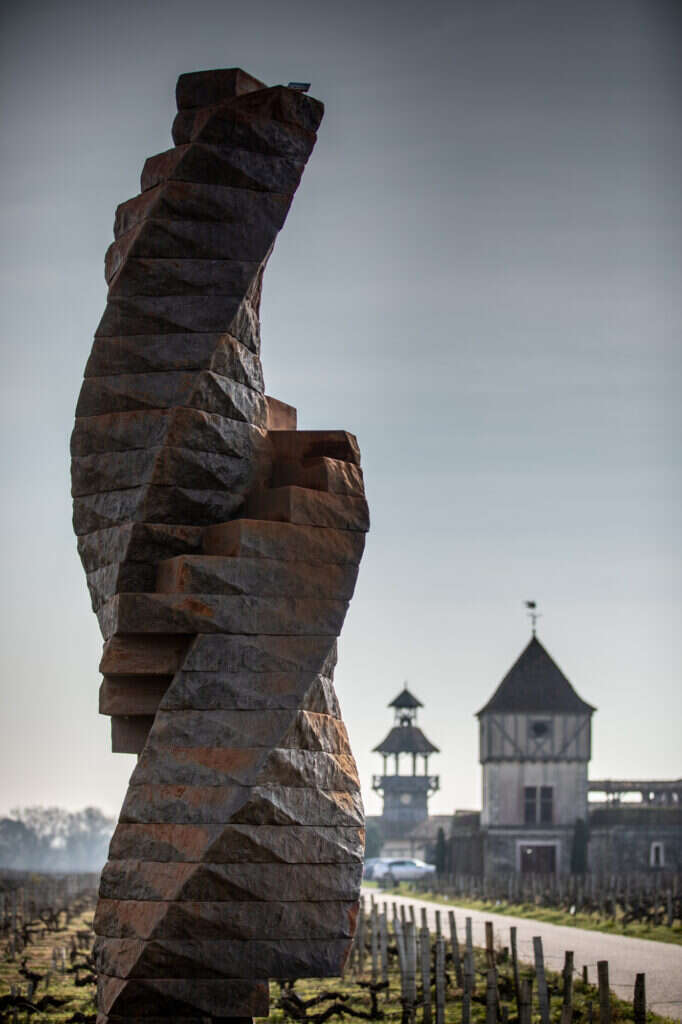
Perhaps we should add to Florence’s curation a sculpture the couple purchased in honor of the 2009 vintage. It is called Torsion II, by British artist Charles Hadcock, its spiral wooden shape depicting two staircases, one climbing up toward the sky and the other, its reflection, turning downward and reminding the Cathiards of a vine tendril. Additionally, “imprisoned” within the tower is a magnum of the 2009 Smith Haut Lafitte estate wine.
The 2009 vintage is especially notable because it was the first wine of Château Smith Haut Lafitte to be awarded a perfect score—all 100 points—by Robert Parker. Torsion II is diplomatically located among the vines on the opposite side of the château from Wang Du’s crumpled replica of the page with the critic’s unwelcome first review of the 2005 vintage.
Note
This article was written before we learned of the sad passing of Daniel Cathiard on January 28, 2026. Our very sincere condolences go to Florence Cathiard and their family, friends, and colleagues on the loss of a charming, gracious, influential, inspirational, and much-loved member of the wine community in Bordeaux, California, and around the world.


