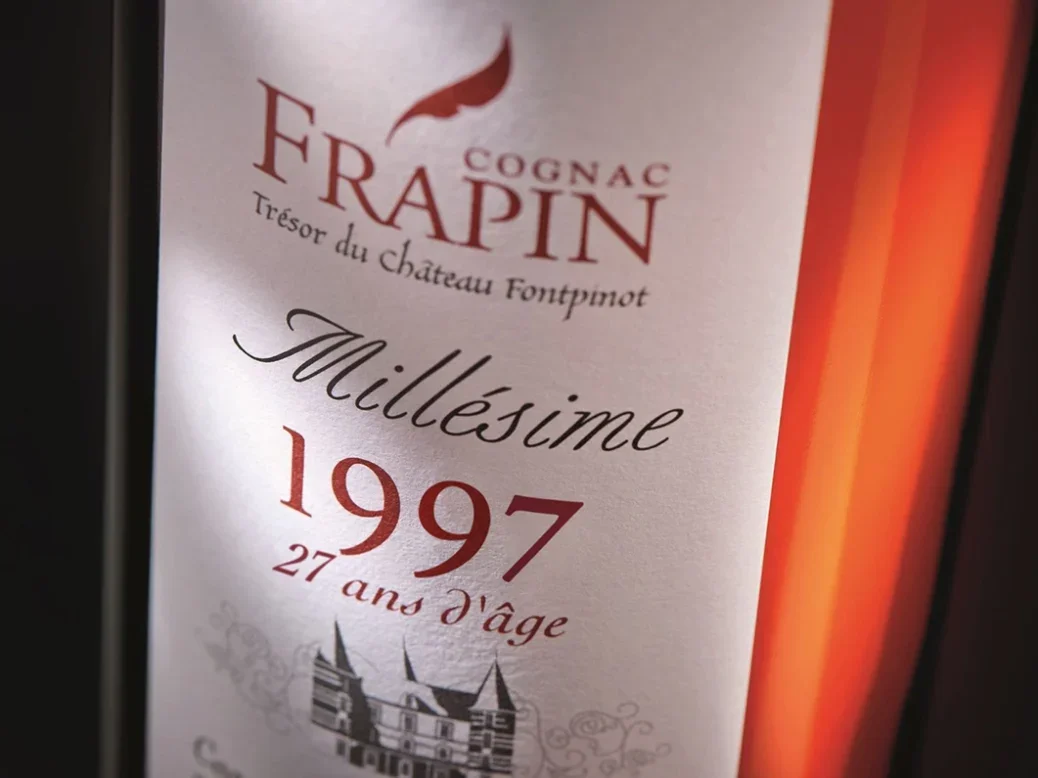
Andrew Jefford on the “extraordinarily dense and fruity” Frapin Millésime 1997 27-year-old Cognac Grande Champagne Premier Cru de Cognac.
By the time you read this, it will have happened. The 2025 Château de Fontpinot crop of Ugni Blanc grapes (plus a seasoning of Folignan, a cross between Ugni Blanc and Folle Blanche) will have been fermented and distilled on its lees, and the distillate poured into young Limousin oak casks (some new; some up to five years old). Seven or eight of the most promising of those casks will have been sealed with wax under the dispassionate eye of an official from the BNIC (Bureau National Interprofessionnel du Cognac) and then set aside.
Not forgotten about, though; far from it. These proto-Vintage Cognacs must still undergo a series of transitions. From a relatively brief spell in young casks (which will deliver vanillins, tannins, and coloring matter), to a set of middle-aged fûts roux; then, after aesthetic calibration for wood influence by the tasting team, to much older casks—some of them centenarian—for the all-important long years of oxidative aging and evaporation, source of the delicious rancio subtleties that lick like quiet fire inside every great Cognac. Every time a tasting sample is drawn, and every time the spirit moves from one little oval wooden cabin to another, the wax seals must be broken, again under those supervisory eyes. Traceability is all. The bureau is therefore summoned a dozen times a year. Every minute of every visit is metered—and invoiced. No one makes Vintage Cognac for a lark.
A Vintage initiated (chez Frapin they all are) may not be a vintage declared. “We begin work,” says cellar master Patrice Piveteau, “on a Vintage after distillation, but we don’t always end up with one. If, after some years, a vintage looks like Château Fontpinot XO, there’s no interest in keeping it as a Vintage. At that point I break those casks, and the spirit goes into the Fontpinot blend. To be a Vintage, it has to be different from everything else in our range.”
Related

Not easy for a single-estate Cognac. There’s no floral Petite Champagne, no earthy fruit from Fins Bois; every drop of Frapin’s intense spirit comes from its farm, a unitary 240ha (593-acre) site in Grande Champagne. A part of the vineyard called Gabloteaux has stony limestone; another part called Chez Piet is more clay-rich, with more stickily unctuous soils. But the difference between them is just a nuance in the base wine and may not be apparent at all after the metamorphosis of distillation and the long journey across the desert of time (25 years or more) that Vintage Cognac makes. “I accentuate variability by using aging processes,” says Patrice. “It comes from the choice of casks and whether or not those casks are aged in dry or humid warehouses” (considered as much a part of the terroir for a Frapin Cognac as the vineyard itself). And, of course, from the genes of the vintage itself—inscrutable for some years, only discerned by Patrice after multiple blind tastings.
Which brings us to the just-released Frapin Millésime 1997, a 27-year-old entirely aged in moist warehousing for suppleness and rondeur. The vintage saw “rain in July, sun in August: a generous year, but classical in style.” The 1998 vintage was released earlier than the 1997 (as a 25-year-old), so clearly it was the younger vintage that blossomed earlier.
Patrice describes the Frapin DNA as “not too much wood, with a certain lightness of style, crystalline, tense, fine. A form of elegance and lightness, but also depth—long in the mouth; no aggressivity. I like complexity, which means that everyone will find different things in the Cognac. We won’t agree, but that doesn’t matter. To be complex, a Cognac shouldn’t have a dominant note—and dominant notes often come from wood. That’s why I stop the wood-aging part of the cycle early.” Each Frapin Vintage is a child, I suggested to Patrice. How would he characterize the 1997? “A brilliant child, impetuous, quite a character—but in the best sense. It has lots to say; you won’t get bored with it.”
Content from our partners
Tasting
Frapin Millésime 1997 27-year-old Cognac Grande Champagne Premier Cru de Cognac (40.8% ABV)
Glowing barley gold in color, with powerful and searching aromas that combine the summer brightness of winnowed grain with surprisingly vivid young orchard fruits. It is sappy, urgent, vivacious; quickly deep into the lungs, filling the bronchioles. Give it time, and a secondary charm begins to emerge: honeyed pain d’épices, crushed stone. On the palate, take a small sip only! You won’t need more: This is extraordinarily dense and fruity, powerful and long, all arrowthrust and thunderball, drama and articulation. The sweetness of its fruits, like the aromatic charm, reveals itself at the very end of the palate and unfolds with time in the glass, remaining deep, buoyant, and masterful throughout. The 1998 (tasted alongside the 1997) has more floating floral notes and butter-toffee richness but less verticality and inner architecture. We shall surely see further, more amply aged iterations of the 1997: It clearly has miles in its legs and ambition in its heart. | 94