Once dismissed as rustic, Greco di Tufo is now a wine perfectly suited to the demand for “grippy, savory, food-compatible whites,” says Sarah Marsh MW.
My visit to Campania began with a quick trot up Vesuvius to peer into its gently steaming crater before a tasting of the new vintages and visits to producers organised as part of an initiative called Campania Stories, a collaboration between producers across Campania designed to promote the region’s ten wine regions. I focused on flights of 2024s from Fiano di Avellino and Greco di Tufo. These DOCGs lie inland in the hilly wine region of Irpina within the province of Avellino. Both regions were promoted to DOCG in 2003. Fiano di Avellino, the more delicate and aromatic of the two, has a greater following, but my sites were set on Greco di Tufo which has a firm acid spine, austerity, appetizing bitterness, and tannic grip.
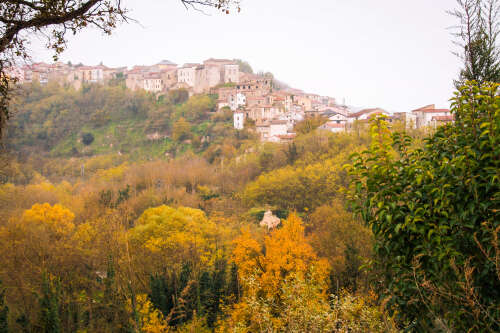
Tufo is Irpina’s smallest but most densely planted appellation with 600ha (1,460 acres) under vine of the 850ha (2,100 acres) permitted. There are eight villages. Center-most is Tufo village located at 250m (820ft) altitude in the Sabato valley, home of the di Marzo sulfur mines, which were opened in 1866 and formed the mainstay of the local economy for a century. The soil is volcanic, but also of marine origin with clays and calcareous marls in the hills which are scattered with parcels of vines. These are typically smaller than a hectare from which families made wine for themselves and boosted their income by selling in bulk. From the 1990s some growers accumulated sufficient hectares to start bottling under their own labels, among them the excellent Benito Ferrara in 1991. Others continue to sell. Many to Feudi di San Gregorio and the giant producer Mastroberardino.
Tufo’s continental climate, which is 5°C cooler than Campania’s coastal appellations, has a strong diurnal which supports a long season allowing Greco to ripen into October. In the past Greco di Tufo had eye-watering TA of 9-10g/l and pH of 3-3.1, which put pay to malolactic. It’s rich in polyphenols and catechins, a flavonoid which contributes bitterness. More like a red than a white, tannin combined with acidity earned Greco a reputation for rustic and/or robust white wines.
Related



No whiplash: The changing face of Greco di Tufo
However, the climate, winemaking, and viticulture have all changed. The traditional high-yielding fan pergola (raggiera) is being replaced with guyot enabling more tailored leaf cover. A run of warm vintages, including 2024, has softened TAs to nearer 7g/l. Fresh, but not whiplash.
Meanwhile, appreciation has grown in the market for grippy, savory, food-compatible whites—all important for encouraging growers to persist with Greco, since it isn’t an easy grape to grow or vinify. Its soft fragile skin makes it vulnerable to mildews and rot in humid conditions (2023 was a disaster). It’s also susceptible to sunburn and oxidation requiring careful handing at harvest and in the winery. After decades making Greco, fourth generation Gabriella Ferrara was surprised by how easy Fiano is to manage by comparison.
Within the overarching di Tufo expression, Greco varies quite considerably according to winemaking approach, as well as picking date and of course terroir. From 2024 I enjoyed the fennel-like I Capitani Serum and the generous yet grippy Tenuta Pietrafusa di Villa Matilde Avallone, although reviewing my notes it seemed many of my favorites came from the area around Montefusco village and in particular from the higher elevation and cooler exposure vineyards. Straight, racy wines with tension and precision including the chiseled Feudi di San Gregorio Greco di Tufo Feudi Studi Ariella and Di Meo Vittorio from a north-facing vineyard at 700m altitude.
Content from our partners

Campania Stories kindly organised my visits to eight producers. Ilaria Petitto, who is the third generation of women at Donnachiara, says Montefusco vines provide the backbone of acidity for Alethia. A blend of two parcels, it is linear, pithy, and sapid in 2023, while the 2013 is smooth, savory, and salty to finish. As Ilaria says, “Fiano is elegant. Its complexity shows immediately (Donnachiara Esoterico is delightful) but Greco you need to age.”
Feudi di San Gregorio has an annual production of 3.2 million bottles, but is super-experimental with small terroir-driven cuvées. Four FeudiStudi Greco di Tufo have distinctly different profiles. My favourite is the Ariella from Montefusco—linear, strict, refined, and salty in 2021, while the 2015 has mellowed to silky saltiness. The other standout is Nassano from Tufo which shows phenolic grip. The 2021 is full-bodied, punchy, and rugged, while 2015 combines marzipan richness with grip. Both have lovely aging potential. Back at home, I read the excellent research into Irpinia vineyards and wines commissioned by owner Antonio Capaldo for his FeudiStudi project. It seems Montefusco soils are not volcanic, but clay and limestone. Moreover it’s the windiest, coolest commune and includes some of the highest vineyards up to 750m (2,460ft).
The report divides the terroir into three sections, two of them north of the Sabato River, before delving into village terroir. In brief the southern section is lower, warmer, and with lighter-textured clay and volcanic soils, it produces a fruitier, gentler style of Greco. The north-west section is higher—steep slopes with compact clay and volcanic soils. From Tufo village, Nassano’s grippy style and high acidity is typical.
In the north-east sector the report links Montefusco with Santa Paolina which is slightly warmer with vineyards between 300–600m (984–1,968ft), but includes some calcareous matter. Benito Ferrara Vigna Cicogna is a lovely example from San Paolina, a 3ha (7.4 acres) south-facing slope first mentioned in 1884 and first made as a single cuvée by accident in 1996. The young wine 2024 is a touch exotic with mango and ginger. A double-magnum of 2008 had mellowed into salted, burnt-caramel richness.
Orientation of the slope clearly affects Greco’s expression together with the percentage of clay and limestone mixed with volcanic matter. Di Marzo makes four terror-driven wines. From a south-facing clay rich slope comes the fuller Vigna Serrone. In comparison Vigna Laure, from north-facing calcareous marls, is streamlined and precise.
Many producers spoke of the “sulfurous” character of Greco di Tufo, especially around the sulfur mines of Tufo, but I was unconvinced. On my final visit to Cantine di Marzio, Ferrante di Somma, whose family owned the sulfur mines, told me a recent study by five geologists found no sulfur in the root zone.
That said, there is a reductive note on some Greco di Tufo. Highly vulnerable to oxidation, Greco is also prone to reduction, which is perhaps not surprising given the high levels of tannins and catechins, both anti-oxidants. This is exacerbated by the typically reductive approach to winemaking and ageing on lees in stainless steel. Skilful producers know how to manage Greco’s peculiarities. Di Meo keeps Vittorio for a staggering 12 years on lees in stainless steel. The current vintage is 2012, although I marginally preferred the pithy, edgy 2008.
Others like to play with the tannin and the redox potential of Greco. Joaquin Oyster 111 IGT 2024, which comes from a steep parcel in Montefulsco, has eight hours’ skin contact. About a third goes into barrels. Unusually there is malolactic on this savory, salty, miso-like, greco which was last produced in 2014. Feudi di San Gregorio Goletto, which is aged in oak and amphora, leans into a fuller, denser profile. Both oxidize the juice to knock out the phenols vulnerable to oxidation.
Irrespective of the winemaking approach, Greco di Tufo is captivating for its capacity to reflect the nuances of terroir. Moreover this capricious variety becomes more complex and intriguing with age.