

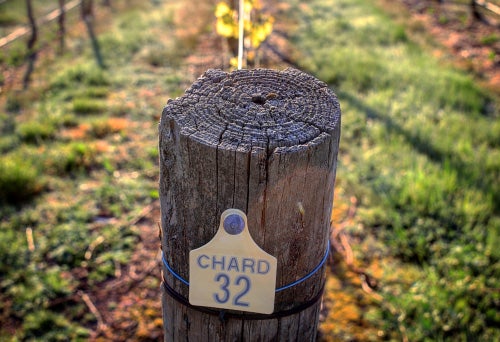
No grape variety has played a more significant role in the development of modern Australian wine than Chardonnay. Ken Gargett traces the variety’s history in Australia and pays homage to its extraordinary stylistic diversity.
There is gold in those vineyards and gold in the bottles. Chardonnay today, despite its far distant origins, seems to be a quintessentially Australian grape. For many, it is the face of Aussie wine, and the success of the industry, at least in recent decades, has been built on its back. (Shiraz deserves a mention, too.) There was a time when Australian Chardonnay was simply those great-value, often rather simple, easy-drinking but full-of-flavor wines, often embalmed in oak, that the world loved—at least for a while. “Sunshine in a bottle” was a phrase often bandied about, and there are still plenty of examples. But Chardonnay in Australia, for serious wine lovers, is now almost unrecognizable from that old stereotype.
Australian Chardonnay has been around for only the blink of an eye, in vinous terms—for about as long as Margaret River has been a wine district. If one turns to what was probably the leading wine book of its day, Max Lake’s Classic Wines of Australia (1966), Chardonnay gets a single mention (while Chasselas gets five and Crouchen/Clare Riesling half a dozen), but even then only as a synonym for the obscure Aucerot (DNA identification then resembling science fiction). At the time, apparently only Baileys of Glenrowan, more famous for fortified wines, was growing Aucerot; the story is that a member of the family brought some cuttings back from his sojourn in France during World War I and claimed them as Aucerot, which was later confirmed by well-known ampelographer François Robert de Castella. When Baileys was sold in the late 1980s, those vines were ripped out to be replaced by a more fashionable variety—Chardonnay, ironically.
The story of just how Chardonnay was established in this country, and who produced the first examples, is rather murky and varies a bit depending on who tells it. We looked at this in depth when we looked at Tyrrell’s Vat 47 Chardonnay in WFW 61 (2018; pp.100–05). Between that, and the work done by Andrew Caillard MW in his astonishing three-volume The Australian Ark, we can now take things a little further.
Related


Origins and pioneers
Conventional wisdom has the first Australian Chardonnay as the 1971 Vat 47 from Tyrrell’s, just as it would suggest that the Hunter Valley is one of the last places in Australia that is suited to this grape—Vat 47 continues to defy that orthodoxy. Caillard believes that Chardonnay first arrived in Australia under the name Pineau Blanc or Morrillon and was made into wine as early as 1876. The earliest concrete example, contrary to what we have been led to believe, came in 1936, when Leo Buring exhibited a “novelty Australian Chardonnay” from 1893, in London.
In 1955, Chardonnay cuttings arrived in Western Australia from the University of Davis, California, thanks to Professor Harry Olmo and the friendships he developed when there. This was a clone given the romantic tag Foundation Plant Services 1 (occasionally shortened to FPS 1). Caillard quotes Brian Croser, a man crucial to the success of the variety in later years, noting that this clone was in the Armstrong Vineyard at Davis at the end of Prohibition. Croser believes that it came from well before Prohibition, given that planting vineyards was hardly a common activity at the time, believing it to have been first planted in the Livermore Valley in 1908.
In 1961, FPS 1 was withdrawn from distribution because of a tendency to succumb to hen and chicken (millerandage), but by then it was already in the West, where it would become legendary as the Gingin clone, still subject to the disease but also treasured by many Margaret River wineries for the quality it imbues in their wines. The name Gingin is believed to come from a small town of that name about 110 miles (70km) north of Perth. The Emu Wine Company planted there extensively in 1968 and later became the Moondah Brook Estate. Most of the vineyard was Chenin Blanc and the classic reds, but there was also some experimental Chardonnay, including this clone. Today, the town of Gingin is best known as part of an international research effort into gravitational waves.
Content from our partners
Croser, who has detailed this history in his July 2018 treatise “The Story of Chardonnay,” noted that on his return to California, Olmo heat-treated FPS 1 and destroyed the original stocks. The heat-treated vines became the clone known as FPS 2A. In 1969, the scientists at Davis decided that FPS 2A was not free of the same virus, so it was also destroyed. The previous year, however, material was sent to South Australia, where it seems to have thrived, even if not disease-free, and Croser planted it in his famous Tiers Vineyard in 1979. Needless to say, as Caillard details, that would all be too easy. Genome sequencing in 2021 revealed that material in Tiers is likely related to vines from the Kaluna Vineyard, planted at Smithfield in New South Wales in the 1830s, meaning it derived from the famous James Busby vine importation of 1832. (Fascinating stuff, perhaps, but if we head any further down this rabbit hole, we’ll need this entire magazine for space.) One final note on clones: Testing reveals that Gingin, Mendoza from Argentina, and OF Chard from the US all share “a recent common progenitor.”
Tyrrell’s has, with some justification, always claimed to have released the first commercial Chardonnay in Australia: the 1971 Vat 47 Pinot Chardonnay. Being Tyrrell’s, there is inevitably a fabulous backstory to it, though the name simply comes from the vat in which the wine was originally placed. Pinot Chardonnay was a common name given to the grape in the early days, and Tyrrell’s stuck with it until label integrity made that impossible. They did so because apparently a local, unnamed wine critic berated them in an article, telling them it was time to drop it. Apparently, Murray Tyrrell’s response was to tell the writer concerned that they would do so, the moment he dropped dead.
Caillard has further evidence that Tyrrell’s claims may have been somewhat premature, noting that in 1969 a Rossetto Beelgara Vineyards Pinot Chardonnay from Griffith in NSW, won a silver medal at the Adelaide Wine Show with an unoaked Chardonnay from that vintage.
Back in the 1960s, Murray Tyrrell—with friends Len Evans, Max Lake (a famous surgeon who established Australia’s first boutique winery, Lakes Folly, and also authored a number of highly regarded wine and food books), and Rudi Komon, a famous art dealer and wine judge at the time—often enjoyed great white Burgundies, and he was keen to give an Aussie version a crack. It was known that Penfolds had a small patch of Chardonnay in a local Hunter vineyard, the HVD Vineyard, but that was used for its Pinot/Riesling—given the lax labeling of the day, it comes as no surprise to discover that the Pinot/Riesling was in fact a Chardonnay/Semillon—seemingly sharing was out of the question. (It is difficult to believe that Murray could not simply have got on the phone to Max Schubert or any local Penfolds winemaker and asked for a few cuttings. Generosity among colleagues has always been an essential pillar of the local wine industry.) It is believed that the Chardonnay in the HVD Vineyard was planted in 1908, by a Catholic seminarian and a nun, both of whom had fled France to marry. The seminarian was the grandfather of the former head of the ACTU (Australian Council of Trade Unions) and federal government minister Greg Combet. HVD stands for Hunter Valley Distillery, since in those days the grapes were largely intended for distillation.
In 1983, the Tyrrell family purchased the vineyard. Murray also released a “Pinot/Riesling,” his Vat 63, in 1970, but again, it was a blend of Chardonnay and Semillon. Both the 1971 and 1972 Vat 47s were unoaked, because they were made in the same manner as Semillon.
The midnight caper to relieve Penfolds of some of its Chardonnay took place in 1967. According to legend, Murray and some of his team grabbed their secateurs, hopped the fence, and took some cuttings for themselves. No one did marketing quite like Murray, so just how true is this tale? There are numerous versions. John Lewis, a writer from Newcastle, has claimed that the cuttings were already destined for the fire and that Murray told him that his actions “were honorably in order.” As mentioned, the idea that Murray had to steal the vines is something that has never sat well. Lewis is another who believed that Murray could have called Schubert at any time and simply asked. Of course, that lacks the same panache when it comes to a tale to sell the wine.
The early reception of Vat 47 was somewhat underwhelming. At the Brisbane Wine Show, the 1973 Vat 47 was awarded a dismal 6/20 by respected judge Bill Chambers. Bruce Tyrrell reckons Chambers would have given the spittoon 8/20. Chambers later said that the “wine was either volatile and oxidized or the best wine I’ve ever seen”—and he was not going to risk a gold medal until he had worked out which. When the same wine won Champion Wine at the Adelaide Show and a further ten golds, perhaps Chambers’s dilemma was resolved.
A fly in the timing tale comes from Mudgee, the Craigmoor winery, where winemaker Pieter van Gent also released a 1971 Chardonnay. There are suggestions it was blended with Semillon, but van Gent has said he made a single hogshead and that was not enough to bottle commercially. There are also reports of examples being made in Rutherglen back in 1912.
So, there are numerous inconvenient facts about our inaugural Chardonnay. But whichever way one looks at this, there can be no doubt that Vat 47 was the wine that started Australia down the Chardonnay path. And once we were on that road, there was no looking back.
Myriad styles, stellar quality
Styles have varied widely over the years—from those easy-drinking “sunshine in a bottle” examples, to wines that were basically so mummified in wood that many consumers mistook the taste of oak for that of the grape. Over the years, the pendulum has swung to offer everything from luscious to lean, fat and buttery to acidic, and simple to complex, along with decadent examples (remember the old Rosemount Roxburgh), maximum or minimum intervention, the unoaked phenomenon (which surely laid a platform for the Kiwi Sauvalanche and that ridiculous ABC, “Anything but Chardonnay” phase), flavorsome, and everything in between. All the while, these wines were made and enjoyed in the reflection of the best from Burgundy. Every aspect of the oak, malo, lees, yeasts, alcohol, blend versus single-vineyard, clones, reduction or not and, if so, then at what level (the near-fanatical reverence held by many winemakers for the wines of Coche-Dury has certainly played an influential role), barrel-fermentation, climate, skin-contact, maturation vessels, winemaking spectra has been poked, prodded, twisted, and examined—and continues to be. In addition, aside from a few wines like Penfolds Yattarna, which is widely sourced, every conceivable terroir has been thoroughly explored. Indeed, it is almost impossible to think of an Australian wine region that has not planted Chardonnay, even though not all are suited. (Officially, 58 of Australia’s 65 regions include Chardonnay.)
In recent years, Australia has produced Chardonnay that can comfortably sit with the very best in the world. Sure, there are oceans of quaffable and even bog-standard offerings that provide simple, easy, and largely forgettable drinking, but the best are surely examples of the world’s most underrated wine styles. Not so long ago, at a lunch with blind wines, a superb Bonneau du Martray sat next to a 1990s Giaconda; the Australian blew the French wine off the table. (A wide range of palates were in complete agreement on this.) Even more recently, at a similar lunch that included some serious Francophiles, I watched as one nearly wept, cradling an empty bottle of 2005 Leeuwin Estate Art Series, wondering why on Earth he’d ever wasted so much money on white Burgs. (I suspect the tears were at the thought of the money he could have saved, rather than an emotional connection to the wine.) These are hardly isolated occurrences, but of course there are also a great many examples that come nowhere near these soaring heights, simply providing good value and good drinking. In fairness to France, it would be a brave man who suggested that their greatest did not still reign supreme, though the premox issues endemic to Burgundy some years ago proved a boon to sales of our best locally.
Chardonnay is the fifth most planted variety on the planet (behind Cabernet Sauvignon, Merlot, Tempranillo, and Airen), and Australia has around 10% of all Chardonnay vines, after France and the USA. Only Shiraz has more plantings in Australia, but in 2024 more Chardonnay was crushed than Shiraz. The first record of volume for Chardonnay crushed in Australia was in 1976—just 445 tons. (By comparison, Semillon was almost 25,000 tons that year.) By the end of the 1970s, the harvest finally hit 1,000 tons, creeping up to just under 40,000 tons in 1990, before peaking in 2008 at 428,000 tons. Chardonnay in 2024 saw a crush of 332,643 tons, almost one quarter of our entire crush. Some 21,442ha (52,935 acres) of Chardonnay are planted—16% of all vineyards. The vast majority of the crush is in regions providing the more commercial styles. Nearly one quarter (23.4%) of export volume is Chardonnay, though this drops to 13.5% when it comes to value. The USA takes 42% (though who knows where the tariff chaos will leave that?) and the UK 12%, followed by Canada, Japan, and Hong Kong.
At its best, Australian Chardonnay is now world-class and worthy of attention from anyone serious about wine. What follows is a look at some of our best. Needless to say, space (and the slackness of a couple of winemakers—you know who you are, Carlos) means that we can never offer complete coverage. This does not even address the use of Chardonnay in our sparkling wines. Chardonnay in this country has never been more exciting than it is today, and it is only getting better. How long before the wine world thinks Chardonnay when Australia is mentioned, rather than Shiraz?
Margaret River magic
Before looking at individual producers, it is worth addressing regional issues. While wines like Penfolds Yattarna are made from the best fruit from a wide range of options across the country, most of our best are from single sites or at least restricted to one region.
One region has, consistently, outperformed all others. The tiny district of Beechworth in Victoria created quite a splash, originally thanks to the extraordinary wines of Giaconda; and recently it has been well supported by a number of stellar producers. But it is Margaret River, one of the most isolated wine regions on the planet, in the far southwest of Western Australia, that must surely be not only our best but one of the most exciting Chardonnay regions in the world.
Australians are known for perhaps placing a greater reliance on wine shows than most countries—Len Evans always stressed how important they were to “improve the breed.” Not every top wine is entered, of course, but the results speak for themselves. If we look at the Capital City shows, considered the most important, over the past decade, we can see that Margaret River has won 41 Best Chardonnay trophies out of a possible 63. In 2023, Margaret River won six out of a possible seven trophies, and picked up five out of a possible seven trophies in five other years. This is even more impressive when one considers that in three of the other years, not all the shows were held, due to Covid. It is astonishing to think that the Margaret River region produces only 1% of all the Chardonnay grown in Australia, and yet its wines won 65% of the trophies for best Chardonnay. Why? Margaret River enjoys a maritime climate—hardly Burgundian. It is low-altitude and certainly not a particularly cool region. No doubt, the oceanic influence plays a role, and the Gingin clone has found its ideal home. The winemakers are highly talented and driven, but that can be said of many regions. It just works! As an aside, the region’s success rate for Best Cabernet trophies is even higher. (Tasmania has an equally successful history, with trophies for Pinot Noir and sparkling wines.)
Most of the notes that follow are based on wines submitted for this article, with a few from random tastings. The choice was up to each winery concerned, but the hope was that they would include something young and something more mature. Needless to say, many of the older wines may no longer be available. If the scores seem optimistically elevated, I can only plead that they are for our very best Chardonnays. For me, the scores reflect that.


