

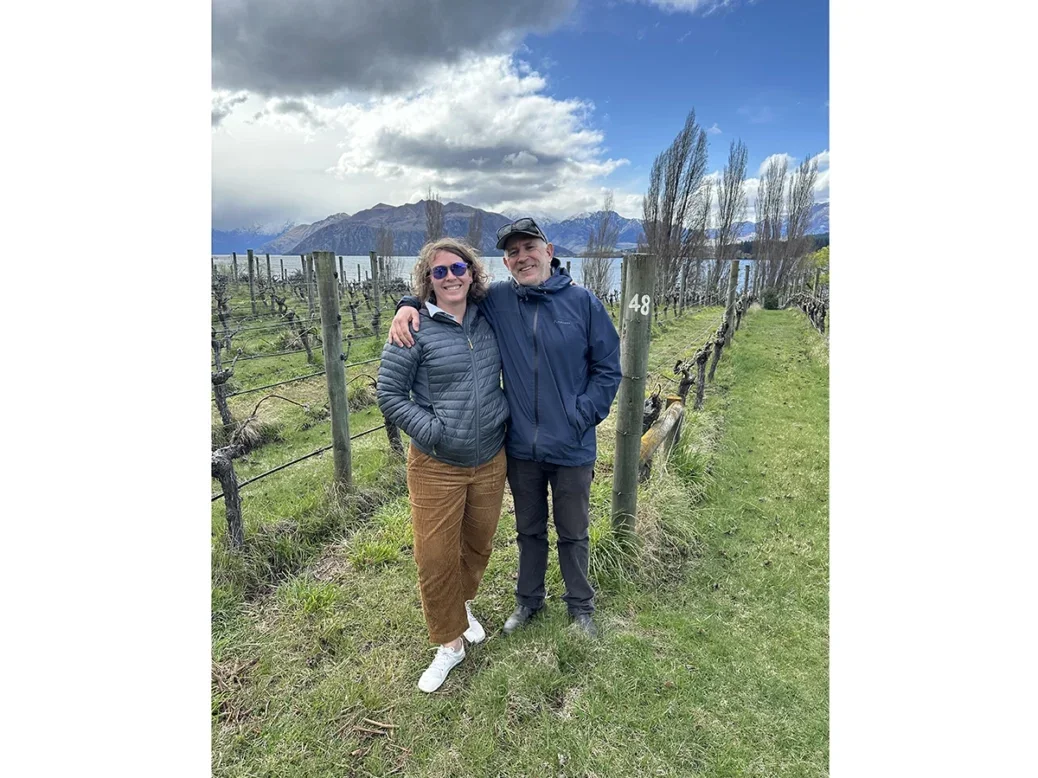
Rippon, with its beautiful setting overlooking Lake Wānaka, may be the most photographed vineyard in New Zealand and one of the most mesmeric in the world. Wānaka means “a teaching place” in Māori, and courtesy of Nick Mills I was taught a great deal during my visit in September 2024, while staying with his mother, Lois, on the property.
It was Nick’s father, Rolfe—the third generation on the property formerly known as Wānaka Station, which had been purchased by his grandfather Percy Sargood in 1912—who started out on the wine front in 1975 by planting small quantities of everything that could be found, because people said nothing would work, before concentrating more on vinifera varieties from 1982. He saved the vines that gave the best results and didn’t need too much pushing and pulling around to produce decent grapes: Pinot Noir, Riesling, Osteiner, Sauvignon Blanc, Gewurztraminer, and Gamay—though recent tests have shown the latter to be a clone of Pinot Noir.
The vineyard site
Rippon’s vineyards are planted on schistous soils that are emerging from metamorphosed graywacke. The region is in something of a rain shadow behind the Main Divide range, with a tempering effect on the continental climate from the lake. Nick feels these conditions are more beneficial to precision and articulation of tannin, rather than flesh in his wines. The vineyards start steeply at the top of the small hill on which Rippon Hall is built, flattening out toward the lake. They are on their own roots, unlike most of Central Otago, and are not irrigated.
From 2008, two single blocks were separated out, though most of each must go back into the principal Rippon wine. All three bottlings bear the subtitle Mature Vine from this vintage. Tinker’s Field, planted 1986–89, is north-facing, gets the afternoon sun, and benefits from some wind protection from Ruby Island. The soil is a relatively coarse schistous gravel. Emma’s Block, planted in 1991, faces east-northeast and is closer to the lake, on clay lenses and finer schistous gravels missing the afternoon sun. Fruit on the front palate, then a little firmness at the back, not quite so complete across the middle. In the vintages where we tasted these two vineyards side by side, I found Tinker’s Field more structured.
Related

Looking through the notes on the wines in the tasting, I see that harvest dates vary between mid-March for the earliest (2018) through to late April (2009). The range is quite similar in Burgundy but a month earlier. What is also clear is that there is no problem with ripening the grapes, yet they retain good acidity, with lower pH readings than is the norm in Burgundy. Nick makes the point that the vineyards provide sufficient balance in the grapes that they do not need to make any must adjustments.
Establishing Rippon
The first winemaker here was Tony Bish, instrumental in the major Pinot planting program between 1986 and 1989, after which he moved to Akaroa and can now be found in Hawke’s Bay. The first wine made at Rippon in 1987 was a Müller Thurgau. Then in 1988 the birds got the whole crop. The first Pinot came in 1989, vinified by Bish and completed by the young Rudi Bauer (b.1960), who had just arrived, having been making wine at Simi in California. Three whole barrels were made! Rudi stayed until 1993, when he handed over to Clothilde Chauvet. A succession of short-term appointments followed from 1995, unfortunately culminating in the loss of the 2002 vintage in the winery, before Nick returned to the property in 2003.
Nick had originally set out to do other things, specifically a ski champion. Ranked number 1 in New Zealand, he appeared to be headed to the 1998 Winter Olympics when a serious knee injury ended that dream. Instead, wine came to the fore with a four-year stint in Burgundy, including a course at the Lycée Viticole in Beaune; various internships, such as eight months at Domaine de la Romanée-Conti; and the striking of many friendships with the new generation of vignerons.
Content from our partners
When Nick headed back to Rippon, where he had been born and grew up, he took plenty of ideas with him—some philosophical, some practical. Two things initiated straightaway were a move toward biodynamic practices from the organic farming that had always been in place, and the inclusion of suitable stems in the Pinot ferment, usually around one third. He also switched to Diam closures in 2004.
In 2012, Rippon held an extensive vertical tasting to herald the centenary of the family’s purchase of Wānaka Station. Since I was coming to New Zealand in September 2024 and planned to spend a bit of quality time on the South Island, I wondered aloud if now might be a good time for another vertical. Nick kindly took the hint and laid on this exceptional lineup. The only unfortunate aspect was that our New Zealand contributor Jane Skilton was out of the country on a long-planned family trip so could not be present.
Getting a taste
We began with a refreshing 2022 Sauvignon Blanc, more jasmine than gooseberry in aromatics, clean and pure on the palate, and the Young Vines Pinot from 2023, an intense and quite crunchy, mineral rendition of darker Pinot fruit, with fair persistence. Then the main event, after which a small vertical of Riesling concluded the day. This went back to 1992 and 1993, both still in fine condition. Other favorites were exquisite 2007 and 2011 Rieslings, a very youthful 2016 and a 2019 Lolo’s Riesling, which was fascinating. It had been fermented in barrel and left on the lees, unsulfured. Paler in color than the regular, with a more phenolic nose, it was clearly more complex and further away from the apple and lime register. Those notes did begin to emerge slowly, though. Multilayered on the palate, with the stony side showing through. Very long. Almost a salty lick to finish.
Back to the main course: Pinot Noir. The tasting was very sensibly arranged from oldest to youngest, so that we could see the evolution of the vines, the wines and the production philosophy. What a tour de force! And it threw up some fascinating and unexpected themes.
First, the condition of the oldest wines, now 30+ years old and made from very young vines. If you want further thoughts on how grapes and wines change character as the vines age, listen to episode 118 of Levi Dalton’s I’ll Drink to That podcast for an interview with Nick immediately after his previous vertical. These first Rippon Pinots have lasted much better than anybody could have expected at the outset. The 1992 won all sorts of prizes, the first from Central Otago and the first Pinot Noir to win Best New Zealand Red. Interestingly, it clearly outperformed the 1992 Barrel Select wine.
Then came a relatively quiet period, without a long-term winemaker to shape the course of Rippon Pinot until Nick returned in 2003. The vines were growing up but had not reached maturity. Nick feels they were beginning to find their feet in 2000, and from 2001 young vines were not included. His 2003 proved to be a superb wine, but it was when we tasted the 2006 that I began to feel that the Rippon Pinot had come into its own—a wine that could achieve its own natural sense of place without undue signs of human intervention.
The wines now developed an inexplicable rhythm of odd- and even-year alternation that in retrospect could be traced back to the start of the tasting. Where we had pairs side by side, the even vintage was consistently softer and smoother than the more aquiline odd number. You can see that clearly in 1991/92, 1997/98, 2006/07, and 2010/11.
In 2008 (the inaugural vintage for the single-block vines), 2009, 2015, 2019 (with the addition of Lolo’s Block on its only release to date), 2020, and 2021, we were able to try the Rippon bottling and the two single-block wines side by side.
The Pinots are all made in the same way, in relation to oak regime, proportion of whole bunches, and length of cuvaison. They spend 18 months in barrel, followed by a further two years in bottle before release.
Conclusions
Rippon Pinot Noir is not a shooting star, but a fully fledged member of the New Zealand Pinot firmament, a tribute to 30-plus years—more than 40 if you count back to the first Pinot planting, indeed 50 since Rolfe Mills first put a vine into his soil—of hard work carried out with love and considerable forethought. Nick has a theory for everything and the work ethic to put his ideas into practice. I speak as if it was just Nick responsible, but he is fully supported by the family, whether his indefatigable mother Lois, his wife Jo, or his siblings, some of whom work on the property. At Rippon, there is a sense of place and a sense of family.
The wines are not hedonistic, yet they are full of fruit. It is clear that they can age remarkably well. I have included suggested drinking dates from 2008 onward. Earlier vintages are mostly fully mature, with the notes indicating where there may be further potential.
The wines speak of Rippon, not the New World or the southern hemisphere or indeed New Zealand, not even necessarily of Central Otago; Wānaka, I think so; Rippon, certainly. They have precision and structure, and they reflect their individual sites and the changing vintages. They require a little work from you the drinker—us, the drinkers—but that effort will most certainly be repaid.
So, which is better, then, Emma’s Block or Tinker’s Field? That depends on your palate. I sensed in the room (we were a dozen or more tasting) that there was slightly more love for Emma’s over Tinker’s, and at the time my preference was a little bit the other way around. Reading through my notes while writing this report, I am not quite so sure. Emma’s Block frequently has the more attractive fruit, especially while the wines are younger. Tinker’s Field has just a little more structure—which you can prefer or otherwise—but also frequently just a little more persistence on the palate. Whichever your choice, I never felt at any point that the Rippon bottling suffered from the extraction of barrels to make up the single-vineyard wines.
Tasting
1991 Rippon Pinot Noir
A warmer vintage. Lighter garnet. Not so much vegetal, but a little beetroot and capsicum. Still elegant, with a fresh red berry fruit showing through beneath. The tannins have subsided, the acidity is still present; rather good length. After a few minutes, this develops more of a tomato character and begins to dry. Drink up. | 88
1991 Rippon Barrel Selection Pinot Noir
Made in Bordeaux barrels with slim staves, and bottled in a flute bottle for visual attention. Very similar in color, perhaps more even across the glass. Less of the beetroot, more fruit-based. Vestigial cherries, then developing quite a rich mid-palate; the oak has done its job of enhancing the wine rather than fighting with it. Lightly mentholated at the back. This is still a real pleasure to drink and nicely persistent. | 91
1992 Rippon Pinot Noir
A cooler vintage. The beginning of architecture in the wine. Pale garnet color. Deliciously perfumed; a little riper fruit than in 1991 judging by the nose. Plenty of class to make you keep wanting to go back for another sniff. A little strawberry, rather graceful fruit, then a tannin or two behind, but lively pinpricks of alpine strawberries follow through on the palate. Overall, a good fruit/tannin/acid balance—a wine that is still very much with us today. | 94
1992 Rippon Barrel Selection Pinot Noir
A separate ferment from the start, rather than being a selection of the best barrels from the regular wine. Though the color has held up well, crimson with a light tawny rim, there is a light oxidative note on the nose. Possibly a little dust from the cork. A greater fruit concentration, but the cork dust is holding it back. Slightly higher-acidity showing of these two ’92s. Rudi Bauer, who made these wines, also had a clear preference for the “regular” bottling. | 90
1993 Rippon Pinot Noir
Cooler again. Still bright in color, with some sediment. A smoky note to the bouquet, quite complex. The beetroot has been cooked and thus softened, while the berry fruit takes the upper hand. Good acidity, with fresh fruit growing on the palate, raspberry with a fresh cherry wash; a few tannins at the finish still, alongside the typical acidity of this site, which starts to become more prominent with time in the glass. | 92
1995 Rippon Pinot Noir
A cool vintage affected by the aftermath of the 1991 eruption of volcano Pinatubo in the Philippines. The palest color to date, relatively evolved. The nose has not completely faded but is softer and lighter. Chaptalized? A few strawberries on the palate but not the fresh energy of most wines to date. | 87
1997 Rippon Pinot Noir
A light garnet color, mature but still bright. The bouquet is gentle but suggests underlying energy, despite the maturity. Quite mentholated, fresh acidity; some alpine strawberries and brisk red cherries. Pleasing, if not quite as complete as 1992 or 1993. | 91
1998 Rippon Pinot Noir
A mature garnet, not quite as clear in color as the 1997. The fruit is a little less fresh on the palate, and the menthol is once again present at the back. In comparison with 1997, the 1998 Rippon Pinot has greater depth of fruit but a little less clarity. | 91
2000 Rippon Pinot Noir
One of the more evolved colors, with a certain amount of depth. There is a light dusting from the cork. There is plenty of energy, though; on the palate, the 2000 Rippon is still a vigorous wine, with the fruit transcending both tannin and acidity. Full, generous, and commanding. Cherries join the mixed red berries at the finish. Nick could see from this vintage that Rippon Pinot could use an extra six months in wood. | 93
2003 Rippon Pinot Noir
A cooler vintage. A clean, vigorous garnet to crimson color, with both generosity and precision on the nose. Bright ripe fresh red fruit, still some tannins on the palate, while the acidity is well folded in. Roses and peonies join the fruit—this is a complex and impressive wine. Rippon is starting to come of age, and Nick Mills shows he is ready to push a little further. | 94
2004 Rippon Pinot Noir
The first vintage under Diam. A cold vintage. Evolving with a paler rim. Ripe fleshy strawberries on the nose, middleweight; softer in fruit style than some of the wines, so fractionally less precision, but still a very pleasing glass of maturing Pinot with good length. | 92
2005 Rippon Pinot Noir
Another cold vintage. A full and even crimson color. This is tense, brisk, and very youthful. Some sour cherries in the fruit mix. The fruit profile suggests that ripening was a little more difficult. Perhaps a little blood orange. Plenty of life left. | 92
2006 Rippon Pinot Noir
A vigorous bright red crimson color, with nose to match. Deliciously perfumed, the palate in full harmony, the full panoply of red cherry, raspberry, and strawberry fruit, the structure perfectly integrated. Tasting this wine, I feel that Nick’s take on Rippon is reaching harmony, all the way through to the back of the palate. The 2006 should have enough life for at least another five years. | 94
2007 Rippon Pinot Noir
A full and invigorating color, similar to the 2006. Not quite so harmonious, but with added tension. Perhaps an extra level of density, and perhaps the first wine where I feel that extra aging could be a benefit. The acidity is a touch more pronounced than the 2006, so not quite the same degree of sweet spot, at least at this stage, though there is still time for the 2007 to improve. | 93
2008 Rippon Pinot Noir
Picked from the second week of April, which has been the Rippon norm. 2008 was a very warm vintage, the hottest until 2018. It was also very generous, but they handled the crop well, with crop-thinning. A pale to mid-crimson, with a lighter rim. Some elegance, albeit in a softer idiom. Red berries with a little orange zest, then firmer behind. Not quite the intensity of 2006 and 2007, but harmonious and persistent. Drinking very well now. Drink to 2027. | 92
2008 Rippon Emma’s Block Pinot Noir
A little fuller in color than the Mature Vines, though again with a lighter rim. A firm deep raspberry fruit shows from the outset. The intensity is immediately apparent on the palate, plus there is a little menthol from the oak. One wonders if the extraction of the single vineyards might have downplayed the regular bottling, though Nick is keen to state that they did their best to safeguard against this. Emma’s Block comes across as quite saline when retasted after Tinker’s Field. Drink to 2030. | 92
2008 Rippon Tinker’s Field Pinot Noir
Perhaps a fraction lighter than Emma’s Block in color. The nose is more fruit-forward, raspberry and strawberry together with a briary underlay. This wine comes across as the most structured on the palate, albeit with perfectly integrated tannins and the longest finish. A slight and pleasing chocolate note at the finish. Drink to 2030. | 93
2009 Rippon Pinot Noir
A cooler year, picked from the fourth week of April, 13% alcohol and low pH. A relatively pale crimson. The bouquet is gentle, with some floral attributes, showing a proportion of whole-bunch fermentation. This is very elegant—less powerful perhaps than 2006 and 2007 but with a beautiful sense of harmony, fragrant and persistent. Drinking well now. Drink to 2027. | 93
2009 Rippon Emma’s Block Pinot Noir
Medium deep crimson. The bouquet took a little coaxing, but then the charm of the fruit really emerges. Nonetheless, the taut and precise style of the odd-numbered vintages shows through on the palate. There is still plenty in reserve here. Drink to 2029. | 94
2009 Rippon Tinker’s Field Pinot Noir
Similar in color, with a little more complexity on the nose; alpine strawberries and some signs of whole bunch, especially on the palate. Leaner but longer than Emma’s, with good acidity to finish. Drink to 2029. | 93
2010 Rippon Pinot Noir
A ripe vintage, picked from April 2, reaching 24° Brix plus (14% in bottle), yet still with good acidity at 3.12 pH. A much deeper and more youthful ruby color than any of its predecessors. Thick glycerol legs, representing the vintage rather than anything intentional. Monolithic on the nose, with a little leathery touch suggestive of tannins to follow. Perhaps a hint of brassica. Powerful, rich, rather unformed dark red fruit on the nose; a suggestion of chocolate; firm acidity. Somewhat in the style of a 2005 red Burgundy—hugely promising but still not ready. Drink to 2032. | 95
2011 Rippon Pinot Noir
Picked early, at the end of March. Back to a more typical mid-crimson color after the much deeper 2010. The bouquet is a little backward, perhaps not as fresh as my favorites. Attractive raspberry fruit emerges behind, with fair length. Retasted later on its own, it had a better chance to shine without the much richer 2010 alongside. Drink now. | 92
2012 Rippon Pinot Noir
This vintage represents 100 years of the family on the property, and 30 years since the first Pinot planting. A warm vintage. Pale crimson to ruby. A light but fine nose, showing less ripe but very appealing fruit and a little whole bunch pepper. In fact, the perfume becomes an absolute delight, both fresh and dried roses. Very harmonious on the palate. Not the most muscled but a sheer delight in its elegant style. Few tannins, a light acidity, and persistent. Drink to 2028. | 94
2013 Rippon Pinot Noir
Picked during the third week of April. A youthful ruby, very promising, with more fruit weight on the nose but less floral than the 2012. More structure on the palate, built around tannins more than acidity, with fair length. No signs of emerging from the chrysalis. Drink to 2030. | 92
2015 Rippon Pinot Noir
An even mid-ruby. Not much bouquet at first, then some cherry and strawberry. Pleasant fruit pervades the palate, not the most intrusive, and then a wealth of succulent cherry to finish. Few tannins, and less structure than many vintages of Rippon. Drink to 2027. | 91
2015 Rippon Emma’s Block Pinot Noir
A pretty translucent lighter ruby color. The bouquet is all about the fruit, primary more than complex, a cheerful raspberry. A little more weight on the palate, with the cherries coming to the fore in a slightly sweet-and-sour format. Drink to 2027. | 92
2015 Rippon Tinker’s Field Pinot Noir
Mid-ruby red. Even Tinker’s Field in 2015 seems more fruit-driven than briary on the nose. Quite an intensity here: fresh acidity. Good tannins make for a chewier finish. Having to reassess this. The muscle is all there, at the moment slightly divorced from the fruit, so a conservative score at this stage. It could yet meld together into a wine deserving a higher rating. Drink to 2030. | 92
2016 Rippon Pinot Noir
No great density of color, and one of the softer-style bouquets. You have to go searching for it a little bit. Fresh cherry, a little strawberry; not quite complete through to the back of the palate, lighter on tannins and acidity. Retasting after the 2017, and again later I can see the structure in full throttle. In fact, the tannins are a little on the firm side. But give it time. The fruit was there at harvest and early on in bottle, Nick notes, while agreeing that it is a bit subdued today. Drink to 2028. | 91
2017 Rippon Pinot Noir
A tiny vintage, picked in the third week of April at 22° Brix and 3.08pH. A clear, pure ruby. The bouquet shows the precision of high-class Rippon. There is a sweetness and weight to the fruit that is quite exciting: energetic raspberry, an attractive thread of acidity, and refined tannins. Drink to 2029. | 92
2018 Rippon Pinot Noir
The earliest harvest ever at Rippon, after rain in March caused an explosion in the ripening process. Picked from March 15 at 23° Brix and 3.1pH. A fresh deep ruby color, with very evident power to the nose, possibly at the expense of elegance. This was a very hot summer. A little leathery note is indicative of tannins. A full sweet, ripe raspberry and peony profile, plus boiled cherries on the palate. Brawny and lush, yet with Rippon tannins behind. A little graphite as well. If all goes well, the 2018 will settle down into a complex wine in due course. Drink to 2032. | 91
2019 Rippon Pinot Noir
A high-yielding vintage after the late 2018 rains. A lovely summer succeeded in ripening the grapes though. An attractive mid-ruby; a sense of balance in both color and nose. Elegance is masking intensity. It feels like a much younger version of the 2006, because of the innate sense of harmony. The intensity builds magically on the palate without ever becoming monolithic. Good acidity and refined but certainly present tannins. I predict a spectacular future! Drink 2027–35. | 95
2019 Rippon Lolo’s Pinot Noir
Lolo’s block, Lolo being how Nick refers to his mother Lois, sits between her house and the cellar door and was planted in 2000; this is the only vintage declared to date. A youthful crimson. Good glycerol legs. Plenty of mixed berry fruit on the nose. A surge of vivid and vibrant dark strawberry fruit across the palate, the front like Emma’s and the structure at the back a little closer to Tinker’s Field. 2027–35. | 94
2019 Rippon Emma’s Block Pinot Noir
Quite a light crimson ruby. The nose is more restrained than usual for Emma’s Block, some cherry but not yet really giving. Very intense on the palate, linear, very far from being ready. Showing a few more tannins than usual in the structure. 2028–38. | 96
2019 Rippon Tinker’s Field Pinot Noir
A similar light crimson ruby. Curiously, it is easier to pick the fruit here than with Emma’s Block. It is remarkably fine; alpine strawberry with a little fine raspberry, everything being hidden in the background. Superb tensile strength. The structure has a finesse missing in, say, 2015. 2028–38. | 95
2020 Rippon Pinot Noir
A cooler year, made even more difficult to manage because of Covid complications. Yet these are classical Rippon wines. An attractive mid-ruby color. The fruit comes out immediately, suggesting a wine to drink before the 2019. Cherries with a little graphite. There is the beginning of the velvet that this wine will surely show in maturity. It is a real charmer, with a succulence to the fruit that has been managed without losing the shape of the wine and the vineyard. Quite persistent. Drink to 2032. | 93
2020 Rippon Emma’s Block Pinot Noir
A very attractive pink-purple color. The bouquet has a sensual and charming fruit, yet with the underlying backbone of classical Rippon. Emma’s Block ability of the fruit to saturate the front of the palate is very evident, but there is plenty to follow through behind: cherries with a little orange zest, medium acidity, refined tannins. 2027–34. | 94
2020 Rippon Tinker’s Field Pinot Noir
Less sensational than Emma’s Block but just as fine. The cherries are a little more reserved and concentrated through the middle of the mouth. Some acidity, but especially the tannic framework is driving this wine. Leave Tinker’s Field for longer. The persistence puts this in a separate class. 2028–36. | 95
2021 Rippon Pinot Noir
A tiny crop, difficult to manage and with Covid-period staffing issues to boot. Not yet released. A lush, super-ripe cherry, followed by schistous tannins. It will be interesting to see how this marries up, its backwardness justifying the relatively late release regimen. A good long aftertaste. 2027–32. | 92
2021 Rippon Emma’s Block Pinot Noir
A fresh light purple. The bouquet is immediately seductive, with a lush darker red fruit, suggesting that the wine will be gorgeous to drink already. The palate corrects us, as we should expect from Rippon, by adding in a firm raft of tannins—though the fruit sweeps over the top of them to carry on to a luxuriant finish with ripe raspberry and some black cherries. 2027–34. | 94
2021 Rippon Tinker’s Field Pinot Noir
An even ruby/purple color. The bouquet is a little more subdued than Emma’s, with some graphite alongside the fruit. Then a huge burst of generous fruit in the middle of the palate: plums; a thick layer of fruit currently covering the structure. An amazing volume of fruit on the aftertaste. 2029–36. | 94


