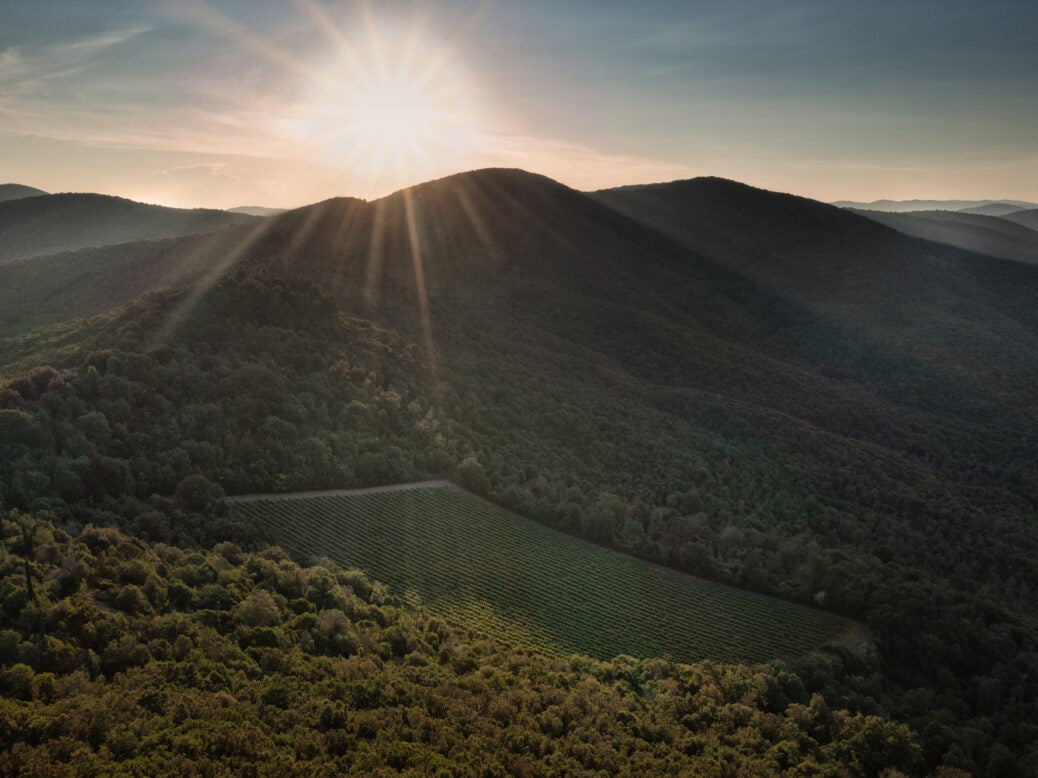
Sarah Marsh MW enjoys a mini-vertical of Sassicaia, including the latest, instantly accessible 2023 vintage.
Priscilla Incisa della Rocchetta, Tenuta San Guido’s head of external relations and a member of the owning family, recalls that “2023 was a very classic season, with humidity in spring, so there was a lot of work in the vineyard to avoid downy mildew.” This included green-pruning to provide ventilation and mechanical under-vine weeding. Priscilla compares the rainfall, humidity, and work with 1985, without the cold winter that killed the olive trees but sufficient for vine dormancy. Brett Fleming, MD of Armit Wines—long-standing UK representative of Tenuta San Guido—reminds us, “The ’85 is seen as a legendary vintage, yet it was very challenging. 2023 was a tricky, not perfect vintage” but “is a great vintage for Tuscany. A terrific vintage for Sassicaia, notwithstanding those challenges.”
Head of winemaking Carlo Paoli compares the season not only with 1985, 1980, and 1978 but also 2021 and 2019: “classic; not intensely hot or intensely cool.” He considers three factors responsible for the style of the 2023 vintage. First, abundant rainfall in winter and spring, which ensured the soil remained fresh and the vines could withstand the summer’s heat spikes throughout the growing cycle. Heat peaks were higher but shorter than in the dry summer of 2022. Second, spring frosts, which affected budding. This, together with poor flowering, reduced the crop. The smallish berries and loose, well-aerated bunches decreased the risk of downy mildew and allowed for better berry development and concentration. (Yields were approximately 10% lower than average for Cabernet Franc and 8% lower for Cabernet Sauvignon.) Finally, after the rain at the beginning of August, the vineyards dried without renewed heat spikes to cause sunburn, and nighttime temperatures fell, which promoted the development of aromatics. Carlo adds, “The vintage stands out for its excellent phenolic maturity for Cabernet Sauvignon and, particularly, Cabernet Franc.” With careful canopy management, Cabernet Franc was able to remain on the vine longer than usual, making 2023 “one of the best vintages ever for Cabernet Franc.” Harvest began on September 4, 12 days later than in 2022.
Priscilla recalls that the harvest was very calm. For Carlo, the key priorities were meticulous sorting, avoiding berry breakage, maintaining cool temperatures, and calibrating the destemming equipment for the gentlest possible handing. Fermentation temperatures didn’t exceed 84°F (29°C), “for delicate extraction, softer tannins, and maximum elegance.” He did five or six délestages, cooling and aerating the fermenting must—more than in 2022 and fewer than in 2021. The wine from the gently pressed grapes, considered free-run, is aged separately, as are further press fractions, though these have never been used during Carlo’s tenure.
Related


Great attention is paid to the sedimentation after fermentation. There are six or seven rackings at intervals of five to six days, with a final 15 days before transferring to barrel. Some 10% of barriques come from Slavonia and Hungary, which Carlo feels bring more complexity. There is 40% new oak. All the parcels are kept separately before blending in January. The historic, higher-altitude vineyard of Castiglioncello is just 1.1ha (2.7 acres), of almost 100ha (250 acres) of total vineyard area, but represents about 10% of Sassicaia, together with the other historic vineyards (from 40–50 years)—Quercia Tagliata, Sughera, and Sassicaia di Sotto—accounting for another 30–35%.
It is worth remarking on the technical analysis of Sassicaia. Irrespective of the season, the acidity is fresh, typically over 6g/l, and the pH is under 3.5. The alcohol, generally 13.5–14%, is a good 0.5% lower than is typical of many Bolgheri wines.
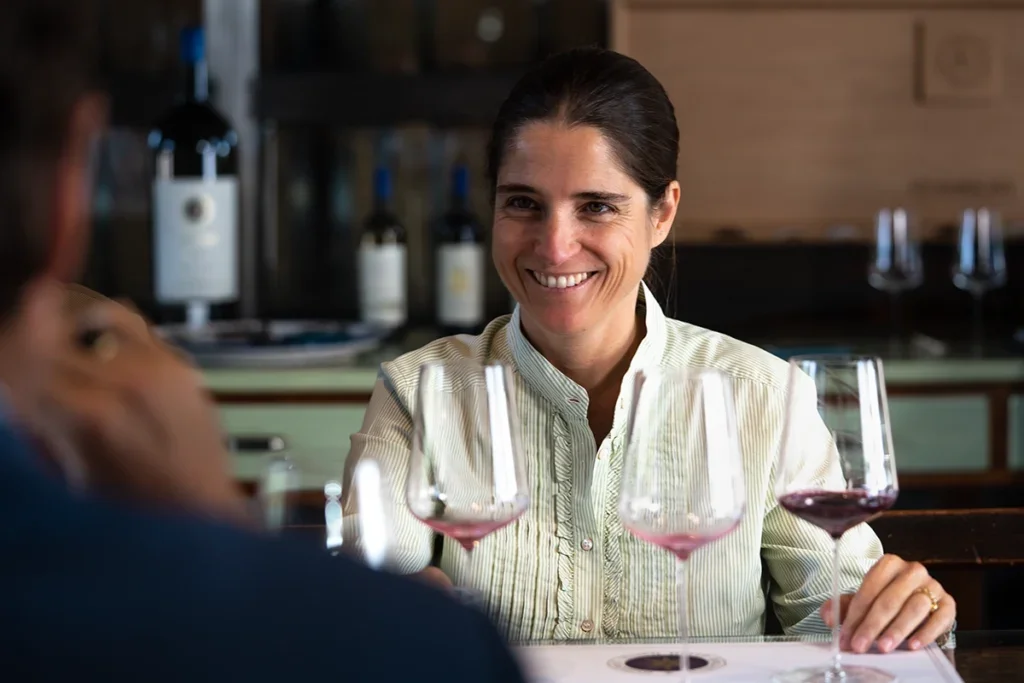
I find the tannin and structure of 2023 light and precise. Priscilla seemed to agree when we discussed the wine after the tasting: “2023 is elegant, fresh, and persistent. It is young but enjoyable now. The good acidity, balance, and tannin will allow it to age. It’s a bit like the 2021 and 2019, but 2023 had a better growing season, with less rain than 2019.”
Content from our partners
Carlo highlights 2023’s strong aromatic expression and good but not exaggerated freshness on the palate. He finds salinity and sapidity, but neither in excess. “The palate impression recalls great vintages: 2021, for sapidity and salinity; and for elegance and freshness, comparable with 2016,” but he points out that another three to five years are really needed to understand the wine. “It’s said to have an extra gear, maybe even two.”
He distinguishes it from the 1985, which he says was “gruff” as a young wine, “only later achieving great recognition, while 2023 already has good drinkability in youth.” He links it more closely with 1998 and 1995 for “strong aromatic expression, not excessive alcohol, and good sapidity.” In general, he recommends waiting five or six years before opening a recent release of Sassicaia.
I find that 2023 as a vintage has oodles of charm—gloriously fruity and perfumed not only at Tenuta San Guido but also from many other Bolgheri properties. And yes, Cabernet Franc has excelled. 2023s are lighter, with less concentration and density, than 2022; fruitier and more vibrant, and the tannins are more refined, though the vintage is easily marked by too much new oak. A delightful vintage, well balanced and fresh, but without quite the sophistication of 2021.
2023 has the benefit of instant accessibility—no bad thing, for 2022 seems to be shutting down—while 2021 has great potential for aging, even though it is already gorgeous now.
Tasting
Sassicaia Bolgheri Sassicaia DOC
Sassicaia 2023 (87% Cabernet Sauvignon, 13% Cabernet Franc; 14% ABV [parcels ranged from 13.3 to 13.8%]; pH 3.45, TA 6.2g/l)
Notably perfumed—not only in aroma but also on the palate, where scents of thyme flower and red rose petal entwine the lithe and linear core. There is silky fluidity to the finely textured tannin. Light but intense, with pure and singing red fruit. There’s tension and brightness. It stretches in a mineral thread into a precise and persistent finish, with a lingering hint of mint and petal perfume. Delightful. It was recently bottled, but I can’t see it shutting down. It is a more immediately accessible vintage than 2022 and unlikely to age as long, but the balance and intensity are there to evolve pleasingly for at least 12–15 years. 2027–37+. | 96
Sassicaia 2022 (88% Cabernet Sauvignon, 12% Cabernet Franc; 13.5% ABV; pH 3.43, TA 6.15g/l)
A very good technical analysis for this sizzling season, which kicked off with sufficiently high temperatures to affect budding. This resulted in a slightly smaller than average crop, carried through an intensely hot summer until mid-August rainfall cooled things down. Sassicaia’s parcels located higher than 1,000ft (300m)—the historic vineyard of Castiglioncello on rocky, limestone-rich soil, and Doccino and del Quercione—have brought brightness and balance to the concentrated fruit, while Cabernet Franc contributes herbal aromatics and freshness. I love the fact that this is not over-concentrated, and the acidity is fresh.
An expressive perfume, slightly exotic and reminiscent of a spice market, combines notes of cinnamon and star anise with tarragon. I first tasted the 2022 from barrel but have also tasted it on three occasions since bottling. There is Sassicaia’s trademark silky elegance. Straight, cleanly edged, firmly structured, and finely knit. Excellent depth of fruit, with no lack of tension and plenty of lively, fresh acidity. But on this occasion, it is grippier on the attack and compact on the mid-palate. The finish seems a touch drier than I’ve tasted before but is properly persistent (a longer finish than the ’23). I feel it has closed down, but there’s no need to hurry this wine. It has excellent aging potential. 2028–40+. | 96–97
Sassicaia 2021
Good water reserves from the winter proved a blessing during the very dry season that followed. The summer was warm but cooler than inland Tuscany, for it benefited from sea breezes. The lack of rain and humidity delivered a clean crop, so important for aging in bottle.
A touch of licorice combines with salted caramel and a waft of woodsmoke on the aroma. A tight, fresh, and zesty spring onto the palate. Piercing intensity, clean edges, and tingling nervosity. I love the arrow of acidity. Gossamer tannins. A fluid and gauzy texture. Such tension, vibration, and high-wired brightness to this wine. It is even more captivating than when I tasted it from a small phial sent over after a tasting of Super-Tuscan wines a few months ago. A brilliantly sustained treble note to finish, pure and ringing. It’s delicate in comparison with so many wines from Bolgheri or within its Super-Tuscan peer group. Tasting it at home alongside some other ’21s from the region, it is technically perfect—but more than that, it’s a beautiful wine that elicits an emotional response. You could drink it now, should you wish. 2026–40+. | 98+
Sassicaia 2019 (85% Cabernet Sauvignon, 15% Cabernet Franc; 14% ABV; pH 3.47, TA 6.05g/l; residual sugar 0.12g/l; impressive dry extract of 33.5g/l)
A hot, dry June was followed by occasional rain in July and August, so the grapes took longer to reach phenolic ripeness. The alcohol is a touch higher, and the acidity a little lower, from a harvest that began seven or eight days later than in more recent years.
Showing some evolution on the nose. Delicate notes of caramel and vanilla combine with aromatic thyme and crushed pink peppercorn. Sweeps effortlessly onto the palate and swishes across on supple satin. It illustrates the purity, elegance, and refinement of Sassicaia, deftly combined with generosity and density. Svelte and fluid, it is more comparable to 2023 than to 2022, at least for the moment. This was a pretty hot vintage, but the wine shows the sophistication of a cooler one. Shimmery finish. It purrs on the palate. Showing very well now but still with plenty of evolution ahead of it. 2026–38. | 96
Sassicaia 2015 (89% Cabernet Sauvignon, 11% Cabernet Franc, a lower Cabernet Franc proportion than in more recent years; 14% ABV; pH 3.4, TA 6.02g/l; residual sugar 0.25g/l; total dry extract 31.20g/l)
High temperatures and drought in July, but rain and a stronger diurnal temperature range in August permitted a longer, slower maturation through a sunny September and October. Fermentation temperatures peaked at 86–88°F (30–31°C), higher than in the other vintages in this tasting. I believe that there was a touch of American oak.
There is a distinctly richer, warmer feel to the 2015 vintage. I like the bouquet more than the palate, with its alluring notes of roasted chestnuts, toasted hazelnut, and soy sauce. This aromatic evolution is enticing. There is sweetness on the attack and appealing saddle leather to the mid-palate, combined with hints of coffee and stable. But it’s rather chunky, lacking some of Sassicaia’s fluidity of texture and elegant flow into the finish. The tannins are quite thick and rich. I am being rather critical, but the other vintages in this tasting are less bold and more elegant and persistent. I would be tempted to decant it and drink it now, while it has fruity sweetness, before it moves into a more tertiary phase. 2026–32. | 94
Guidalberto IGT Toscana
2024 marks the 25th anniversary of Guidalberto. “Maybe it has suffered from being in the shadow of Sassicaia,” remarks Priscilla, “but it is not a ‘second wine.’” It has always been made in a standalone winery, where olive oil was previously made. The 2024 has 52% Cabernet Sauvignon and 48% Merlot. “It has always been a blend of these two. Only at the beginning did it have some Sangiovese, which stopped when we started Le Difese.”
Some 90% of the fruit comes from the San Guido estate, with 10% from neighboring Castello di Bolgheri, owned by the della Gherardesca family. The land was all part of the same estate until 1930, when San Guido was formed. Castello di Bolgheri supplied all the Merlot for Guidalberto in the early days, but San Guido planted Merlot and is now almost self-sustaining. Guidalberto is matured for 13 months in barriques, 40% new, principally French, with 10% from other origins, including Slavonia and Hungary.
A warm July was followed in August by a significant weather front; the rain and drop in temperature made it a difficult year in which to achieve full maturity in Merlot, although crop-thinning helped achieve this and to keep the fruit healthy. Harvest started with Merlot on 28th. With sunny and windy conditions in September, it was a better season for later-ripening Cabernet Sauvignon. “2024 has less structure than 2023,” remarks Priscilla, “but is fresh and harmonious.”
Guidalberto 2024
Perfumed mulberry-fruit aroma, with a touch of five-spice. Smooth attack. You feel the softness of Merlot on the mid-palate, which is rounded with juicy damson fruit, albeit it lighter than the 2022 below. Follows through lively and bright, with a light quiver of tension and a pleasant touch of cocoa bitterness to finish. 2026–34. | 90
Guidalberto 2022
A darker, richer perfume than the 2024, with blackberries and ripe plum. It’s generous and quite full-bodied, but with freshness and a lively snap and tannic bite from the Cabernet. The sweetness of Merlot returns on the nicely sustained finish. It was a better year for Merlot than 2023, and the profile has a more sumptuous feel. Guidalberto is a relatively gregarious wine, in contrast to Sassicaia. But while it is already quite accessible, there is still an aging potential of 10–15 years. 2026–36. | 93–94
Le Difese IGT Toscana
Le Difese 2024
2002 was the first vintage of Le Difese, which is a blend of 75% Sangiovese (from Chianti Classico and Ruffino Chianti) with Cabernet Sauvignon from Bolgheri. “The first step into the San Guido family,” says Priscilla; “our welcome wine.” It is sold largely through restaurants. A fruity, berry-bright aroma. The palate follows the red-fruit profile, with redcurrant and pomegranate notes, fresh acidity, and a light crunch of tannin. Lively wine. Ready to drink. | 88