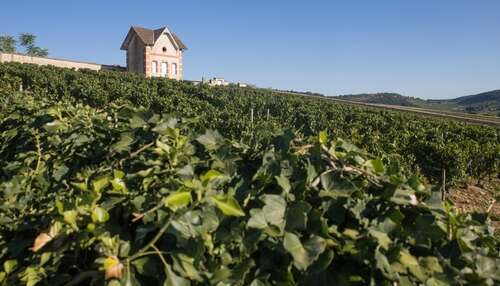
MEURSAULT
CHÂTEAU DE MEURSAULT
Stéphane Follin-Arbelet, director general of Château de Meursault and Château de Marsannay, comments that the weather, mildew, and yields got progressively worse from Puligny (45hl/ha) up to Marsannay (10hl/ha). “Mildew pressure was higher than in the past ten years.” They did 14 treatments. “At a certain point, you have to accept to lose, as you may gain just 2hl/ha but your carbon footprint will go up. We had higher volumes the two previous vintages.”
There was a two-stage selection—by hand and using an optical sorting machine. “So, very little harvest but a good one.” Average yields for reds were 15–20 hl/ha. “It was easier for the whites. Reds were more difficult, as there was more time with the grapes and we didn’t have the same confidence. We destemmed in the Côte de Beaune, as it was hard to get ripeness. The vatting was a little less long than usual, as we didn’t have the flesh and didn’t want to extract too much. We love the texture. We are focused behind each vat and were more delicate. I find better balance and more fruitiness than in 2021.”
Related

“It was not a lovely vintage, because of the mildew, so we were very careful at every stage, but the result is a good surprise. Closer to 2019 in style, as the yields were small and it was ripe.
“You could drink the wines in two or three years but you could also wait. This is the big thing in Burgundy now— that Pinot Noir can be drunk young. This is a change from the past. The wines now are fully ripe. They are so seductive, they are drinkable from barrel.”
White
Content from our partners

Meursault Premier Cru Charmes Dessus
Lime flowers: an elegant and lifted floral aroma. Straight and lively. Lime-fresh, well-edged, and vibrant. A hint of salted almond. This is elegant and pure. Lovely finish. So accessible. 2027–40. 94–95
Meursault Premier Cru Perrières
Floral and lime on the nose, this is compact, focused, and intense. Channeled and tight. This has power and precision. Very assured finish. Just wait a little. 2029–40. 95
Corton-Charlemagne Grand Cru
From a 0.16ha (0.4-acre) parcel in Le Charlemagne, mid-slope, just under the cross, which is worked by horse. One 350-liter Damy barrel, and it shows quality oak on the nose—slightly overpoweringly new, but it’s early days. Super concentration up-front. Compact and powerful. Dense, with a cold cut of minerals. Very persistent. A lovely example. 2028–40. 96–97
Red
Beaune Premier Cru Grèves Les Trois Journaux
From a precious 1ha (2.47-acre) parcel. “We reduced the yields, so it was hard to manage.” Ripe, summer-fruit aroma. Juicy, mulberry fruit, generous, soft, and supple tannins, with just enough acidity and freshness to finish. 2028–32. 92
Pommard Premier Clos des Epenots
On the nose, a touch of licorice to a smooth and fluid palate, which ripples in a silken ribbon across the palate into a long, streamlined, and elegant finish. Beautifully woven with acidity. 2028–40. 95
Volnay Premier Cru Clos des Chênes
Blackberry fruit with a little spice. Juicy splash, energetic with fresh acidity. A touch of austerity and bite. Fresh and grippy finish. Vigourous. Almond-kernel bitterness carries the finish. Good typicité. 2028–40. 95
Corton-Maréchaudes Grand Cru
A relatively good-sized crop of 15–20hl, as there was less mildew here and “the grapes were in better shape.” Rich and juicy upfront to a full palate with chunky tannins cut with quite a lot of acidity. Black fruit, spice, and earthiness to finish. A little rustic, maybe. 2028–40. 93
DOMAINE BALLOT-MILLOT
Charles Ballot speaks of the “maturity and complexity” of the vintage. He lost 30–60%, principally from mildew. “In 2013 we had similar pressure of mildew—it went very fast on the leaves and then on the grapes. We had to spray every five days… fifteen times.”
“The ripeness was a good surprise.” Natural alcohol levels were 12.2% for Bourgogne; 12.5–13% for village, and 13–13.5% for premiers crus; two weeks before harvest, it was 11%. “I bought some sugar but didn’t need it—thanks to the late-season sun and wind but also the low yields, which brought ripeness quite quickly toward the end. The temperatures were not high, but high enough to finish things off. Without those two final weeks, it would not have been the same vintage.”
He did a gentle foulage, to have a softer press, then “débourbage overnight, to take out all the earth and the sulfites, so we could take just the clear juice and reduce the VA.” Charles used mostly Cavin barrels, plus a few from Damy and Tremeaux for the whites.
Yields were low for the reds. Santenots was slightly higher, at 25hl/ha, but the rest were at 10–15hl/ha. All the fruit was destemmed. “I will not go above 28 degrees. In 2024, I used pump-over and some rack and return, but no pigeage since 2017.” He is more interested in larger barrel formats for reds. “I buy two each year, so all the Santenots and and half of the Refène, is now in 500-liter barrels.
“2024 is a beautiful vintage for me. We do not make a lot of vintages like this. I can’t say it is typical Burgundy, as we don’t have typical vintages anymore. For the reds, it has more concentration than 2010. Flowers and fruit and juice. Very easy. Not for long aging, as for the whites, but elegant. Reds have the freshness and fruit of 2017, and a bit of 2016’s coolness. The whites are a little closer to 2016, with more concentration but less acidity, and some of the fruit of 2017.”
Exciting whites—among the best I tasted this year. The Pommard show lovely typicité for each terroir.
Bourgogne
From bought-in grapes and must, 60% from Meursault and 40% from Puligny. A generous and peachy Bourgogne, with nice acidity and a line of minerality to finish. 2027–29. 85
Chassagne-Montrachet Premier Cru Morgeot Tête du Clos
By comparison, this is squarer than the Meursault premiers crus; a touch tropical and then smoky gunflint. A softer graphite finish. 2028–35+. 93–94
Meursault
A blend from village lieux-dits Les Corbins (the largest part), Les Pelles, and Chaumes des Narvaux. Gently rounded, with greengage fruit and a little mineral to finish. Harmony, balance, and charm. 2027–30. 88
Meursault Les Criots
A touch of mango on the nose, then guava on the palate; this lightly tropical Mersault has elegance, lightness, and is super-salty to finish. 2028–34. 90
*Meursault Les Narvaux
A few of the vines for this are young, but 60% are 40 years old and most of the balance 80 years old. “We pick this earlier than usual in hot vintages and later in cold. It is extreme here—if it is cold, it’s cold. I love Narvaux. So much life in the soil and I like the wine.” I agree. Savory minerals on this dense, rather compact wine, which has Narvaux’s typical, light muscularity. Tip-top. 2027–34. 90–91
*Meursault Premier Cru Les Charmes Dessus
Tight, pointed, straight, and fizzling. Nervy, piano-wire Charmes, with lively tension on the finish. Razor-sharp, in a good way. Fine-boned. 2028–36+. 95
*Meursault Premier Cru Les Genevrières
There is always millerandage here. So much density and intensity. Packs a punch for Genevrières. Ripe aromatics envelope a steely core, and the perfume, together with a thread of taut salinity, carry the excellent finish. 2028–35+. 95–96
Meursault Premier Cru Les Perrières
Another vineyard that always has millerandage. Richer, with more gloss of ripe fruit than the Genevrières; a sweeter, honeyed note, which encases the sapid and mineral core. So, a warm/cold juxtaposition and a powerful finish. 2028–35+. 95–96
Reds
Pommard Premier Cru Les Charmots
Just one barrel. Tense and sapid, the tannins having an attractive crisp austerity. It is snappy and energetic. 2028–35. 93–94
Pommard Premier Cru Pézerolles
Lively red-fruit aroma, with a zesty, linear palate. Bright, fresh, and energetic. A fine-textured delicacy to the tannin and salinity to finish. A light and bright Pommard. 2028–34. 93–94
Pommard Premier Cru La Refène
Dark-cherry fruit and spices on the nose, and the palate has a fresh-earth, savory feel. It’s full and quite broad, but with a fresh, forest-floor finish. Tannins are grunty from this red soil. 2029–35. 93
Volnay Premier Cru Santenots
From Les Plures, the lieu-dit across the track from Santenots-du-Milieu, and 25-year-old vines, which are not vigorous. Fresh, with juicy, red-cherry fruit. A lighter-bodied and crunchy Santenots, with freshness and a hint of mint. A certain delicacy. Charming Santenots. 2028–34. 93
DOMAINE MICHEL BOUZEREAU
Jean-Baptiste Bouzereau found it “very difficult to work in April, May, and June, but if we were told we could have 85% of a normal year for the whites (45hl/ha), we would have signed immediately!” He started harvesting in earnest on September 16 and finished in Blagny on the 20th.
For whites “foulage, as usual, as the grapes we very clean, so a symbolic débourbage, really. We didn’t have any oidium, so it was okay.” The whites were chaptalized up to 13% ABV. Indigenous yeast. For 15 years, 40% of Les Grands Charrons has been fermented in 500-liter barrels, and the rest in pièces, but in 2024, Jean-Baptiste’s son, Paul, began to work at the domaine and is trialing 350-liter barrels. For two years, Paul worked at Pierre-Yves Colin. Generally, it was “an easy vintage in the cellar,” remarks Jean-Baptiste.
Average yields for the reds were 35hl/ha. “Even at these yields, we reached a good level of ripeness—they came in at 12.5–12.6% ABV.” The reds were all destemmed, then held for six or seven days at 57ºF (14ºC) before fermentation, spending three weeks in the vat. Only pump-over by way of extraction. Aged in 228-liter barrels. Bottled at 700mg CO2. “No new oak in 2024, as volumes were so small that I used the barrels from the year before.”
Jean-Baptiste finds 2024 like 2007, “but the yields were higher in 2007 and I have changed the proportion of oak. I decreased it to 20% from 25%, and this makes a big difference to the terroir expression. It’s a little like 2011 but more citrus and salty. The good luck this vintage was the quantity. The wines are more energetic, more precise, and have more terroir definition than 2011.”
Bourgogne Côte d’Or Clos du Moulin
The first vintage of this cuvée was 2018, when Jean-Baptiste bought this 50-year-old vineyard, which also has some 11-year-old vines. Ripe aroma, with a real Meursault feel; generous, with light mandarin and white-peach notes. Fresh and bright acidity to finish. Appealing. 2027–32. 83–84
Meursault Les Grands Charrons
From five parcels, one third in the upper section, just under Tessons, where the soil is more calcareous, and one third lower down the slope, where the soil is deeper, but not flat, and there was no issue with mildew. A lighter, saltier, slimmer version of Les Grands Charrons, with ripe citrus fruit and lemon pith to finish. 2027–32. 88
Meursault Les Tessons
From 50-year-old vines. I like the energy and intension. Super-zesty. A more linear palate this year; vibrant citrus and a smooth, chalky finish. 2027–34. 90
*Meursault Premier Cru Blagny
From lieu-dit Les Ravelles. Light, straight, piercing. It’s high-toned and high-wired; zippy tension and a flighty, saline finish. Sharp. Longer than Tessons now. I love this style. Wine I want to drink. 2028–34. 91–92
Meursault Premier Cru Les Charmes
A straight and light palate, with white peach. A lightly silky feel, and salinity to finish. Delicate and fine-boned. 2028–34. 94
*Meursault Premier Cru Les Genevrières
Perfumed palate, fuller than Charmes but airy with the aromatics that envelop the palate. Sharpens to become precise and firm and persistent on the finish. 2028–35. 94–95
Meursault Premier Cru Les Perrières
Firm and tight and channeled. Much more battened down. Pushes into a decisive finish. 2028–35. 94–95
Puligny-Montrachet Premier Cru Les Cailleret
Punchy, cold-stone aroma. Dense and compact; layered. Deep and complex. Persistent, sapid finish. 2029–35+. 95–96
*Puligny-Montrachet Premier Cru Champ Canet
From vines planted in 1955. Only 0.13ha (acre), and three barrels in 2024. Floral and delicate, with a lacy feel and breezy sea-salt to finish. I prefer this more elegant style from a less solar vintage. 2028–34. 94
Puligny-Montrachet Premier Cru Champs Gain
Very expressive and approachable. A vibrant blend of juicy greengage fruit and zesty acidity makes for a lively, piquant, juicy wine. Sapid on the finish. 2028–34. 93
Reds
Bourgogne Côte d’Or
Red-cherry fruit on the nose, then splashy on the palate; easy-going, with a snap of tannin to give a crisp bite. Appetizing. 2026–29. 82
Pommard Les Cras
Bright and crunchy, with plentiful red fruit and a slightly earthy note. Here, too, the tannins provide some freshness. 2027–29. 86
Beaune Premier Cru Vignes Franches
I prefer this in 2024 to 2023. It is succulent and juicy but has nice freshness and a touch of crisp tannin to balance the soft red fruits. Quite energetic for Beaune, and decent concentration for a young vineyard. 2028–32. 87
DOMAINE BUISSON-CHARLES
Patrick Essa harvested with his son Louis from September 16 to October 30. The domaine is not certified organic, but Patrick says he used only copper, sulfur, and tisanes. Low average yields for the reds, at 14hl/ha, while whites were only slightly higher at 18hl/ha. “They were ripe we didn’t need any chaptalization. It’s a very pure vintage,” remarks Patrick. “I like the acidity. It is part of the year. The last vintage with this acidity was 1996, when the wines were harvested late. 2024 is also like 2005 and 2008. Not like 2004, which was a large vintage and not my favorite.”
The whites were whole-bunch pressed. “I don’t like foulage. I think you lose the floral part if you do this and you do not have the same quality in the first juice.” No new oak in 2024. Patrick will age this vintage for a longer time in barrels. “I like to take all the lees, which will help feed the wine and enrich it.” The whites were very primary when I tasted them—probably the most backward that I tried—as the MLF had just finished. Given they were a little behind, I can see they may need longer. Patrick will bottle the whites in August 2026. “At the moment, the wine is a baby.” The acidity is certainly racy—slicing, even, on the palate—but there is ripeness, the aromatics on the whites bordering on tropical. Natural cork, as Patrick loathes Diam.
His son Lous has been making the red wines since 2019, and it seems that they make the whites together. “Volnay,” says Patrick “is one of the most underrated villages in Burgundy. The premiers crus have a sweetness and elegance.” We tried the 2023 Santenots, and I found it better than usual. Patrick readily concedes that he never made a red wine like this before and attributes the texture to Louis.
“For reds, we select the grapes in the vineyard and again in the cuverie.” For 2024, there was 30–40% whole-bunch, layered in the vat. “It was necessary, as we had tiny quantities.” Vatting lasted four to five weeks at 59–73ºF (15–23ºC). “It was necessary to obtain sweet tannins.” They didn’t need to cool down the temperature in 2024, but when they do, it goes through a heat exchanger, as the reds are fermented in concrete. “We don’t search color. At higher temperatures, you lose the aromatic part.” One or two pipeages only. “We prefer to obtain a silky texture with tannins but sweet tannins. Infusion is not my cup of tea. We had nice grapes.” Pressing is in a small basket press. “We could do this as we had very little.” The malolactic finished only in May, but the reds were very forthcoming. “We need two years for the élevage—longer in 2024, to get the aroma and texture. The pH of the Pommard is 3.45, the Santentots 3.55. We have no concerns for VA. It is ripe, but not overripe.”
Patrick’s advice: “You can drink 2024 in ten years; not before.”
White
Bourgogne Cote d’Or
A blend of vineyards below Meursault and Puligny. 12.3% ABV naturally, with a pH of 3.21. Racy, straight, and citrus. Tight, edgy, and saline. 2027–30. 85
*Meursault Les Tessons
From 0.3ha (acre) in the southern part of the vineyard. A light caraway seed and citrus aroma; this has good density and intensity. It’s compact and focused but rich, with a powerful finish. 2029–34. 90
Meursault Vignes de 1945
From lieu-dit Pellans. Firm acidity cuts through ripe citrus fruit. Tight for now. A very straight, mineral, and pretty persistent finish for a village wine. 2028–32. 88
*Meursault Premier Cru Les Cras
From vines planted in 1955, touching Volnay Santenots. A warm-stone sensation on the palate; rounded and quite generous. Ripe Cantaloup melon fruit, undercut by firm acidity, with a sweet/saltiness to the finish. 2030–36+. 93
Meursault Premier Cru En Bouches-Chères
From vines that are now 70 years old. Ripe, tropical fruits and concentration. High, whipping acidity, a lacy character, with a floral and salty finish. 2028–36+. 93–94
Red
Bourgogne
Some 35–40% whole-bunch. Two- to three-year-old oak. Rich, red plum fruit, with good concentration. Crisp, minty tannins, with a light, garden-herb aroma on the finish. 2027–32. 85
Pommard
From the En Mareau lieu-dit, northeast-sloping, and vines planted in 1984. Patrick says this reached almost 14% ABV naturally, but after fermenting with 25% of the stem, it ended up at 13.5.%. Only two barrels in 2024, rather than the usual five. Ripe red-cherry fruit, with a crisp and mineral note; crunchy tannins and appealing oregano notes on the finish. 2028–32. 86–87
Volnay Premier Cru Santenots
Some 50% whole-bunch. A light mint and thyme-flower aroma. Anise notes are carried on to the palate. A round and rather airy Santenots, with a brush of tannin adding to a fresh bite to finish. Louis has done a good job with the whole-bunch in this vintage—not too much. 2029–40. 93
DOMAINE GÉNOT-BOULANGER
Guillaume Lavollée chose not to chaptalize, because the wines naturally reached from just under 12%ABV to 12.8%. Quite right. He kept fewer lees than in 2023 or 2022. “Where there was oidium, I did a more selective settling.” He likes a light foulage. No added sulfur until after MLF. High malic acidity here and many wines finished the MLF over the summer. Some cuvées, with small volumes, have no new oak. He uses 500-liter and 228-liter barrels for whites. 2024 may have shorter aging than 2023, for which most cuvées, red and white, spent two winters in barrel. Guillaume finds the 2023s better balanced after long aging in barrel but is unsure about the 2024s.
Average yields for the reds were 15–20hl/ha, but in Corton and in the Côte de Nuits, they were as low as 10hl/ha. “When we picked the grapes, we discovered the grapes were very light. It didn’t look like millerandage, but there was not a lot of juice. The reds in Volnay and Pommard needed very little sorting.” The reds were destemmed. “I did a bit more punching down—twice what we did in 2023—especially at the end of the fermentation. It was more difficult to extract. One week decanting. Not long as there was not much sugar to finish off before barreling down.”
“2024 is so heterogeneous as some wines have 40hl/ha and some 15hl/ha. It is fresh and less ripe (except for Corton-Charlemagne), which I like. 2021 was more homogenous because everything had lower yields. 2024 is maybe a bit like 2016, but that has more ripeness.”
Beaune en Lulunne
Big losses to mildew here, so only 15hl/ha. “The situation for whites was worst here, as the springs made it very humid.” Lots of limestone here, but always wet. Cutting citrus on the attack, a dollop of apricot richness in the middle, and a salty, sappy finish. Interesting. 2027–30. 87
Savigny-lès-Beaune
From three different parcels: Goudelettes and Goullards, both planted in the 1960s, and Saucours, where the vines are about 30 years old. A lime-fresh aroma, with zesty, bright, pithy fruit on the leaner, lighter side. 2026–29. 85
Chassagne-Montrachet Premier Cru Les Vergers
This is largely from old vines in Clos St-Marc, planted in the 1980s and 1950s, but also some six-year-old youngsters. Floral: orange blossom. Elegant and silky, straight and pure; quite racy into the finish. Precise at the end. Good typicité. 2027–34. 93
Meursault Premier Cru Les Bouchères
Honeysuckle aroma; really quite perfumed on the palate, too, which expands into a gently rounded body. Freshness comes through the slightly candied fruit. It’s light and precise on the finish. 2028–24. 94
Puligny-Montrachet Nosroyes
A restrained aroma, but a lively, quite intense palate, neat at the edges, nicely energetic and saline. Lovely village Puligny. 2027–32. 89
*Puligny-Montrachet Premier Cru Les Folatiéres
Au Chaniot. Good density on the mid-palate, quite compact, slightly earthy, and definitely punchy. There is sweetness woven in with the acidity, and a graphite minerality to the finish. 2028–34. 94
*Puligny-Montrachet Premier Cru La Garenne
Racy, bright, piercing, and straight as a die. Steely minerality. Piano-wire finish. 2028–33. 93–94
Corton-Charlemagne Grand Cru
From the top of Le Charlemagne, near the wood, in the middle, and southwest facing. It drains well here, but yields were nevertheless low, only 17hl/ha. Raised in a one-year-old 500-liter barrel, which keeps it just nicely reductive. Ripe peach and even more tropical aromas, then a generous, succulent palate, bordering on fleshy. A good cut of acidity and persistence on the finish. 2029–38+. 95–96
Red
Chambolle-Musigny
20hl/ha. From a rocky parcel, so there was less mildew here. It is delicate and floral, with red fruits, fine tannins, crisp and light and salty to finish. A delicate and finely textured taffeta village wine. 2028–34. 90
Aloxe-Corton Premier Cru Clos de Chapitre
15hl/ha. Sturdy, with burly muscle, chewy tannin, and a licorice bite. 2028–33. 85
*Mercurey Premier Cru Les Sazenay
From a parcel of 1.81ha (4.47 acres). Black-currant fruit aroma; a touch spicy. Cocoa powder, crunchy and quite austere, with a smoky, gunflint finish. Buckets of character. 2026–30. 89
Mercurey Premier Cru Saumonts
From a parcel of 1.7ha (4.2 acres) planted in 2016. Red fruit, light raspberry and red currant. Light-bodied, with crisp tannins; fruity and attractive. Quite simple but nice. 2026–29. 86
Pommard
A blend of Les Cras and Les Vignots, the former bringing the mid-palate; it should be warm in Les Cras, but it wasn’t in 2024, when it was harvested only two days earlier than Les Vignots, whereas it had been ten days earlier in 2023. A ripe aroma of mulberry, which carries to a red-fruit palate. It’s bright and fresh and super-crunchy. I quite like this fruity, snappy Pommard. 2027–32. 88
*Pommard Premier Cru Clos Blanc
Appealing, ripe strawberry fruit up-front; sappy freshness, crispy tannins, and a chalky finish. What’s not to like? 2028–34. 92–93
Volnay
A blend from lower parcels on clay soils, averaging 20hl/ha. A red-fruit aroma and raspberries on the palate; fresh and bright; light and crunchy. White pepper shows the cloudier side of the vintage, as does the slight minty note. 2026–30. 87–88
DOMAINE VINCENT GIRADIN
Eric Germain managed to stay organic, thanks to 22 sprays. He likes to use a crusher de-stemmer for the whites and felt it was “very good in 2024 because the main disease was mildew, and when grapes were affected, they were totally dry. During the harvest, they were not picked, so there was no impact on the quality. With this technique, we have more turbidity in our wines but without any impact on the flavors or phenolic characteristics.” He adds, “Of course it was a good year to work with lees, because we had low levels of ripeness, and if we wanted give body and feel to the wines, it was necessary to have a lot of lees.”
The reds were destemmed and went through an optical sorting machine. Gentle transfer using a forklift to put the fruit into bins. A cool, pre-fermentation maceration, with CO2. More pump-overs during the fermentation, with punch-downs only toward the end, over three or four weeks.
For both reds and whites, Eric feels “the density isn’t optimal, as they weren’t fully ripe because of the weather. We added sugar and increased the alcohol content by nearly 1% for each.” But he continues, “The purity, aromatic clarity, and drinkability of the wines is remarkable. I don’t think it’s a great vintage for the critics, but it’s certainly one that people will want to drink. I think tastes have changed a lot in recent years, and this vintage fits perfectly with current trends.”
He compares 2024 to 2014 for the whites and 2012 for the reds. He feels the whites have the capacity to age well over ten years and will “for sure need time before drinking.”
White
*Meursault Casse-Têtes
From a northerly, very stony parcel of 44-year-old vines; citrus, cucumber-fresh, and floral. Straight and zesty, with a sweet and saline line. I like the tension. Lightly pithy notes to finish. Good length for a village wine. What’s not to like? 2026–32. 88
Meursault Premier Cru Les Charmes-Dessus
Silky strike to an intense, high-wired and taut palate. It has delicacy as well as intension, light drive, and precision. Keen edges, while the core has a light sheen. There’s focus to the sapid and stony finish. 2027–34. 93–94
*Puligny-Montrachet Premier Cru Combottes
Cool and reserved. Grippy, straight, and sapid. Sucking on stone, but the aromatics mid-palate are also a touch exotic. So it’s savory and a bit purple. A compact and tight structure, with chalky persistence. Somewhat severe at the end, in a good way. 2028–36. 93–94
Puligny-Montrachet Premier Cru Folatières
A silky slip into the palate, which is straight and fluid, with a light sheen. Stretches into a sweet and saline finish. 2027–34. 93
*Batard-Montrachet Grand Cru
Power with elegance. Certainly some sweetness and concentration mid-palate and yet contained. It’s lithe and layered. Moves with vigor into a persistent, salty finish. 2028–35+. 96
Red
Volnay Premier Cru Clos des Chênes
A smooth, cool, and reserved feel, but with plenty of red fruit. The tannins are finely textured, maybe slight crunchy. It is precise. There is purity and the finish is salty, delicately fruity, and nicely extended. 2027–32. 92–93
DOMAINE DES COMTES LAFON
Domaine des Comtes Lafon has acquired two village Puligny parcels, including a creamy, rounded Puligny Les Charmes, which had more substance than the Champ Croyon. Some 500-liter barrels were used for the village white.
Pierre Lafon found that cover crops helped in 2024, as they “helped regulate the water and allowed us to use the tractors.” They did 14 sprays in the white vineyards and 13 in the red, using 10lb (4.5kg) copper. “In a hot year, we use just 2–2.5kg [4.4–5.5lb] of copper,” says Pierre. “We believe it is better for the vineyard and the health of the people who are working there.
“We have enough concentration. Not much acidity, but not much alcohol either.” He finds the whites like 2014.
“The red grapes were very small and intense. It was important to pick them early, as they were ripe—from September 9. Low alcohol. We chaptalized by 0.5% to get to 12.5%, to have the matter and the balance. We needed to round it out with a bit more alcohol.” So Pierre’s concern was not to extend the fermentation for extraction. “We didn’t need to lengthen the fermentation.”
The reds were all destemmed in 2024. “Only pump-overs, and we decreased to one rather than two a day. 2024 is lighter in style, but we are aiming to be lighter. I feel now that we do not need to have big reds. They are reds from a cool vintage, with nice concentration and very well-balanced. This is a vintage with good aging potential for the reds.” Good whites, but I was a little underwhelmed by the reds.
White
Meursault
A blend mostly from En la Barre, En Luraule, and Les Crotots, with some Clos de la Baronne and young-vine Perrières in 2024. Lightly rounded and just slightly sumptuous, this has quite generous fruit, well-balanced acidity, and some energy. A well-rounded village wine. 2026–30. 88
*Meursault Premier Cru Genevrières
Delicate and aromatic. Airy palate carried on a pure and perfumed line. Light but intense, with an extended and focused finish. Graceful. 2028–35. 94–95
*Meursault Premier Cru Perrières
Powerful, straight, and intense. A shard of minerality drives into a cold and steely finish. Quite a step up. 2028–35+. 95–96
Meursault Premier Cru Porusots
50-year-old vines. A slightly herbal note on the nose, although this was almost the last to be picked. A step up from the Bouchères and Gouttes d’Or, this is more refined, intense, and persistent. 2028–34. 93
Montrachet Grand Cru
From 0.328ha (0.8 acres) of old vines on 161–49 rootstock. No new oak. Pure, intense, and concentrated; certainly some intensity here, but also an assertive phenolic note. It is persistent. We’ll see how it develops. 2028–35+. 96
Red
Volnay Premier Cru Clos des Chênes
From a parcel of 0.3ha (acre) in the lower part next to that of Lafarge. Only two barrels in 2024. Elegant and light-bodied, pure and fine-textured. It is salty and wafting to the finish. Crisp but not austere. It’s charming. 2027–32. 92
Volnay Premier Cru Les Santenots-du-Milieu
Rather reductive on the nose, but the palate is very light, with an elegant texture; a slim and delicate profile, to a wafting, light, and salty finish. Rather shy for now. I’d like to see more intensity and intension and persistence. 2028–32. 92
DOMAINE SÉBASTIEN MAGNIEN
Sébastien has 7ha (17 acres) in the Côte de Beaune and 8ha (20 acres) in Meloisey on the Hautes-Côtes, where he finished harvesting 12 days later on September 27. “Meloisey terroir has a lot of stone and was well-drained, so it wasn’t so difficult to make the treatments. In the end, we had good grapes, with no disease, which is very good for the aromas. It is not a vintage with high alcohol. I didn’t chaptalize, as I got 12% ABV in the Hautes-Côtes, and the highest was Beaune premier cru at 13.5%—a good alcohol level to keep a nice balance and to have a Burgundy expression.”
In April and May, Sébastien plows in the grasses to avoid competition: “There is too much vine density.” He doesn’t use herbicides, but in a vintage like 2024 he did use some systemic products, and he sprayed nine or ten times in the Chardonnay parcels. “We removed the leaves, and just by doing that, we saved two or three treatments. I have one person per hectare doing the work.”
“I crush the whites a little for the aromas. I don’t like to make a lot of turns in the press and I like to do a long press. By crushing, I can have more and better lees, which is very good for aging.” The must was left to settle overnight. “When you have clean grapes, it is good to take all the lees you can.” The whites were racked just before harvest and into stainless steel before bottling the following year. The reds, except the Hautes-Côtes, might have been left in barrel for the second winter. He likes working on the reductive side.
The reds were destemmed. “I like the purity of the fruit. I like wines to be very juicy, and with whole-bunch you have less of this in the young wines. I do not need whole-bunch to age my wines. It was interesting in 2018, 2019, and 2020, when I did use some, because it was useful for freshness. The 2024 reds have freshness, but they are ripe, without too much alcohol—and you will finish the bottle.
“2024 was difficult. You had to work every day… every day… from April until July. So stressful and tiring… but the wine makes us forget the difficulties of the vintage.”
I really enjoyed these wines. Sébastien is doing good things!
White
Bourgogne Aligoté
From a Meloisey vineyard, with clay and white clay. Super-fresh, lime-zesty, bright, and pithy. 2027–30. 82–83
Bourgogne Hautes-Côtes de Beaune
Juicy, lemon aroma. A vibrant and energetic palate, with a candied edge to the fruit and an attractive bitterness on the finish. Almond-kernel bitterness, and it has some finish for a Bourgogne. 2027–30. 85–86
St Romain Sous Château
From a parcel of old vines, planted in 1950, on a south-facing slope at an altitude of 1,000–1,150ft (300–350m), “with friable, stony limestone,” says Sébastien. His vineyard is just under the steepest section, under the château, and clearly benefited from the sunshine, for it is nicely ripe. Zesty, pure, slim, and trim. A shiver of salt, with citrus sweetness. Lively, saline finish. “I really like this appellation, as we have a big personality for this wine.” Very good. 2027–32. 87
Beaune Premier Cru Les Aigrots
A steep terroir, “but the limestone is very compact and there are big stones, which keep the warmth during the day and reflect it at night. My parcel is in the section that is a little more south facing, while the majority of the vineyard is more east facing.” Sébastien has 1.2ha (2.9 acres), divided in red and white. A touch of litchee, with white flowers and white peach; lightly rounded, with peachy fruit undercut with a tight line of chalky minerality that pushes into the finish. A very good Beaune. The lowest acidity of the whites here, but balanced by chalky minerals. “You must get the balance in the vineyard. Then you must keep it and take time. I would never add tartaric acidity.” 2027–32. 91
*Meursault
A Tessons and Vireuils blend. This comes from the commune, so Sébastien can’t use the name on the label. As the parcels are at the edge of each climat and right beside each other sharing a stony soil, it makes sense to blend them. Delicate yet intense up-front, this is racy, with a soft salt finish. 2027–32. 89
Meursault Les Meix Chavaux
“More east facing, also limestone. Above my parcel, there is not much depth in the soil. Mostly planted in 1992, but one third is very old.” Just beside the Clos Meix Chavaux. Smooth wet stone, this fuller, roundly supple and saline. A colder grip to the finish, but there is a light, sumptuous citrus and just lightly tropical fruit in the middle. 2027–34. 90
*Puligny-Montrachet Premier Cru Les Folatières.
“From the middle, where it becomes steep and there is a lot of rock. For the two first rows, the vines are on rock.” Elegant, straight, channeled, and powerful. Super-mineral, lively tension, and precision. Persistent quartz finish. Among the best Folatières I tasted in 2024. 2028–35+. 95
Red
Bourgogne Hautes-Côtes de Beaune Clos de la Perrière
A surprisingly dark fruit and spicy aroma. Strikes the palate with black-currant richness. There’s spicy forest fruit and licorice, and quite thick and sturdy tannins, which give a boost of freshness to the ripe fruit. 2027–32. 86
Bourgogne Hautes-Côtes de Beaune Vieilles Vignes
From Meloisey vineyards more than 50 years old—one section is just above a limestone quarry, giving tannin and depth, and in the village, there is clay, which gives the fruit. Three of the four parcels are on limestone. Plentiful red fruits and good intensity for this Hautes-Côtes. “The old vines do the job.” A crisp, salty note and a light crunch to the tannins. Super-juicy fruit. Very yummy. 2026–30. 85
Beaune Les Bons Feuvres
From the bottom of the slope. Sébastien says that under the clay there is limestone, so it’s quite well-drained… but this speaks of the clay to me. Quite full and concentrated, soft tannins, sweet and juicy. Nice enough but not exciting. 2027–32. 86
Beaune Premier Cru Les Aigrots
Ripe red-currant fruit aroma, with red peppercorns. A delicate, fine-textured, filigree Beaune; pure, crisp, and delicate, with an aromatic, just lightly saline finish. Precise. 2028–34. 92–93
Pommard Les Perrières
From under Petits Epenots, where the soils are lighter. Black cherry and chocolate, with a snap of tannins. This is fresh and yet deliciously ripe. Crunchy freshness and good concentration. 2027–34. 88–89
*Pommard Les Petits Noizons
South facing. The oldest vines, planted in 1930, in a parcel just above Les Charmois. A touch of cocoa powder on the nose, with ripe raspberry fruit. This is elegant, with fine-textured tannins that have a light, crisp snap. Fantastic. As good as some premiers crus I tasted. 2028–35. 91