Stuart Walton reviews Moveable Feasts: Paris in Twenty Meals by Chris Newens.
A Paris bistro,” observes Chris Newens, “is the stage of a thousand clichés.” The waiters are not especially loquacious or polite. There are always one or two old geezers sitting up at the zinc counter inside. Out front, the rattan chairs are arranged around small marble-topped tables, all facing the sidewalk. There will be coffee and croissants in the morning, steak-frîtes later in the day. That springtime urge to be in Paris, which hits you as you are stepping onto another rush-hour Tube train in the anglophone metropolis, is always the impulse to be sitting just here, with only a couple of elegant shoppers and the ghost of Samuel Beckett for company.
Newens was sitting in just such a place out in the 20th arrondissement, when he chanced to hear a group of locals debating among themselves as to what the characteristic cuisine of that district would be. Indochinese? Moroccan couscous? Tunisian Jewish? The barman hailed from the Aveyron region of southern France, which is where the capital’s coal came from in the 19th century, its merchants regularly traveling up to Paris to sell it. They took their wine with them, too, so as to offer a couple of glasses to the city-dwellers as they laboriously filled their own sacks with the fuel. Eventually, the coal shops started offering little snacks alongside the wine, and lo, the bistro came into being.
If the 20th, where many of the influx of Aveyronnais and Auvergnats settled, has a typical dish, then it must be their aligot. Tremendously satisfying to make, though not as straightforward as it sounds, it is essentially a cheesy mash, but one that virtually requires the eye of a microphysicist in judging the correct incorporation of shredded Tomme cheese into creamed potato. It should be roughly two thirds potato to a hefty one third cheese, truculent with garlic and pepper, the mixture gradually thickening into farinaceous spools like taffy. Contrary to what many recipes suggest, it is not about cream and barely about butter; its richness is entirely derived from rendered cheese. It is ready when it can be pulled in elastic swaths from the pan and piled into a bowl on its own, or set alongside an ample Toulouse sausage and a glass of belligerent Fer Servadou.
Related
In Moveable Feasts, Newens describes a counterclockwise helical circuit of Paris, from the 20th in the eastern reaches, to the innermost precinct of the first, where the Louvre’s glass pyramid rises on the Seine’s Right Bank. At each stop, he finds a gastronomic leitmotif, many of which are nothing to do with French culinary tradition but are the food of migrant communities, inhabitants of tent cities in the Bois de Vincennes, the undocumented and the homeless, but also those restaurant workers—Sri Lankans predominantly—without whom the whole hospitality trade would subside into a gaping sinkhole. There is as much Paris in a doner kebab with sauce algérienne as there is in the omelette garnie that the author eats at Les Deux Magots, which is to say that the capital’s claim to authenticity, in food as in much else in its cultural life, arrived from elsewhere. It may be that even the bistro gained its name from Russian soldiers in the occupation force of 1814, bellowing at the waiters in their own language to hurry up—“Bystro!”
A visit to the Cordon Bleu cooking school in the 15th—which charges fantastical sums for its professional courses—is instructive in every regard. At the behest of an Ecuadorian company on a sales swing through Europe, the school was serving its notion of an Ecuadorian menu: crab crème brûlée; plantain stew; dragon-fruit sorbet; and Arriba chocolate mousse. There is a species of culinary colonialism going on here, in which it is imagined that almost anything from anywhere can be transformed into French haute cuisine. Authenticity is born in the provenance of ingredients, the principle on which the whole AOP system is predicated, but there it stops, the gastronomic idioms into which it is molded then taking on a smoothly Francoform semblance. Only the pugnacious chili sizzle of Mexican or Indian repertoires has proved stubbornly impervious to appropriation. Newens, an Anglo-Parisian of a decade’s standing, notes that the French palate can find itself struggling with a fairly spicy ginger ale.
At the Cordon Bleu, Newens meets a young Peruvian-American, Gabriel, who discovered the unquenchable culinary urge in himself as a teenager when, lolling alone at home in Florida one day, he found a hankering for banana bread dawning upon him but had no idea how to make it and Mama was not there to do it for him. He is now punishing himself to the limits of what the human organism can tolerate, attending long days of classes, commuting from a tiny apartment in the suburb of Issy-les-Moulineaux, where he spends most of the evening and half the night watching tutorial videos, making notes, watching them again, and practicing his chopping skills on a hulking weekly mound of vegetables, nearly all of which go into the trash. And why? Well, it’s France, isn’t it? What could be better than learning French cooking from French people? In actual Paris.
Content from our partners
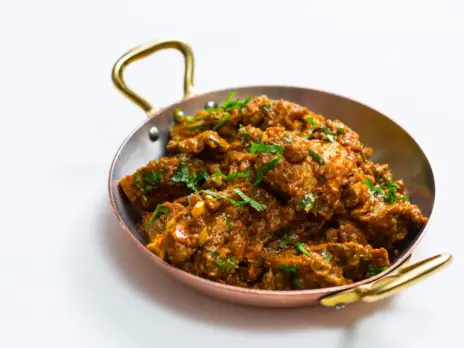
A trip to the Moon City swingers’ club in the ninth generates more sauna steam than light, the food for such establishments having become as obnoxiously poor as corporate buffet catering. Supermarket processed meats and salad? Hard to get horny on that, but our author has a wife after all. There is, perhaps inevitably, more happiness in a Congolese restaurant in the 18th, where gargantuan portions of malangwa (fish stew) are served, or in the meen puyabaisse (a Sri Lankan take on bouillabaisse) inspired by a trip around the kitchens of the seventh, than there is at the Café Georges V on the Champs-Elysées. Here, onion soup and boeuf bourguignon remind us that there is a whole world beyond the confines of heritage cooking that is waiting to be discovered.
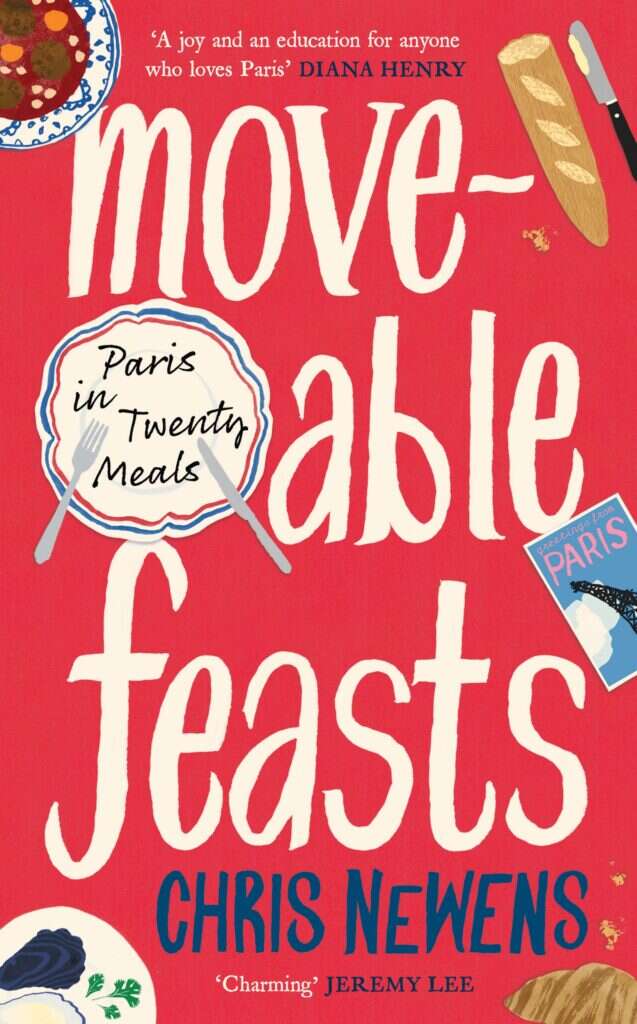
Moveable feasts: Portraits in three dimensions
Occasionally, Newens adopts the approach of TV journalism, playing it dumb so as to coax fuller explanations from those he interviews. It doesn’t really wash these days to announce that you are on a mission to find out what something is—malangwa, say—as though Internet search engines didn’t exist. The Maggi sauce, a Swiss product used in the preparation of the dressing for a Vietnamese-style banh mi sandwich, is “hydrolysed vegetable protein, which means… I’m not sure.” Google it! On the obligatory red-eyed trip to the megalopolis of the Rungis wholesale market, Newens claims that he has never heard of Valençay goat cheese. The sweet scent of dope smoke that hovers like vaporized eau de toilette around the stalls seems more familiar.
The mantle of the idiot-savant, however, is much more rarely donned here than tends to be the case with a first book, and Newens utilizes his interview material well. His interlocutors—from the pitiable, to the lovely; the solo tourist spooning up strands of cheese goo from her onion soup gratinée, to the phlegmatic fishmonger at the Place Maubert market ordering a Calvados in the pre-dawn blear—emerge in three dimensions, as does most of the food. At each chapter’s conclusion, there is of course a recipe, with a description of what happened when the author cooked it, rather than a bland set of instructions. Sometimes, these are simple accounts of professionals doing the same and are as open to question as any supposedly canonical version of anything is. Nothing is more questionable than cooking styles for eggs, and I allowed myself a pff of disdain at the young chef at La Palette in the sixth arrondissement, who cooks an omelette with neither butter nor pepper. Vraiment?
Toward the close of Moveable Feasts, Newens makes a heroic attempt to draw together the 20 strands of culinary Paris in a philosophical synthesis. This rather founders on the reef of truisms, a notorious hazard to authorial shipping, when a familiar strain about the excellence of French produce rises from the billows—an axiom that could have introduced 350 pages on Paris rather than standing as its culmination. More illuminating is his observation that Paris has been a city of revolutions of one sort or another—social, political, cultural, gastronomic—but has also been remarkably adept at seamlessly incorporating them into the metropolitan and national fabric. This, above all, is what Paris does well, absorbing the tidal currents of fashion rather than toe-dipping and moving on.
At the colossal Bouillon République in the third, Chris Newens drinks in the joyous clamor, “[t]he beautiful communal sound of hundreds of people feasting at the same time.” As a restaurant critic over the years, I came to hate this in the London gastrodomes, raising your voice across the dinner table to try to make yourself heard to your guest, screaming and eating simultaneously. What emerges from the Parisian version of this is a recipe for egg mayonnaise. Sometimes you have to go the distance, get on the Eurostar or the next flight, and encounter the French fundamentals of dining to understand how it works and why it so often doesn’t work in the translation. For the anglophone reader, this above all is the job that Moveable Feasts performs with panache.
Moveable Feasts: Paris in Twenty Meals
by Chris Newens
Published by Profile Books; 358 pages; £18.99 (US edition will be published by Pegasus in spring 2026)