

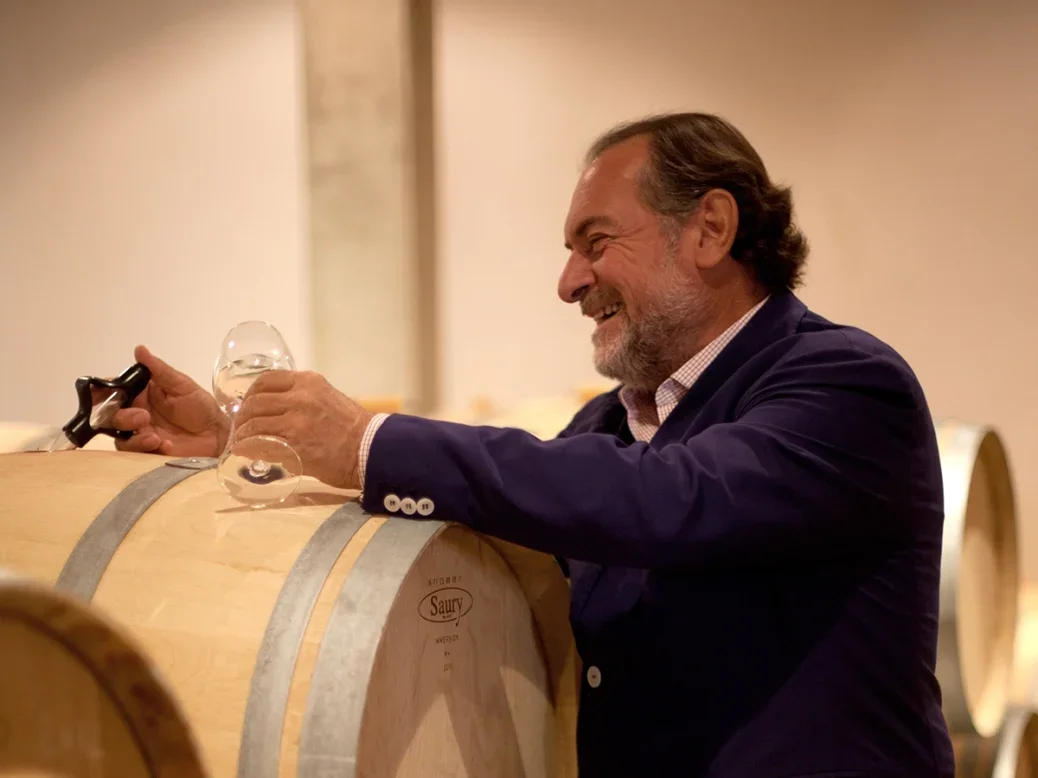
When the death of wine consultant Michel Rolland was announced at the end of March, following a heart attack at the age of 78, it marked something of the end of an era. In the two decades either side of the millennium, Rolland came to define the bullish nature of the period’s fine-wine market. Not just in the bold, punchy style of the wines, but in the buoyancy and confidence that went with it—qualities that applied just as much to the man himself as they did his wines.
Such a path was perhaps pre-ordained when Michel Noël Rolland was born in Libourne on Christmas Eve, 1947—the greatest vintage of the century for Bordeaux’s Right Bank. Growing up on his family’s Pomerol estate, Château Le Bon Pasteur, he was immersed in the world of wine. Encouraged by his father Serge, he pursued formal training at Château La Tour Blanche’s School of Viticulture and Oenology in Sauternes, graduating in 1967, before continuing his studies at the University of Bordeaux’s Institute of Oenology, where his tutors included the legendary Émile Peynaud, arguably Bordeaux’s first wine consultant, and where he graduated in 1971. There he met Dany Bleynie, a medical student who had switched her studies to enology and became his lifelong collaborator. They got married in 1970.
In 1973 the couple joined the Chevrier laboratory in Libourne, offering analysis and advice to local producers. Three years later, they assumed full ownership of the business, changing its name to Laboratoire Rolland. His father’s death in 1979 saw Rolland take over the running not just of Le Bon Pasteur, but the other family properties in St-Emilion (Château Rolland-Maillet) and Lalande de Pomerol (Château Bertineau St-Vincent). Such hands-on experience convinced Rolland that the issues he observed in the lab had their roots in the vineyard. He began visiting the vineyards of his clients to offer viticultural as well as vinification counsel, while his wife continued her more chemical analysis in the lab. It was to prove a winning formula.
Michel Rolland, Robert Parker, and 1982 Bordeaux
The other happy circumstance arrived in the form of Bordeaux’s 1982 vintage. After a string of poor, weedy years, ’82 was initially seen as having swung too far the other way. A relatively unknown American critic by the name of Robert Parker was one of the few who felt otherwise, lauding the wines for their rounded appeal. Rolland, who first encountered Parker at a tasting of the vintage the following year, agreed, and was struck by how Parker’s palate chimed with his own.
Related
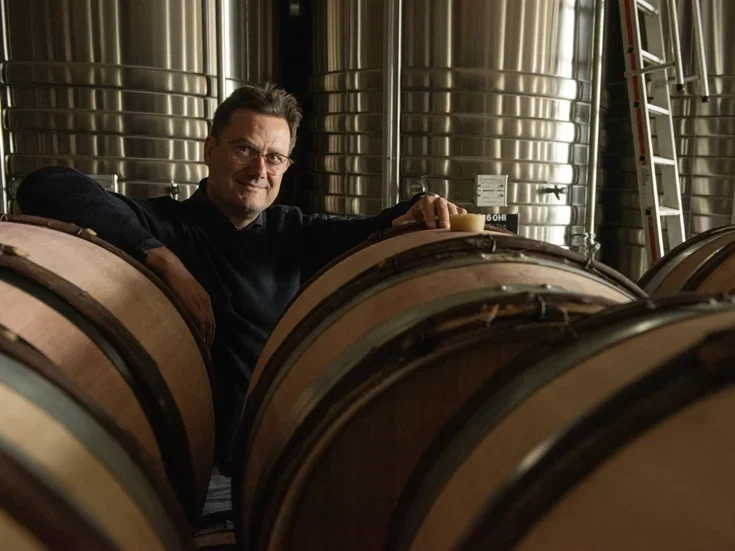
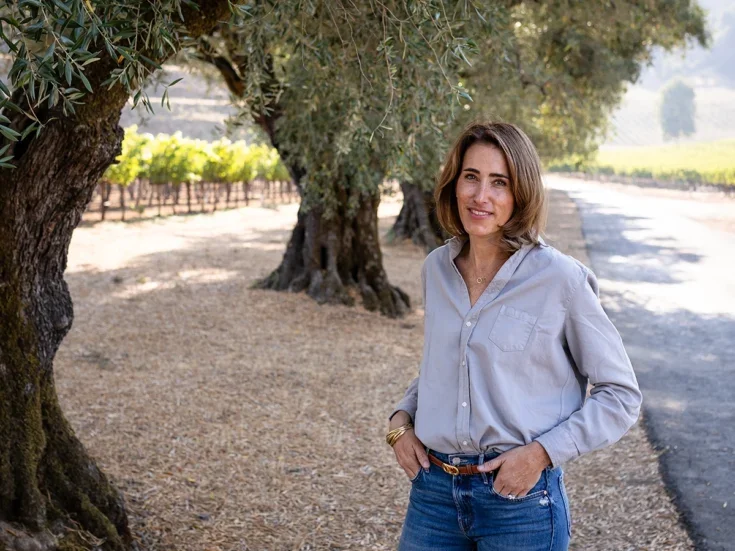
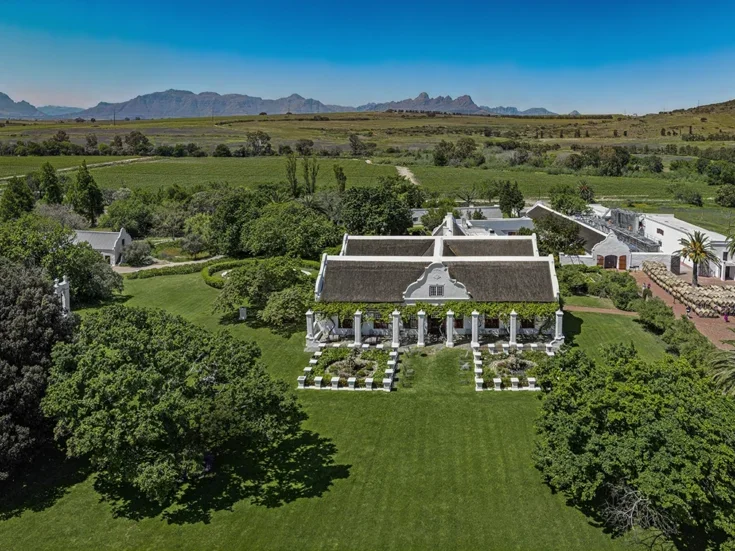
A year later, Rolland visited California for the first time, where Parker recommended him to Simi Vineyards. Despite having a negligible command of English, Rolland was hired as consultant to winemaker Zelma Long, his first engagement outside France. As his reputation spread, other secondments followed, spawning the term “flying winemaker” to describe a globetrotting consultant operating in both northern and southern hemisphere harvests. Back in Bordeaux, the ultimate success of the 1982 vintage—as predicted by Parker—encouraged producers to make more wines in the critic’s favored plush style—and more and more of them came to Rolland to achieve it.
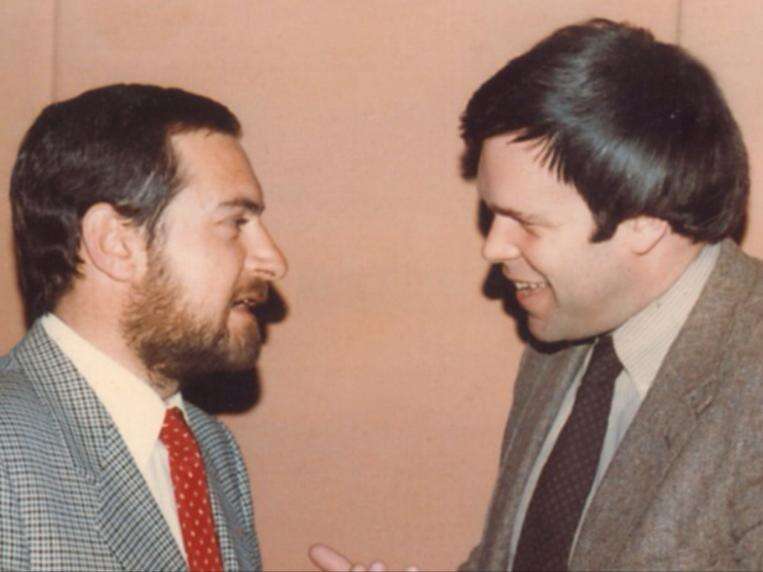
A string of compliant vintages in the late 1980s revived Bordeaux’s fortunes, while on the other side of the Atlantic, Napa Valley’s cult Cabernets were becoming a thing—with Parker and Rolland shaping the style of both. To Rolland, such wines made perfect sense. Growing up, his father and grandfather would serve 10–15-year-old wines at home, wines whose tannins had softened and become approachable. As fewer and fewer consumers had the time or resources to wait so long, Rolland sought ways in which to realize this rounder, more supple nature on release. His solution came first in the vineyard, where he advocated green-harvests, low yields, and long hang-times for maximum ripeness, and then in the winery, where he embraced such techniques as extended maceration, micro-oxygenation, and new oak to produce opulent, fruit-forward wines with polished tannins and immediate appeal.
Initially, his success was largely confined to his native Right Bank, whose clay soils and preponderance of Merlot lent itself to such a style. But after US consumers lapped up the wines of his Californian clients, he found a similarly receptive audience in Argentina, where ambitious, well-resourced producers with an eye on the US market had the conditions and raw materials to foster such an approach.
Content from our partners
It was as he expanded farther afield, notably into Tuscany and Bordeaux’s more traditional Left Bank, that he ran into resistance. Purists in such regions derided the Rolland wines as “international” in style—an identity they felt diluted terroir in favor of homogeneity. It didn’t help that Rolland’s clients included a high-profile array of ambitious, wealthy owners, from Alain-Dominique Perrin, the former head of Cartier turned owner of Château Lagrézette in Cahors, to Bordeaux mogul Bernard Magrez and the since-disgraced actor Gérard Depardieu. The conflict reached its apogee with St-Émilion’s Château Pavie (owned by supermarket magnate Gérard Perse) and its notorious 2003 vintage, lavishly lauded by Parker but disdainfully dismissed as “Port-like” by Jancis Robinson MW. The following year, Rolland’s own fame reached its zenith when he was cast as the pantomime villain in the documentary Mondovino, an arch critique of the wine industry pitting global forces against local producers. While admitting frustration at the film’s somewhat manipulative editing, Rolland was sanguine about the criticism. “If you have no critics, you may as well not exist,” he said. “I prefer to exist.”
Changes in fashion
Over time, the popularity of Rolland’s bold signature style waned, and while his business didn’t suffer unduly, his profile dwindled. Looking back at his career in 2024, he told wine club 67 Pall Mall that he was lucky to operate when “everyone was looking for roundness, suppleness, generosity, and opulence.” By comparison, “Today, the fashion is for acidity and greenness, which is not for me.”
He was similarly derisive of other trends, including natural, non-alcoholic, and organic and biodynamic wines. “There are some great organic and biodynamic wines, but a wine doesn’t become great just because it’s made that way.” Likewise, while working across 18 countries with such unheralded varieties as Plavac Mali in Croatia, Areni in Armenia, and Sagrantino in Italy, he was wary of wines made from indigenous grapes. “I always try [to use] native grapes first. But to stick with native grapes just because they’re native? That’s stupid,” he told UK trade title The Buyer in 2018.
For him, quality trumped everything. And there can be little doubt that his influence on quality, particularly in emerging regions, was hugely positive. Ultimately, as he said in 2006, “Wine is a business—my clients want to make wine to sell wine.” He was unromantic about his vocation. “I am not an artist,” he once said. Instead, he described his work as a blend of science, experience, and psychology. He might have added energy—even in his later years he maintained a grueling travel schedule that would have tested a man half his age.
His most celebrated skill, however, was his blending ability. Speak to any of his clients, and chances are they will have a story—often told in awestruck tones—of him mastering a range of samples they had spent weeks assessing, arriving at the perfect blend within moments. Rolland was disarmingly candid about his preternatural abilities. “I can’t explain how I do it,” he said. “It’s instinct—like a painter, or a golfer, with a magic touch.”
In 2020, he handed over the majority shareholding of Rolland & Associés to his three long-term partners. Today the business consults to more than 150 estates in 14 countries, while another 250 estates engage it for chemical analysis and advice. His wife Dany continues in her role while their daughters Stéphanie and Marie oversee the marketing, management, and administration. The family’s only remaining Bordeaux property is Château Fontenil in Fronsac, which it acquired in 1986 (Château Le Bon Pasteur and the other Right Bank properties were sold in 2013). Overseas, it owns Argentinian estates Val de Flores and Bodega Rolland as well as the “MR” Napa Valley project; other interests in Toro and Stellenbosch have also been sold.
Rolland is survived by his wife Dany, their two daughters, and their five grandchildren. ▉


