Andrew Jefford is inspired by a single (half-) bottle of 2011 Hugel Grossi Laüe Gewurztraminer.
So stupid: I bought only one half-bottle. Why not three, or five? We drank it last year: disarming and truthful wine, in spotless condition, pale despite 14 years in its smaller format. Some wines position hurdles for their drinkers; this one stacked the hurdles neatly out of sight. It gave pleasure alone; it courted us. Out floated honey, flowers, and ginger, bobbing on a tide of cream; graceful, harmonious, fragrant. We can’t call the places where wine grapes grow “enchanted”—the work’s too hard, the weather too stern, the struggle against disease too stinking and brutal. Here was a wine, though, that contrived to smell of enchantment and magical spells.
We sipped, the three of us. Rich, soft, generously contoured; harmonious and lush, yet tender and bright, too. Succulent, of course. And perfect delivery, here, of necessary sweetness. (I remembered Jean Boxler saying on my last visit, “Dry Gewurztraminer is not for me.” Not for me either; it’s doomed to lack resonance and wealth, its bitterness to linger, unbalanced.) The 2011 Grossi Laüe was teasing, nourishing, well proportioned; nothing flabby or corpulent. Spice warmed its finish; its 14.5% ABV was feathered deftly into its wings. Singular beauty; there’s nothing else like this in the world of wine.
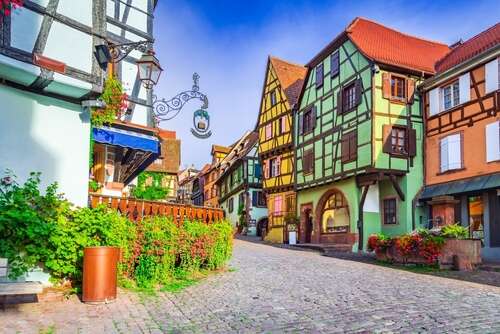
I’d bought it, hurriedly, from the Hugel tasting room, on the corner of Riquewihr’s cobbled main street, where Rue du Général de Gaulle meets Rue du Première Armée, in October 2023. Armies, generals, marauders, and bandits have often clattered up and down this little town, fortified since the 13th century; somehow or other it has escaped unscathed. Its streets are now a hallucination of pastel colors and half-timbering.
Related
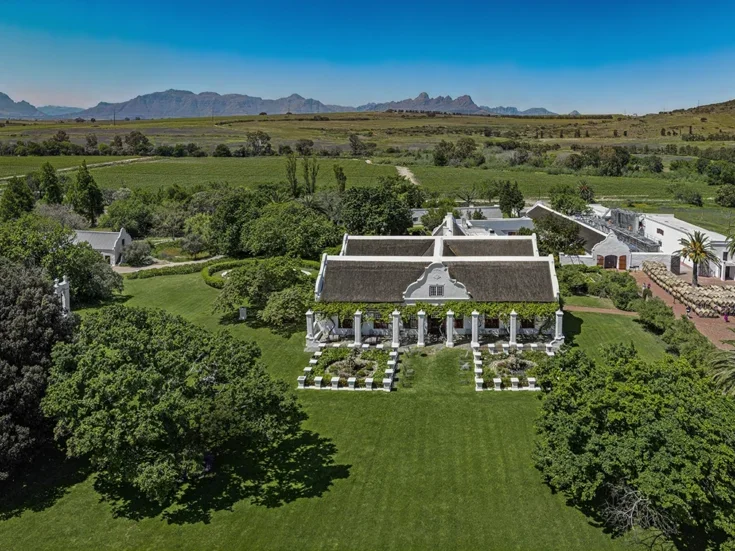
The town would have been part-ruined when Hans Ulrich Hugel (the “HVH” on the label) first arrived from his native Switzerland in 1639; this was the middle of the butchery of the Thirty Years’ War (1618–48). Riquewihr had been besieged, conquered, and pillaged by the Duke of Lorraine’s troops in 1635; they were to return in 1652. Never mind wine production; during these years, famine stalked Alsace, half of whose population was to die during the chaotic conflict as bands of outlaw mercenaries roamed unchecked. Prior to this conflict (which killed some 8 million Europeans), Alsace boasted 430 wine-growing villages, and rivaled Bordeaux. It took almost two centuries for its communities and vineyards to recover.
Further catastrophes awaited. The Franco-Prussian War of 1870–71 brought the first of four traumatic changes of nationality for Alsace, and under German rule, Alsace wine-growing became industrialized, milked for volume above all. The battles of 1914–18 and 1939–45 ruined vineyards (the great Rangen de Thann included) and obliterated villages less lucky than Riquewihr. Even after its return to France in 1945, the respectability of appellation came late to Alsace and somewhat grudgingly: in 1962, and with zero recognition of its great historical sites. These emerged from four centuries of shadowy eclipse only in 1983 and 1992 (with emblematic Schlossberg lighting the pilot light in 1975). For the 1992 cohort of grands crus, that means fewer than 30 growing seasons, fewer than 30 vinifications, and just a single generation of stewardship. This is nothing: Burgundy’s vineyards have been continuously scrutinized, in largely peaceful conditions, for a thousand years. You want to understand vineyards intimately? Take a century; take three generations. That, at least, will initiate the process.
A shockingly exciting prospect
All of this is why, in my opinion, Alsace is the most exciting wine region of France at present. Imagine if Burgundy had been travestied and despoiled over centuries in this way, leaving us just poised on the lip of rediscovery. Then imagine that the rediscovery was not a game consisting of matching 51 expansive grands crus with five grape varieties, but a head-on lunge into the nuances of parcel, site, climat, using all or any grape-variety resource. This is a shockingly exciting prospect. It’s what beckons for Alsace over the next few hundred years, climate change allowing.
Content from our partners
Let’s go back to Grossi Laüe—which means Grosses Gewächs or grand cru in Alsacien. This is a Hugel trademark conceived to overcome patriarch Jean Hugel’s proscription of the term “grand cru” on a Hugel label—a proscription finally abandoned by the family in 2015, when “Grand Cru Sporen” appeared on the label of this wine. (A similar proscription has been abandoned by the current generation of Trimbachs, too. They are now busily building a “grand cru collection.”) Riquewihr is lucky enough to have not one but two of the greatest grands crus of all: Schoenenbourg, unfurling like a giant surfer’s wave to the north of the town, and the more gently contoured Sporen to the south. Both are geologically complex, adding to their intrinsic site variabilities. It’s not so much that Sporen is “a great site for Gewurztraminer” (though you can put it that way if you want); it’s that Gewurztraminer, in whole or in part, unlocks the graceful, cream-laden charm and elegance of the site, in the same way that Riesling unlocks the multidimensioned range of fruit and plant expression that Schoenenbourg is capable of. With Schoelhammer, Hugel gives voice to a unique parcel within Schoenenbourg, just as Jean Boxler now anatomizes his own great site of Sommerberg into four different parcels (coded by initials on the labels). Jean-Michel Deiss has already parsed his entire range into a Burgundy-style pyramid and uses complantation to emphasize site and efface the distraction that comes with varietal labeling; while Olivier Humbrecht MW has, for many years now, been burrowing deeply into his own range of sites, regardless of classification. These are all routes to the same destination: places of beautiful difference that can be sipped.