Despite the difficult, wet conditions that prevailed for much of the growing season, 2024 Burgundy is a much better vintage than many initially feared, with very good whites throughout the region, even if the reds are more mixed, says Sarah Marsh MW.
Sarah Marsh MW
It was the summer of tough love. Mother nature was short on nurture sending regular rainfall that disrupted the flowering and caused severe downy mildew. A harsh upbringing, but with sunshine too scarce to ripen an average crop, mother knew best. She brought crop and season into balance and with a little love in late-August into September, the result is so much better than the beleaguered vignerons dreamed possible.
The whites are good, indeed very good. There is much joy to be found in the sweet spot of village and premier cru wine. For the reds, the low-yielding 2024 can be charming on the Côte de Beaune. “Un goût de trop peu.” Côte de Nuits reds are more challenging.
Related
2024 Burgundy: Style
Whites
Trim and straight whites, which are fresh and energetic. They have floral aromatics, juicy citrus flavors, and salty finishes. Slim in texture and lightish in alcohol at 12.5–13%. Pleasing for those of us who find recent rich vintages rather heavy and heady. I enjoyed the translucency to the terroir and precision in expression this lithe style affords.
They are linear wines, crisply defined. Even those from richer climats are just gently rounded; airy rather than broad and full-bodied, while lighter terroirs are often delicate and dancing or racy with violin-string tension. There’s notable minerality, often in the form of salinity, and not just in Puligny. Salty Meursaults abound. And there’s pithiness. I like bitterness, and the 2024 whites reveal the enticing side of bitter. The acidity is vibrant, but rarely hard, often a lip-smacking, lime-like freshness.
Content from our partners

Either side of this core style, which is pretty consistent, there are whites that are rather weedy and grassy or a touch severe. Wine from those who harvested too early or where yields were too high. At the other, riper end, the aromatics can tip into tropical, although the palate remains light.
While richer vintages can require a second winter to refine, the 2024 will benefit from more time on lees to enrich the mid-palate and bring the leaner and more cutting wines into balance. That said, the concentration was generally good, as Chardonnay cropped about two thirds of average.
Is it classic white Burgundy? Well, certainly more so than 2022 or 2023—but what is typical, now that Burgundy is subject to extreme weather events? In any event, the style of 2024 white Burgundy appeals to me as well as to many of the producers. “I like the purity and freshness,” remarks Bruno Colin. “No artifice in these wines: the terroir, from vines to the wines.” These whites will resonate with terroiristes.
Reds
The Côte de Beaune has delivered charming reds, with plentiful, ripe red fruit in a spectrum from sprightly redcurrant, to warmly scented strawberry. They are light- to medium-bodied, some really rather delicate, fresh, and lively. Very Pinot, pure and perfumed. Engagingly slim-textured, the reds are more terroir- than vintage-driven.
Key to the success of these Côte de Beaune reds is ripe tannin and sufficient concentration. Low yields, from 10 to 25hl/ha, enabled phenolic ripeness. Gentle extraction was the best approach to keep the tannins light and the style fruit-focused. Many wines I tasted have crunchy tannin; some more finely textured than others. They are attractively crisp and sometimes a little minty. Where I tasted wines with a high proportion of whole-bunch on the Côte de Beaune, I didn’t like it. But where a lower proportion contributed a light garden-herb lift to the aromas, I found it pleasing.
Reds are not as consistent as the whites, which have altogether more substance—something the reds can lack. There are red wines that are rather too light, thin, and green. It’s worth looking farther south to Mercurey, which has produced attractive, juicy reds in 2024. Moreover, they represent good value in comparison with many reds of the Côte d’Or.
Côte de Nuits
On the Côte de Nuits, the welcome sunshine in August brought phenolic maturity, but vines were enfeebled by the most aggressive mildew experienced for decades and had fewer leaves for photosynthesis, resulting in light-bodied and slim-textured wines, most of which were chaptalized to reach around 12.5–13%. A relatively simple, fruity style, largely in the red-fruit spectrum, but quite often forest fruits: pretty Pinot Noir. The best in show have finesse, delicacy, and precision, with fine tannin, delicate and chiffon-textured. The shape is straight. Even those from deeper clay soil are only gently rounded. Small berries can give delicious, focused sweetness. The slim texture and low glycerol content allow the sensation of minerality intrinsic to classic Burgundy to be clearly expressed. Plenty of salty wines, and it is often this salinity that extends finish. There are very good wines, including a sprinkling of excellent wines, but beware the severe limitations of this vintage, which was apparent even among the quality producers I visit. In any wider spectrum of producers—be cautious.
Tannin, in terms of both quantity and texture, should not be problematic in 2024, for the thinnish, fragile skins ripened well. Moreover, most of those I visited reined in extraction and were careful with pressing. Close attention to lees resulted in finely textured tannin and overall precision. It’s a low-tannin vintage. Even so, where producers have not adapted their extraction, tannins can feel out of kilter with the light substance of the vintage, resulting in lean, mean, and dried-out wine, rather than light, fine, and fruity. It was a mistake to pursue phenolics and substance that simply were not there.
It surprised me that some whole-bunch—even quite a high proportion—was more successful in the Côte de Nuits than in the Côte de Beaune, adding aromatic nuance, a sense of freshness, and some complexity to the fruity, straightforward style of the 2024s. Indeed, whole-bunch wines were among the best I tasted—but equally, some of my worst. Most producers removed all stems, since they were often affected by mildew, and in the wider context, only the talented minority will have improved their wine by including them.
Acidity is modest, and some wines can feel a little soft, which some remedied by tweaking with tartaric acidity. Where the acidity seems high, it’s unlikely to be from the vineyard. Some resorted to new oak to bring sappy freshness and extend the finish which can work for more intense wine, but for my palate there was often too much new oak on Côte de Nuits for such a slight, light vintage.
Beware of thin, even skinny wines, lacking substance and sometimes freshness, and often any finish. They are simple. Village wines can lack expression of terroir—for some, the worst sin of all. Even great terroir can feel empty without any layering. Sometimes, the finish is present, but without enough intensity. Nothing unpleasant, but no complexity. No excitement. Just ordinary.
Of course, this is not how the producers present the style: “Light but not thin,” said many. Others stretched further: “Brightness and luminosity.”
“Many vintages can have finesse, even if it’s not necessarily the main impression you take away from them. But in 2024, it is,” muses Cyprien Arlaud, who has produced some of the best 2024 Burgundy I tasted. Charles Van Canneyt’s prosaic comment cuts to the chase. “2024 is a fresh, energetic, and digeste vintage—the style of Pinot Noir I like.” Quite so, for the best wines.
2024 Burgundy: Quality
Whites
What about the quality of the whites. Fingers poised above my keyboard in June 2025, I’m debating. Should I curb my enthusiasm? The whites have so many virtues. Let’s start with excellent terroir expression and continue with freshness and vibrancy. There’s an exciting combo of citrus fruits and salty minerality. Lighter wines—thank goodness. Wine I can drink, not just taste. The straight, zesty style is such an appealing contrast to the solar richness, glycerol, and tropical-fruit generosity of recent hot vintages.
I have to be careful not to overstate the quality. They are good. Very good. But not everybody’s cup of tea. Not for those who favor a rich style of white Burgundy. As you will read in the winemaking section below, there is little artifice about these wines. Traditionally, Burgundy would build up the wine in a vintage of rain and limited sunshine by chaptalizing, stirring the lees, and enriching flavor and texture with glossy new oak. But there has been a sea-change since the Naughties, to more cleanly represent the vintage, and I feel 2024 Burgundy is a white vintage to be proud of. The quality does not reflect the disastrous season. It was extremely challenging, but the very fetching results were worth the effort. Almost everything I tasted was appealing in some way. Of course I visit very good domaines, nurturing tiny vineyard parcels, but I also tasted large cuvées of 200,000 bottles made with purchased fruit that met my expectations for quality and style.
Moreover, I sense the whites will improve in the same manner as 2017 whites. I tasted most of the whites in June 2025. Continuing with tasting in October there was little evidence of progression, but it’s the second winter that matters.
Is it the vintage of the century? No. Will it evolve beneficially over 20 or more years? Unlikely… But is that necessary? There should be no problem in keeping higher end premier cru for 10 to 12 years—possibly longer if extensive aging capacity is among your criteria for quality. Very mature vintages of white Burgundy are a marvelous curiosity and I love them, but a decade is sufficient to evolve complexity.
Charles Baillot has made some of the best ’24s I tasted. “We couldn’t have made such a complex vintage in the in the past,” he mused. “My grandfather would not have sprayed so much. So, we can say 2024 is old-style, with new techniques. Every year is a new story. I think it is one of the best vintages we have made in the 2000s. I like the salty balance. You want another glass. A very exciting vintage.”
Knuckling down, would I advise buying grands crus in this vintage? Sorry. Probably not, unless money is no object. While the appellation hierarchy was respectfully represented from regional wines to top premiers crus, the grands crus didn’t quite cut the mustard. There should be an extraordinary leap of quality to grand cru, not least for the price they now command. They can lack the requisite mille-feuille, fathomless depths and spectacular finishes of the best vintages. There are better vintages of grand cru whites to stash in your cellar. The 2024 whites are delightful, but more concentrated vintages with super-clean fruit are best for long-term aging, and anyone shelling out for grands crus should want to keep them.
Reds
Côte de Beaune reds are forward and fruity. Good work in the vineyard and a gentle approach in the winery have produced clean and well-balanced wine. A pleasant, mid-range vintage for early drinking.
The Côte de Nuits is a notch below in quality and consistency. Most producers I visited, many of whom are among the best, have made attractive Burgundy, but not all. This is a classic vintage in the pejorative sense for those who have not evolved sufficiently over the past 15 years. Even some good names are resting on their laurels. There were too many decidedly average wines. Roll this out to encompass producers from the good, to the bad and the ugly, and I have to rate this somewhat below average; a poorer vintage for this day and age, and certainly in the context of the past decade—and I am not great fan of hot vintages as my report on 2023 testifies.
Meanwhile, the producers and their importers are working hard to promote this lean vintage as elegant. Don’t be hoodwinked. The facts remain. The wines are low in matter and intensity and have limited aging potential. If you are thinking of dabbling in red 2024 Burgundy en primeur, be prudent. Try before you buy, if you can. And don’t pay high prices.
I would bypass Bourgogne from the Côte de Nuits. There are better regional wines elsewhere, including Hautes-Côtes de Nuits from conscientious producers. Some Hautes-Côtes vines are farther from the ground and suffered less from mildew. Generally, village wines are simple. Chambolle and Vosne village wines were the most disappointing—maybe because of higher expectations. Quality and consistency improve with premiers crus, which is the safest category in which to purchase wine. I was particularly taken with Morey-St-Denis premiers crus—and, for that matter, grands crus. Some grands crus are decidedly unimpressive—notably Clos Vougeot—but there is also surprisingly disappointing Bonnes-Mares and, sadly, some Echézeaux.
Côte de Nuits whites are certainly worth your attention and, relative to their red counterparts, can be more exciting. A roll call from north to south: Bruno Clair’s stony Marsannay La Charme Aux Prêtres and Morey En La Rue de Vergy; Berthaut-Gerbet Fixin Champs des Charmes, Domaine de Vogüe’s sensational white Musigny; Jacques-Frédéric Mugnier’s rather full, rich, and sapid La Maréchale Blanc; Domaine de l’Arlot Clos de l’Arlot blanc, not forgetting its tip-top Hautes-Côtes Le Mont, and Domaine Arlaud’s Bourgogne Hautes-Côtes de Nuits. Such appealing Aligoté from Machard de Gramont—Le Chêne du Court—and Thibault Liger-Belair—Clos des Perrières la Combe. More serious is the racy Morey-St-Denis Premier Cru Clos des Mont Luisants, also Aligoté, from Ponsot. Hurrah!
Undoubtedly merchants will “talk up” the Côte de Nuits 2024s. It will not be an easy sell, between the 2023s and the 2025s, but in any event some high-profile estates are planning to present their 2024s as a package with another recent, larger vintage—maybe 2022 but most obviously 2023. The market has become resistant to high prices and there is stock. Not only will this help with allocations of the small volumes of 2024 Burgundy, it will also prevent customers skipping the vintage. A few producers will simply hang on to one-barrel cuvées for library stock, special events, or much later release.
I started my Côte de Nuits tastings with Christophe Perrot-Minot on the (correct) assumption that an optical sorting machine together with precision winemaking was likely to showcase the best of the vintage. His yields were so low that many cuvées are single barrels. He describes the season as “a shit vintage” and compares the quality to “a good 2014.” Take note. Few are as adept as Christophe Perrot-Minot at making a silk purse from a sow’s ear.
Incidentally, I don’t hold with optical sorting machines in every vintage—they can be too clinical, ironing out the wrinkles that give the vintage personality—but in 2024, ruthless selection was necessary. There is no quirky charm from mildew.
Other standouts domaines in the Côte de Nuits in 2024 are Cyprien Arlaud, De Vogüe, Thibault Liger-Belair, Domaine des Lambrays, and David Duband. If you favor a plush, fruity-rich style, then Hudelot-Noëllat will push your buttons. The village with which I was most impressed in 2024 is Morey. Despite my catalogue of criticisms, there are many very good Côte de Nuits wines in 2024, and some that are truly delicious.
2024 Burgundy: Vineyard and cellar
Season and vineyard
In October 2024, the harrowed expression etched on the faces of the vignerons told the story of the stressful season, but come June 2025, the furrowed brows had smoothed.
The challenging season brought double the average rainfall—47 inches (1,200mm) in total, and up to 75 inches (1,900mm) in the Côte de Nuits. It may have been the wettest spring for 50 years. Following a warm winter and spring, budding raced ahead. Some began de-budding from April 12, which is quite early. The end of April was cold, with the risk of frost, but temperatures didn’t fall below 37ºF (3ºC) in most places, though Marsannay and Maranges were unlucky. “It was like leopard spots,” says Pablo Chevrot. “Very hard to work the vineyard, as every ten meters, there was a difference, and this made the date of harvest so difficult.”
May was cloudy and wet on the Côte d’Or, but not in comparison with Chablis, which received 7.7 inches (196mm), while 3.8 inches (97mm) was recorded in Dijon and 3.5 inches (89mm) in Beaune. The vines grew very slowly. Mid-flowering occurred in the middle of June. Flowering was prolonged, owing to 3.4 inches (88mm) of rain, which caused coulure and millerandage. Pinot Noir was more affected than Chardonnay, since the former flowered later, in worsening conditions, and the Côte de Nuits was hit hardest.
Most affected on the Cote d’Or was the stretch from Marsannay to Gevrey, and the south side of Chambolle into the neighboring section of Echézeaux and Clos Vougeot. The north side of Chambolle and Morey suffered somewhat less, Morey getting off lightly and consequently having the highest yields. There was progressively less rain south of the Hill of Corton. In the Chalonnais, Rully had just 2.3 inches (58mm) of rain in May, and was much drier than the Côte d’Or in July and August.
The summer of 2024 was not so much cold as overcast. Temperature was just a smidgen—0.36ºF (0.2ºC)—below average. “Not like cold vintages pre-2015,” remarks Ben Leroux. “But how do you define a warm vintage now?”
On average, there were 97 fewer hours of sunshine in Burgundy. Chablis had the least sunshine and was the wettest area in May and June, but nevertheless had more sunshine than average in August. In fact, August in Burgundy was 15–35% sunnier than average. Jean-Baptiste Bouzereau recorded 90ºF (32ºC) in the vineyard in last week of August. The Côte de Nuits was saved by those last two weeks of August, which were just sufficient to ripen thinnish skins, but without many leaves for photosynthesis, sugar levels were predictably low. Moreover, leaves were plucked to open up the canopy and aerate the bunches. But despite these efforts, mildew was rampant.
The pressure of downy mildew was off the charts. Not in living memory has there been such an aggressive attack, and the effect in the Côte de Nuits was most extreme. Some gave up the fight. Maybe mildew was worst in cold, clay-heavy terroirs, at the bottom of the slope, while well-drained soils on the slopes, such as Puligny-Montrachet Champ-Canet and Beaune Grèves, held less moisture and fared better. Louis-Michel Liger-Belair found that the vines in the “sandy soil” of Vosne-Romanée Petits Mont had less mildew. At Oliver Leflaive, Solène Panigai recollects, “Regional parcels were much more difficult to manage. The clay retained more water, and we had more mildew.” There’s not a lot of regional Burgundy below the Côte d’Or, and below the Côte de Nuits, frankly, the wines are best avoided.
Where there was grass between rows of vines, it grew vigorously. “It was green everywhere,” says Frédéric Weber at Domaine Bouchard. “We became gardeners, continually mowing the grass, but the grass absorbed the water and allowed us to get into the vineyard with the tractors.” In the Côte de Beaune, several producers felt grasses had a beneficial effect on the pH, absorbing some of the water and lowering the potassium uptake, which makes sense. In the Côte de Nuits, the rain was probably too extreme.
Contact sprays were washed off by frequent rainfall. Many organic producers in Chablis sprayed up to 24 times; in the Côte de Nuits, 16 to 22 times was typical, while on the Côte de Beaune, 15 was more usual. Even producers using systemic products for one to three passes through the vineyard, sprayed 11 to 14 times, and some more often.
Organic viticulture or lutte raisonnée? In a season such as 2024, those in the latter camp argue that diesel pollution from powering tractors for more frequent sprays and the compaction of the soil, together with the impact of so much copper and sulfur on the vines, the surrounding environment, and vineyard workers, justifies using some systemic sprays, particularly around flowering. Copper is a heavy metal and doesn’t degrade, but it is the only effective weapon to fight mildew for organic producers. (Sulfur is used against oidium, which was of little concern in 2024.)
Arguing for lutte raisonnée, Laurent Pillot used 6kg of copper, which is quite typical in a difficult year using this approach. “Normally, we use 300 grams per hectare each time we spray. With 10,000–11,000 vines, that’s quite a small amount per vine.”
I asked every producer I visited how much copper they used. Organic producers were frequently more precise about the quantity. It became clear than on the Côte d’Or less copper was used by organic, often biodynamic, producers. Moreover, some used caterpillars, which are lighter in compaction and fuel. Certified organic, Domaine De Montille used 3.5kg copper; biodynamic producer Cyprien Arlaud made 25 sprays but used 3kg; Louis-Michel Liger-Belair declared ten sprays and 3kg.
Unlike the producers taking the lutte raisonnée approach, many of the organic and biodynamic producers used fewer than the 4kg/ha that is the statutory maximum. The quantity can be averaged over five years. 2024 will be offset by 2022, when only about 2.5kg/ha were necessary, and 2025 was similar. “It’s not about the amount of copper, but the timing,” says Nicolas Rossignol of biodynamic producer Domaine Rossignol-Trapet in Gevrey, who used 3.8kg. Demeter limits copper to 3kg, but in certain vintages it can be higher. He sprayed 12 times. Biodynamic producers didn’t necessarily spray more frequently. Admittedly, in Chablis the organic producers were the worst offenders, but on the Cote d’Or, I feel the organic producers hands down win the copper debate.
Nevertheless, there was a quantity of copper dumped in Burgundy’s vineyards in 2024. It seems likely that in 2026, certain copper products will be prohibited. “Hydroxy copper maybe withdrawn by the EU. Disease is getting stronger and we may have fewer tools to fight it,” says Thibault Liger-Belair. Nicolas Rossignol feels that the copper is really too heavy. “It’s not easy to spray and it sits on the bottom of the tanks. I used Nordoxe in 2021. It sticks to the vines, so when we expect a big rainstorm, it can be useful.” At Domaine Michel Lafarge, also biodynamic, they believe it might be possible to do without using copper in an easy vintage by using algae and tisanes to help boost the vines’ resistance, but not against a bad attack of mildew. Most organic producers seem at a loss. Thibault Liger-Belair is reconsidering working organically.
Staying with biodynamic producers for a moment, Cyprien Arlaud, who has plowed using horses since 2003, finds the soils better adapted to both drought and extreme wetness. “The soil is alive and manages water. The vines got ripeness from the soil in 2024, not the sunshine.” Who am I to disagree, as his wines were among the best and most consistent in 2024. At Domaine Roumier, however, the parcels plowed by horse suffered more from mildew. Go figure.
There is another factor: your neighbors. If adjacent vineyards were badly managed, mildew could run rampant through the vines of a more conscientious producer. Cyprien Arlaud felt producers in Vosne-Romanée were the most scrupulous in managing their vines.
Harvesting and volume
Harvesting took place in conditions that were probably the best of the season for the Côte de Beaune, although there was some rain September 7–10. “With ripe fruit we were scared by the storm before harvest,” recalls Guillaume Lavollée (Génot-Boulanger), but ten dry days, helped by a north wind, dried up the vineyards and put the final touches to the ripening, with a little beneficial dehydration. There was some concern about botrytis, but the wind kept it in check. The old adage, “September saved the season,” came true.
The harvest of the reds on the Côte de Beaune started around September 12, while Chardonnay started September 14–17. Pinot Noir ripened more quickly than Chardonnay, given the small crop. Chardonnay needed time to reach phenolic maturity or can taste quite green. Some started harvesting Chardonnay as early as September 9.
Many producers sorted Chardonnay to remove berries that had shriveled and dried from mildew. Although most of these fell off or were removed in the vineyard, a vibrating table was useful to shake out the remainder. The yields for Chardonnay were 25–30% lower than average, around 40–45hl/ha, which is fairly good. Côte de Beaune reds yielded 10–25hl/ha, with most producers recording 15–20hl/ha.
I expected average yields in the Côte de Nuits would be much lower, but most of those I visited averaged 17hl/ha. But it was often one higher cropping vineyard that improved the average, for many vineyards produced less than 10hl/ha.
There were producers, or particular vineyards, with an extremely low crop or none at all. Christophe Perrot-Minot, who was very rigorous in his selection, recorded 5–10hl/ha. While Ben Leroux commented, “The vineyards where we had the lowest yields, we did the most sorting: 5hl/ha might decrease to 3hl/ha.” Not everyone had this rigor.
But low yields in the Côte de Nuits are no guarantee of quality. Steadfast organic/biodynamic producers did not have smaller crops than those who used systemic sprays, and some had more. Domaine des Lambrays finished at just 45% lower than average.
Where there was insufficient crop to make barrel, the fruit was added to a wine downstream. A producer in Vosne-Romanée added some Chambertin to Cazètiers. A Chambolle producer put Musigny’s miserly crop of 176lb (80kg) into Amoureuses.
Temperatures plummeted to a chilly 43ºF (6ºC) in the mornings, which relieved the need to cool down the fruit either in the winery or in air-conditioned containers, which has been a pressing concern in recent hot vintages.
Whites
The fruit, analysis, and adjustments
The acidity is certainly fresh, but will not feel especially high for those who like whites with firm acidity. It’s worth pausing to consider acidity. This is not the acidity of a cold summer but a wet and cloudy one, from which the result is different. Not only is there less acidity, but the wines are less lactic, for the malic was degraded by the pre-harvest sunshine. The pH affects the sensation of acidity—low pH accentuates it. In 2024, the pH was not especially low. So, the wines taste fresh but, for the majority, not super-sharp.
I checked the analysis of the wines with most of the producers I visited to compile an overall picture and include some of their recollections. Typically, there was anything from 2.5–4.5g/l malic, which is not high when compared with an extreme vintage such as 2008. “A new generation, who have limited experience of malic acidity, consider 2.5–3g/l to be high,” remarks Ben Leroux. There has been such low malic acidity in recent hot vintages, it can be difficult for the bacteria to get stuck into converting it to lactic. In the cold, old days, malic and tartaric could be 50/50, but 2024 is a more classic ratio of around one third malic to two thirds tartaric, which generally ranges from 5–7g/l.
So, don’t expect 2024 to be notably lactic in style (taste of sourdough). On the contrary, the acidity has a vibrant, citrus feel. If you are in any doubt, try a bottle of 2008. After MLF, the total acidity in sulfuric is 5–6g/l, and pH around 3.3–3.35, which is average.
At harvest Ben Leroux averaged 4.5g/l tartaric and 2–3g/l malic. “August was not cold, and it didn’t rain for three weeks, which brought down the malic.” Where he had cover crop, the pH was lower—generally, pH 3.3 after MLF. “Since 2015 we’ve had a shift to higher pHs. There is not a big difference between 2023 and 2024.”
When the soil is wet, there can be more potassium uptake, which affects tartaric deposits and pH. As Frédéric Weber recalls, “The pH started at 3 and rose to 3.2–3.3 after malolactic. A lot of potassium changes the balance.”
Sugar levels were a little higher than you might suppose. Potential alcohol ranged from 11.5% to as much as 13.5% in the sunniest spots. Some producers remarked that where yields were low, potential alcohol increased by 1%, even 2%, in the final two weeks. Of course, many chaptalized to reach 12.5% or maybe 13% for premier cru wines. Some still see 13.5% as the appropriate alcohol for white Burgundy, although it’s pleasing to see more producers content to have a premier cru at 12% when this is what nature provides.
Simon Colin recalls that the harvesting date “was a compromise between ripeness and health, unlike 2023. I waited for sufficient ripeness in the taste, not for sugar: 11.5–12 degrees at harvest, so I chaptalized 0.5–0.7, just to be above 12%. We do not have to be 13%!” Domaine Chapelle de Blagny also chaptalized a little, to reach 12%, no higher. Domaine Marc Colin was among the few who resisted adding any sugar.
Charles Ballot achieved some of the ripest Chardonnay. “Finally, we had a good maturity in the last two weeks. Not hot, but hot enough. Malic decreased a lot, but the tartaric remained stable.” He harvested at 12.2–13.5% potential alcohol and didn’t use the sugar he bought. He had quite low malic, 1.8g/l, and slightly higher pHs, 3.23–3.3, before MLF, which were just finishing when I arrived in June.
Foulage, pressing, and decanting
Some love foulage, others eschew it, but clearly the objective in 2024 was not to cram as much fruit as possible into the press. “With less sunlight, it was not a year for any skin contact,” considers Ben Leroux, who pressed whole-bunch. Sébastien Magnien, Simon Colin, and Pablo Chevrot are among those who like a light crush, a gentle squeeze, of the whole bunches to release more solids, allowing them to press with fewer turns and lighter pressure. Sébastien took nearly all the lees he extracted, while Simon felt foulage allowed him to be more selective. “In 2024, like 2021, you have to be very precise in selecting lees.” Pablo Chevrot takes lees only from the first press (not the taille), working with turbidity of 300NTU for Aligoté, up to 400NTU for premiers crus, whereas in a hotter, more alcoholic vintage, he would have 500NTU. Brian Sieve at Montille, who likes “a more phenolic style, even in this vintage,” presses up to two bar and says the juice can be 1,000NTU.
Charles Ballot uses foulage to have “more lees if the maturity is good, as it was in 2024. I don’t like to turn too often in the press, as this crushes the grapes too much and you get green things. The mouth of the foulage is wide. It’s gentle.” Solène Panigai at Oliver Leflaive also used foulage for premier cru, to have more lees. “In a colder year, the lees are much better and more precise.”
A few producers had some oidium (powdery mildew) in some parcels. Unpleasant lees are more likely to come from oidium and botrytis, in its gray rot form, than from downy mildew. Sabine Mollard at Marc Morey had some oidium on Charmois. “I decanted well, because the bourbes were not good, but [close by] in Chenevotte, there was no problem, and all the lees were clean.”
Jean-Michel Chartron prefers to use very clean juice, whatever the vintage, and never takes many lees. He likes to be in full control of the fermentation and will add yeast when necessary. Ben Leroux emphasizes how important it was to do a good débourbage to get rid of earth on the fruit washed onto the grapes by the rain. Charles Ballot also likes to do a thorough débourbage to get rid of any unwanted substances.
Élevage and vessels
The lees, which help to keep wine reductive during extended élevage, are useful, since most quality-led producers will keep white Burgundy for a second winter before bottling. Equally useful in this respect are larger barrels (350–600 liters) in which many producers are now maturing their whites—and some reds, to boot. Ben Leroux uses demi-muids made more reactive from thicker, 60mm (2.36-inch) staves, compared with the average 42–46mm (1.65–1.8-inch) for 600-liter barrels, which are twice as thick as staves for 500-liter barrels. At Damaine Jean-Louis Chavy, I found the whole cellar had been converted to larger oak, as instigated by his son, Paul Chavy, who is gradually taking charge.
Pablo Chevrot is among those using oval foudres to keep lees in suspension, and thanks to this, his Maranges Blanc is much improved. He finds new foudres have a subtle oaky note, which remains stable for around six years, unlike traditional pièces. He buys them from Grenier, a cooper below Nuits-St-Georges, which started with demi-muids but now specializes in foudres.
Just a few producers, including the Chavys, Darviot-Perrin, and Oliver Leflaive enriched their wines using bâtonnage, which has largely fallen out of favor. Stirring the lees was useful in the days when it was difficult to ripen fruit, but generally now, in our sunnier era, bâtonnage makes whites heavy, and while 2024 Burgundy was not a hot vintage, nor was it cold. Most preferred to preserve the character of the vintage. In any event, a fresher, straighter style is fashionable. It’s a good thing, too, as traditional stirring of the young wines introduced oxygen into the barrel. There are always exceptions, however. Bâtonnage was useful to fatten up some rather underripe whites from Auxey-Duresses, for example.
Very few producers use the lees of the previous vintage to feed the current wine. It’s an interesting technique—both reductive and nourishing for the wines—as long as the lees are good and there is no risk of bretty barrels. (I used it and liked the effect on a demi-muid of Meursault). Innovative young Maxime Lafourge and Louis Trapet both put their 2024s over lees of 2023; and Lafourge used 350-liter barrels. I don’t know why more producers do not follow the practice.
Reds
Analysis and adjustments
Whereas a reasonable cohort of domaines making whites didn’t chaptalize, almost everyone opened the sugar bags for reds. (Ponsot and Frédéric Mugnier were among the few who didn’t.) Côte de Beaune reds were destined to finish with 12–12.5% and alcohol levels were lower in the Côte de Nuits, so most producers boosted by between 0.5% and 1%. Many didn’t seek to change the identity of the vintage, which is to be applauded, making just small adjustments to reach 12.5–13.2%. It plays to the market, as lower alcohol is on trend.
Chaptalizing is of greater importance in lengthening the fermentation, allowing producers time to extract color and tannins as gently as possible. “It was important to prolong the fermentation, since structure and volume took time to arrive,” recalls Charles Van Canneyt. Most will add small quantities of sugar in two or three stages toward the end of fermentation. Laurent Pillot, however, waited until after fermentation, “when we know how much alcohol we will have—or else it can be a surprise. In 2020, we ended up with 0.8% more than expected. The analysis may say one thing, but alcohol levels can be much higher when you have millerandage and less juice.” Jacques Devauges remarks, “The first week, the color was just rosé. It was a benefit to have a slightly longer maceration than usual, but with careful remontage.”
While crop levels for Côte de Beaune reds were generally higher than on the Côte de Nuits, the weather south of the Hill of Corton gave Pinot Noir better chances to ripen. It required sorting, but not as strictly as on the Côte de Nuits, although it was there that some producers told me they did no selection.
Malic acidity was approximately 4g/l in the Côte de Beaune. To an extent, malic acidity was burned away by the August sun, which differs from 2013 and 2008, high-malic vintages of the past. In the Côte de Nuits, levels of malic acid were very inconsistent. Some declared 1.8g/l, others 2.5g/l. I am not sure all recollected correctly. Those who had the figures in front of them said it was higher; including Geraldine Godot at Domaine de l’Arlot where 3.8g/l was typical, while Paul Cheron recorded an average of 4g/l.
Qualified enologist Pablo Chevrot in Maranges found that using some whole-bunch, and delaying pigeage, helped decrease the malic acidity. “The intracellular fermentation in the berries degrades the malic. The pH levels for reds started at 3.0–3.15, and we ended up with 3.5–3.6. It was one of the biggest changes we have ever seen.” So, too, at Domaine du Couvent in the Gevrey climat La Romanée. Despite its southerly exposure, this had 4.44g/l of malic. So, while the pH started at 3.18, it swung to 3.55, demonstrating the dramatic effect that high malic acidity can have on pH.
Frédéric Weber recalls that “malic acidity was 4.2. Tartaric was quite low. Lots of potassium, and this decreased the acidity during fermentation, so reds ended up with pH 3.7 and TA 5–5.5g/l [in sulfuric].” Cyrielle Rousseau also noticed the effect of potassium. It’s likely there are higher levels of potassium in the grander terroir—a legacy of the past, when these received the most fertilizer. Fortunately, the rain stopped mid-August. Had it been wet until harvest, the potassium would have been higher.
The level of pH was ranged from 3.45-3.6, however many producers, notably in the Côte de Nuits, tweaked tartaric acidity to achieve this. The potential was there in many wines for pH 3.7. Some are happy to have this, while others prefer to be no higher than 3.6.
Why is this of interest? A pH of 3.5 is ideal for reds, not only for aging in bottle but during élevage to combat issues of volatile acidity and Brettanomyces. Microbiological problems are of increasing concern in Burgundy. Higher pHs leave wines vulnerable to Brett. There were raised levels of VA in 2024, from 0.6 to 0.8 and above.
All said and done, it is not a vintage of high acidity. On the contrary, the final wines are modest, and some can taste quite soft.
Winery
The Côte de Beaune is where I see most innovation in the winery and cellar. Here producers are employing techniques traditionally employed for whites to improve their reds—and vice versa. This includes cleaning the red juice using a white-wine technique. The juice that is released from the bunches through the process of destemming and moving to tank, is drawn off to settle and be decanted from the unwanted debris—including mud splashed onto the bunches by the rain in 2024—before being returned to the bunches in the fermentation tank. Standard practice for whites. Unusual for reds. (Of course, the grapes have to be destemmed or largely so). I have come to expect such resourcefulness from the ever-inventive Ben Leroux, but I was impressed to find Maxime Lafouge using this technique in Auxey-Duresses. Admirable attention to detail. For such good reasons, Domaine Jean et Gilles Lafouge is making Auxey-Duresses in another league to most other domaines in the village, and both producers have made precise wines in 2024. The crossover of techniques for reds and whites continues to unfold. This year it’s all about the purity of lees for both reds and whites.
The Pinot Noir berries were small. Some described them as being like blackcurrants. In the Côte de Nuits, producers found the skins were thin, but also very fragile and deteriorating as September progressed, probably because of the rain in early August. There was a high skin to juice ratio in the Côte de Beaune, where there was less rain and it seemed the grapes had little juice; around 800–840lb (360–380kg) of grapes were necessary to produce a barrel of wine, rather than the typical 700lb (320kg).
Not surprisingly, the majority of producers opted for very gentle extraction. Some, including Jean Chauvenet, abandoned pigeage entirely in favor of remontage or tapotage: “Just a light push—20cm [] to allow the juice up to cover the cap—not plunging.” I tasted at Rossignol-Trapet with Nicolas, his daughter and nephew. Nicolas recalled the 1980s, when his cousin Franck made the wine and would arrive each morning all revved up to perform three pigeages a day. “He loved it!” These days, Rossignol-Trapet makes delicate wines. Cousin Franck’s workout was exchanged long ago for gentle extraction. Just light remontage in 2024, and two weeks of settling for fine lees before barreling down.
Given that Pinot Noir in ’24 was low in substance, polyphenols, and anthocyanins, it was risky to pursue too much tannin and color. There were many wines I didn’t like because their producers had made this mistake. A delicate touch was needed, particularly where stems were in the vat. As Jacques Devauges remarked, “We took only what it was easy to extract.” He used only remontage, but extended the vatting to three weeks, winning an extra three to four days, giving the wine “more density and more expression of terroir, so there was not just fruit dimension.”
Some producers used a mixed approach to get the best from 2024. Guillaume Lavollée at Domaine Génot-Boulanger in Meursault used greater than usual extraction at the end of fermentation to pull more color and matter. Jérôme Castagnier and William Waterkeyn at Domaine Jessiaume describe using a délestage at the end of fermentation, after soft extraction, to achieve mid-palate fullness, while Charles Magnien increased the low fermentation temperature from 79ºF (26ºC) to between 86 and 92ºF (30–33ºC) to gain more mid-palate. Edouard Clair recalls they made the same extraction as usual, including a lot of pigeage, since the skins were so thin.
There was a cohort that went decisively for more extraction—among then Méo-Camuzet and young producers Paul Cheron and Louis Trapet, who are pushing boundaries and experimenting. At Domaine Trapet, Louis fully destemmed but made twice the normal number of pigeages, taking more lees to barrel and using more new oak to discover what might be achieved with the small crop. Brave, but successful for only some cuvées.
What of whole-bunch? It was a challenge to use them in the Côte de Beaune requiring thorough selection on the sorting table. Many preferred to tread cautiously and destem. Too much extraction in combination with whole-bunch resulted in stemmy and chewy wine. The benefit of whole-cluster lies in the aromatics. In Maranges, Chevrot used 10% providing an attractive, herbaceous hint. “The balance, quality, and ripeness were there to use 50% in 2025, but not in 2024. With mildew, it’s hard to find good bunches.” I tasted Côte de Beaune wines with up to 30% whole-bunch that had fine tannins, including those of Simon Colin, Bouchard Père & Fils, and Ben Leroux, “where we had ripeness over 12.5%,” demonstrating that a modest positive selection of the best bunches could be beneficial. I liked the wines with lower levels of whole-bunch at Montille. “The pH is 3.3–3.5, but the whole-bunch makes it seem brighter and poppier than this,” remarks Brian Sieve. Where producers used 100%, this was too much for my palate, but others may like the results.
Surprisingly, whole-bunch seemed more successful in the Côte de Nuits, with good examples from Amalie Berthaut and Bruno Clair, albeit the Clair brothers decreased the proportion from 50% to 30–40%. “The balance of stem and berries is different in 2024, as the berries were so small and you smell them more,” comments Edouard Clair. At certain producers, even 100% whole-bunch can be successful. Clos des Lambrays was made with 100% whole-cluster, which is not apparent in this refined grand cru, which owes much Jacques Devauge’s delicate approach to extraction.
Other producers who use stems decreased the normal proportion or abandoned the practice. Domaines Rossignol-Trapet and Trapet destemmed everything in 2024, as did Charles Van Canneyt and Henri Magnien. Ben Leroux totally destemmed on the Côte de Nuits. “We had three berries per bunch. It would have been a pile of stems!” Maxime Cheurlin at Domaine Georges Noëllat agreed. “Absolutely not interesting to use stems in 2024. They were not good enough for me.” Perrot-Minot decreased from the typical 40% to 8–10%. “It was difficult to find good ones.” Thibault Liger-Belair’s team destemmed bunches by hand and added back only the best green stems, discarding anything black touched by mildew, to avoid les goûts moisis terreux. Some, of course, always destem, including Frédéric Mugnier, De Vogüé, and Jean Grivot. “I am not ready yet,” says Mathilde Grivot.
On the one hand, whole-cluster is a stylistic choice, to add aromatics and a sensation of freshness, but in 2024 it was equally one of logistics. As Brian Sieve remarks, “We had the vats to fill.” Where a large vat is too empty, insufficient CO2 is generated to saturate and protect the fruit. So, it’s a tradeoff. A potential safeguard in some ways, but whole-bunch fermentation is more likely to have problems with VA. At Domaine Armand Rousseau, the smallest vats are 30hl, so Cyrielle took the radical approach of blending premiers crus Cazetiers and Lavaux St-Jacques (works well!); the grands crus were also paired up—Ruchottes with Mazis, Bèze with Chambertin—to have ten-barrel cuvées for each wine.
Some told me there was a shortage of small tanks available to buy. Charles Van Canneyt, however, managed to purchase eight for his small cuvées. With small crops, little juice, and often insufficient small vats, some producers preferred to blend fruit from different parcels to avoid tiny cuvées, which are not only problematic to make, but also to allocate in the market. Three barrels is a minimum to vinify comfortably. It’s very tricky to make a one-barrel cuvée when every action is amplified. I’ve tried. But it seems that more producers were willing to give it a go in 2024 than in 2021. Temperature control is problematic, particularly in stainless steel, but some (Comte Liger-Belair, Domaine Eugénie) prefer small steel vats, which are easier to keep clean, particularly with Brett on the rise, while others used upturned 500-liter barrels as fermentation vessels. “We opened a lot of 500-liter barrels,” recalls Thibault Liger-Belair.
A few young producers in Chassagne, including Adrien Pillot (Domaine Fernand and Laurent Pillot) and Simon Colin, are experimenting with vinifying red grapes inside a regular pièce. The destemmed berries are popped through a sealable aperture, and the barrels are rolled for gentle extraction. Vatting may be a little shorter. “When the fermentation is finished, we press quickly, as the wine is not protected,” said Adrien, who spent 30 minutes emptying the first barrel into the press, but it now takes him five. This method is time-consuming, but Adrien does it “to gain some fruitiness.” I found his 2024 Volnay Brouillards both velvety and fruity.
David Duband began using integral fermentation in 2019: “It was a good solution for one-barrel cuvées.” He now makes 35 barrels this way. Given his liking for whole-bunch (albeit less in 2024), only 330lb (150kg) can fit into a 228-liter barrel, so it takes nearly two barrels to ferment the wine to age in one. It is somehow bizarre that just three gentle rolls extract sufficient tannin. Moreover, David Duband wines made this way have super-supple tannins. Incidentally, David is convinced that whole-bunch aromatics come from intracellular fermentation and not from stems.
Careful pressing and fractioning of the press was especially important in 2024. Thibault Liger-Belair finds the lees are much finer since moving to a basket press in 2019, and he settles the wine until late-October. Jean Lupatelli at Domaine Comte Georges de Vogüé emphasized the importance of pressing softly this year. He pressed off to 0.7 bar and then stood by every press, tasting. “The marc was very wet when we finished.” Perrot-Minot makes a double decant before barreling down: “most important when you have the profile of ’21 and ’24.” Rossignol-Trapet pressed to just 0.3 bar, with only one turn at 0.2.
Considering the purity of the wine, those who used délestage could remove the unwanted lees by settling overnight and returning it to the cap—a technique I first encountered a few years ago at Comte Armand, where Paul Zinetti has successfully used the technique to refine the texture of Clos des Epeneaux. Cleaning the fermenting juice in a vintage such as 2024, when the fruit is far from perfect, is a very useful technique to improve the purity and texture, but also to remove remnants of the considerable quantities of product sprayed in the vineyard in 2024.
These days, many producers I visit, especially in the Côte de Beaune, settle the newly fermented wine after pressing for at least a week and up to a month before barreling down to decant it from the gross lees. I am sure that’s why the reds are far less reduced in October than they were ten to 20 years ago. Consequently, it’s often unnecessary to rack during élevage—and yet for some reason, 2024 is a reductive vintage. This may be the residue of sulfur in the vineyard trapped in the bunches, or stressed yeast, or maybe the quality of the lees. Many in the Côte de Nuits had racked after malolactic, but even so, some wines were reductive.
Élevage and finishing
Those producers in the Côte de Beaune who, for their white wines, have exchanged traditional 228-liter pièces for larger format oak, are increasingly using them for reds. Charles Ballot uses 500-liter barrels for Santenots and partially for Refène. Bruno Colin uses 350-liter barrels for both red and white. Bouchard is using some 750-liter amphora, “for freshness,” says Frédéric Weber, even though it represents just 5% of any cuvée. Pablo Chevrot aged Maranges Fussière in foudres. “I never imagined it… but the ’24 was lighter and more elegant, and I didn’t want to put it in barriques.”
In the Côte de Nuits, however, most producers are wedded to their 228-liter pièces, although foudres might be used for entry-level wines. Perrot-Minot, who uses glass globes, is an exception. He moved the 2024s, many of which are single-barrel cuvées, into glass after the malolactic, to “keep the freshness, purity, and balance, and to protect the color, which is delicate, and with too much oxygen can turn orange.” He uses 220-liter globes, which cost €4,900 each. “It’s a big investment to start with, but afterwards you use fewer casks. They protect the identity, whereas casks can vary.”
With a few exceptions—I’m highlighting some and I am sure there are more—too many Côte de Nuits producers seem rather stuck in a rut. Why put the wines back in pièces just because it has always been done the way? Of course, moving to glass or ceramic for small cuvées is an investment, maybe even an emotional wrench from the past, but stainless steel for larger cuvées will not break the bank, considering the ex-cellar price of the wines. Moreover, these materials do not need renewing in the way oak does. Nor do they carry the risk of Brett.
I was not surprised that producers on the Côte de Beaune reduced time in barrel in preference for a second winter in tank before bottling. This preserves and improves freshness and definition, as it does for their whites. A few Côte de Nuits producers also taking this approach, including young Paul Cheron and Charles Van Canneyt, seemed on the point of moving the wines from barrel in October, but it would be good to see other producers moving wine earlier to reductive vessels. My tastings in the Côte de Nuits in October showed many wines going dry, probably lacking the structure for such traditional aging, and yet producers were content to leave them until spring.
At Domaine des Lambrays, however, all the wines had just been racked into tank, with the exception of the Clos. Jacques Devauges will leave them there over the winter, “to center themselves.” If only more producers showed such flexibility to adapt. Why not? Each season is different. To do this, of course, the quality and selection of the lees must be perfect, but these producers will probably make the better wines in 2024.
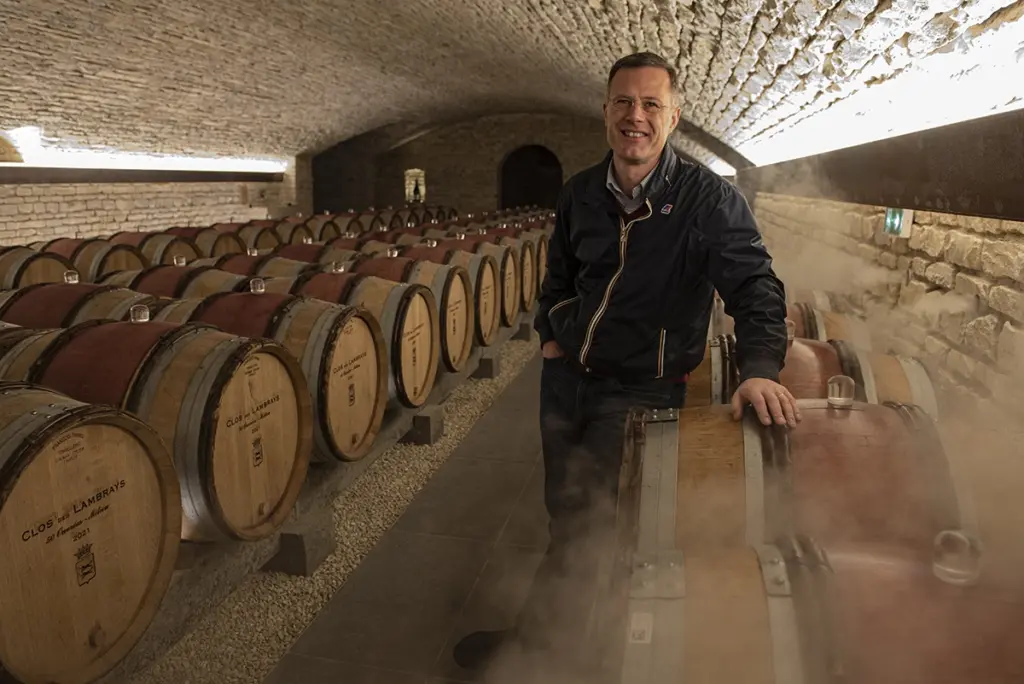
As for oak, you might expect producers to have reined in new oak on the light 2024s, particularly given the small crop following two large vintages for which producers would have bought more barrels. On the contrary, certainly on the Côte de Nuits, many producers maintained their usual proportion of new oak or used more. Small (one-, two-, or three-barrel) cuvées can be carrying anything between 50% and 100%, which I feel overwhelms this delicately structured vintage. It’s always better to use more new oak on a cold vintage than a hot one, but 2024 was not a cold vintage.
Thibault Liger-Belair is among those who used quite a lot of new oak but gets away with it. Deep thought has gone into the oak sourcing and wine matching. He used at least 60% new oak “to give the mid-palate more roundness in 2024,” and found forests of densely planted oak with a tight grain from sandy soils most effective for this. He goes to extreme lengths, however, to ensure the oak doesn’t mark the wine with toasty or vanilla flavors, selecting the trees and producing the barrels himself using very light toast or blonde. He’s something of an oak fanatic.
You are likely to encounter more oak than usual—second and third fill—on entry-level wines, to ensure these barrels were filled. Second-fill oak can sometimes feel more toasty than new blonde barrels—often just too much oak for this vintage. Some producers, though, used none at all—among them, Domaines Jean Chauvenet and Roumier.
For those bottling earlier, it’s likely that some, especially in the Côte de Nuits, will do a light fining, to give the 2024s a final polish. Louis-Michel Liger-Belair, Maxime Cheurlin, and Christophe Roumier anticipate bottling a little earlier than usual. Others, including Grivot and Thibault Liger-Belair, are planning a longer élevage. Those favoring a shorter élevage in the Côte de Beaune include Oliver Leflaive’s Solène Panigai and Stéphane Follin-Arbelet, directeur général of Château de Meursault and Château de Marsannay: 2024 Burgundy “is a fruity vintage, and will be drinkable very soon, so we are not going to keep the wines in the barrels too much. The reds do not have the tannins of 2023, 2022, or 2020.”
When to drink and aging capacity of Côte d’Or wine
Will 2024 whites be approachable early, when most wine is consumed? Yes, I think so, although not all the producers agree. For my palate, slimmer, trimmer vintages are more expressive in youth than richer ones; expressive of terroir, that is. It’s more important to keep rich vintages to slim down. All that said, should you wish to cellar wines from this vintage, I would advise keeping whites rather than reds.
Village-level white wine from the “lesser” villages can be opened soon after they are bottled, so from early 2026. Meursault, Chassagne, and Puligny village wines and premiers crus from the likes of St Aubin have a drinking window from early 2027 until 2030 or so; more serious premiers crus from 2028 to 2035; grands crus from 2028/30 until 2036+.
Frédéric Weber at Domaine Bouchard considers, “You can have a lot of pleasure in the 2024s, while you can keep the 2022s and 2023s.” But Jean-Michel Chartron advises differently. “We must wait, as it is a fresh vintage with good acidity. We have Diam corks, so we can age them. With Diam, they will close down for sure.” Accessibility is affected by the quantity of free SO2, in combination with the closure. Some Burgundy producers are rather generous with free SO2, which does hold back the wine, but they are conscious that their wines could be well-traveled before they are opened. Patrick Essa, who uses cork, feels his whites should not be opened before ten years have elapsed.
Reds from both Côtes will be accessible for earlier drinking, and I see little benefit in keeping most of them more than six to ten years. Low in acidity, tannin, and matter, they do not have the structure for long aging. Bear in mind that much of the fruit was far from perfect and some pHs are quite high.
Increasingly, I prefer youthful red wines and feel that the Côte de Beaune reds will be the most enjoyable, thanks to their pretty fruit. They will be very pleasing over the next two or three years. I would also open the Côte de Nuits reds quite quickly and not keep them too long: from late 2026/27 to 2030 for village wines. Premier crus from 2027/8 to 2032/4. So 8-10 years for higher end premier cru and 8-12 for the best grand cru is probably about right to benefit from complexity with some fruitiness. The very best may keep 15 years, but they will be fully mature and may be over the hill. It’s worth considering the slim, but higher acid 2008s. At 17 years of age, even grand cru 2008s are past their best, while premier and grand cru 2013s, with 12 years on them, combine the nuances of bottle-age with some sweetness of fruit. Unlike 2013s, however, it is not necessary to wait for 2024s to come around. Certainly drink them before 2022s and 2023s, which will benefit from longer aging.
Vintages to compare and contrast
Whites
The whites remind me of 2011, for the balance of alcohol and acidity in combination with lighter body, but the 2024s have more precision as well as more concentration. The 2011s were harmonious at the same stage of their élevage, relaxed even, while the 2024s are more vibrant and exciting.
The 2024s share the straight palate, freshness, and vitality of the 2014s, but with lower tartaric acidity and somewhat less intensity, but the ’24s are gaining with élevage and could finish close in quality to the 2014s, which are the gold standard for their decade. Maybe the 2024s are somewhere between the 2007s—which were straight, racy, and so very citrus during élevage, but of course higher in acidity—and the 2017s—which were fuller and rounder, but charming and not too rich. 2024 leans more toward 2017 but is better than both 2007 and 2017. Many producers referenced 2021, but that was leaner and meaner. 2024 has immediate charm, and in that respect it’s very like 2017. The 2014s are livelier and lighter than the clunky 2016 whites.
Charles Ballot, who had some of the ripest whites I encountered, recalls that directly after fermentation they reminded him of 2010. “Generous and a little bit exotic, with good concentration, balance, and complexity.” Pierre Vincent also referenced 2010s for whites, while Bruno Colin finds them “a bit like 2011: fresh, without high ripeness.”
Jean-Baptiste Bouzereau considers the whites most like 2007, “but they were very citrus even before bottling, while the 2024s have a little roundness for those who waited longer, as the fruit had good ripeness.”
“The general level of the whites is much better than the cool 2021s,” says Pablo Chevrot. “The level of the whites is very high. They are riper and have good aging potential. I prefer the whites to the reds.”
Reds
On the Côte de Beaune, the wines have the red-fruit charm and easy accessibility of the 2017s, with similar levels of freshness but some have more concentration. They can also have more tannin, where producers unwisely overextracted and/or used a high proportion of whole-bunch. 2016 is another low-yielding vintage, but it had a much fresher season and the style of the wines is more intense and precise than the 2024s, and the tannin is finer. Most of Côte de Beaune reds I tasted are fruitier, riper, and much more attractive than the 2021s, but whole-bunch can certainly bring an herbaceous character reminiscent of 2021 where too high a proportion was used.
Charles Ballot believes that the 2024s are “close to 2016, if with less acidity, and with the fruit of 2017.” Sébastien Magnien’s parallel was “2017 for freshness for reds, but we have more concentration in 2024.” Stéphane Follin-Arbelet finds the 2024s fruitier and better balanced than the 2021s and describes them as “friand” (soft and crumbly).
On the Côte de Nuits, many producers also referenced 2021, but with more or less substance. I found the 2021s (tasted at the same stage of their élevage) more herbaceous, with higher acidity and greater abundance but lower ripeness of tannin. The acidity accentuated the tannin, while by comparison, 2024 is gentle, light, and fruity, with softer acidity and lower, nicer, and riper tannins. 2024 does not have the high acidity of 2021, 2020 (which also had high alcohol), 2016, 2014, or 2013.
Considering “lighter,” less solar vintages, there are some similarities with 2013 reds on the Côte de Nuits—another wet vintage that turned out better than expected. While writing this, I am assessing some 2008s, 2013s, and the occasional 2014. 2024 bears no relation to 2008. There are more abundant and coarser tannins in 2008, which has the imprint of a phenolically unripe vintage of high acidity. There is some resemblance to 2013, which, like 2024, is quite light-bodied, and there is sweetness in these 12-year-old wines, but 2013 has much more acidity than 2024 and was less aromatically and phenolically ripe. It also has more tannin and probably more stuffing than 2024. It’s fully mature now, but has taken an age to come around, which 2024 will not. So, 2024 doesn’t really have the substance or aging potential of 2013. I hadn’t considered 2014 until tasting a few good examples on my most recent trip, which proved more like 2024 than 2013 has. (On the Côte de Beaune, 2024 is more charming than 2014 or 2013, both of which suffered from hail).
Edouard Clair finds 2024 “a little like 2021 but with less matter than 2021 for us—inexplicable when the yields were so low. Less tannins than in 2021 and yet riper than 2013 or 2014.” Jacques Devauges regards 2024 as being like “a super 2021, with more color and ripeness and matter and higher potential.” Charles Magnien finds similarities with “2021, but with more intensity of fruit and less acidity,” with which Fabien Géantet agrees: “Like 2021 but better.”
“The 2024s have a thin, light structure,” remarks Christophe Perrot-Minot, “like good 2014s, but the 2024s are fresher and more brilliant. The 2013s and 2011s had more concentration, while the 2008s were drier and more tannic.” Jean Lupatelli at Comte Georges de Vogüé compares with 2021 for the ripeness and with 2014 for the “more classic, fresh, and pretty profile.” Alexander Able finds 2024 like 2014 for freshness but with more concentration. Géraldine Godot, who was also in the 2014 camp, kindly opened a bottle of Richebourg from 2013 and from 2014, and there was definitely more correlation with 2014.
Cyprien Arlaud compares his 2024s with his 2004s. My 2004s were fine and light and not pyraziney, but my 2024s are better.”