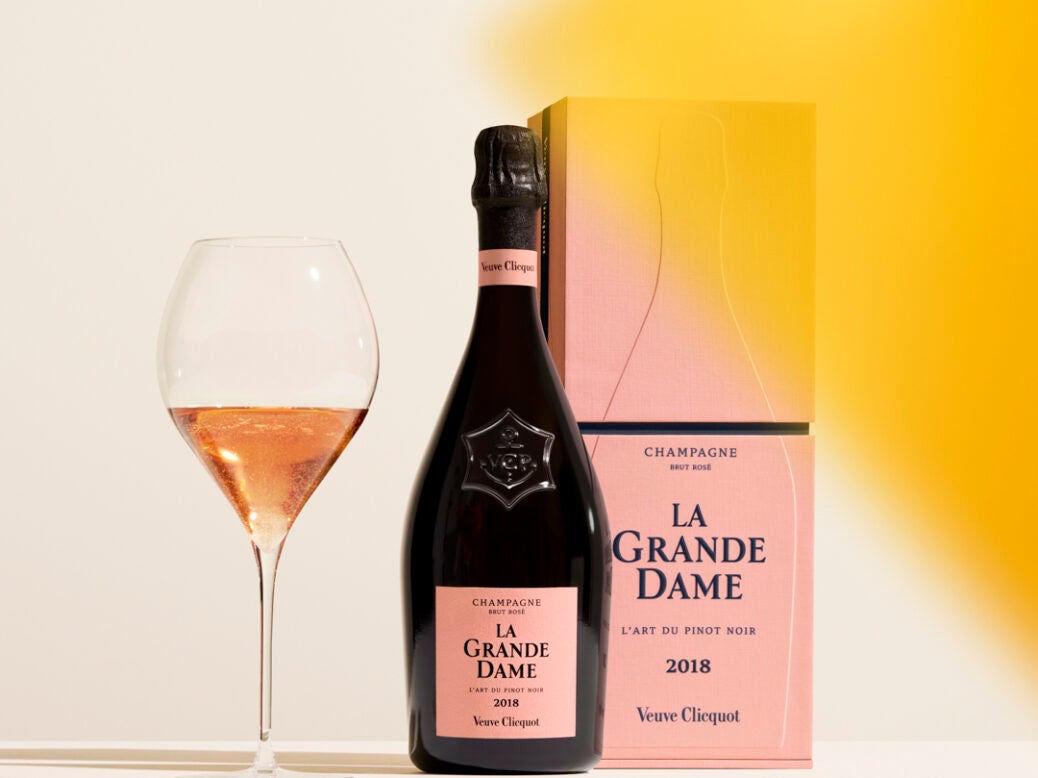
Anthony Rose reviews 2018 Veuve Clicquot La Grande Dame Rosé.
It’s early summer at Tom Aiken’s Michelin-starred restaurant Muse, tucked away in London’s Belgravia. Didier Mariotti, Veuve Clicquot’s chef de cave, is presenting the 11th release of La Grande Dame Rosé since its creation in 1988. As Mariotti started as chef de cave of Veuve Clicquot in 2019, he couldn’t yet be said to be Monsieur Grande Dame (the 2019 cuvée will be his first vintage), but he is unquestionably Monsieur Veuve Clicquot, having made the Veuve Clicquot Yellow Label NV for four years now.
Mariotti has an expensive habit of pouring the wine into two glasses simultaneously: the large, wide Veuve Clicquot tulip, and a Burgundy glass. His point is that the two shapes reveal different dimensions of the same wine. The wider tulip, he says, shows “verticality,” structure, and energy; the Burgundy glass, “horizontality,” texture, volume, fruitiness, the physical feel of the wine on the palate. So far, so français; the sort of conceptual idea that the champenois particularly enjoy but makes sense once you grasp it.
The northeast-facing grands crus of Verzy and Verzenay on the Montagne de Reims, the structural backbone of La Grande Dame, are most coherently understood, he suggests, through the vertical frame—intensity, nerve, and a characteristic closing bitterness that defines the cuvée’s personality: “We know sweetness well, but we are afraid of bitterness . However, this quality of bitterness is the best way to maintain that long finish. It’s positive bitterness.”
Related

The point is not merely stylistic but has become, thanks to climate change, winemaking doctrine. The old yardstick was sugar maturity, but the team now pays close attention to phenolic maturity as well. That bitterness, which was once associated with underripe fruit from the northern Montagne, is increasingly understood as a marker of terroir expression, of structure, and of length. It is, however, you may be relieved to know, not compulsory to drink La Grande Dame from two different glasses at once.
After a rainy winter that replenished the chalk’s water reserves, a long, hot summer in 2018, unusually warm through August, accelerated maturation. Where once the harvest might have come 100 days after flowering, today 80 to 85 days is the norm. Speed of maturation brings its own challenges, not least at the press center, where grapes can arrive at 104–113°F (40–45°C), necessitating earlier picking (Veuve Clicquot stops at noon in high heat) and greater urgency in everything that follows.
Honoring a long legacy
The Grande Dame blending process begins with a blind tasting, village by village, of somewhere between 400 and 600 wines from the current vintage. For La Grande Dame Rosé, the key lies in a parcel that predates the cuvée itself by nearly 250 years. When Barbe-Nicole Clicquot set out to create a rosé Champagne in 1818, it was the red wine from Clos Colin that she reached for. She was, Mariotti recounts, “in love with Bouzy”—so much so that she tripled the size of the parcel, which now extends to 2ha (5 acres) of Pinot Noir on south-facing clay-limestone soils.
Content from our partners

Mariotti is not looking for power or tannin but something light, fresh, and vivid. He presents a bottle of the 2012 Clos Colin Pinot Noir, which tastes like a delicious red Burgundy in its own right. A week-long, cold maceration precedes fermentation, keeping extraction gentle. The result is a red wine devoted, as he puts it, entirely to enhancing the rosé rather than dominating it. On average, it accounts for 13–14% of the final blend.
The blending in of the red to the white—the rougiement—must by law be declared to the authorities eight hours in advance. Mariotti refreshes the batch every six months. With extended lees-aging, he notes, texture and roundness accumulate, effectively softening the palate even as the dosage decreases. The 2018, disgorged after seven years on lees, carries enough of that roundness to make the 6g/l dosage feel entirely integrated.
Tasting
2018 Veuve Clicquot La Grande Dame (12% ABV)
Disgorged in February 2024, this is a blend of 90% Pinot Noir, 10% Chardonnay; aromatically fresh and bright, a light billowing mousse delivers pristine stone fruit, pineapple, citrus, and a trace of phenolic bitterness in its grip; still youthfully fresh, there is energy and structure, hinting at autolysis and a fine dry finish. According to Didier, more complexing notes of autolysis will develop in bottle over the coming years, “but we are not looking for it in La Grande Dame.” | 94
2018 Veuve Clicquot La Grande Dame Rosé (12% ABV)
Disgorged in September 2025, the blend of 90% Pinot Noir and 10% Chardonnay is a vibrant deep cherry in color, with a floral and raspberryish fragrance and vinous mid-palate ripeness, whose vibrant fruit quality, thanks in part to the red-wine element, is intense and rich, with raspberry and cherry fruit; in no way heavy—rather, it’s delicate and effortless, with a trace of that phenolic bitterness on the finish that adds structure, freshness, and vinosity. | 95