

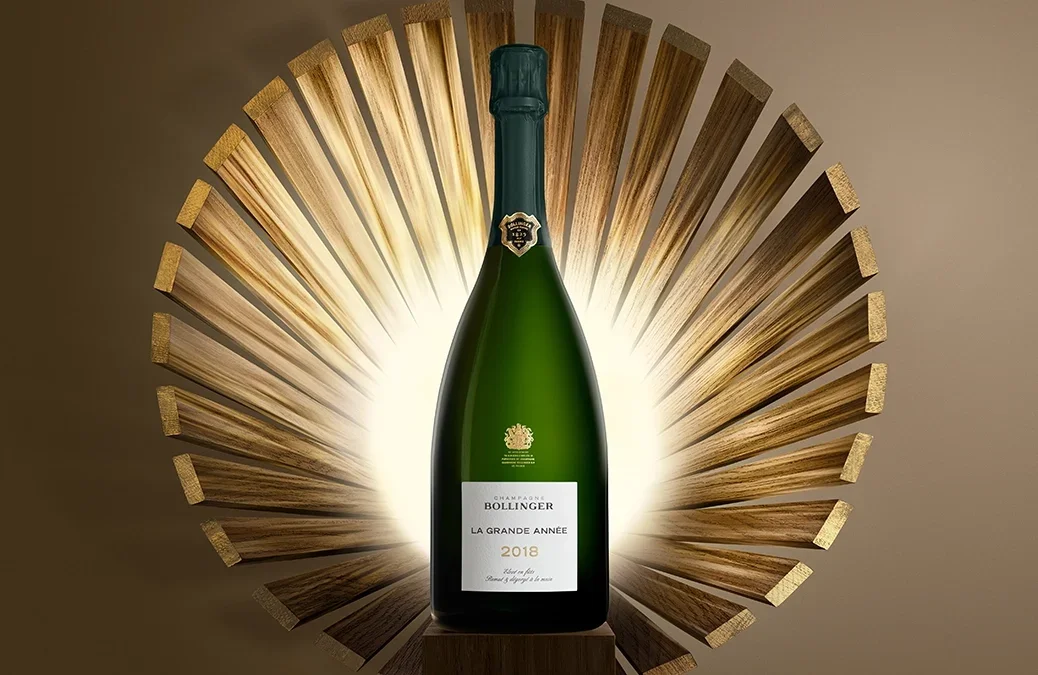
On an evening avowedly dedicated to “craftsmanship, expertise, and transmission,” Champagne Bollinger presented the latest releases of its white and pink Vintage cuvées in Aÿ in March. The launch of the 2018 Grande Année doubled as the perfect occasion to inaugurate the new cellar—just another scheduled milestone in the grand countdown to Bollinger’s bicentenary.
It was in 2022 that Champagne Bollinger unveiled its seven-year multi-stage plan—the same time that it takes to age a bottle of La Grande Année—which will take the house to its big birthday in 2029 and future-proof it in the process. This grand plan includes a new cellar, now completed, with a hotel featuring a spa, conference rooms, and a restaurant still to come. Étienne Bizot, chairman and chief executive of Champagne Bollinger, noted during a pre-dinner speech that he remembered one thing well from when he first started working in Champagne in 1990: “The image of a fence that was closed to the customer.” Now, 36 years later, things have changed. The opportunity of welcoming guests to Aÿ—to the vineyard rather than to the chalk caves of Epernay and Reims—is important to Bollinger. “We are very much attached to our heritage,” Bizot said, noting that the same family has been at the helm “since 1829, without outside investors. Transmission is in our DNA,” he said. “We need to stick to the long-term vision, whatever the short-term situation is.”
Charles-Armand de Belenet, managing director of Champagne Bollinger, put the opening of the cellar, overlooking the Vieilles Vignes Françaises vineyard (more specifically, the portion of it replanted with ungrafted saplings in 2015), in context. Long before any plans for the upcoming anniversary took shape, the first part of future-proofing the house was to invest in the quality of the wine, de Belenet said. The key element of that was to increase the capacity for oak aging. At the time, in the mid-2010s, Bollinger had around 3,000 barrels. By 2019, at the launch of the 2008 Grande Année in 2019, I noted that there were 3,500 barrels. Today, there are around 4,000 barrels. The new cellar will enable Bollinger to increase that to 5,000–5,500 barrels. De Belenet observed that it was twice as expensive to build a new cellar within the existing village structures than in a new construction somewhere in the outskirts, reiterating the company’s commitment “to stay deeply rooted in Aÿ.” Other elements of future-proofing, de Belenet noted, were the company’s B-Corp certification and the organic certification of its vineyards. De Belenet also paid homage to late cellar master Gilles Descôtes, who had given the initial impetus for the increased oak capacity; 2018 was to be his last Grande Année vintage. His successor, Denis Bunner, was conspicuous by his absence. Bollinger confirmed to me later that “Denis left Bollinger earlier this year” and that the company was “currently in the process of selecting a successor.”
A memorable triple debut
To get us all in the mood for tasting the new releases from 2018, the evening started with a cellar tour, when we learned that each hand-riddled bottle of La Grande Année is turned 28–30 times over the space of three months to make the lees travel into the neck of the bottle; for the rosé, which is harder to riddle, this number rises to at least 32 times. As well as being hand-riddled, La Grande Année is also hand-disgorged. In the new overground cellars, we sampled three new 2025 base wines that in 2018 became elements of La Grande Année, presented by Yann Dubart, enologist and part of Bollinger’s R&D team. First came a Chardonnay from the later-ripening village of Cuis in the Côte des Blancs that always makes it into the Grande Année blend—not only due to its fine acidity but for tradition’s sake, since this vineyard belonged to Comte Athanase de Villermont, one of Champagne Bollinger’s co-founders. This was followed by a creamy, oak-aged Pinot Noir from Aÿ, whose juiciness constituted 19% of the final blend, and finally, a saline, structured Pinot Noir from Verzenay. With Sophia Luduvice, another enologist and part of Bollinger’s R&D team, we also tasted three further wines that illustrated the different maturation vessels for Bollinger’s base wines, all from 2018, aged for seven years and disgorged without dosage for this evening: a smoky and reduced Pinot from stainless steel; a rounded, vanilla-scented Pinot from a four-year-old barrel; and a nutty, smooth, and gorgeously balanced Pinot from a 25-year-old barrel.
Related


It was then the turn of Bérangère Fierfort-Caqué, another enologist and member of the tasting committee, to speak about the 2018 vintage, which had started with a rainy winter that clocked up 50% more precipitation than the ten-year average. Spring was mild and moist, spelling mildew pressure. Rain stopped in mid-June and was followed by heatwaves and almost no further rain—just 2in (50mm) between mid-July and harvest, which started on August 23. Fierfort-Caqué observed, “While 2015 [another hot year] was very vinous, 2018 is more vibrant, like ripe fruit just picked from the trees.” Her description was borne out later when the wine was paired with food and presented in different bottle formats.
Everything on the evening was designed to showcase expertise, technical and artistic accomplishment, and craftsmanship. In-house cooper Gaël Chaunut demonstrated his intricate craft with ancient tools; a dance troupe gave a dreamlike performance outside the panoramic windows against the illuminated Vieilles Vignes Françaises vineyard; and brothers César and Léo Troisgros of the eponymous restaurant took over the kitchens. In the often performatively fancy, pretentious, and wasteful world that is fine dining today, these two brothers crafted a menu that was a testament to their profound understanding of flavor and texture and their belief in the integrity of real ingredients. No, I would not have dreamed up pairing tender spring cabbage with caviar and highlighting it with tarragon, citrus, and dashi, but the deep, alluring saltiness of that starter chimed with the salty depth of chalk in the white 2018 Grande Année. The middle course of langoustine “draped” in truffle was, admittedly, a showpiece, the brothers emerging from the kitchen to poach black Périgord truffles in Champagne in front of the guests. The main course of duckling with shiso, served with the 2018 Grande Année Rosé, was one of the most vivid combinations ever; the deeply verdant, aromatic flavor of beetroot-glazed, raw shiso leaves sang with the pink poultry meat, uniting the heightened yet earthy aroma of the herb with the visceral, tender nature of the meat. Nothing was pointless or overstated; everything was harmonious and so very memorable.
The wines shone, too. La Grande Année 2018 is already approachable and generous from bottle. Served from magnum, much brighter, fresher fruit notes emerged, recalling and confirming Fierfort-Caqué’s impression of “vibrancy.” While the bottle was more mellow, the magnum came across as livelier, crunchier, and totally energetic. The Rosé was even more intriguing on the night. One of my notes from the evening was “embryonic,” and while the wine unfolded with the food, it also stood up perfectly to the Troisgros flavors, which were by no means shy.
Content from our partners
Tasting
2018 Bollinger La Grande Année
Blended from 66% Pinot Noir (chiefly from Aÿ and Verzenay, supplemented by Mareuil-sur-Aÿ) and 34% Chardonnay (from Avize, Chouilly, and Cuis). Aged for five years on lees and disgorged in March 2025, with a dosage of 6g/l.
A slight smokiness hovers on the creamy nose, then overtones of hayflower and ripe red-apple flesh appear. The palate is mouth-filling, juicy with stone fruit, expansive like a cloud, creamy, supple, smooth, and agile; generous but without heft. It is totally approachable already but will gain more and more gastronomic interest. All is supported by the customary Bollinger creaminess and fine, ripe, juicy acidity. | 96
2018 Bollinger La Grande Année Rosé
Blended from 67% Pinot Noir (comprising 62% white-vinified wine chiefly from Aÿ and Verzenay, supplemented by Mareuil-sur-Aÿ, and 5% red wine from the Côte aux Enfants vineyard) and 33% of Chardonnay (from Avize, Chouilly, and Cuis). Aged for five years on lees and disgorged in May 2025, with a dosage of 7g/l.
While you’d expect the pink version of this creamy, generous Champagne to be even richer and rounder than its white sibling, the opposite is true. Citrus brightness teases with flashes of blood orange, and apple flesh adds its own supple freshness. Meanwhile, the palate is sinuous and ripples with red fruit and riper apple flesh. It has the ripeness of fruit of 2018 but is deeply anchored in the cool, chalky soil and has yet to unfurl fully. | 96


