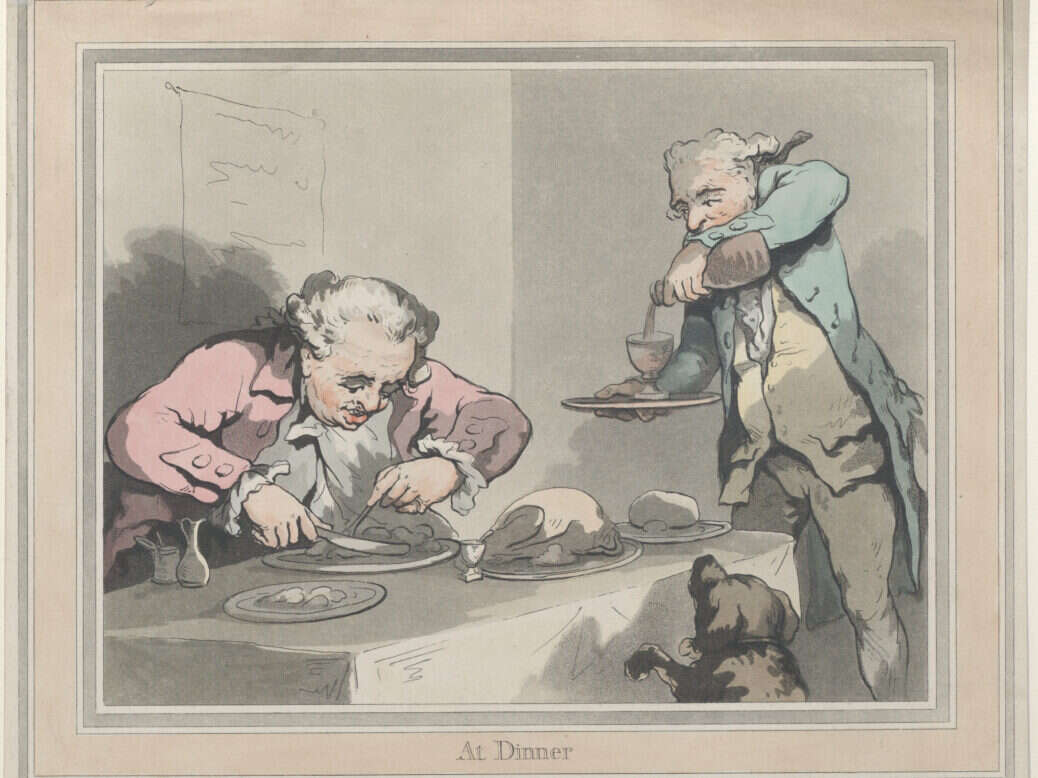
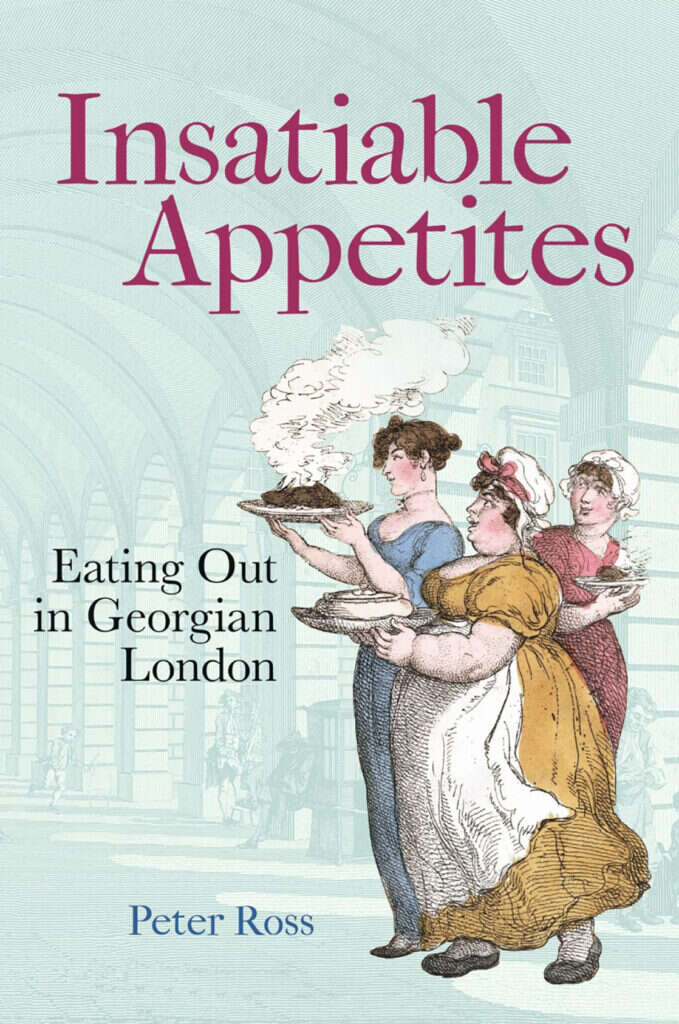
Stuart Walton reviews Insatiable Appetites: Eating Out in Georgian London by Peter Ross.
The Georgian period in Britain marks the moment that food became integral to a sense of the nation’s self. Where it was once merely sustenance, available to the cultural imagination only in the stark terms of surfeit or scarcity, a rumbustiously confident nation—especially its English segment—reached for food and drink to define itself anew. National nourishment, archetypally the roast beef of Old England in the words of the patriotic ballad of 1731, was both plentiful and plain, fit to expand a yeoman’s girth but not given to the excessive denaturing and overembellishment of the undernourished French. English interior styling may have succumbed to a fit of the rococos, but what was expected on the plate was straightforward nutriment, and plenty of it.
That said, a renewed interest in the artifice of the cook’s repertoire informs the opening address of Henry Fielding’s great novel of the urban picaresque, Tom Jones (1749), in which the author is conceived as an ingenious “restauranteer,” preparing and serving an extravagant feast for his readers. Moreover, food is becoming a precise cultural marker, not just between England and France but within the home nations. Tobias Smollett’s Welsh squire Matthew Bramble, the central character of Humphry Clinker (1771), on a tour of the British Isles, is reliably appalled at what other people will consume—Covent Garden milk that bears only a passing rancid relation to what emerges from the cow, oysters cultured in Essex slime-pits, “haggice” consisting of “a mess of minced lights [lungs], livers, oatmeal, onions, and pepper, inclosed in a sheep’s stomach,” none of which would have done his propensity to gout any favors.
Then again, venturing overseas was enough to make you wish you had stayed put. Lord Byron’s peregrinations in Albania and Greece on the Grand Tour in 1809–10 were regularly spoiled by his Nottinghamshire valet’s “perpetual lamentations after beef and beer.” The plaint—echoed in the present-day insistence that, for all Europe’s pleasures, nobody over there knows how to make a decent cup of tea—reflects the cultural allegiances that blossom forth from purely sensory matters. It might be dull enough at home, but you’ll miss it when it’s gone.
Related


Much of English culinary sensibility is on display in Peter Ross’s splendidly panoramic survey of public eating in the capital during the 125 years of the Georgian era. His study is structured over the course of a typical London day, beginning in the pre-dawn hour when street vendors nourished those who had not gone to bed, or at least not to sleep, with bread and butter and bowls of hot saloop, a long-vanished decoction of powdered orchid tuber in sweetened milk or water, warmed until its polysaccharides thickened. From there, we progress from servants’ breakfasts—cocoa and a roll, a drop of invigorating brandy splashed into the tea, buttered toast in profusion—through midday meals and afternoon treats at the bun shop, to magical evenings in dinner booths among the colored lanterns at Vauxhall Gardens, a fortifying hot pie at supper, and back to the sexual labors of the night.
From cock ale, to the jelly craze
Ross takes as comprehensive a view of London society as his voluminous sources allow, consulting Henry Mayhew’s sociological survey in the 1840s of London Labour and the London Poor, alongside the grand banquets that often dazzle the historian’s eye for anything sparser, as well as the variegated evidence of cookbooks, surviving bills of fare, parliamentary legislation, waspish squibs, and the classic novels. The unfathomable gustatory habits of Jane Austen’s more eccentric characters, and what their attitude to food says about their moral constitution, are as revealing as the more garish satires of her predecessors in the 1700s. There is incidental detail to be gleaned in the backgrounds of the mordacious prints of Thomas Rowlandson and the Cruikshank brothers.
What people ate is an enduring source of fascination. Although the orchid roots that went into saloop were gradually replaced by the cheaper sassafras, the drink itself would disappear almost entirely, living on in England only in the revenant form of sarsaparilla, itself doomed when the sassafras benzene safrole was discovered to be carcinogenic. It is perhaps easy to see why cock ale—beer that had had a bag stuffed with a parboiled cockerel, raisins, and spices steeped in it—passed out of fashion, for all that it is one of the theories for the derivation of the term “cocktail.” Nobody wants turtle soup anymore, but it was once sufficiently enjoyed that “mock” versions of it, made with the more prosaic likes of gelatinous calf’s head and foot in spiced, truffled broth lashed with Madeira—this in the nation that scorned French lily-gilding—were formulated to cater for more straitened budgets.
Content from our partners
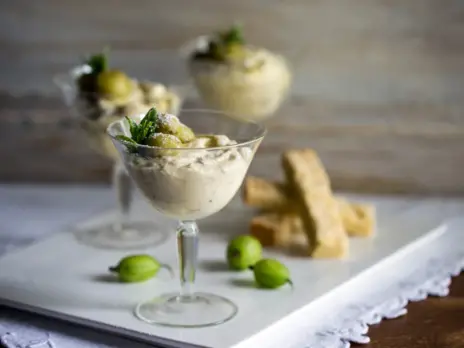
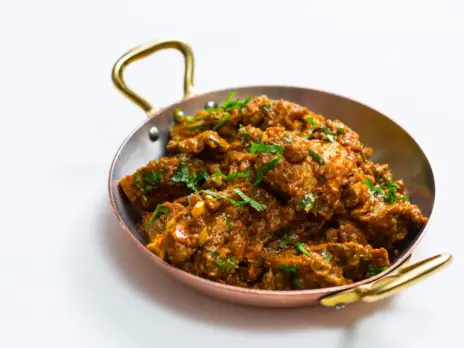
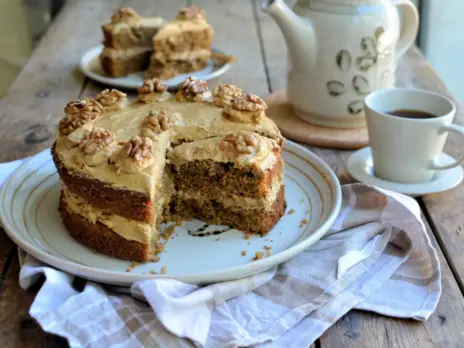
Ross’s focus is on public eating—not just coffee houses and tea shops, gin palaces and restaurants, but in the street, too. Peter Stokes, known as the Flying Pieman, purveyor of pies and puddings, could knock out a dozen slices of his wife’s plum pudding in a single lightning circuit from Hatton Garden to the Fleet Market, before returning home for the next batch. So entrepreneurially successful was he that any customers who took too long to rustle out the requisite penny found themselves bereft, calling him vainly back as he moved on to readier custom. Food on the go was a routine expectation in a city that barely rested even at its leisure. East End pubgoers were often regaled with hot portions of fried flying fish, an importation of the Sephardic Jewish diaspora from the Iberian peninsula. It only awaited juxtaposing with the fried potato invented in the Meuse Valley at around the same time to be amalgamated into one of Britain’s most enduring culinary signifiers.
If the availability of public food and drink furnished the urban landscape with a horn of plenty, it was also the breeding ground of a persistent culture of suspicion. Adulterating bread and watering beer had been made savagely punishable offenses long before the Georgian era, but the air of sharp practice that hung around restaurants and taverns, and especially the supper boxes of the nocturnal pleasure gardens, was a miasma that never fully cleared. In a baized and linened candlelit booth, one could dine sumptuously while listening to the musical entertainments, but the service system seemed an open invitation to corruption. The waiters had to purchase the food themselves from a central kitchen and then ask for reimbursement from the diners, so that their only income was gratuities, which led to potential ruin when the diners considered that they had had sloppy or tardy service. A Regency beau might even find it beneath him to bother with fumbling out coins at all. The Anglo-American tipping culture, with its combined overtones of desperation and extortion, lived to spread its miseries into the 21st century.
What was served at Vauxhall was subject, from the mid-Georgian period on, to a relentless process of shrinkflation, the chickens ever younger and tinier, the pie-fillings dwindling to air in a pastry shell, the cold meats sliced so thinly you could read the Times headlines through them. And what was in the Sherry? Molasses, boiled raisins, even alum, quite likely. And yet, there in the interstices of institutional fraud and consumer fury, is Lady Caroline Petersham entertaining Horace Walpole and a gang of bravos in a box at Vauxhall Gardens, stewing minced chicken in butter in a china dish over a lamp, “stirring and rattling, and laughing.” The party only broke up at around 1:30am, cheered and delighted by Lady Caroline’s unflagging bonhomie.
As to bonhomie of the sexual variety, hardly anything was more likely to guard against flagging than jelly, the object of a consumption craze in mid-Georgian London almost as peculiar as the collective addiction to gin had been in the 1730s. Probably because it had originally been served at brothels and bagnios, jelly became indelibly associated with sensual desire. It was both stiff with gelatine but sufficiently flaccid in the glass to slip down easily and became an indispensable element of the nocturnal economy. A visit to a jelly house was “the prelude to every kind of debauchery,” according to John Cleland’s Midnight Spy (1766). St James’s Park in the darkness was a seething mass of jelly-fueled copulation, bawdy-house sex workers plying their trade alongside soldiers from the Birdcage Walk barracks offering themselves to homosexual punters. Isaac Cruikshank’s print Billing and Cooing at the Jelly Shop (1798) shows a well-dressed dandy spooning jelly into the mouth of his simpering mistress, while to the right a fashionable young gent with no need of company practices a little image manipulation on himself in the mirror through an eyeglass. Shelves stacked with jelly glasses rise behind the counter.
Peter Ross has written a compendium of Georgian eating habits that is as efficient as it is beguiling. The period illustrations are captivating, and the book is furnished with a useful bibliography and thorough editorial apparatus. It deserves a place on the already loaded shelves devoted to social histories of the 18th and early 19th centuries, professional interest in which has been as robustly sustained recently as though its exponents ran on jelly.
Insatiable Appetites: Eating Out in Georgian London by Peter Ross
Published by Bodleian Library Publishing; 247 pages; $45 / £30