

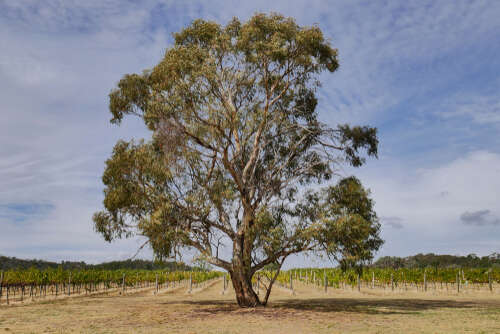
As a region, Beechworth is a mere 130ha (320 acres), smaller than the appellation of Condrieu. A cool region, the geology varies, of course, but granite and quartz are important here. Chardonnay—intense and textured—is not the only variety performing magic in Beechworth, but the success of Giaconda has put the focus firmly on it. It is a region of overperforming producers.
Giaconda
Rick Kinzbrunner has been compared to Don Bradman. In Australian-speak, there can be no higher accolade. Sir Donald is the greatest cricketer who ever lived—indeed, for many, the greatest sportsman, though that is the sort of statement that leads to very late nights and many empty bottles. He transformed the game through his skill. Quite whether Rick sits at that level is another of those topics for lengthy debate, but it is fair to say he raised Australian Chardonnay to new levels and still today is seen as its greatest practitioner. (Brian Croser also deserves at least a look-in here.)
I first met Rick many years ago, when he was doing a short stint with a now-defunct Rutherglen producer before establishing Giaconda. I have been buying Rick’s wines (which I guess is pretty much as big a compliment as I can pay them)—not just the incomparable Chardonnay—since back in the past century, and every single bottle has proved just as thrilling as the last. Rick’s experience does extend past a small local producer in a mostly fortified region. He also spent time at Stag’s Leap and Petrus, as well as Brown Brothers in Victoria. Since 2007, Rick’s son Nathan has worked with him.
Rick describes finding the site for his vineyard in the then-almost-unknown region of Beechworth as luck, but one suspects there was a little more to it. He has described how he fell in love with Beechworth at first sight—a tiny town once home to gold miners and bushrangers. He also had his eye on a clone that Penfolds had brought in from Le Montrachet, P58, but that had not really caught on in the way it eventually would. Rick liked the clone for its low yields and fruit intensity. As he says, “Right from the start, I always had a passion for Chardonnay, though there was very little of it in Australia at that time. When I tasted my first French Chardonnay (Chablis), I was hooked.” He did try Burgundian clones, with little success, but he does have a little Mendoza.
Related

Rick’s vines are now more than 40 years old, planted back in 1982 (the operation opened in 1985), and his method of winemaking has changed very little. Excavation of his cellar required two and a half tons of dynamite—it sits at 61–63°F (16–17°C) all year round, with humidity at 90%. When he first planted, the split in the vineyard was 60% Cabernet and 40% Chardonnay. Needless to say, Beechworth Cabernet does not hold quite the same aura to which it once aspired. Right from the start, he made the wine he wanted to drink and, fortunately for the rest of us, “never fell for the current fashionista styles.” Grapes are harvested when fully ripe, though he notes that, on average, perhaps not quite as ripe as in the past, since he likes to avoid the possibility of overripeness. He has replanted some Chardonnay to cooler parts of his site, thanks to the impact of climate change, and is always on the lookout for minor vineyard tweaks. The vineyard is run on “strict organic principles,” and the wine is made “in a super-traditional method, only basket-pressed, a quick settling, then fermented with natural yeasts (small amounts of inoculated yeasts sometimes used) and fermented underground in 225-liter barrels, 30% new. Maturation time has been reduced from 20 months to 12. Malolactic is always natural and 100%.” His oak regime has changed very little. The wine is not pumped at any stage, except as juice out of the press. As well as making his wines, Rick also operates as the sole importer for the Sirugue French oak cooperage for both Australia and New Zealand. At Giaconda, they use a mix of Tronçais and Vosges, which are given three years’ air-drying and then a range of toasting.
Back in 2003, Rick split the bottling between cork and screwcaps. I remember this well, because friends who had not been able to get their allocation under screwcap, which quickly sold out, were reluctant to buy under cork. Whichever you prefer, this seemed odd, since they’d been buying under cork for years. By 2013, the market had spoken, and the use of cork was terminated. They have not seen any issues selling the wine, even in prestige markets, but given the international recognition and admiration for the Giaconda Chardonnay, that is hardly surprising. These wines are Australian, but they do offer a wary nod to the best from Burgundy.
Rick is not easing into retirement in Beechworth, and his standards seem higher than ever. Many feel that the 2022 Chardonnay was his greatest wine yet (Rick would opt for the 2023, I believe), though given that he has racked up almost as many scores of 100 as the great Bradman, it becomes hard to pick a winner. If the divinities and the tax office decide I can only buy one wine a year, it will be Giaconda Chardonnay.
Content from our partners
Chardonnay 2011
2011 was generally considered the weakest vintage across Australia in many years. Clearly, no one told Beechworth. A gleaming, deep-gold hue. This has gorgeous aromatics of oatmeal, figs, and stone fruits, notably peaches. There are hints of Tahitian lime and a lovely saline minerality in support. Wonderfully complex, this is balanced and intense, with a fine line of acidity. The creamy texture is wonderfully alluring, and there is great length. This still has at least eight years ahead of it. | 97
Chardonnay 2017
Pale lemon in color, this is a rich, full-flavored, wonderfully decadent style of Chardonnay, with great intensity. Gunflint notes, with minerals, stone fruits, apricot skins, and figs. The oak here was less apparent than with the 2019, tasted at the same time. Integration has preceded precisely as I imagine the winemakers would wish. There is a flick of nutmeg, nougat, and the merest hint of caramel toffee. Great intensity on the palate and such length; this walks the tightrope between power and refinement. Not hard to believe it will still be drinking beautifully in 20 years. | 99
Chardonnay 2018
There are several exceptional Australian Chardonnays, but if I am asked to show someone what I believe to be the best of the best, it is to Giaconda I will always turn. It has been my go-to option for great local Chardonnay for three decades, and this is one of the very best. With considerable age already under its belt, this wine shows just why so many people revere this Chardonnay. The color was still a bright, fresh, pale lemon, with flecks of green. On the nose, we have notes of hazelnuts and cashews, lemon sponge cake, peach pits, stone fruits, gunflint, and oatmeal. A wine of immaculate balance, great intensity, serious concentration, and a long and lingering finish. Layered and complex, this still has 15 years ahead of it. World-class. | 98
Chardonnay 2019
One from the portfolio that seems to be taking a little longer to completely come together than is usual—not that this is a problem. A pale lime/lemon in color, its youth is there for all to see. Taut, poised, and concentrated, with good focus; there are oak notes evident as integration proceeds. The nose reveals aromas of cashews, oatmeal, white peaches, nutmeg, cinnamon, lemon curd, and Key lime pie. Coiled power here, with a line of fine acidity; this is still amazingly youthful. A long and lingering finish. The wine is seamless. It is a masterpiece of force and finesse and should remain so for at least 20 years. | 98
Chardonnay 2021
Tragically, Australian bushfires destroyed any possibility of the release of a 2020 vintage. Rick and his team more than made up for it with what is the first of a trio of some of the finest wines ever made in Australia. This is simply spectacular. Complex, with great length and intensity running the full length, and the most alluring and seductive texture. There are notes of hazelnut, freshly sliced limes, and stone fruit, with nectarines, oysterhells, white jasmine, and beautifully handled oak. The balance is extraordinary, and this is surely a wine that will provide pleasure for at least the next two decades. Served blind to a couple of Burgundy addicts, they picked it as a great vintage of a Blain-Gagnard grand cru. | 100
Chardonnay 2022
At the time it was released, this extraordinary Chardonnay was largely considered the best Rick had released, along with the 1996, if memory serves. And perhaps 2018? It was, as they say in the classics, a tour de force. Pale yet shining lemon in color, it gives the impression that it is perhaps still just a little closed. Certainly tight and focused, but the structure is seamless. There is truly exquisite balance throughout, with underlying power. The nose reveals notes of figs, oatmeal, white peaches, florals, minerals, gunflint, and lemon curd. The oak is supremely well integrated, and there is a line of fine acidity running the length. The wine seems to linger forever. On the palate, it seems hints of tropical notes like pineapple are just sticking their nose above the parapet. Sheer class. I assure you that I prefer not to hand out scores of this magnitude with what might seem the flippancy with which they occur. I do look very hard for reasons to knock back a few points whenever possible. I just couldn’t find any. | 100
Chardonnay 2023
Probably all you need to know is that I understand that Rick considers this his favorite of all the Chardonnays he has made. He talks of it combining the power of the 2021 vintage with the “fruit and matchstick of 2022,” but more subtle than either. For him, this is synchronicity in a glass. Tight and concentrated, with power, line, and length; the balance is perfect, and the texture wonderfully seductive. Even at this early stage, the complexity is obvious, and we can expect more to come. Flavors revolve through stone fruits, florals, figs, gunflint, matchsticks, oatmeal, lemon curd, and herbs. Early days, but the oak has been handled so deftly that what is there seems just one more part of the whole. Definitely a wine where the sum of the parts exceeds the individual components. Twenty years? Thirty, if you really wanted to try, I suspect. | 100
Savaterre
Anyone planting a vineyard in the Beechworth region will inevitably find themselves in the shadow of Giaconda, but Keppell Smith at Savaterre has persisted and established his own reputation for excellence—deservedly so. The vineyard is at the foothills of the Victorian Alps. Closely planted at 9,400 vines per hectare, as Keppell says, means less than a bottle from each vine.
Savaterre is another winery importing its own oak, in this case Cavin Burgundian barriques, mainly from the Chatillionais forest. They ensure a light toasting only. When asked about their process, Keppell says it is “just old-school winemaking. No rush at any stage.” Why Chardonnay? “Because it’s the king of white grapes […] and it performs exceptionally in Beechworth on our ancient soils.” Keppell describes himself as a Burgundy tragic, so this was a natural direction in which to proceed. Keppell also loves the 2022 vintage, calling it a “Goldilocks vintage” and a benchmark for Beechworth, believing his 2022 Chardonnay is the best he has ever made.
Chardonnay 2022
Although this wine had seen 18 months in French oak, the intensity of the fruit had completely absorbed it. We have notes of flint, river stones, wet steel, citrus, ginger, glacé lemon, hazelnuts, and grapefruit. A wine of serious focus and length; there is a seductive texture with fine balance. Love it. Eight to ten years. | 96


