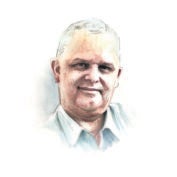
Frédéric Panaïotis was a uniquely talented and charismatic man, says Tom Stevenson, a scientist and multi-linguist whose transformation of Champagne Ruinart was but one of many achievements.
Most of those who knew the late chef de cave of Champagne Ruinart called him Fred, but for my good friend György Markus he will always be Panasonic. About 10 or 12 years ago, George (as I like to call him) emailed Panasonic about a forthcoming event they were due to attend. The reply came overnight from Osaka, a location that struck a chord because George had just watched Black Rain. He remembered an amusing scene in that thriller when Michael Douglas introduced Ken Takakura’s character as “Masahiro Matsumoto from the Osaka police station.”
Shortly after, George, Fred, and Essi Avellan MW, another good friend of mine, hosted a masterclass for 250 paying guests in Budapest. They each had one wine to present, and when Fred saw George and Essi, there was a glint in the Frenchman’s eye. He had many wonderful, often awesome qualities, but he could also be quite frivolous. Fred drew George and Essi to one side and said, “Right, how about a bit of fun? We give each other a specific word or phrase at the very last moment, and the challenge is to somehow work it into our presentation. What do you say?” Of course they both agreed.
Just before George took to the stage, Fred handed him a piece of paper with “pizza margherita” written on it. A bit later, Essi got “reindeer.” Both were relatively easy to integrate as food pairings. Last up was Fred. George slipped him a note, and Fred did a double take when he read “Masahiro Matsumoto from the Osaka police station.”
Related


George whispered this to Essi, who nearly had a giggling fit, and they both sat there wondering how Fred would complete his task. As he neared the end of his presentation, George and Essi were convinced that Fred would have to chicken out, but after explaining how, when, and where it could be enjoyed, he concluded with, “This wine would be perfect even for Masahiro Matsumoto from the Osaka police station.” His two fellow presenters burst out laughing, leaving everyone else in the room wondering what Fred was talking about and why George and Essi could not stop laughing. The three of them had more than a few drinks that night, and that is how George and Essi like to remember him.
Fred would probably like me to stop there. He was such a humble and unpretentious person that he would not want us to dwell on his many talents and achievements. But sorry, Fred, you meant so much to all who knew you that I feel a duty to share the rich and extraordinary fabric of your life for others who were not lucky enough to know you so well.
The Panaïotis effect
Fred Panaïotis was one of a kind. He was one of those rare people who lit up a room, and if you knew him, you felt lucky. Lucky to talk with him, lucky to share a glass, or just lucky to be in the same space. Fred’s warmth, humor, and endless curiosity enabled him to forge connections effortlessly—between people, ideas, languages, cultures, traditions, science, and poetry.
Content from our partners
Thinking back, I might have seen Fred at Scharffenberger in 1988 or 1991, but I did not get to know him until 1995, when I was formally introduced by Jacques Péters, chef de cave at Veuve Clicquot. Although Fred was “just” one of several enologists on the winemaking team, it was immediately obvious that there was something special about him. He was in his early 30s and already wise beyond his years. Intelligent, charming, and blessed with a gift for languages. (He spoke eight, effortlessly.) I soon discovered that even as just one of a team, he moved through life with a lightness and an attentiveness that made everyone around him feel seen and important. He had this effect on people: the Panaïotis effect.
On one occasion, when I was living in Cheltenham and unable to travel for health reasons, he took the Eurostar to London then continued by train on the Great Western to Cheltenham, just to visit me. Yes, he wanted to show me a particular wine for a very interesting reason, which was obviously to Ruinart’s benefit, but he could have put a sample in the post. I felt that he really wanted to taste the wine with me, to observe my reactions, and to hear my opinion first-hand. Fred was always on the road or rail or in the air. He was so hard to pin down that it had taken The Champagne & Sparkling Wine World Championships four years to fix it in his diary to attend our annual dinner this year to collect his long-overdue Lifetime Achievement Award. He was always in another country (usually Japan). So, not only was there very little to be gained from a one-to-one tasting with me (I was already semi-retired and not the latest, loudest voice on Champagne), it would also have been a logistical nightmare, with such a busy diary. Yet he made room for me in his hectic schedule and made me feel privileged in the process. A perfect example of the Panaïotis effect.
A lifetime of achievement
Fred was half-Greek on his father’s side but was born in Reims after his grandparents had moved to France. He was therefore second-generation French and Champenois by birth. He spent much of his childhood helping out in his grandfather’s Chardonnay vineyard in Villers-Marmery on the eastern Montagne de Reims. He did not yearn to be a winemaker, and according to Fred himself, his earliest memories were of enjoying fishing, a love of animals, and an ambition to become a veterinary surgeon.
In 1985, as a first step on the path to becoming a veterinarian—or at least to finding some sort of work involving animals—Fred began studying biology at the Institut National Agronomique Paris-Grignon. His teacher at school had suggested biology as a good option to begin with because it could open up many other career opportunities, should he change his mind. It was a difficult year for Fred; his father had died, but during the Christmas break his uncle poured him a glass of 1976 Domaine Gros Frère & Soeur Richebourg, and his world changed. He was suddenly smitten by wine and returned to the Institut National Agronomique in Paris, where he switched his course to viticulture and enology. In 1988, he graduated with a diploma in agricultural science specializing in viticulture and enology, followed by a higher diploma in enology from the highly reputed wine college at Montpellier.
After a short time in the northern Rhône, Fred headed for California, where his first employ as a newly minted enologist was a three-year stint at Scharffenberger in Anderson Valley. When he returned home to Champagne in 1991, he worked as an enologist on the technical team at the Conseil Interprofessionnel du Vin de Champagne (CIVC), where he specialized in closures and storage. In 1995, he was hired by the eagle-eyed Jacques Péters at Veuve Clicquot, who had a knack of spotting über-talented future chefs de caves. Fred underwent 12 years of first-class mentorship before securing the plum position of chef de cave at Ruinart, also part of LVMH, in 2007.
My first meeting with Fred in that new position is as vivid as if it happened yesterday. He told me about all of his aims and ambitions for what had always been a hidden gem of the LVMH empire. He had already given himself lots to do, but I added to it. The Dom Ruinart Rosé had always been a bit of a miracle; essentially the Dom Ruinart Blanc de Blancs colored by red wine, thus predominantly Chardonnay. But when kept a few years, it became more Pinot than most 100% Pinot Noir Champagnes. The Dom Ruinart Blanc de Blancs, however, could sometimes be too big. While no one could deny that there had been some truly magnificent Dom Ruinart Blanc de Blancs vintages, there were also some vintages that were good but not great; they had plenty of complexity but were just held back by their sheer size. I felt the cuvée needed to move toward more finesse and elegance without sacrificing its core character. Fred agreed. He told me that the one thing he really liked about Chardonnay in general was its “simplexity.” This was the first time I heard him use that portmanteau, but it was certainly not the last. Fred reckoned that Chardonnay should be easy to appreciate, friendly, nicely textured, and marked by aromatic freshness. It should not be heavy or old-school. Fred did, however, say that if he wanted to achieve that without radically affecting Dom Ruinart’s rich style, it required slow work to avoid drawing attention to the evolution, and it would probably take him a decade at least. This was all music to my ears, especially when he said that plans were already afoot. This is, I believe, why Essi Avellan is correct when she says, “The greatest Dom Ruinart vintages are still waiting to emerge from the cellars.”
This would be by no means Fred’s only accomplishment. I could roll off a long list of bullet points that would only scratch the surface of his successes at Ruinart, but the three most important for me are the following cuvées. Ruinart Blanc Singulier: By using exclusively plots that have been ring-fenced due to their recorded sensitivity to climate change, and by blending with 20% réserve perpetuelle, Fred was (to use his own words) “trying to answer the question of what a blanc de blancs might look like in the future.” Dom Ruinart Blanc de Blancs 2010: By using NDtech corks rather than crown caps, Fred hoped to demonstrate that the aromatics from untainted corks can increase the quality of Champagne. As he specialized in closures at the CIVC, it was not surprising that he would return to this subject at some stage in his career. Ruinart Tricentennial Cuvée: Due to be released in 2029.
A magical ability to connect
But Fred’s life should not be restricted to the contents of a bottle, even one as iconic as Dom Ruinart. He was so much more than that. He was a brilliant teacher, a man of science and learning, who loved to question, explain, debate, and, yes, to joke. He was that rare person who could be both deeply rational and profoundly sensitive, whose scientific mind never lost sight of poetry or humor or emotion. As cricket lovers would say, he could both bat and bowl; he loved translating science into pleasure and pleasure into science. In addition to his native French, he spoke fluent English, Italian, German, Spanish, Russian, Chinese, and probably his greatest linguistic love of all, Japanese. The reason he spoke so many languages was not simply because he could, but because he believed that if he was able understand the logic behind a language, it would help him to understand the culture of the people who spoke it. Well, he obviously understood and loved Japanese culture because he traveled to Japan more times than to any other country. His favorite Japanese dish was a “fantastic kaiseki,” which is a bit like “today’s special” in English, except that kaiseki is presented in many different mini-dishes, and his best experience of kaiseki had always been in Kyoto, not Tokyo. I’m sure that while much of the praise for Fred in this obituary would have him blushing to a horrified extent, the one thing he would be happy about would be if any reader visiting Kyoto took advantage of his years of experience and tried the kaiseki in Kyoto. It’s not even restaurant-specific; it’s just Kyoto not Tokyo.
At home Fred grew shiso and myoga on his balcony in Reims and preferred simple vegetable-focused dishes when cooking at home. He had been cooking experimentally since his university days, and in his settled home life he also cooked udon, tempura (at 340°F [170°C]), and even periwinkles! He could hold his own in one-to-ones about food pairings with the world’s greatest chefs. His fascination with mushrooms was a quiet obsession often indulged on long foraging walks through the woods. He loved trees and plants and was at the forefront of viti-forestry initiatives in Ruinart’s Taissy vineyard. Fred believed in putting nature at the center, and he lived that belief with conviction. There was something almost magical about Fred’s ability to connect with nature.
He had just returned from Japan at the time of his death. Fred was an accomplished freediver. He was a highly qualified master freediver who taught and coached others. He was able to dive to depths of nearly 170ft (51m), and when challenged about the risks involved, he would always say he was a risk-calculator, never a risk-taker. Top of his bucket list was to freedive in Lake Baikal in the Russian region of Siberia. On June 15, 2025, however, at a depth of just 82ft (25m), he became detached from his lanyard and tragically died at Carrière de Rochefontaine, an old marble quarry in Belgium that had been repurposed for freediving.
He had said to me more than once that if Ruinart wanted to keep him (which they did), he wanted to “hang around” until at least 2029 when the Tricentennial Cuvée would be released. Sadly, he will not be there.
My deepest condolences go to his mother Monique, his daughter Thelma, and his lifetime partner Vineta Brutane. I extend those condolences to everybody else who knew this extraordinary man, because I still cannot understand or accept his death and doubt that you will be able to either. Try to find the name Panaïotis unconnected to Fred and out of 8 billion people on this planet, you will likely find just a single digital footprint. He was truly one of a kind.