Margaret Rand meets the ex-lawyer behind Hattingley Valley, one of the leading players in English wine’s elegant, poised modern incarnation.
There’s a parlor game to be invented about English vineyards. It would involve matching the vineyard to the owner. It might be that the founder just really, really wanted to make wine. The operation might be a bit seat-of-the-pants; it might be tiny, even minute, but it will be hands-on and a bit ad hoc. Then there are the operations started by tech bros or finance zillionaires; there will be a business plan that specifies how many hectares, how many bottles, and at what price. That plan might have been pushed a bit off-piste by events (investing double what was expected seems normal), but it will be a thoroughly professional setup.
Simon Robinson is a lawyer. Okay, he’s a retired lawyer, but there are no more ex-lawyers than there are ex-actors. I can’t offhand think of any other English vineyards started by partners in magic-circle solicitors’ firms—Robinson was a partner at Slaughter & May for 24 years—so as a case study he’s a bit of a one-off.
Before English wine in its current incarnation took off, it used to be made by farmers who planted vines in a promising field. Hattingley Valley undoubtedly represents English sparkling in its current elegant, poised incarnation, but Robinson was a farmer. He bought 650 acres (260ha) of Hampshire, with the same amount again rented, while he was still at Slaughter & May, and around 2000, as the price of wheat slid, he looked to diversify. So, he, um, planted vines in a promising field.
Related
“The usual diversification is cheese and a creamery, which is quite problematic in distribution. If you’re not in supermarkets you’re not in business, and that’s not the case in wine. We are in supermarkets, and they’re generally pretty good, but I realized that if you have a product that is not time-limited, like eggs or milk, you can sell overseas more easily. So, we’re very keen on exports. At Wine GB, which I chaired for a few years, one of the members asked, ‘Why is Wine GB wasting so much time on exports? I’m a small producer with 10,000 bottles, and I’m never able to export.’ There was a hum in the room, and I said, ‘I’m glad you asked that. There are 10 to 12 big producers’—this was seven or eight years ago—‘and they’re all growing. If they sold all their wine in the UK market, what would that do for your prices?’ There was the click of lightbulbs going on around the room. I was never asked that question again.”

Doing things properly and sustainably
Actually, it wasn’t quite as simple as Robinson sticking some vines in a field. In about 2003–04, he went to Nyetimber, which was beginning to win awards, and met Peter Morgan, who later ran Plumpton College. “He said, ‘There are three businesses here. There’s growing grapes, making wine, and selling it. Which is the hardest? Selling it. Any fool can grow grapes, any fool can make wine…’” At this point, head winemaker Rob MacCulloch MW interjects: “Any fool can make wine, but not necessarily good wine.” Accepting the point, Robinson continues, “So, we did soil sampling, and planted in 2008.” There are 30 acres (12ha) of vines in all. “I’ve always been focused on building a sustainable business. It’s not just that I like wine and want to make good wine. There’s no point unless it’s financially sustainable. I’m not in the billionaire class where it doesn’t matter.”
Says MacCulloch, “I’ve seen wineries that are tax write-offs for the owners. There’s too much of that in wine and not enough financial sustainability. A good start would be to make to the right cost and volume and the right taste.”
Content from our partners
“You have to get the taste right, then it all lies together quite neatly,” adds Robinson. “We planted in 2008, built the winery in 2009–10, and opened it a week before the first grape deliveries. Emma [Rice, the first winemaker at Hattingley] asked if we wanted to make wine for other people. We had 14 to 15 clients at one point. It made me realize I was a bit more of a pioneer than I thought, and that the industry was crying out for facilities. At Slaughter & May, if we pitched for business and we got 25%, that was very good. But we were getting 95%.”
Emma Rice was there as winemaker from early on, having met Robinson at the end of 2008 and left only in 2022; last year she launched two wines of her own. “We literally built the place,” she says; the idea had been to rent out some of the buildings as workshops, but the winery just kept expanding. “Luckily I had the foresight to put good drainage and flooring everywhere.” She talks of Robinson’s “trust in me, his utter acceptance that I could do this for him. What struck me was that he was very transparent and honest; eminently trustworthy. He didn’t like—doesn’t like—people to say no to him. So, instead of saying no you try to find a solution. And he doesn’t like saying no either, so his first instinct is, How might this work? If I said I wanted a new press or pump or whatever, his default response was, ‘Yes, of course; let’s see how we can make this work.’”
Rice also mentions Robinson’s love of vintage cars. “He had three or four then, including a Rolls-Royce. So, I would say, ‘You could buy this press, it costs x, or you could buy this, which is the Rolls-Royce of presses,’ and he’d say, ‘Oh, we’ll have that one then.’ But I like to think I never took advantage.” Those drains were expensive, certainly, but they’re stainless steel and robust, and easy to keep clean. “The bane of a winemaker’s life is drains.”
She adds, “He wanted to do things properly, and he wasn’t afraid to go out on a limb. He said early on, I don’t think we’ll be making still wine any time soon.” Sparkling was the aim, and Krug and Bollinger were the style models. That rich style decided the equipment. “I’d worked in California and loved working with barrels,” says Rice, “but they weren’t common in the UK then. Dermot [Sugrue] had one or two; Nyetimber didn’t. The number of barrels I persuaded Simon to buy was a bit of a leap, but it paid off in the long run. In England, you have to be very careful about how much new oak you use. Old barrels are key.”
“Emma laid down a very good winemaking framework to temper acidity,” says Robinson; acidity of course is a very good thing in sparkling, but it’s not in short supply in England and generally does need to be tempered. Some batches do the malo, and some are fermented in barrel—the tailles, for example. But batches fermented in barrel do not do the malo. Blending is important, and long maturation. “We don’t try to mask acidity with dosage,” says MacCulloch. Dosage is around 6–9g/l.
Bringing a smile and justifying the price
In 2022, MacCulloch took over from Rice; she was a hard act to follow. What does he bring? “I hoped I wouldn’t mess up what she’d already achieved. I bring wider experience of longer-established wineries, and I’m tightening up on the detail. I’m bringing improvements from serious overseas wineries, which is hard to do when you’re starting up.” He’s worked in Australia, New Zealand, California, Germany, and elsewhere.
“What else can we do within that framework? It gives us scope to look at the detail,” he adds. That’s things like wine storage, tanks, and barrels, blending options. “I can bring more texture, maybe. I used to make rosé in New Zealand—it’s visual, and the color is hard to get right. We don’t want to adjust the color at disgorgement.” They’ve started a rosé reserve program, and over the past few years they’ve bought four new oak puncheons every year. “This year we’re buying only 20hl barrels, and ex-red barrels for rosés.” They do not want to overdo the oak impact.
All that contract winemaking was not without its problems. “There are lots of downsides to it,” says Robinson. “The margins are not as good, and it tends to be very management-intensive.” MacCulloch adds, “There are certain aspects where you have to educate and house-train your clients in order to work best with them. It helps now to have fewer clients.”
Says Robinson, “I had slightly the wrong mindset—I had a legal mindset, which is what the client asks for, he gets, and we set a price. That’s not the case with winemaking. Clients become an issue, too, because they’re not always very good at communicating with us: They’ll send more grapes in the middle of harvest than we’re expecting, because they’ve bought a vineyard without telling us. So, we took the decision to reduce client winemaking. We have comfortable capacity; we could do more, but we’re comfortable.” Clients have their own specific winemaker, and MacCulloch makes Hattingley.
And so it was that without really intending to, Hattingley arrived at something very like the Champagne model. In 2012, “a diabolical year, we had no grapes at all, nobody did. We’d done two harvests, and I thought, What have I got myself into? So, I decided—and it’s not as black-and-white as it sounds—not to grow any more grapes than we grew then, and buy in the rest. Quite a lot of people were coming to us saying they had land and wanted to grow grapes.” Some, of course, had just bought a house and fancied a few vines; but some were professional fruit growers who were fed up with losing money on apples and pears, and who knew their job. “The ground was usually suitable,” says Robinson. They’re down to four winemaking clients now, including Pommery, which will build its own winery eventually. “Without really knowing how Champagne works, we’ve followed the logic and ended up as they work. We have a spread of vineyards here going east; eastern vineyards have become the core of the rosé. In Champagne, they go south for ripeness; we go east.”
“What’s important is vineyard management,” says MacCulloch. “Site is important—we’re not going to buy from a marsh.” “We have three core precepts,” adds Robinson. “A good site and the right varieties. That’s not usually a problem. The third is that they have to know what they’re doing. That’s the most difficult. They have to know what to do, when.” Enthusiastic amateurs are not wanted. “The follow-on is that they have to specify how much land they have, and it must all come to us. We can’t allow them to send some here and some elsewhere. We’re tightening up on the volumes they can grow, to make sure of quality. We’ve always had a quality clause in the contracts, because we recognize that if they don’t make money, they’ll stop. So, it’s more of a partnership. As a lawyer I look at [some] contracts and shudder slightly…”

“It’s about helping them to understand what they need to do to grow grapes and make with them,” says MacCulloch, “as opposed to just growing grapes. It’s quite a difference. Grower liaison is a big part of what we do.
“When I started out, New Zealand had the right quality and the right price point, and look at it now… My worry is that with the sheer volume of vineyards in England, all leaping on the success bandwagon, we need to prevent ourselves becoming the next New Zealand.”
The sites they are working with are all sparkling sites—about 250 acres (100ha), excluding Pommery. They’re not planted for still wine and, says Robinson, “We’ve almost decided not to make still”—which of course was what they almost decided at the beginning. They have made the odd one. “In good years we can make a reasonable still wine, but we’re competing with very good still wines, and the consumer is not getting good value.”
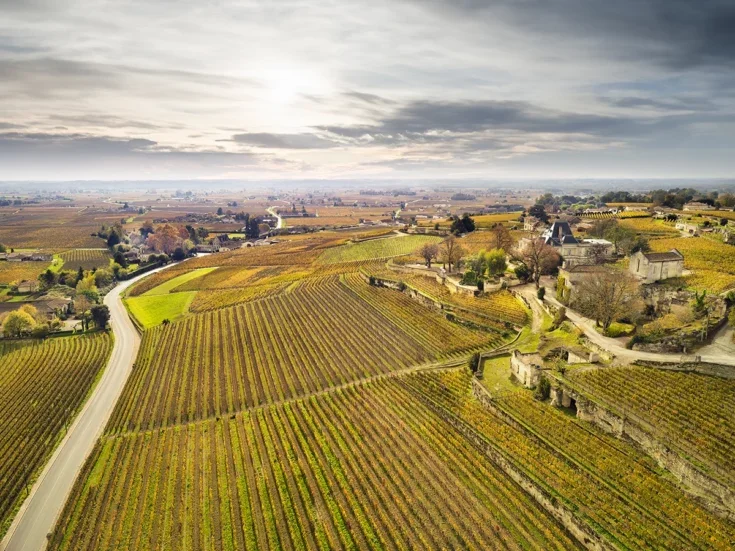
MacCulloch reckons that good English still Pinot Noir usually hits the quality of a Bourgogne Hautes-Côtes in a cooler year, but at Auxerre prices. “That’s quite hard,” he says. “We want to avoid that.” They get grapes from all over the country and blend, and at Hattingley itself, which slopes down from a plateau at 200m (660ft) the topsoil is sticky clay over chalk. It’s on a ridge of the South Downs, on the edge of the National Park. There are big flints, too—they’re called Hampshire diamonds locally—“not like elegant French silex,” says Robinson. They add organic matter in the form of manure, and sow cover crops for aeration and to break up the clay cap; but not legumes. They don’t want to fix nitrogen. And since the rest of the estate is part arable, part livestock, there’s a neat circle; the pomace is fed to the cattle, and the cattle manure feeds the soil. The estate vineyards have names like Chalky Hill and New Site: “We’re not very imaginative,” says Robinson.
It’s not all that much like Champagne soil, he says, and “basing things on the Champagne model, aside from the grower model, is not what we do,” he says. Their attitude they describe as New World rather than Old World—experimental, give-it-a-go. English producers have to be more self-sufficient than French; their coopers and manufacturers are not just down the road, and the idea that their chosen wine style is consumer-driven rather than producer-driven is very New World. “We are not making wine for ourselves,” says MacCulloch. “We’re making wine to be high quality, approachable, to bring a smile to people’s faces.”
“And to justify the price,” adds Robinson. “We made King’s Cuvée [the top wine] in year one from our own vineyard. It was one barrel, the smallest container we had, and it was magnificent wine, and we priced it accordingly.” It is not, however, at the price levels now being set by deluxe cuvées from other producers. “£30 is the tipping point. Above £30, people buy for friends. Below that they buy for themselves. We made only a couple of hundred bottles, but it had a halo effect.”
The flagship bottling is Classic Reserve, beautifully precise and with a nice edge of bitterness; it’s MacCulloch’s favorite wine in terms of something that is hard to make—and hard to make well. There’s also a floral, saline Blanc de Blancs Vintage, and a King’s Cuvée Rosé, rich and winey. Rice started the initial reserve-wines program, and they also have library stocks of old Vintages that they are releasing: 2010 King’s Cuvée and 2010-base Classic Cuvée, all marzipan and savoriness, very fresh, very winey. “King’s Cuvée took a long time to come into its own,” says Robinson; it didn’t start showing its best until 2014–15. So, the next vintage will be 2022. “We’ll make it whenever we can. The ethics of how we operate are important,” he adds. “We decided we wouldn’t sell the same wine under different labels at different prices. The salespeople said everybody does it. But to a lawyer, it’s a red rag to a bull.”

Robinson has done all this largely on his own money: probably £7 million to £10 million, he reckons. He brought in a minor investor in about 2014–15. “Wine growing outperforms the farm now,” he says. “It’s probably 90% of the turnover of the estate. It’s not yet profitable, but it’s very close to it. I reckon we’re the most financially stable of all the big producers.” Production varies according to the year; about 200,000 bottles of Hattingley in 2024, plus 75,000 bottles of contract winemaking. “This will be the first year we sell more than we make under the Hattingley Valley brand,” says Robinson. In the early years, production outstripped potential sales almost every year; that is now balancing out.
Lawyers take instructions from their clients: You give them the facts, and they will do what they can with them. Not unlike putting together a blend from different vineyards. As a parlor game, this might have legs.