Margaret Rand heads to Dorset’s chalk and flint country to meet Justin Langham and winemaker Tommy Grimshaw, the ever-adaptable team behind the multi-award-winning Langham Wine Estate.
Flor started to form,” says Tommy Grimshaw of Langham. “Panic. We don’t have a filter. So, we tasted it, and it tasted okay. Then we tasted it for a year, and we learned how to work with it.”
The flor in question grows on part of Langham’s perpetual reserve, but “learning how to work with it” is emblematic of the way the wines have evolved here. They’ve been shaped not just by the land but also by the repurposed, uninsulated buildings, by the constraints of tractors and space. These are not wines designed in somebody’s head and then constructed. They are what happens when you go along with what happens and turn it to advantage. You could call it terroir, if you liked.
The vineyard, on chalk and flint country in Dorset, is part of a roughly 1,000ha (2,500-acre) estate that was livestock and arable, became arable only, and is now vines and arable. Justin Langham’s father John planted the first vines, to the great mirth of his family, after he bought the estate in 1980; it was an unsuitable site, says Justin, and the deer ate everything anyway, so it never actually produced any grapes. “But it probably sowed a seed,” he says. “Farming is my main business, but I was always concerned that so much income came from EU subsidies, which would end, so I needed another string to my bow. I looked at other ideas, then the vineyard idea. In about 2005 or 2006, I Googled ‘how to plant a vineyard,’ and it came up with Plumpton College. So, I enrolled, got enthusiastic, traveled to Champagne, and got a better understanding. It seemed to be not a completely stupid idea.
Related
“But I didn’t know how to make wine. I thought I could adapt my knowledge of other crops to grapes, but making wine is another set of knowledge. I didn’t have time to take five years off and do that, so I thought I’d get someone else. I started with a vineyard manager and a few barrels, a press, and it grew from there. I’m a bit cautious and didn’t want a warehouse of vinegar, so we sold quite a few grapes at first.
“I gradually became convinced. The first real yeehaw moment was in 2013, when we entered Stephen Skelton’s Judgment of Parson’s Green competition, and we came first. That gave us a lot of encouragement; probably even more than winning eight trophies this year [2025] at Wine GB.”
Quite a journey
From Parson’s Green to Wine GB was still quite a journey. Justin had the land and some buildings, “but I didn’t have a huge amount of money burning a hole in my pocket.”
Content from our partners
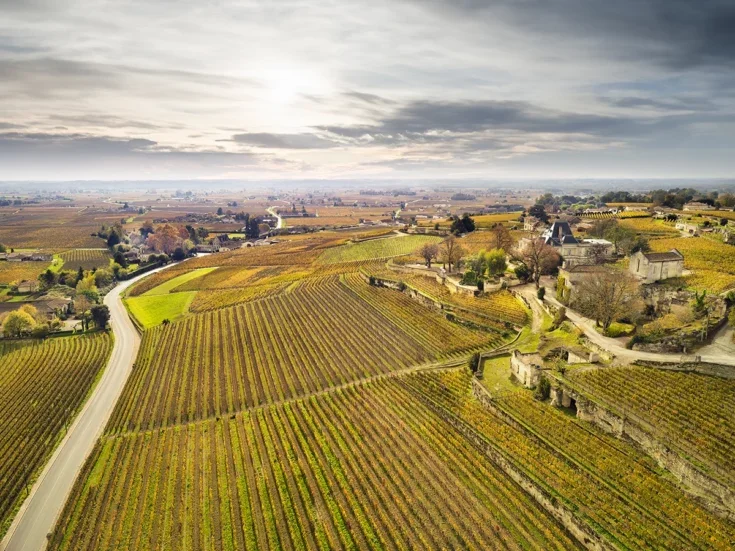
The first parcels, the Home Block and Bowling Green, were planted in 2009: Chardonnay, Pinot Noir, and Meunier. Says Grimshaw, “Consultants [including Skelton] looked at various sites on various farms on the estate; these were the obvious ones.” They were also the best plots for arable, and the farm workers put in deer fencing around them; having capable people available for this sort of thing is useful—they made the hoppers in the winery, too. The rows are wide—8ft (2.5m)—for more airflow, “and with leaf-stripping we can minimize spraying, and have a higher canopy without shading,” says Grimshaw. Oh, and wide spacing also meant Justin didn’t have to buy a new tractor. The graft is quite high, because Justin wanted an early crop; they took the first crop in 2010, and John was able to taste the first still wines before he died. But that high graft does mean, says Grimshaw, that the pruners—an in-house team—have to be extra careful.
There’s not much topsoil—in one corner at the top there’s less than one inch (2cm)—and then it’s chalk, as far down as you care to dig. This is nearly as far west as you can go in England and still have chalk; it’s relatively young chalk, porous and pure. But of course, the farther west you go in England, the more rain you have—this is why Langham is not organic. In terms of degree days, however, it doesn’t do badly compared to other parts of southern England. Calum Chance, head of sales and marketing, provides a few figures—to be taken with a pinch of salt, he says, since there is discussion about how best to count them. But from April 1 to July 15, using a base of 10°C (50°F) and no cutoff at 30°C (86°F), Dorset scores 512 degree days compared to 505–556 in East Sussex, and 450–562 in Kent. Dorset can be a bit warmer than Kent in the early part of the growing season, he says, and they pick later in Dorset, which potentially gives longer hang-time.

Langham is 10 miles (16km) from the sea as the crow flies, and the prevailing wind is from the southwest; they’ve planted at 260–360ft (80–110m), and frost doesn’t seem to be a major problem. “We’ve only ever lost 10–15%,” says Grimshaw. “The woodland was thinned via ash dieback, so the cold air can roll down more now. And the hill protects us from stormy weather; we’re on a hill, but we’re not the biggest hill around.”
The winery buildings are ex-livestock and arable barns: brick, raftered, beautiful, but a bit cramped. A new winery has been planned—a big black shed, functional rather than Instagrammable. The style of the wines evolved from the existing winery; now they’ll have to keep that style in the big functional shed.
A business transformed
What is that style? Terroir expression, certainly. They pick at 10–10.5% ABV at most, in order to add less at tirage and get 12% ABV at the end. “I don’t like the extra glycerol of 12.5%,” says Grimshaw. “If you add dosage on top, it can be quite greasy.” They use no enzymes, no nutrients, and indigenous yeasts for both fermentations.
Daniel Ham was the winemaker from 2015 to the end of 2019 and was actually the estate’s third winemaker; he succeeded Liam Idzikowski, who is now at Danbury Ridge. Ham, slightly surprisingly, came from Ridgeview. He arrived in 2015. The 2016 was “terrible; frosted: we only picked eight tons from 11ha [27 acres].” It might have been terrible, but it meant they could experiment in the winery. Ham let a couple of barrels ferment spontaneously, and in 2017 they switched to spontaneous fermentation for everything. They stopped using sulfur dioxide during the winemaking, and they stopped filtering. “I wouldn’t call it natural,” says Ham; “it was more an ecological approach, using natural microbiology.” He’s a biologist by training and traveled a lot to Champagne and other regions. Grower Champagnes, but not just grower Champagnes, were an influence.
The viticulture remained conventional, however. “I moved away from Langham because of this disconnect between the winemaking and the farming.” He now has his own venture, Offbeat Wines, in Wiltshire. “I’m very pleased Tommy took over and continued in that way. My biggest fear when I left was that somebody would go back”—back to more conventional methods.
Langham had stopped selling grapes in 2015, to focus entirely on winemaking; and in 2020, in the middle of harvest, they got a telephone call: “You’ve won the Best Sparkling Wine Producer in the World Award at the IWSC.” “I was loading the press,” says Tommy. “I said, ‘Great.’” Only gradually did it sink in, and of course, 2020 being what it was, there was no awards ceremony. “But four old sheds had knocked Veuve Clicquot off its perch.”
“It transformed the business overnight,” he adds. “It didn’t change what we do, but people started to give us a go. Without that, it would have taken a lot longer. We had a spotlight. It amplified what we were doing differently and that our style of wine was suited to fine-dining restaurants.”
They could have capitalized on the award by raising the price; instead, they almost tripled the vineyard area. “Justin doesn’t do things by half,” says Chance. From 12ha (30 acres) it became 34ha (84 acres), and that’s it now, apparently. The most recent vines went in during 2024 and include a few Pinot Gris vines. The earlier plantings were nearly all Champagne clones, but the latest ones are Dijon still-wine Chardonnay and Pinot, for more fruit concentration.
As background, Ham had come from Ridgeview, and there was another intern in 2016. They started playing with indigenous ferments and less filtration and fining; they discovered grower Champagnes (Anselm Selosse became an inspiration) and realized that nobody else in England seemed to be doing things like this. The style of the wine changed in 2017, becoming even lower intervention: no enzymes for settling, no added yeast for the first fermentation, no fining agents, no filtration. “I don’t want faulty natural wines,” says Grimshaw, “though we are natural in a way. But too many people have used that term for faulty wines. We make fine wines.” Later he adds, “There’s no right way or wrong way to make them. But it’s the way I want to make them.”
Conviction, complexity, and experimentation
In 2018, Ham started looking for an assistant winemaker. Grimshaw had been at Sharpham, “very focused on still wine, very conventional, and I found a mismatch between what I was doing and what I wanted to do. Dan was thinking in the same way. I was his assistant from January 2019, and I learned from him. When Dan left, I was 24 and too young for a head-winemaker role, but I didn’t say no. I had to turn down an internship at Felton Road, though.” Nigel Greening is “still a bit of a mentor to me, in a weird way,” he says.
“A lot of English winemakers have been to the same college, with the same lecturers, and have been making wine for less than five years. Where’s the fun?” He, like everyone else at Langham, is not formally trained. He started at Sharpham as a holiday job, then worked there when he left school. In time, he became assistant winemaker, and then Dan found him.
Squeezed into the four winery buildings are the original one-ton Puleo press on which the automation never worked, so somebody has to sit beside it all the time; a three-ton Europress—“my favorite presses,” says Grimshaw; “Larmandier-Bernier call them bin lorries, because they work in the same way”—and now another five-ton Europress. The fruit comes in 0.6 US ton (600kg) at a time, they have the farm workers to help, and they don’t usually use SO2 because they like oxidative pressing: “If you oxidize early on, the wines reap all the benefits.”

There are barrels, all ex-Burgundy or ex-Champagne, five to 12 years old, all individually suspended on straps for ease of access, and no two identical barrels are put next to each other. The barrels at the top, he says, ferment slightly faster because it’s warmer; there is no insulation, and this is key to the way Langham has evolved.
“One parcel of juice in five barrels means five different parcels,” says Grimshaw. In all, they have 140 different base wines, 30 in steel and the rest in oak. (Justin brought the foudres from France on the ferry, on the back of his Land Rover.) “We build layers of complexity, even before the second fermentation and lees aging,” says Grimshaw. “We want rich, complex still wines with high acidity.” The wines ferment for nine months, go dormant in the winter, and finish in the spring: “A cold March makes me nervous,” says Grimshaw. They add bacteria for the malo. But now they will have temperature control in the new winery. Grimshaw might set it to mimic the seasons: “It will be an insulated building, but we could open the doors in the winter. Or there might be an argument for not insulating the part of the building that will have tanks and barrels. Modern winemakers will do anything to avoid a stuck fermentation, but we do the opposite; it was decided by the building.”
The reserve wines are kept in underground tanks, bought as water tanks because Justin discovered that water tanks are cheaper than wine tanks. Ham had left some parcels of 2017 and 2018 Chardonnay, and Grimshaw had always been interested in the idea of a solera sparkling, and Perpetual is the result. Chardonnay from 2019 was added to the solera, and after four years on the lees and a year under cork it was released in 2025. And what a beauty it is. Grimshaw says it’s the greatest wine he’s ever been involved with; it’s layered and compelling. At around £95, it’s expensive, but it’s a lot cheaper than some top English cuvées these days. And it tastes convincing.
Corallian is the wine that everyone knows: base wines with saline, flinty notes are used for that. Broader, cherryish, almondish wines go into Culver; there’s also a powerful, tense rosé, a blanc de blancs with shoulders, and a savory, dark-fruited Pinot Noir with zero dosage. “We don’t want a big, heavy autolytic profile,” says Grimshaw; “18 months lees for Corallian and Culver is about right. We had to release too early a few years ago, but we’re up to 9–12 months cork now. Nothing leaves here before nine months.”
And then there are the oddities, if that’s the right word. Probably it’s not. There’s NBG: Nothing But Grapes. Grimshaw anyway prefers grape sugar to cane sugar for dosage. “I’d love to use our own pasteurized grape juice for dosage.” So, he tried using fermenting must for the second fermentation: “It was very acidic. We did an indigenous malo, too, and selected some barrels; it was 2020, which was a high-acid year, so it needed dosage, and we wanted the dosage to come from the same Chardonnay, but from 2021.” The result is NBG, and it is certainly high in acidity. But it’s also very pure, very hazelnutty, very structured.
They experiment with still wines—of course they do. They made 1,100 bottles last year, from some of the last-picked Chardonnay from 2022. They’re playing around with Pinot Gris; there were only 132lb (60kg) in 2024, and they let the cellar hand have fun with it the first year. “We’ll probably split it in half, and do half whole-cluster, steel, and oak, and the other half on skins. We’ll see how far we can push it. We’ll have four different wines that way.” They’re experimenting with ratafia; they’re talking about an olive grove and a nut orchard, to be able to serve flavored nuts—almonds, probably—with their wines in the restaurant.
Because, yes, of course there’s a restaurant. It has a relaxed, rustic feel (“We’re not in the southeast, you know,” says Chance) and serves excellent local food. You can sit outside and look at the vineyards and wander around and talk to people’s dogs. And having not just the land but also the buildings has clearly made a big difference to the economic viability of the estate. Justin says that about half the turnover is now wine, though clearly the arable takes up much more space. The winery also employs three or four times as many people as the rest of the farm. “The wine is profitable and has never made a loss,” says Justin, though 2024 was a poor year—and what with building works and repairs and increased costs, the figures didn’t look so good. “We can’t afford to make losses year after year; there’s no bottomless pit of money. The best year for wine was 2021; the IWSC trophy at the end of 2020 put a rocket under sales, but we knew it was a one-off. Because of it, we expanded the vineyard and started the new winery. It all stems from that IWSC award.”
This year, at the Wine GB awards, Justin promised the staff that if Langham won five trophies, they’d all go go-karting. Next year?